Skip to content
The straight answer to how long a DWI stays on your record in Texas is both simple and sobering: forever. A DWI conviction becomes a permanent part of your criminal history unless you take specific legal action to get it removed or sealed. That reality can feel like a heavy weight, especially when you’re worried about how it will impact your family and your future.
The Permanent Mark of a Texas DWI Record

Facing a DWI charge brings a wave of uncertainty. For parents and families across Texas, the questions that follow are often deeply personal, rooted in a real fear for the future. How will this affect my ability to provide for my family? Can I still volunteer at my kid's school or coach their team? Will this one mistake stop me from getting a better job down the road?
These are completely valid fears. In Texas, a DWI conviction isn’t just a note on your driving record; it’s a public criminal record that can follow you for life. It’s the kind of thing that shows up on the background checks run by:
- Potential Employers: A conviction can be a major roadblock to getting hired, especially for jobs that involve driving, professional licenses, or positions of trust.
- Landlords and Apartment Complexes: Many rental applications now include a background check, and a DWI on your record could easily lead to a denial.
- Volunteer Organizations: Schools and youth sports leagues almost always screen their volunteers. A criminal record could get you disqualified from being involved in your own child's activities.
- Professional Licensing Boards: If you hold a license for your career—as a nurse, teacher, or real estate agent, for example—a DWI can trigger serious disciplinary action.
Understanding Your Path Forward
While the idea of a permanent record is a tough pill to swallow, it is not the end of the story. The Texas legal system has specific pathways for people to clear their name and truly move on with their lives. This guide is designed to replace that fear and uncertainty with clarity.
The most important thing to remember is that you have options. A DWI charge does not have to define your future or limit your family's opportunities. Understanding the legal avenues available is the first step toward taking back control.
We're going to walk through what a DWI record really means, the different types of records it affects, and—most importantly—the legal tools like expunction and nondisclosure that offer a real route to a clearer future. The situation is serious, but knowledge is power.
Understanding Your Criminal and Driving Records

When you're facing a DWI charge, it's not just a single mark against you. It actually creates two completely separate records that can haunt your life in very different ways. Getting a handle on this distinction is the absolute first step toward building a strong defense and protecting your family's future.
Think of your criminal record as your permanent life transcript. This is the big one. It’s what potential employers, landlords, and professional licensing boards will see forever if a DWI conviction is on there. It details the charge, the legal rollercoaster, and the final verdict, carrying the heaviest long-term consequences for your opportunities.
Then there’s your Texas Department of Public Safety (DPS) driving record. This is more like a specialized report card focused only on your history behind the wheel. It tracks traffic violations, license suspensions, and DWI-related incidents. While it’s incredibly important for your driving privileges and insurance rates, its scope is much narrower.
The Criminal Record: Your Life Transcript
The criminal record is what causes the most sleepless nights for Texas families, and for good reason. A conviction for a first-offense DWI is a Class B Misdemeanor, and it becomes a permanent, public part of your story.
This means that any time a background check is run, that conviction will pop right up. It can become a serious roadblock when you're trying to:
- Get a better job to provide for your kids.
- Rent a new apartment or house for your family.
- Apply for a professional license in fields like nursing, real estate, or teaching.
- Even just volunteer at your child’s school or coach their Little League team.
Because the criminal record is so public and permanent by default, tackling it head-on through the legal system is the single most important step you can take. Understanding what options you have is essential, and for many, exploring a path forward is vital. You can learn more about how to expunge a misdemeanor in Texas in our detailed guide.
The Driving Record: Your Driving Report Card
While the criminal record hits your overall reputation, the DPS driving record directly impacts your freedom of movement and your wallet. A DWI on this record triggers hefty driver's license surcharges, potential license suspension, and skyrocketing insurance premiums.
And unlike a speeding ticket that might fall off after a few years, DWI offenses are treated far more seriously. These marks stick around for a very long time, reflecting just how seriously the state takes impaired driving. This means insurance companies and anyone else who checks your DPS record can see that history for years and years.
Grasping this two-record system is crucial. It makes it clear why a solid legal defense has to fight both the immediate driving consequences and the lifelong shadow of a potential criminal conviction.
How a DWI Appears on Different Texas Records
To put it simply, a single DWI incident creates multiple problems across different official documents. This table breaks down what shows up where and why each one matters.
| Record Type | What It Shows | Primary Impact |
|---|---|---|
| Criminal Record | The official DWI charge, court proceedings, and the final conviction. It is a public document. | Affects employment, housing, professional licenses, and volunteer opportunities. |
| Driving Record (DPS) | DWI-related incidents, license suspensions, and points. | Leads to license surcharges, higher insurance rates, and potential loss of driving privileges. |
Each record requires a different strategy. One affects your career and reputation, while the other governs your ability to drive and how much you pay for the privilege. Both must be addressed to truly move past a DWI charge.
The Critical Difference: Was It a DWI Arrest or a Conviction?
This is, without a doubt, one of the most important things to get straight. People use the words “arrest” and “conviction” like they’re the same thing, but in the eyes of Texas law, they are worlds apart. Grasping this difference isn’t just about legal trivia—it’s the key that unlocks your entire future and determines how long this DWI incident will follow you around.
Think of it this way: an arrest record is created the second you’re put in handcuffs. It doesn't mean you're guilty. It’s just an official note that law enforcement suspected you of a crime. That record exists from that moment on, even if the prosecutor drops the case the very next day.
A conviction, on the other hand, is the final gavel drop. It’s a formal, legal judgment that you are guilty. This only happens if you plead guilty, a judge or jury finds you guilty at trial, or you enter a plea of "no contest" (nolo contendere). The conviction is what permanently stamps the DWI onto your public criminal history, unleashing the most serious, long-term consequences.
Understanding that gap between an accusation and a final judgment is where all your power lies.
Why the Final Outcome of Your Case Changes Everything
The single most powerful factor that decides if you can ever clear your record is how your DWI case ends. That final outcome dictates what legal tools you have at your disposal, if any. Let's paint a picture with a couple of real-world scenarios.
Imagine two dads living in neighboring Texas towns. On the same Friday night, both are pulled over and arrested for a first-time DWI.
- Dad A: He immediately hires a sharp DWI defense lawyer who digs into the police report and discovers the initial traffic stop was illegal. The attorney gets the entire case thrown out—dismissed. Because there was no conviction, Dad A is now eligible to get an expunction. This powerful legal action completely destroys every single record of the arrest. It's like it never happened, and he can legally deny it for the rest of his life.
- Dad B: He ends up with a DWI conviction. His path is now completely different. An expunction is off the table. His only option to minimize the damage is an order of nondisclosure, a process that seals the conviction from the public but doesn't erase it. It’s a decent solution, but it’s not the clean slate Dad A gets.
This shows you exactly why fighting the charge from day one is so critical. A dismissal or an acquittal is your ticket to the best possible outcome: making the whole thing disappear.
Arrest Record vs. Conviction Record: An Accusation vs. a Verdict
Here’s the simplest way to think about it: an arrest is just an accusation. A conviction is a final verdict. One is a question mark; the other is a period at the end of the sentence. The legal system gives you a powerful way to undo an accusation that didn't stick, but it's far less forgiving once there’s a final judgment of guilt.
The entire goal of a strong DWI defense is to stop an arrest from ever becoming a conviction. Every single move your attorney makes is aimed at achieving an outcome—like a dismissal or a "not guilty" verdict—that keeps the door to an expunction wide open.
This is why you should never just assume a DWI arrest automatically leads to a conviction. There are countless potential defenses, from challenging the shoddy calibration of a breathalyzer machine to questioning the officer’s procedure during the stop.
Your Legal Options Hinge on This Distinction
To make it crystal clear, here’s how your case’s outcome directly impacts your ability to clean up your record:
- Case Dismissed, Found Not Guilty, or No Final Conviction: This is the home run. You are almost certainly eligible for an expunction, which completely erases the arrest from your history.
- Convicted, but Completed Deferred Adjudication: You might be eligible for an order of nondisclosure after a waiting period. This seals the record, hiding it from most employers, landlords, and the general public.
- Convicted and Served Probation or Jail Time: For years, this was a dead end. However, recent changes in Texas law have created limited pathways for sealing some DWI convictions, though the eligibility rules are much stricter.
This fundamental difference highlights why you have to act fast and build a strong defense right after an arrest. The decisions you make in those first few days can be the difference between a temporary nightmare and a permanent stain on your record.
Clearing Your Record With Expunction And Nondisclosure
Hearing that a DWI conviction is permanent can feel like a punch to the gut. It's easy to feel hopeless, but this is where fear ends and action begins. Texas law gives you two powerful ways to fight back and get a second chance: expunction and an order of nondisclosure.
These are your routes to rebuilding your reputation and protecting your family's future.
But which one is right for you? It all boils down to the outcome of your DWI case. This is exactly why a rock-solid defense from day one is so critical—the legal strategy used in court directly determines whether you'll be eligible for these life-changing remedies later on.
This flowchart lays out the two main paths your record can take, ultimately leading to either expunction or nondisclosure.
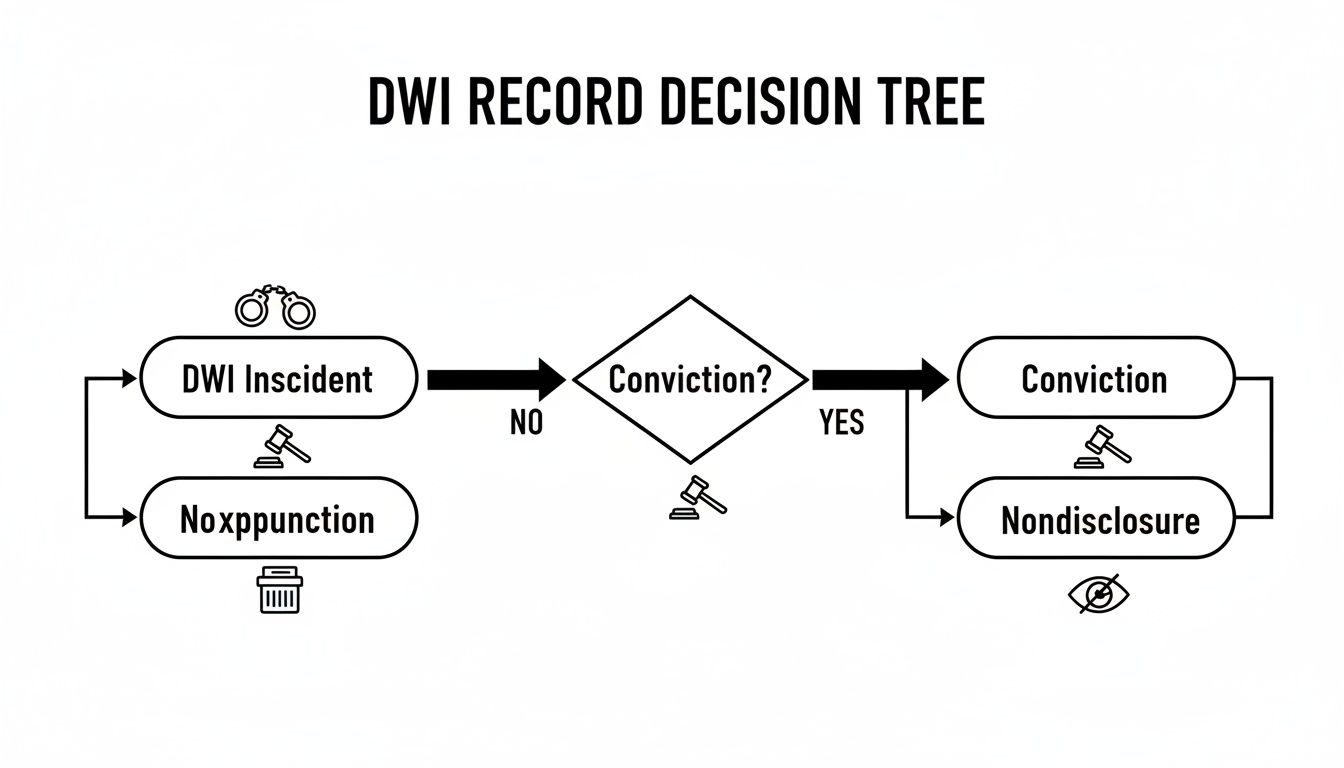
As you can see, everything hinges on one question: Were you convicted? That's the fork in the road. The answer dictates whether you can aim for complete record destruction or just have it sealed away.
Expunction: The Gold Standard For Clearing Your Name
Think of an expunction as hitting the legal reset button. It’s the most complete and powerful option out there because it leads to the total destruction of your arrest records.
When a judge signs off on an expunction, every single agency holding a record of your arrest—from the local police to the county court clerk—is ordered to destroy it. Gone.
Once it's done, you can legally deny the arrest ever happened. It’s as if it was wiped from history. This is the ultimate goal for anyone facing a DWI charge because it offers a truly clean slate.
But getting there isn't easy. Eligibility for this powerful tool is extremely limited. You can typically only get an expunction if your DWI case ended in one of these ways:
- You were found not guilty at trial (an acquittal).
- The prosecutor dismissed your case.
- You successfully finished a pretrial intervention or diversion program.
An expunction is the only way to answer the question, "How long will a DWI stay on my record?" with a simple, "It won't."
Nondisclosure: Sealing Your Record From Public View
If you were convicted, an expunction is off the table. That’s where an order of nondisclosure comes in. While it doesn't destroy the record, it does the next best thing: it seals it from the public.
It’s like putting a private lock on a public file. Once a nondisclosure is granted, your DWI conviction is hidden from:
- Potential employers
- Landlords and apartment complexes
- The general public
This means when a company runs a standard background check, that conviction won’t pop up. But—and this is a big but—the record isn't truly gone. Certain government agencies, licensing boards, and law enforcement can still access it.
An order of nondisclosure is designed to stop a past mistake from slamming future doors shut. It gives you the confidence to apply for jobs and housing without worrying that your DWI conviction will get you automatically disqualified.
Eligibility for nondisclosure is more complicated and usually involves a waiting period after you’ve completed your sentence. The specific rules depend on the details of your case, like whether you got probation or deferred adjudication. The requirements are complex, but our guide on an order of nondisclosure in Texas breaks it down further.
Comparing Your Two Main Legal Options
For parents and families, figuring out the right path is crucial for long-term stability and creating opportunities. This table breaks down the key differences between these two legal remedies so you can see exactly what each one accomplishes.
Comparing Expunction and Nondisclosure in Texas
| Feature | Expunction (Record Destruction) | Order of Nondisclosure (Record Sealing) |
|---|---|---|
| What Happens to the Record? | The arrest record is physically destroyed and scrubbed from all government databases. | The conviction record is sealed and hidden from public view. |
| Who Is Eligible? | Typically for cases that are dismissed, acquitted, or result in a not-guilty verdict. | For certain DWI convictions, often after a waiting period and successful sentence completion. |
| Can You Deny It? | Yes. You can legally deny the arrest ever occurred on applications for jobs, housing, etc. | No. You cannot deny the conviction, but it won't show up on most background checks. |
| Best For | Achieving a complete clean slate and ensuring the DWI never impacts your life again. | Protecting your employment and housing opportunities after a conviction. |
Knowing which option you might qualify for is the first step toward putting a DWI behind you for good. An experienced attorney can look at the facts of your case and map out the best strategy for your family.
Take Control of Your Future and Protect Your Record
While it’s true that a DWI conviction in Texas can stick around by default, it absolutely does not have to define the rest of your life or derail your family's future. You have the power to take action. This guide has walked you through the critical differences between various records, the absolute importance of how your case ends, and the legal tools available to help you move forward.
Pathways like expunction and orders of nondisclosure were put in place for a reason—to give people a second chance. They aren't just loopholes; they are powerful legal instruments for reclaiming your reputation, protecting your loved ones, and opening up future opportunities. The weight of a DWI charge is heavy, but it's a weight you shouldn't have to carry alone.
Taking Decisive Action for a Clear Future
The first step is always the hardest, but it's also the most important one you can take. Reaching out for help is a sign of strength. A seasoned attorney can dig into every detail of your case, pinpoint the best strategy, and start building a defense to protect everything you've worked so hard for.
Don't let uncertainty and fear paralyze you. The legal system is confusing and intimidating, but with the right guidance, you can face it head-on and fight for the clean slate you and your family deserve.
Building Resilience Beyond the Courtroom
Facing a legal battle like a DWI takes a huge amount of personal strength. To really take charge of your future, it’s also important to focus on how you can develop self-discipline in other parts of your life. Building that kind of resilience won't just help you get through the stress of your case; it will empower you to make positive choices for years to come, making sure one mistake doesn't write your entire story.
You don’t have to find your way through this frightening legal landscape on your own. You have options, and you have rights. The Law Office of Bryan Fagan is here to help you understand them and fight for the best possible outcome.
If you are ready to explore your options and fight for a clear future for you and your family, we invite you to get in touch. Let us help you protect what matters most. Your initial consultation is free and completely confidential, giving you a safe space to ask questions and get the answers you need.
Got Questions About Your Texas DWI Record? We Have Answers.
When you're facing the fallout from a DWI, a flood of questions and worries is completely normal. For parents, those questions often feel a lot heavier, touching on everything from your job to your kids. Let's cut through the noise and get you some clear, straight-talk answers to the concerns we hear most often.
Can I Get a Job with a DWI on My Record?
The short answer is yes, but it’s going to throw up some serious roadblocks. Most employers run background checks, and a DWI conviction is a major red flag, especially for any job that involves driving, holds a professional license, or requires a position of trust.
This is exactly why fighting to get an order of nondisclosure is so critical. Sealing that conviction from the prying eyes of most private employers can be a game-changer, leveling the playing field so you can compete for jobs based on your skills, not a past mistake.
Will a DWI Affect My Child Custody Case?
You bet it can. In any family court case, the judge’s one and only mission is to protect the “best interest of the child.” A recent DWI conviction can become a powerful weapon for the other parent to argue that you might pose a risk to your child’s safety.
It's absolutely essential to get out in front of this. You need a sharp family law attorney who can help frame the incident, mitigate the damage, and show the court that this was an isolated event, not a dangerous pattern of behavior that puts your parental rights in jeopardy.
How Long Do I Have to Wait to Seal My DWI Record?
There’s no one-size-fits-all answer here; the waiting period in Texas to file for an order of nondisclosure really depends on the specifics of your case and sentence.
For some first-time offenses where you successfully finished deferred adjudication, you might be able to file right away. For most other cases, though, you’re looking at a waiting period of two to five years after you’ve completed every single part of your sentence—that includes probation, fines, everything. An attorney can dig into your case details and give you a firm timeline.
How Does Texas Compare to Other Places?
While Texas laws feel incredibly strict, it helps to see the bigger picture. Many countries have legal blood alcohol limits that make ours look generous. For example, Sweden has a remarkably low 0.02% limit, and countries from Algeria to South Africa set their thresholds at or below 0.05%.
These tougher international standards usually come with much harsher penalties. It's a perspective that helps explain why Texas courts take DWI charges so seriously—they are part of a global effort to curb a dangerous problem, a reality you can learn more about by exploring DUI statistics.
A DWI charge can make you feel like you’re on an island, but you don't have to face this alone. At the Law Office of Bryan Fagan PLLC, our team is dedicated to protecting your rights and fighting for your family’s future. If you're ready to start clearing your name and opening doors to new opportunities, we're here to help.
Contact us today for a free, confidential consultation to go over your case and explore your legal options. Visit us at https://texascpslawyer.net.