Skip to content
The moment you realize your driver's license is suspended, a wave of panic can set in. For Texas parents, this isn't just an inconvenience; it's a crisis. How will you get your kids to school? How will you make it to work to provide for your family? This feeling of being trapped and powerless is something no family should have to endure alone. The legal system, especially when it feels like it’s working against you, can be incredibly confusing and intimidating.
This guide is here to offer more than just legal facts. It’s a roadmap designed with compassion, providing clear, practical steps to help you navigate this difficult time. We will walk you through the process, explain the law in plain English, and provide the reassurance you need to get back on the road and restore stability for your family.
Understanding Your Texas License Suspension

Getting that official notice from the DPS can be a gut punch. It leaves you feeling stranded and completely unsure of what to do next. For so many Texas parents, a suspended license is more than just an inconvenience—it’s a massive barrier. It stops you from getting kids to school, making it to work, or handling a family emergency.
This guide is here to cut through the confusing legal jargon and give you a clear, manageable path forward.
Why Was Your License Suspended?
The first thing to understand is that the steps to get your license back are tied directly to the reason it was suspended in the first place. Every situation has its own set of rules, deadlines, and potential penalties. Pinpointing the root cause is the absolute first step you have to take.
License suspensions in Texas happen for a lot of reasons, but some are more common than others. We see them pop up again and again for things like:
- Driving While Intoxicated (DWI): An arrest, not just a conviction, can trigger an automatic suspension of your driving privileges.
- Unpaid Fines and Surcharges: The state's OmniBase program will put a hold on your license if you have unresolved traffic tickets or unpaid fees.
- No Car Insurance: If your liability insurance lapses or you can't show proof of coverage when required, a suspension is often the result.
- Too Many Traffic Tickets: Racking up too many points on your driving record over a short period will lead to a suspension.
To help you get a quick handle on what you might be facing, here’s a look at the most frequent causes for suspension and what’s typically required to start the reinstatement process.
Common Reasons for License Suspension in Texas
| Reason for Suspension | Common Initial Requirement | Typical Suspension Period |
|---|---|---|
| DWI/DUI Offense | SR-22 insurance, alcohol education course, court fines | 90 days to 2 years |
| Unpaid Tickets/Fines | Payment of all outstanding fines and court fees | Varies until paid |
| No Auto Insurance | Obtain SR-22 insurance, pay reinstatement fee | Varies until compliance |
| Too Many Traffic Points | Defensive driving course, pay surcharges | Up to 1 year |
| Medical Condition | Medical evaluation and clearance from a physician | Varies by condition |
This table is just a starting point. Your official notice from the DPS will have the specific details you need to follow.
A license suspension is more than a legal problem; it's a family problem. When you can't drive, the stability of your entire household is at risk. Our goal is to provide the compassionate guidance you need to restore your mobility and your peace of mind.
Think of this guide as your roadmap to getting back behind the wheel. We're going to walk you through the whole process, explaining exactly what you need to do, from figuring out why your license was suspended to submitting that final piece of paperwork.
This journey takes patience and precision. For example, a suspension for a DWI involves a completely different set of tasks—like completing an education program and getting an SR-22—than one for unpaid tickets. We’re here to help you sort through these complexities so you don't miss a single, critical step. By the end, you'll have a clear action plan to confidently get your life back on track.
Finding Out Why Your License Is Suspended
First things first: you can't start fixing this problem until you know exactly what caused it. Getting your license back starts with understanding precisely why it was taken away in the first place. Trying to navigate the reinstatement process without this crucial piece of information is like driving blind—you'll just end up wasting time, money, and a whole lot of energy.
Before you can even begin to think about a plan, you have to pinpoint the specific hold—or, more often, a series of holds—on your driving record. The Texas Department of Public Safety (DPS) is your official source for this.
Your Go-To Tool: The Texas DPS Online Portal
The most direct way to get the full story is by using the Texas DPS License Eligibility portal. This online service is designed to give you a complete, up-to-the-minute snapshot of your driving status. You'll need your driver's license number, date of birth, and the last four digits of your Social Security number to log in.
Once you're in, the system will tell you if your license is "eligible" or "not eligible." If it's the latter, you'll see a detailed list of every single compliance item you need to clear before you can even think about reinstatement. This could be anything from unpaid fines to mandatory courses.
Pro Tip: Print this page or save it as a PDF. This isn't just a status update; it's your personal checklist for getting back on the road.
The Usual Suspects: Common Reasons for Suspension in Texas
While every situation is unique, I've found that most suspensions fall into a few common categories. Knowing these can help you make sense of the information you find on the DPS portal.
- Driving While Intoxicated (DWI): A DWI arrest almost always triggers an automatic suspension called an Administrative License Revocation (ALR), which happens before you're even convicted. If you are eventually convicted, you'll face a second, separate suspension ordered by the court. Getting through a DWI suspension usually means completing an alcohol education program, paying some hefty fines, and getting SR-22 insurance. We cover the financial side of this in-depth in our guide on DWI fines in Texas.
- The OmniBase Program: This is a big one. The OmniBase program is a statewide system that puts a hold on your license renewal if you have outstanding traffic tickets or failed to show up for a court date. Many people don't realize this can quickly escalate to a full-blown suspension. You absolutely cannot get your license reinstated until you've settled every last one of these local court issues.
- No Proof of Insurance (SR-22 Requirement): Texas law is strict about liability insurance. If you're in an accident or get pulled over and can't show proof of financial responsibility, DPS will suspend your license. To get it back, you'll almost certainly need to get an SR-22 certificate from your insurance company, which is basically a guarantee to the state that you're carrying the required coverage.
If your suspension came from a court order, it's critical to make sure you were properly notified. Sometimes, a suspension can be challenged if you were never legally served with notice of the hearing. To get a better handle on the legal paperwork involved, you can learn more about an affidavit for service from this helpful resource.
It's a surprising fact, but a huge number of suspensions aren't even about dangerous driving. Overwhelmingly, they're tied to financial issues like unpaid court fees, which can trap people in a cycle of debt and immobility. For example, a study showed that in New Jersey, around 5.5% of all licensed drivers had a suspended license in 2018. That's 424,869 people, and an incredible 91% of those suspensions were for non-driving reasons. You can discover more insights about these findings in the full study.
A Real-World Scenario
Let me paint a picture for you. Imagine a single mom in Houston—we'll call her Maria. She gets a speeding ticket while rushing to pick up her sick kid from school. Life gets in the way, she's juggling work and her son's health, and the court date just slips her mind.
A few months later, a letter arrives: her license is suspended. She had no idea that simply missing a court date for a ticket would trigger an OmniBase hold. Now she can't legally drive to her job or get her son to his doctor's appointments. The stress is immediate and overwhelming.
For Maria, the first step is logging into the DPS portal to confirm that OmniBase hold. Next, she has to contact the original court, pay the old ticket and any failure-to-appear fees. Only after she's cleared that up can she move on to paying the DPS reinstatement fee. It’s a perfect example of how one small oversight can snowball, but it also shows that once you identify the root cause, you have a clear path forward.
Your Action Plan for License Reinstatement
Alright, so you know why your license is suspended. Now it's time to map out your comeback. Getting your license back isn't a single step; it's more like a journey with a few distinct stages, each with its own checklist. Let's break it down into a clear, manageable process so you know exactly what to tackle first.
The very first thing you have to do is satisfy all the court-ordered and administrative requirements tied to your suspension. Think of this as the foundation. You can't move forward until this part is completely done.
This diagram lays out the initial game plan: figure out the details, find the root cause, and get your documents in order.
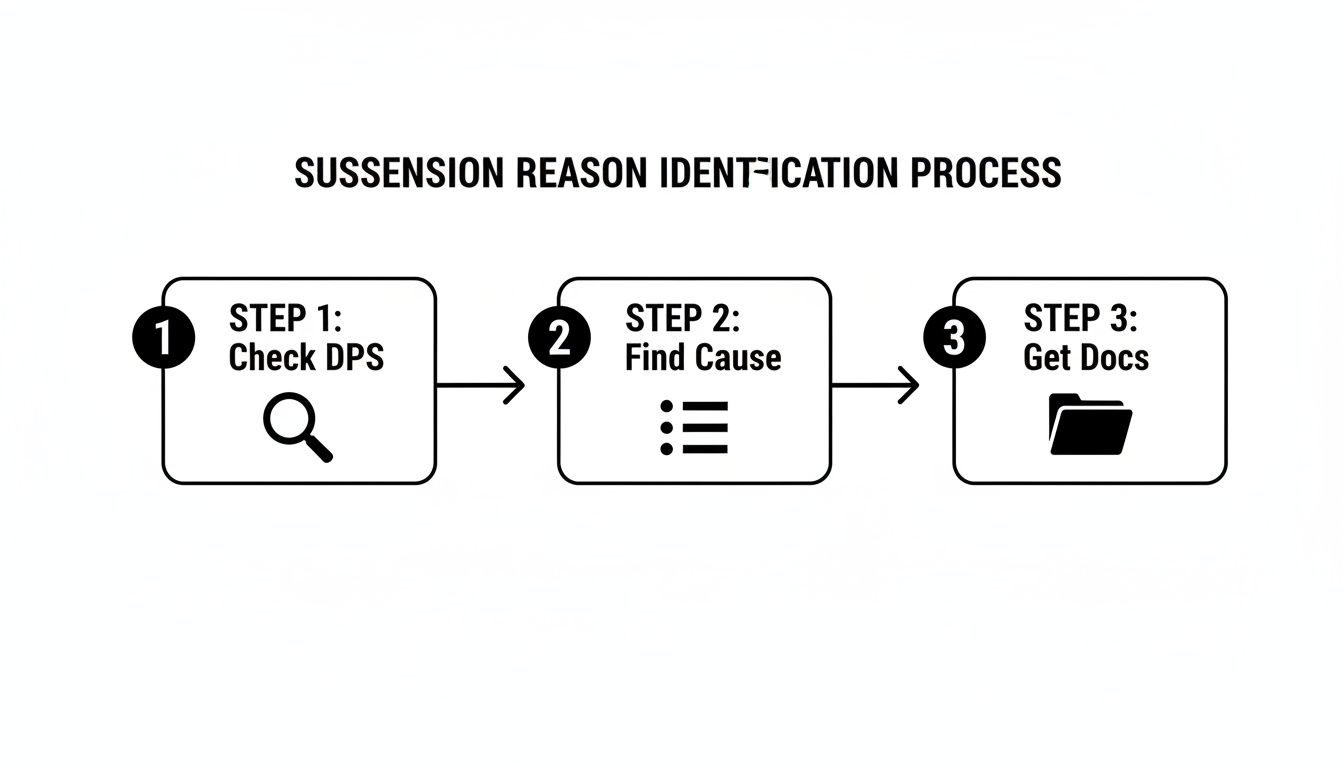
As you can see, a solid plan starts with a thorough review of the DPS portal to pinpoint the exact reasons for the suspension and then gathering every piece of paper you'll need.
First, Settle Your Legal and Administrative Duties
This phase is all about clearing the original issues that got you suspended in the first place. Consider it settling your tab with the court and the state. Every single item on your DPS eligibility checklist has to be checked off before you can even think about the next step.
Here are some of the most common requirements you’ll run into:
- Paying All Court Fines and Fees: If your suspension is from unpaid tickets under the OmniBase program, you’ll have to contact each court individually and pay what you owe. Don't be surprised if there are extra administrative or late fees tacked on.
- Completing Mandatory Courses: For DWI-related suspensions, you'll almost certainly need to complete a state-approved DWI Education Program. If it’s not your first offense, you might be looking at a more intensive DWI Intervention Program.
- Serving the Suspension Period: Every suspension has a set timeframe. You simply have to wait it out. Driving before that official end date, even if you’ve done everything else, is illegal and will only make things worse.
Let’s look at a real-world example. Say a young father in Dallas gets his first DWI. His license is immediately suspended through an Administrative License Revocation (ALR). His road to reinstatement starts by waiting out the 90-day suspension period. During that time, he finds and completes the mandatory 12-hour DWI education course. Only after both of those things are done can he move on.
Next, Tackle the Insurance Requirements
Once your legal obligations are handled, the next big hurdle is insurance. Texas needs proof that you’re financially responsible and can cover damages if you get into an accident. For most drivers coming off a suspension, this means getting a special insurance certificate.
This is where the infamous SR-22 comes into play. An SR-22 isn't actually an insurance policy. It's a certificate of financial responsibility that your insurance company files directly with the Texas DPS. It’s their way of telling the state, "We've got this person covered for at least the minimum liability."
You'll most likely need an SR-22 if your license was suspended for reasons like:
- Driving While Intoxicated (DWI)
- Driving without valid insurance
- A history of serious or repeated traffic violations
Meeting the specific insurance requirements for your vehicle is a non-negotiable part of the plan. Be prepared, as needing an SR-22 can definitely make your premiums go up. It’s a good idea to shop around and find an insurance agent who has experience with these filings; they can handle the electronic submission to the DPS for you.
Remember, the SR-22 isn't a one-and-done thing. You have to keep it active for the entire required period, which is usually two years from your conviction date. If your policy lapses for any reason, your insurance company is legally required to snitch on you to the DPS, and your license will get suspended all over again.
Finally, Submit Your Paperwork and Fees to the DPS
You've cleared your legal duties and your SR-22 is filed. You're in the home stretch! The last phase is formally applying for reinstatement with the Texas DPS. This means pulling together all your compliance documents and submitting them with the required fees.
Here's what your final submission packet should contain:
- Proof of Compliance: This is everything from course completion certificates (like from your DWI class) to receipts showing you've paid your fines.
- Proof of SR-22: Your insurance company should file this for you, but it's smart to keep your own copy handy just in case.
- Payment for Reinstatement Fees: You’ll have to pay the state's reinstatement fee, which usually runs between $100 and $125, though it can vary. You can pay online via the DPS License Eligibility portal, send it by mail, or handle it in person at some DPS offices.
After you’ve submitted everything, keep an eye on your status through the DPS online portal. Once it officially says "eligible," you are good to go. Do not get behind the wheel until you see that confirmation. That's your green light, and it means you've successfully navigated the process and can get back on the road.
Getting an Occupational License to Stay on the Road
When your license gets suspended, life doesn't just stop. For parents in Texas, the need to drive is immediate and non-negotiable—getting to work, taking kids to school, and just running the household are absolute essentials. A full license reinstatement can take time, but that doesn't mean you have to be completely stranded.
This is where an Occupational Driver License (ODL), sometimes called an essential need license, can be a true lifeline. An ODL is a special, restricted license granted by a judge that lets you drive for specific, court-approved purposes during your suspension period.
What an ODL Actually Allows You to Do
Think of an ODL not as a green light to drive whenever you want, but as a temporary, highly specific permit. It comes with strict limitations defined by a court order, all aimed at letting you maintain your livelihood and care for your family without breaking the law.
Typically, a judge will approve an ODL for travel related to:
- Work: Driving to and from your job is the most common reason.
- School: Attending your own classes or educational programs.
- Essential Household Duties: This can include things like grocery shopping, taking your children to daycare or school, and getting to medical appointments.
The court order will spell out the exact hours you can drive, the counties you can drive in, and for what purposes. Straying from these rules is a serious violation that can land you in even more trouble.
The Process of Petitioning the Court
Getting an ODL isn't as simple as filling out a form at the DPS. You have to formally petition the court in the county where you live or where the offense that led to the suspension happened. This is a real legal process where you need to build a compelling case for a judge, proving you have an essential need to be on the road.
First, you'll need to gather your documents. This is where a lot of people trip up. You will need:
- A Petition for an Occupational Driver License: The formal legal document you file with the court.
- An SR-22 Certificate: You absolutely must have this proof of high-risk insurance before a judge will even look at your petition.
- A Detailed Driving Log: This is critical. You need to map out your requested driving times and locations, explaining exactly why you need to drive during those specific windows.
- A Letter from Your Employer: If you need to drive for work, a letter on company letterhead confirming your hours and duties can dramatically strengthen your case.
This process is more than just paperwork. For Texans, especially those with repeat offenses like a second DWI, navigating the system requires precision. A first-time DWI suspension might be 180 days, but repeat offenses can stretch up to two years, often with ignition interlock device requirements.
A common mistake we see is people underestimating the importance of the driving log. A vague request like, "I need to drive for work from 8 AM to 6 PM," will almost always be denied. You have to be specific about your commute, any necessary travel during the day, and your route.
A Real-World Scenario
Let's look at a real-life situation. Consider Sarah, a single mom in San Antonio whose license was suspended after a DWI. She works as a home healthcare aide, meaning her job requires her to visit multiple clients across the city all day. She also has to get her daughter to and from daycare.
Without a license, she's facing the loss of her job and her ability to care for her child. For Sarah, an ODL isn't just a convenience—it's a necessity. We would help her create a petition with a detailed driving schedule showing her client visits, her commute times, and her daycare runs. Her employer’s letter would back up her job duties. By presenting this clear, undeniable evidence of essential need, she has a much stronger chance of getting a judge to say yes.
Successfully petitioning for an ODL is a detailed legal task. The process demands careful preparation and a deep understanding of what a judge needs to see. You can find more specific guidance in our detailed article on how to get an occupational license in Texas. Having an experienced attorney present your case can make all the difference, ensuring your petition is complete, compelling, and filed correctly the first time.
The Risks of Delaying Your Reinstatement
When you’re staring down a list of fines, required courses, and confusing paperwork, the temptation to just shove it all in a drawer and deal with it "later" is strong. Life gets in the way. You have work, kids, and a million other things demanding your attention. Delaying seems like the path of least resistance, but in Texas, it’s one of the most dangerous choices you can make.
The truth is, the consequences of kicking this can down the road are far worse than the hassle of just getting it done. Dealing with your license reinstatement isn’t just some legal chore; it’s a critical step toward protecting your family’s future and stopping a small problem from snowballing into a full-blown crisis.
The Immediate Legal Dangers of Waiting
The single biggest risk you take by delaying your reinstatement is getting caught behind the wheel. It's that simple. In Texas, driving with a suspended license is a serious offense known as Driving While License Invalid (DWLI). While a first-time DWLI might be a Class C misdemeanor, the penalties escalate incredibly fast.
Things get much worse if you're caught driving without insurance or if your original suspension was for a DWI. In those cases, the charge often jumps to a Class B misdemeanor.
That means you could be facing:
- Up to 180 days in jail
- Fines as high as $2,000
- An even longer suspension period tacked onto your original one
Every time you start your car, you're rolling the dice. A routine traffic stop for something as minor as a broken taillight can instantly explode into a much bigger legal battle. To get a better sense of what's at stake, you can learn more about the specifics of a Driving While License Invalid charge in Texas.
The tough reality is that a suspended license problem you ignore will never solve itself. It only grows, creating more legal and financial burdens that become harder and harder to overcome.
The Long-Term Cycle of Recidivism
Putting off reinstatement doesn’t just expose you to immediate legal trouble; it can trap you in a cycle that's incredibly difficult to break. This is especially true for anyone whose suspension is tied to a DWI. Procrastination becomes a habit that often leads right back to the same mistakes.
Research paints a pretty grim picture here. A shocking 50% of second-time DUI offenders wait over a year to get their license back, and about a third never do. The data shows a clear link: those who put off getting reinstated are more likely to re-offend when they eventually do drive again.
Even more concerning is that up to 75% of suspended drivers admit to driving illegally anyway, often without insurance, which puts everyone on the road at greater risk. In a state like Texas, with a high number of DWI-related suspensions, this "delay trap" can turn a temporary penalty into a permanent barrier to getting your life back on track. You can read the full research about these findings to understand this cycle better.
We get it. The financial and logistical hurdles of reinstatement are real. But confronting them head-on is the only way to break the cycle and secure your freedom for good.
Got Questions About Getting Your License Back? We Have Answers.
Going through a license reinstatement can feel like you're trying to solve a puzzle with half the pieces missing. It’s completely normal to have questions. You've already learned how to figure out why your license was suspended, how to get an occupational license, and the dangers of putting this off. Now, let’s tackle some of the most common questions we hear from Texas families to clear up any lingering confusion and get you on the road to getting your license back.
We get it—the stress and uncertainty are overwhelming. This isn't just about satisfying the DPS; it's about getting your family's life back on track and regaining your own peace of mind. Let's get these final details sorted out.
How Much Is This Really Going to Cost Me?
There’s no single, flat fee for reinstating a license in Texas. The total cost can vary wildly depending on why you were suspended in the first place. While the base DPS reinstatement fee is usually between $100 and $125, that's almost always just the starting point.
You’ll also need to budget for other expenses that can pile up quickly. Think about things like: court fines for the original offense, fees for required classes (like a DWI education program), the cost of getting and keeping SR-22 insurance, and any leftover surcharges on your driving record. For something like a DWI-related suspension, it’s not uncommon for the total cost to climb into the $1,000 to $2,000 range—and sometimes, even higher.
How Long Until I Can Legally Drive Again?
Once you’ve submitted all your paperwork and paid your fees, you have to play the waiting game. After the DPS has everything they need from you, the processing time can be anywhere from a few business days to several weeks. It really just depends on their current backlog and how complex your specific situation is.
This next part is critical: do not get behind the wheel until you have official confirmation that you're good to go. The absolute best way to know for sure is to check your status on the Texas DPS License Eligibility portal. When that portal says your status is "eligible," you've got the green light.
Don't make the mistake of assuming you're clear just because you mailed a check or uploaded a document. Driving before that status officially changes to "eligible" can land you with a whole new charge for Driving While License Invalid (DWLI).
Do I Actually Need to Hire a Lawyer for This?
Whether or not you need an attorney really hinges on the reason for your suspension. If it was something straightforward, like a single unpaid ticket that put an OmniBase hold on your license, you can probably handle it yourself by working directly with the court and the DPS.
However, for anything more complicated, bringing in an experienced attorney is a very smart move. You'll definitely want legal help in situations involving:
- A DWI or a history of multiple offenses
- Needing to go to court to get an Occupational License
- Feeling stuck trying to deal with the DPS bureaucracy or just not understanding what they want from you
A good lawyer makes sure all your forms are filled out correctly the first time, represents you at any court hearings, and helps you sidestep expensive errors that could drag out the process. They become your advocate, working to save you time, eliminate stress, and get you the best possible result.
The path to reinstating your license can feel overwhelming, but you do not have to walk it alone. When your family's stability is on the line, having a compassionate and knowledgeable advocate can make all the difference. At the Law Office of Bryan Fagan, we understand the fear and uncertainty you're facing, and we are dedicated to helping Texas parents protect what matters most. If you feel lost in the process or simply need a trusted advisor to guide you, please reach out. Contact us today for a free, confidential consultation to discuss your specific situation and create a clear plan to get you back on the road. Visit us at https://texascpslawyer.net to get started.