Skip to content
When a past criminal charge hangs over your head, it can feel like a constant weight on your shoulders, affecting not just you, but your entire family’s future. The fear and anxiety are real, especially when you’re trying to build a stable, secure life for your children. Every job application, apartment rental form, or background check feels like a moment of judgment, where a mistake from your past could threaten everything you’ve worked so hard for. This is particularly true for parents navigating the stress of a CPS investigation, where any past record can be used to question your ability to care for your children.
Your Path to a Fresh Start After a Criminal Charge

This guide is designed to cut through the legal confusion and offer a clear, hopeful path forward. At The Law Office of Bryan Fagan, we understand that for Texas families, this is about more than just paperwork—it’s about protecting your family, securing your future, and getting your life back on track.
Understanding the Impact of a Criminal Record on Your Family
It’s a startling fact, but around 74 million Americans have a criminal record. Most of these aren't for serious convictions; they're often for arrests that never even led to charges or for minor misdemeanors from years ago. This number shows just how many parents face lifelong roadblocks to stable employment, good housing, and educational opportunities. For a deeper look at this nationwide issue and what states are doing about it, you can explore the latest on record-clearing legislation.
In Texas, you have two primary ways to handle a past record: an expunction, which completely destroys the record, or a nondisclosure, which seals it from public view. For a parent, getting one can be a complete game-changer, opening doors that were once firmly shut.
Why Sealing Your Record Matters
Think about a real-life scenario. We worked with a single mom in Houston who had a minor theft charge from her early twenties. She successfully completed deferred adjudication, but for years, that charge held her back. She was stuck in a cycle of low-wage jobs because every time a promising opportunity came up, the background check would sink her chances. This instability made her feel vulnerable, always worried about her ability to provide for her kids.
Once we helped her get an order of nondisclosure, everything changed. She was finally able to enroll in a nursing program and build a stable, rewarding career to support her children. That’s the kind of difference sealing a record can make for a family.
Getting your record cleared can unlock opportunities you thought were lost forever:
- Better Job Prospects: You can confidently apply for higher-paying jobs and professional careers without that old charge coming back to haunt you.
- Secure Housing: Your application for an apartment lease or a home loan won't be automatically denied because of a past mistake.
- Educational Goals: Applying to college or for financial aid becomes a real possibility again.
- Peace of Mind: On most applications, you can legally and honestly state that you were never arrested or prosecuted for that offense.
After sealing a record, many people are ready for a fresh professional start. If you're looking to pivot your career, checking out some powerful career change resume examples can give you the confidence to highlight your skills in a new light.
A past charge doesn't have to define the rest of your life. You have every right to move forward and build the future you want for your family. While the process of sealing a record might seem complicated, it's absolutely achievable with the right support.
We see the emotional and financial strain a criminal record puts on Texas families every day. You don't have to navigate this alone. The Law Office of Bryan Fagan is here to offer the compassionate, expert guidance you need from the very start. Give us a call for a free consultation to talk about your options and take that first step toward a brighter, clearer future.
Choosing Your Path: Expunction vs. Nondisclosure
When you're ready to move on from a past mistake, the first step is figuring out which legal tool is the right one for your situation. In Texas, you'll hear two terms thrown around a lot: expunction and nondisclosure. They might sound similar, but they operate in completely different ways, and choosing the right one is everything.
I like to explain it like this: an expunction is like taking a document, running it through a shredder, and then burning the pieces. It’s gone. The official record of your arrest and the case against you is physically destroyed. For all legal purposes, it’s as if it never happened.
An Order of Nondisclosure, on the other hand, is like taking that same document and locking it away in a high-security vault. The record technically still exists, but it’s sealed off from the public. This means landlords, most private employers, and your nosy neighbor can’t see it.
Who Qualifies for an Expunction?
An expunction is the clean slate every parent wants, but because it's so powerful, the eligibility rules are incredibly strict. This is the gold standard, and it’s typically reserved for cases that were resolved in your favor—without a conviction or any form of probation. For parents involved in a CPS case, an expunction is particularly powerful, as it completely removes any trace of a past arrest that could be misinterpreted by an investigator.
You might be a candidate for an expunction if:
- You were arrested, but the prosecutor never formally filed charges.
- Your criminal case was flat-out dismissed.
- You went to trial and were found "not guilty" (acquitted).
- You successfully finished a pre-trial diversion program.
Think of a young dad in San Antonio who got arrested for shoplifting after a simple mix-up at a big-box store. He had a clean record, and once the prosecutor saw the facts, they dismissed the case. Because there was no conviction or probation involved, he was the perfect candidate for an expunction. Once the judge signed the order, all records of that terrible day were destroyed, allowing him to pass background checks for a new job without a single worry.
When a Nondisclosure Is the Right Option
So what happens if your case didn't get dismissed outright? A lot of people resolve their cases by agreeing to deferred adjudication probation. This is where you plead guilty or no contest, the judge "defers" finding you guilty, and you're placed on community supervision. If you do everything you're supposed to, the case is dismissed. The catch? The arrest record is still there.
This is exactly where an Order of Nondisclosure comes into play. You can’t get an expunction after completing deferred adjudication, but you can petition the court to seal the record.
An Order of Nondisclosure prevents private entities, like background check companies, from accessing your criminal history for that specific offense. For most people, this provides the fresh start they need for employment and housing.
The waiting period to file for nondisclosure depends on the crime. For many misdemeanors, you can file right after your probation ends. For more serious misdemeanors or certain felonies, you’ll have to wait anywhere from two to five years. For example, someone who completes deferred adjudication for a first-time DWI has to wait two years after their probation is over before they can ask the court to seal it.
The good news is that the legal world is finally catching up to the idea of second chances. A record-sealing revolution has been happening across the U.S., and now 37 states have laws to help people clear at least some felony convictions, not just misdemeanors.
To help you get a clearer picture of these two powerful tools, here’s a quick breakdown:
Expunction vs. Nondisclosure at a Glance
| Feature | Expunction (Destruction) | Order of Nondisclosure (Sealing) |
|---|---|---|
| What Happens to the Record? | The record is physically destroyed. All agencies are ordered to delete it. | The record is sealed from public view but still exists for law enforcement and certain government agencies. |
| Who Is Eligible? | Arrests that did not lead to a charge, dismissed cases, acquittals, or completed pre-trial diversion. | Successfully completed deferred adjudication probation. |
| Can You Deny the Arrest? | Yes, you can legally deny the arrest and the charge ever occurred (with very few exceptions). | No, you cannot deny the arrest if asked under oath, but you don't have to disclose it on most job applications. |
| Who Can See the Record? | Essentially no one. It's gone. | Law enforcement, prosecutors, and some state licensing agencies can still see the sealed record. |
| Best For… | People whose cases were resolved completely in their favor. | People who successfully completed deferred adjudication and want to clear their public record. |
Choosing the right path forward starts with understanding exactly how your criminal case was resolved. The final outcome dictates which of these options you can pursue, and getting it right is the key to unlocking your future.
To help you understand the nuances, our firm has created a detailed guide on what an Order of Nondisclosure in Texas means for you and your family. For more insight into the nationwide trend toward record sealing, this article from the Harvard Journal of Law & Technology is an excellent resource. Getting it right is the first step toward true peace of mind.
Taking the First Steps in the Texas Record Sealing Process
So, you’ve figured out whether an expunction or a nondisclosure is the right move for you. That's a huge step. Now, it's time to actually start the legal process. It can feel a little intimidating, but think of it less like a rigid, unforgiving checklist and more like a guided journey. The whole point is to present a clear, accurate, and compelling case to the court, and that begins with getting all your ducks in a row.
The entire process is built on a foundation of official documents. Your very first move is to gather all the essential paperwork tied to your case. This means tracking down arrest records, the charging documents (known in Texas as an "information" or "indictment"), and the final court disposition that officially shows how everything was resolved. You'll need every one of these to prove you're eligible and to fill out your petition without any errors.
Pinpointing Your Eligibility and Waiting Period
This is a critical—and often confusing—part of the journey: figuring out the exact waiting period. Get this wrong, even by a single day, and your petition will be denied. You’ll have to start all over again. The clock starts ticking based on how your case ended and the type of offense.
For an expunction, if your case was dismissed without any probation, you typically have to wait for the statute of limitations on that crime to run out.
- That’s two years for most misdemeanors.
- It's three years for most felonies.
For a nondisclosure, the waiting period kicks in after you’ve successfully finished your deferred adjudication probation.
- Many misdemeanors have no waiting period at all—you can file right away.
- More serious misdemeanors, like a DWI, require a two-year wait.
- Certain eligible felonies come with a five-year waiting period.
Calculating this date correctly is absolutely non-negotiable. It’s one of the most common places where people slip up, and it’s a detail where precision matters immensely.
This flowchart breaks down the two main pathways for sealing a record in Texas, from figuring out if you qualify all the way to the final outcome.
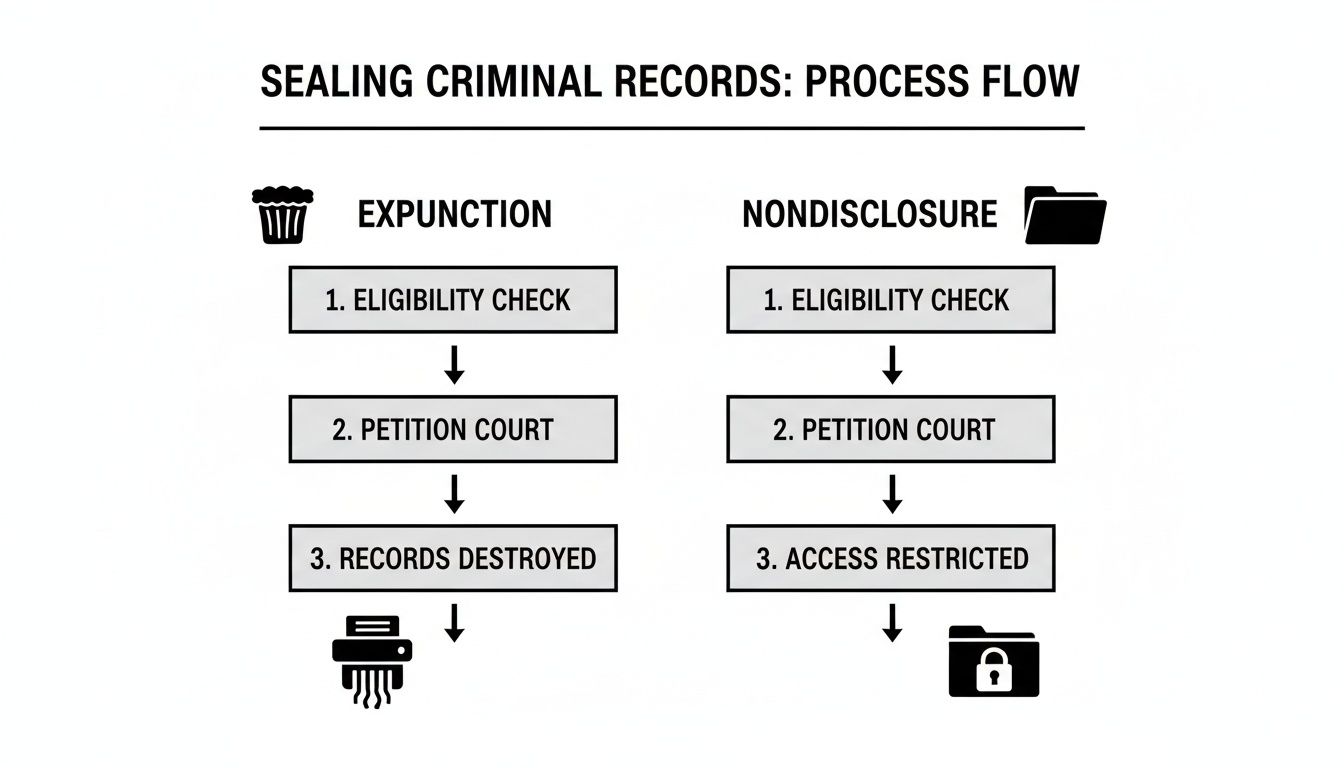
As you can see, while both paths lead to a sealed record, an expunction gives you a complete erasure. A nondisclosure, on the other hand, acts as a powerful shield, hiding your record from public view.
Drafting and Filing the Petition
Once you have your paperwork and you’ve confirmed your waiting period is over, the next phase is drafting the legal document that formally asks the court to clear your record. This is called a Petition for Expunction or a Petition for an Order of Nondisclosure. This document has to be factually perfect. It needs your personal information, all the details of the arrest, the case number, and the specific legal reasons you're entitled to this relief.
After it's drafted, the petition has to be filed with the district clerk in the county where you were arrested or charged. This is the very same court that handled your original criminal case. Filing this petition is what officially opens your civil case to clear your name.
Key Insight: A petition to seal your record isn't a criminal case—it's a civil lawsuit. You are the "Petitioner," and you're essentially suing the state agencies that hold your records, asking a judge to order them to destroy or seal them for good.
Notifying the State Agencies
You can’t just file the petition and hope for the best. You are legally required to notify every single government agency that has a copy of your record. This formal process is called "service," and it gives each agency a chance to object to your request.
These agencies almost always include:
- The District Attorney’s Office that prosecuted you.
- The law enforcement agency that arrested you (e.g., Dallas Police Department, Travis County Sheriff's Office).
- The Texas Department of Public Safety (DPS).
- The District Clerk or County Clerk where the records are physically held.
Failing to properly serve even one of these agencies can completely derail your case. Each one has its own specific rules for accepting service, and you have to follow them to the letter. This is another area where many self-filed petitions unfortunately fail. For a closer look at these procedural hurdles, our detailed guide on how to get a record expunged in Texas is a great resource.
Getting Ready for the Court Hearing
After all the agencies have been served, the court will set a hearing date. The good news is that in many straightforward cases, especially if no one objects, the hearing is just a formality. The judge will review your petition, confirm you meet the criteria, and sign the order. You might be in and out in just a few minutes.
However, if the State objects or if the judge has questions, you have to be ready to answer them clearly and respectfully. The prosecutor might ask about the original charge or what you’ve been doing with your life since the case closed. The key is to be honest, concise, and focused on showing why you legally qualify to have your record cleared.
Walking into a courtroom can be nerve-wracking, no doubt. But with thorough preparation, you can approach it with confidence. This entire process, from gathering those first documents to the final hearing, is your chance to formally close a chapter of your past and step into a future free from its shadow.
Common Mistakes to Avoid When Sealing Your Record
Navigating the process to seal a criminal record can feel like a high-stakes journey. You’ve done everything right—completed your probation, stayed out of trouble, and are more than ready for a fresh start. The last thing you want is a simple, preventable error sending you back to square one, especially when your family's stability is on the line.
A small mistake could force you to refile and wait even longer for the relief your family needs.
Over the years, we’ve seen countless families make small but critical mistakes that get their petitions denied. These aren't due to a lack of effort but a lack of familiarity with the court's strict, detail-oriented requirements. Understanding these common pitfalls ahead of time is the key to a smooth and successful process.
Miscalculating the Waiting Period
This is, without a doubt, the most common error we see. Filing your petition even one day too early will result in an automatic denial by the court. The waiting periods in Texas are not suggestions; they are hard-and-fast legal deadlines that must be met.
Imagine a father who completed deferred adjudication for a DWI. Excited to finally clear his name and apply for a better job to support his kids, he files for nondisclosure a few weeks before the two-year waiting period is officially over. The court dismisses his petition, forcing him to pay new filing fees and start the entire process again, adding months of delay and frustration.
Here’s a quick reminder of the timelines:
- Expunctions: You generally must wait for the statute of limitations to expire on the offense (two years for misdemeanors, three for most felonies).
- Nondisclosures: The clock starts after probation ends. The wait can be immediate for some misdemeanors, two years for others (like DWI), and five years for certain felonies.
Calculating this date with absolute precision is non-negotiable.
Incomplete or Inaccurate Petitions
The legal petition you file is the foundation of your entire case. It must be perfectly accurate, listing every detail of your arrest, case number, and the specific legal grounds that make you eligible. Any omission or error can cause major problems.
We once consulted with a woman whose petition was rejected because she failed to list a minor, related charge that was dismissed alongside her main case. Because the petition wasn't a complete record of the incident, the judge couldn't grant it. This tiny oversight cost her time and money.
Your petition is a legal document that swears the information within it is true and correct. Meticulous accuracy isn't just good practice—it's a legal requirement.
Failing to Notify All Required Agencies
When you file to seal your record, you are essentially suing the state agencies that hold your information. You must formally notify every single one of them, a process called "service."
Forgetting to serve an agency is a fatal flaw in your case. Common agencies include:
- The District Attorney’s Office
- The arresting police department or sheriff's office
- The Texas Department of Public Safety (DPS)
- The clerk of the court holding the records
Each agency has its own rules for accepting legal service. Failing to follow them precisely for every single entity gives them grounds to object, which can delay or even derail your entire case.
This is one of the most technical parts of the process and a primary reason why professional legal help is so valuable. An experienced attorney knows exactly who to notify and how to do it correctly, preventing your petition from being dismissed on a procedural technicality.
What Happens After Your Record Is Sealed

The moment the judge signs that nondisclosure or expunction order is a massive win. You can feel the weight lift off your shoulders—a burden your family has carried for years is finally gone. But what happens after you walk out of the courthouse? It’s not just about that piece of paper. It’s about understanding your new rights and stepping confidently into a future you’ve fought hard to reclaim.
Getting your record cleared is about more than just personal relief; it’s about economic freedom. A criminal record creates huge barriers to employment, housing, and education, leading to economic losses that tally into the hundreds of billions nationally. When you clear your record, you're not just helping yourself; you're helping reverse that trend for your entire community. You can dig deeper into the research on this from United for Impact.
Your fresh start is here. Let’s talk about what to expect next.
Legally Answering "The Question" on Applications
This is the part you've been waiting for. When a job, housing, or loan application asks if you've ever been arrested or convicted of a crime, your answer can finally be different.
- After an Expunction: An expunction completely destroys the record. You can legally—and truthfully—deny the arrest ever happened. For all practical purposes, it’s gone from your history.
- After a Nondisclosure: You can also legally deny the arrest and prosecution on most applications. This applies to private employers, landlords, and schools.
The ability to honestly check "no" on that box is one of the most powerful benefits of sealing your record. It removes the single biggest barrier that has held you back, allowing your skills and character to shine through.
But it’s critical to know that a nondisclosure doesn't make the record completely vanish. Certain government entities and licensing agencies can still access it. You must disclose the sealed offense if you're applying for a job with a law enforcement agency or certain state licensing bodies, like the Texas Board of Law Examiners or the Texas Medical Board.
Confirming Compliance and Tying Up Loose Ends
The judge's order is the first big step, but it's not the last. The court sends the order to all state agencies holding your records, directing them to comply. This process isn't always instant, so a little follow-up on your end is a smart move.
A few weeks after your order is granted, it’s a good practice to:
- Get Certified Copies: Head to the district clerk’s office and get several certified copies of the signed expunction or nondisclosure order. You’ll want to keep these for your personal records forever.
- Verify Compliance: Run a background check on yourself through the Texas Department of Public Safety (DPS). This is the best way to confirm the record no longer shows up on your public criminal history.
- Address Private Databases: Private background check companies buy data in bulk and don't always update their records right away. If an old record pops up on a private check, you can send the company a certified copy of your court order and demand they remove the outdated information.
Think of it like updating your address with the post office—you have to make sure everyone gets the memo. This final bit of diligence ensures your hard-won victory is reflected everywhere it counts. This whole process is an investment in your future, and it's important to understand all the steps involved. For a better idea of what to expect financially, you can review our guide on the cost of expungement in Texas.
Sealing your record is your opportunity to redefine your story. It’s about ensuring that a past mistake doesn't dictate your family's future. You've done the work to get here; now it's time to embrace the freedom you have rightfully earned.
A Few Common Questions About Sealing a Criminal Record
When you're trying to put a criminal record behind you, a lot of practical questions come up. This isn't just about filling out legal forms; it's about getting your family's future back on track. We hear the same questions from families across Texas, so let's get you some clear, straightforward answers.
How Much Does It Cost to Seal a Criminal Record in Texas?
The total cost can vary quite a bit, mostly depending on how complex your case is and which county you're filing in. At a minimum, you'll need to budget for court filing fees, which usually run a few hundred dollars. You'll also have smaller costs for formally notifying all the state agencies involved.
The biggest part of the investment, however, is typically the attorney's fees. This isn't just for paperwork; it's for the legal expertise needed to draft a perfect petition, navigate the court's specific procedures, and make sure every single detail is handled correctly. While it's an upfront cost, the long-term return—better job opportunities, stable housing, and real peace of mind—is truly priceless.
Can a Felony Conviction Be Sealed in Texas?
This is a really important distinction. As a general rule, if you were convicted of a felony and served a sentence (meaning, your case didn't end with deferred adjudication), you can't get it sealed with a nondisclosure or wiped clean with an expunction. Those legal tools are meant for very different situations.
- An expunction is for cases that were ultimately resolved in your favor, like a dismissal or an acquittal.
- A nondisclosure is mainly for people who successfully finished deferred adjudication probation.
While the law is pretty strict on this, it never hurts to talk through the specifics of your felony case with an experienced attorney. They can confirm exactly what options you might have.
How Long Do I Have to Wait Before I Can Seal My Record?
Patience is key here. The waiting period is a non-negotiable part of your eligibility, and it changes based on the offense and how your case was resolved. Filing too soon is one of the most common mistakes we see, and it results in an automatic denial, forcing you to start the whole process over.
Here’s a general breakdown to give you an idea:
- For an Expunction: If your case was dismissed, you have to wait until the statute of limitations for that crime has passed. This is usually two years for misdemeanors and three years for felonies.
- For a Nondisclosure: The clock starts ticking the day you successfully complete your deferred adjudication probation. For many misdemeanors, you can file almost immediately. For others, like a first-time DWI, there’s a two-year wait. For certain eligible felonies, the waiting period is five years.
Getting this date right is absolutely critical for your petition to succeed.
Do I Have to Disclose My Sealed Record on a Job Application?
For the vast majority of private employers, the answer is a resounding no. This is probably the most powerful benefit of getting your record sealed. Once a Texas court grants an order of nondisclosure or an expunction, you can legally and truthfully deny the arrest ever happened on most applications for jobs, housing, or loans.
The big exception here involves applying for sensitive government jobs. If you're trying to work in law enforcement or for a state agency that demands a license (like the state bar or a medical board), you absolutely must disclose the sealed offense.
An attorney can give you clear, specific advice based on your career path, so you can answer those application questions confidently and correctly every single time.
A mistake in your past shouldn't stop you from building a secure and hopeful future for your family. The process of sealing a record can feel overwhelming, but you don't have to figure it out alone. The attorneys at the Law Office of Bryan Fagan PLLC have the experience and compassion to guide you through every step. We are here to listen, offer reassurance, and provide the practical legal help you need to move forward with confidence. For a free, confidential consultation to discuss your case and learn how we can help, please contact us today.