Skip to content
It’s the knock on the door every parent dreads. The one that makes your heart sink into your stomach. It’s a caseworker from Child Protective Services (CPS), and suddenly, your world is spinning. The first thought that flashes through your mind is terrifying: can CPS take my child without a court order in Texas?
The short answer is yes, but this can only happen in the most extreme, emergency situations where a child is in immediate danger.
As Texas family law attorneys who have stood beside countless parents during their darkest hours, we understand the wave of fear and confusion that a CPS visit brings. This guide is here to cut through the panic, offer clear explanations of the Texas Family Code, and provide the practical, reassuring guidance you need to protect your family.
The Knock on the Door Every Parent Fears
A visit from CPS, which is part of the Texas Department of Family and Protective Services (DFPS), is one of the most stressful experiences a parent can face. The fear and confusion are completely overwhelming. But this guide is here to cut through the panic and give you the facts. We'll walk you through the Texas laws that give CPS its authority, explain your rights, and offer real, practical steps to protect your family.

Our goal is to give you the knowledge you need to navigate this crisis. You are not alone, and you have legal options. Understanding how this process works is the very first step toward taking back control.
When Can an Emergency Removal Happen?
Texas law gives CPS the power to remove a child from their home without getting a court order first, but only when there is solid evidence of an immediate danger to the child’s physical health or safety. Think of it as the legal system's emergency brake—it's designed to protect a child when waiting for a judge would be too risky.
This incredibly serious action, sometimes called an "exigent removal," is reserved for situations where leaving the child in the home, even for a few more hours, would pose a severe and imminent threat. It’s not a power that caseworkers can use on a whim.
The core principle is urgency. The danger must be so immediate that there is no time to obtain a judge's permission first.
This guide will help you understand:
- The legal standard of "immediate danger."
- Your rights during a CPS investigation.
- The critical first steps to take after a removal.
- How to fight to get your child back home.
Knowing how to react when you're under this immense pressure is absolutely critical. To get a better handle on the initial encounter, it’s worth understanding how to respond when CPS shows up at your door in Texas.
What Legally Qualifies as Immediate Danger
"Immediate danger" is the legal phrase that gives CPS the authority to remove a child from your home without first getting a court order. It's a term that can sound vague and frankly, terrifying. But in Texas law, it has a very specific, high bar that CPS must clear.
This isn't about a messy house or a parent's general "suspicion." We're talking about a situation where a child faces a real, imminent threat of serious physical or emotional harm, and there's no time to wait for a judge to weigh in.
For example, a cluttered, chaotic home might trigger a CPS investigation, but it rarely meets the standard for immediate danger. Now, picture a parent passed out from drug use while a toddler wanders near an unfenced swimming pool. That second scenario paints a clear picture of imminent risk and is exactly the kind of situation that justifies an emergency removal under the Texas Family Code.
Defining Imminent Harm in Texas
The Texas Family Code is very clear on this. CPS can't just act on a gut feeling or a vague concern. To bypass the courts, they must have evidence that points to specific, severe circumstances where a child's safety is on the line.
A caseworker's general worry or disapproval of your parenting style is not enough. The law is intentionally designed this way to balance the critical need for child protection with a parent's fundamental rights. While other states have their own procedures for navigating emergency child custody, Texas sets its own distinct and high standard. The danger must be happening now or be about to happen.
To give you a clearer idea, let's look at what situations might trigger a removal versus those that would likely just start an investigation.
Grounds for Emergency Removal vs. Investigation Only
| Situation Justifying Emergency Removal | Situation Warranting Investigation Only |
|---|---|
| Parent is found unconscious from substance use while caring for a young child. | Anonymous report of occasional marijuana use, with no direct danger to the child. |
| Evidence of recent, severe physical injury (e.g., broken bones, burns) with no plausible explanation. | Concerns about a messy or cluttered home environment without immediate safety hazards. |
| A child discloses credible details of ongoing sexual abuse by a household member. | A report that parents argue frequently, but with no evidence of physical violence. |
| A parent has abandoned a child, leaving them without any care or supervision. | A child is behind on schoolwork or has poor attendance. |
This table shows the stark difference between a situation needing investigation and one that constitutes a true emergency in the eyes of the law.
Aggravated Circumstances Under Chapter 262
The Texas Family Code goes even further by listing specific "aggravated circumstances" in Chapter 262. These are situations so inherently dangerous that they create a legal presumption that keeping the child in the home is not a safe option.
These often include:
- Serious Bodily Injury: The child has suffered a severe injury, and evidence points to a parent as the cause.
- Sexual Abuse: There is credible evidence that a parent has sexually abused the child.
- Abandonment: The parent has left the child without providing for their care, safety, or basic needs.
- A Pattern of Abuse: The parent has engaged in a consistent pattern of conduct that threatens the child's life or well-being.
- Termination of Rights to Another Child: The parent's rights to another child were previously terminated based on findings of abuse or neglect.
Knowing these legal definitions is your first line of defense. If CPS removes your child, their reasoning must align with these high-stakes scenarios. Understanding the difference between what CPS can investigate versus what legally permits an emergency removal is what empowers you to effectively challenge their actions. For a deeper look, you should read our guide on what happens during an emergency CPS removal in Texas.
The Critical First 14 Days After an Emergency Removal
The moments after a CPS worker takes your child are a gut-wrenching blur of shock, fear, and confusion. But in the middle of that chaos, you have to understand that a legal clock just started ticking. The Texas Family Code, specifically Chapter 262, lays out a very precise timeline for what comes next, and those first 14 days are without a doubt the most important stretch of your entire case.
This isn't a time to wait and see what happens. It’s a time for immediate and strategic action. Every single step you take—or fail to take—during this two-week window can dramatically affect your chances of bringing your child back home.
The All-Important Adversary Hearing
Within 14 days of an emergency removal, the court is legally required to hold a specific hearing. It's called the Adversary Hearing, and it’s your first and best opportunity to stand before a judge and fight the removal. Think of it as the system's built-in check on CPS's power. This is where a judge, not the caseworker, gets the final say on whether there's enough real evidence to keep your child in state custody.
At this hearing, the CPS attorney has to prove to the judge that there was an immediate danger to your child and that it’s currently not safe for them to come home. You and your lawyer have the absolute right to be there, to present your side of the story with your own evidence, and to argue directly against the removal.
Key takeaway: The 14-day Adversary Hearing isn't a final trial to terminate your parental rights under Chapter 161. Its only job is to decide if your child should stay in foster care while the investigation moves forward or if they should be returned to you right away.
The infographic below really highlights the huge difference between a situation that just needs a standard investigation and one that CPS might argue is a true emergency justifying removal.
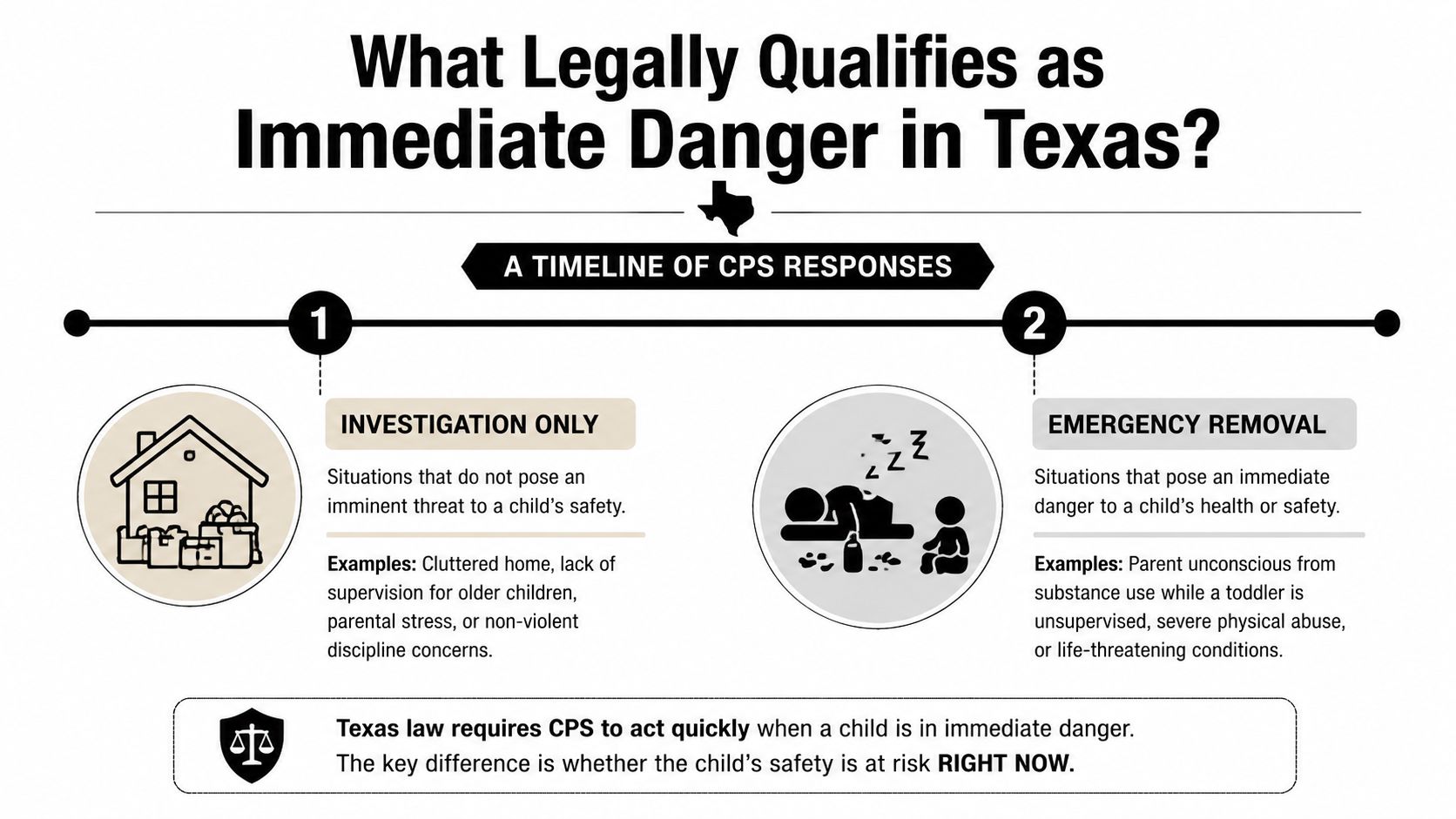
As you can see, the legal bar for an emergency removal is incredibly high. It's meant only for those rare situations where a child is facing a genuine, immediate threat.
Preparing for Your Hearing
The judge's decision at the Adversary Hearing comes down to one thing: the evidence. This is exactly why what you do in the days leading up to it is so critical.
Here are the first steps you need to take:
- Document Everything: Sit down and write out a detailed timeline of the removal. Who was there? What exactly did the caseworker say? What reasons did they give for taking your child? Don't trust your memory—write it all down.
- Gather Your Evidence: Start collecting anything that shows your home is a safe and stable place. This could be photos, text messages, or even school and medical records that support your case. Think about people who can vouch for your parenting and would be willing to be witnesses.
- Contact an Attorney Immediately: Do not walk into this hearing alone. An experienced CPS defense lawyer understands exactly what a judge needs to see and hear. They can help you build the strongest possible argument for getting your child back where they belong.
This 14-day window is your chance to change the entire direction of your case. Being proactive and prepared is the most powerful tool you have in the fight for your family.
Knowing and Using Your Rights When CPS Visits
When a CPS caseworker shows up on your doorstep, it's natural to feel your world tilt on its axis. The mix of fear, confusion, and pressure can be completely overwhelming. In that high-stress moment, it's easy to forget one crucial thing: you have rights. And knowing what those rights are—and how to use them—is your family's first line of defense.
Let's get one thing straight right away: a CPS caseworker is not a police officer. They don't have the power to arrest you, and they can't just barge into your home whenever they please. Their authority has firm legal limits, and they must have a court order or your clear permission to come inside.
Asserting Your Rights Calmly and Firmly
If a caseworker arrives without a court order, you have every right to refuse them entry. You don't have to be rude, but you do need to be firm. A simple, "I am not comfortable letting you in without a warrant," is all you need to say. This isn't an admission of guilt; it's you exercising a fundamental constitutional right.
You also have the right to remain silent and the right to have an attorney. You are under no obligation to answer their questions on the spot. So many well-meaning parents try to be cooperative and end up talking themselves into a corner, accidentally giving CPS ammunition to use against them later.
Imagine this scenario: A caseworker arrives, prompted by an anonymous report about a messy house, and asks to come in for "just a quick look around." Instead of letting your nerves take over, you can step outside, close the door behind you, and calmly say, "I want to cooperate, but I will not speak with you or allow you inside until I have consulted with my attorney." This response is polite, legally sound, and shows you're taking the matter seriously while protecting your family's privacy.
Your home is your sanctuary, and the law protects it from unwarranted government intrusion. Understanding the limits of a caseworker's authority—for instance, their inability to conduct searches without legal permission—is a critical piece of this puzzle. You can learn more about what constitutes an illegal search and seizure in Texas to better protect yourself.
Practical Steps to Protect Your Rights
Knowing your rights is one thing, but having the confidence to use them when you're under pressure is another. If CPS shows up, burn these three points into your memory:
- The Right to Refuse Entry: You do not have to let a caseworker into your house unless they hand you a court order signed by a judge. Period.
- The Right to Remain Silent: You are not required to answer any questions. You can, and should, wait until you've spoken with a lawyer.
- The Right to an Attorney: State clearly that you will not discuss anything further until you have a lawyer present or have had a chance to consult with one.
Politely standing your ground isn't being "difficult"—it's being strategic. It buys you precious time to get the professional legal advice you need. In any CPS investigation, that is the single most important step you can take.
How a CPS Case Can Impact Your Custody Order
For parents who are divorced or separated, that custody order can feel like a fortress—a legally binding document that spells out exactly who has rights to the children and when. But a knock on the door from CPS can make that fortress feel like it’s built on sand.
It's one of the first questions we hear: “Does a CPS case just wipe out my custody order?” The short answer is no, an investigation doesn't instantly make a judge's order disappear. But it absolutely gives the other parent a powerful new tool to try and tear it down.
How CPS Findings Can Blow Up a Custody Case
When CPS concludes an investigation with a finding of ‘Reason to Believe’ that abuse or neglect happened, everything changes. This isn't just a caseworker's opinion; it's a formal finding that can serve as the legal ammunition a judge needs to completely overhaul your current custody arrangement.
A motion to modify custody that might have been dead on arrival before suddenly has legs. It’s now backed by a state agency's official determination.
Think about this common scenario: a dad has a standard possession order with weekend visits. If CPS issues a ‘Reason to Believe’ finding that he has a dangerous substance abuse problem, the mom can immediately file a modification. Armed with that finding, a judge is far more likely to order that all of the father’s visits must be supervised, or even suspend them completely until he proves he's no longer a risk.
A Word of Warning: Don't ever make the mistake of thinking your CPS case and your custody case are two separate battles. They are deeply connected. The outcome of the CPS investigation will almost certainly bleed into any family court decisions about your parental rights.
The Hidden Danger of "Voluntary" Agreements
During the chaos and fear of an investigation, a caseworker might offer you what sounds like a reasonable solution: a Parent-Child Safety Placement (PCSP). They'll frame it as a "voluntary" way to avoid having your child formally removed by the court. You just agree to place your child with a relative or even the other parent for a little while.
It sounds like a way to keep your child out of foster care, but this is a classic trap. We’ve seen it hurt too many families.
These so-called "temporary" safety plans can create permanent problems. When you sign that paper, you can be seen as legally admitting that you can't provide a safe home for your child. The other parent can then march into family court with that very agreement and argue that you voluntarily gave up your child because you knew you were a danger.
This is why our most urgent advice is always the same: do not sign any CPS safety plan, placement agreement, or any other document without talking to an experienced family law attorney first. Protecting your rights isn't about caving to pressure; it's about being strategic. A quick fix that seems harmless could do irreversible damage to your custody case and your future with your child.
Your Action Plan for Fighting Back and Bringing Your Child Home
The moments after a CPS caseworker removes your child are a blur of shock, panic, and a feeling of utter helplessness. But this is the critical time to move past the fear and take immediate, decisive action. Knowing the law is one thing, but having a clear plan is what will truly empower you to fight for your family.
From the second that door closes, the clock starts ticking. Every choice you make, every word you say, and every action you take will be scrutinized. This isn't a situation you can navigate on your own; you need a strategy, and you need it now.

Immediate Steps to Take
What you do in the first few hours and days is absolutely crucial. Follow these steps to protect your rights and start building your defense from the ground up.
- Hire an Experienced CPS Defense Attorney Immediately. This is without a doubt the most important first step. A lawyer who lives and breathes Texas CPS law can start preparing for the critical 14-day Adversary Hearing and make sure your rights are defended from day one.
- Create a Detailed Timeline of Events. Grab a notebook and write down everything you can remember about the removal. Document the names of the caseworkers, the exact date and time, and what was said by all parties. This written record can be invaluable later.
- Do Not Sign Any CPS Paperwork. You may be pressured to sign so-called "voluntary" service plans or other agreements. Politely but firmly refuse, stating that you will not sign anything until your attorney has reviewed it.
- Prepare for Your Hearing. Immediately start working with your lawyer to gather evidence that tells your side of the story. This can include photographs, text messages, emails, and a list of credible witnesses who can vouch for your character and parenting.
- Comply with All Court Orders. Once a judge issues an order—for services, therapy, or testing—follow it to the letter. Demonstrating your willingness to cooperate with the court's directives is essential to showing you are a safe parent.
An experienced attorney does more than just show up in court—they become your strategic partner. They know how to challenge the legality of a removal when CPS can't prove immediate danger, and they can help you navigate the tricky requirements of a service plan without you having to admit to something you didn't do.
Taking these steps helps you move from a place of defense to one of control. The fight to bring your child home begins the moment they are taken, and your preparation starts now.
Answering Your Urgent Questions About CPS Removals
When you're in the middle of a CPS crisis, your mind is racing with a million questions, and you need clear, direct answers. The fear and uncertainty can be completely paralyzing. Here, we’re cutting through the noise to tackle some of the most common and urgent questions we hear from Texas parents facing the unthinkable.
While we want to give you immediate, practical guidance, remember this: the single most important step you can take is to contact an experienced family law attorney. They can protect your rights and give you counsel tailored to your specific situation.
Can CPS Force Me to Take a Drug Test Right Now?
No. A caseworker cannot force you to take a drug test on the spot without a court order.
But this is a delicate situation. If you flat-out refuse, CPS and the court might see that as a red flag—an admission of substance use, even if that's not the case. The best way to handle this is to protect your rights while showing you aren't being difficult.
State clearly and calmly: "I am willing to cooperate, but I need to speak with my attorney before consenting to any tests." This simple sentence does two crucial things: it asserts your rights and shows you intend to follow the process, just not without legal advice.
Do I Have to Let CPS Talk to My Child Alone?
This is one of the toughest spots a parent can be in. Legally, you have the right to be present when your child is interviewed. However, caseworkers are trained to separate children for interviews to check for any signs of coaching or fear.
You can politely insist on being present—it is your right. Just be prepared for the caseworker to note your refusal in their report. A smart alternative is to suggest the interview take place at a neutral location, like a child advocacy center. There, the interviews are recorded and conducted by a trained forensic interviewer, which adds a layer of protection for everyone.
Again, the wisest move is to consult your attorney before any interview happens.
You have the right to say no to many of a caseworker's requests, but how you say it matters. Always be polite but firm, and always state your intention to consult with legal counsel before making a decision.
How Can I See My Child After They Are Removed?
After an emergency removal, the law doesn't force CPS to grant you visitation before the first court hearing, which is known as the Adversary Hearing. This is a terrifying reality for parents.
Your first move should be to immediately and repeatedly request visitation in writing. Send emails, send texts—create a paper trail.
This record proves to the judge that you are eager and willing to see your child. When your attorney files a motion with the court demanding visitation, a judge is far more likely to grant it to a parent who has been actively and consistently seeking it from the very beginning.
A CPS case is an emotionally draining and legally treacherous journey. You should not have to walk this path alone. The attorneys at the Law Office of Bryan Fagan are here to provide the tough, experienced legal guidance you need to fight for your family. We understand the fear and urgency you feel, and we are here to fight for you and your family with compassion and strength. Don't face this battle alone. Contact us today for a free, confidential consultation.