Skip to content
A past mistake shouldn't define your future, especially when you're fighting to provide a safe and stable home for your children. If a criminal charge from your past is holding you back, the constant fear of a background check can feel overwhelming. It’s a weight that can slam doors on better jobs, safe housing, and even volunteering at your child's school. For a parent involved with Child Protective Services (CPS), that old charge can become a weapon used against you, creating a cloud of suspicion that has nothing to do with your love for your kids.
Reclaiming Your Future and Protecting Your Family
That knot of fear and stress that tightens with every application you fill out is exhausting. But what if you could legally lock that past away and give your family the fresh start it deserves? For many Texans, the key is an order of nondisclosure.
An order of nondisclosure doesn’t erase your history, but it does seal it from public view. Think of it like putting a sensitive file into a locked cabinet. The general public can no longer see it, but authorized state agencies, including law enforcement, still have a key. This powerful legal tool can help you:
- Confidently apply for new jobs and promotions without that constant worry.
- Secure safe and stable housing for you and your family.
- Get back to being fully involved in your child's life—from school events to extracurriculars.
- Finally move forward with peace of mind and dignity.
An order of nondisclosure is designed to give deserving people a genuine second chance. It does this by limiting public access to their criminal history, removing a huge obstacle to personal and professional growth.
This process is a game-changer for people who might not qualify for a full expunction. While it's different from completely wiping the slate clean, understanding the expungement process in Texas can help you figure out which path is the right one for your situation. Our guide is here to demystify the order of nondisclosure in Texas, giving you the clear, compassionate, and actionable steps your family needs to leave the past behind.
If a past charge is holding your family back, you aren't alone, and you definitely have options. The Law Office of Bryan Fagan is here to help you navigate this complex legal journey with both skill and empathy. Contact us today for a free, confidential consultation to discuss your case and discover how we can help you get the fresh start you deserve.
Understanding What a Nondisclosure Order Actually Does
When you hear someone talk about "sealing a record," it's easy to picture a past mistake just vanishing into thin air. While an order of nondisclosure in Texas is an incredibly powerful, life-changing legal tool, it’s crucial to understand what it actually does—and just as importantly, what it doesn't.
Think of it this way. An expunction is like taking a file and running it through a shredder. For all legal purposes, the record is destroyed and never existed.
But a nondisclosure order works differently. It’s more like taking that same file, placing it in a high-security vault, and giving out the key to only a very select group of people. Your criminal record isn't gone; it's just hidden from public view.
Who Can—And Can’t—See Your Record
This difference is everything, because it determines who has access to your information once a judge grants the order. For a parent trying to rent a better apartment or a professional applying for a new job, the effect is massive.
Once your record is sealed with a nondisclosure, it's wiped from public databases. This means:
- Private Employers: Most companies running standard background checks will never see the sealed offense.
- Landlords: Apartment complexes and property managers will no longer have access to that information.
- The General Public: Nosy neighbors, friends, or anyone else running a public background check will come up empty-handed.
- Data Brokers: Companies that scrape and sell public data are legally required to remove your sealed record from their systems.
For most day-to-day situations, you can legally and honestly say the arrest or prosecution never happened. This is the fresh start you’ve been waiting for.
The Limits of Nondisclosure
However, that file is still in the vault. Certain government and law enforcement agencies will always have a key.
An order of nondisclosure (OND) in Texas is a legal tool that seals certain criminal records from public view, allowing individuals to legally deny the offense for most private purposes, like jobs and housing, without actually destroying the record itself.
Under Texas Government Code §§ 411.071 – 441.0775, these sealed records remain fully accessible to government agencies and law enforcement for official business. You can dive deeper into the differences between nondisclosure and expungement in Texas to see which might be right for you.
Let’s use an example. Imagine a mother who, years ago, had a minor, non-violent offense sealed after successfully completing deferred adjudication. She’s now a respected community member and wants to volunteer at her child’s elementary school. That position requires a fingerprint-based background check with the Texas Department of Public Safety (DPS).
Because a school district is a government-affiliated entity, they will see the sealed offense. The same goes if she applies for a state professional license to be a nurse or a teacher—the licensing board will have access. The sealed offense could also be brought up against you in a future criminal case.
This is exactly why understanding the fine print of an order of nondisclosure in Texas is so important. It offers tremendous relief from public judgment but doesn't make you invisible to the government.
Determining Your Eligibility for Nondisclosure in Texas
Knowing if you even qualify for an order of nondisclosure is the first, and most important, hurdle on the path to getting a fresh start. The Texas legal system has a specific checklist of rules you have to meet before you can even think about filing a petition. For a lot of people, this is the most confusing part of the whole process, but it doesn't have to be.
The main road to eligibility runs straight through deferred adjudication. This is a special type of community supervision (think probation) where you plead guilty or "no contest," but the judge holds off on actually finding you guilty. Instead, the finding of guilt is "deferred," and you're placed on probation with a list of things you have to do. To really get a handle on this critical idea, it's worth learning more about what deferred adjudication in Texas means for your case.
If you successfully jump through all the hoops—paying fines, finishing classes, and staying out of trouble—the judge dismisses the case entirely. It’s this dismissal that flips the switch and makes you eligible to ask the court for an order of nondisclosure.
Waiting Periods The Clock Starts After Dismissal
Now, even after your case is dismissed, you can't just run down to the courthouse and file the paperwork. Texas law makes you wait a certain amount of time, and how long you have to wait depends on what kind of offense it was. This waiting period is basically a way for the system to see if you're going to stay on the right path after your case is over.
- For most misdemeanors: The clock starts ticking on the very day your deferred adjudication is successfully completed and the case is dismissed.
- For felonies: You’re looking at a two-year wait from the date of discharge and dismissal before you can petition the court.
Think of it this way: Completing deferred adjudication gets you to the starting line. The waiting period is the final lap you have to run before you can cross the finish line and finally file your petition.
When Probation or Jail Time Was Involved
So what happens if you didn't get deferred adjudication? What if you got "straight" probation or even did some jail time? Thanks to some recent changes in Texas law, the door to nondisclosure has opened a crack for some people who completed sentences for certain low-level, first-time misdemeanors.
These situations come with their own set of specific waiting periods, which are usually a bit longer. For example, you might have to wait two years after you've finished your sentence. This path is definitely more narrow and restrictive, but it offers a glimmer of hope to many who were previously locked out of the process completely.
Automatic Nondisclosure for Certain First-Time Offenses
Texas has also carved out a special path for an "automatic" order of nondisclosure for some first-time, non-violent misdemeanors. Under this law, if you successfully wrap up deferred adjudication for a qualifying offense, the court is required to issue the nondisclosure order right then and there when the case is dismissed. This makes things a whole lot easier, but it only applies to a very small slice of offenses.
Offenses That Disqualify You From Nondisclosure
Just as important as knowing if you qualify is knowing if you don't. The law slams the door shut on sealing certain serious crimes to protect public safety. If you have ever been convicted of or received deferred adjudication for any of the following, you will be permanently ineligible for a nondisclosure:
- Any offense that requires you to register as a sex offender.
- Murder, capital murder, or aggravated kidnapping.
- Trafficking of persons or continuous trafficking of persons.
- Any offense involving family violence.
- Stalking or violating a protective order.
And that's not even the complete list; the rules can get tangled pretty quickly. For example, having a past conviction for one of these disqualifying offenses can stop you from sealing a completely different and otherwise eligible charge. The demand for this kind of relief is huge. While the latest data from the Texas Department of Public Safety is a bit hard to come by, past reports show thousands of these petitions are filed every year. With tens of thousands of misdemeanor cases potentially eligible annually, it’s clear people are looking for a way to restore their privacy.
Trying to figure out these eligibility rules on your own means doing a deep dive into your entire criminal history. This is where an experienced attorney becomes invaluable. They can analyze your past charges, make sure you meet every single legal requirement, and get you on the right path to sealing your record for good.
How to File a Petition for an Order of Nondisclosure
Taking the leap to file for an order of nondisclosure can feel like standing at the bottom of a legal mountain. The paperwork, court deadlines, and confusing official language are enough to make anyone want to turn back. But the truth is, the process is really just a series of clear, manageable steps.
Think of it like following a recipe. If you add the right ingredients in the right order, you get the result you want. This guide is your step-by-step recipe for filing a petition, designed to make the whole journey feel a lot less intimidating.
The flowchart below breaks down the basic path for a Texas nondisclosure, from checking if you're even eligible to finally filing with the court.
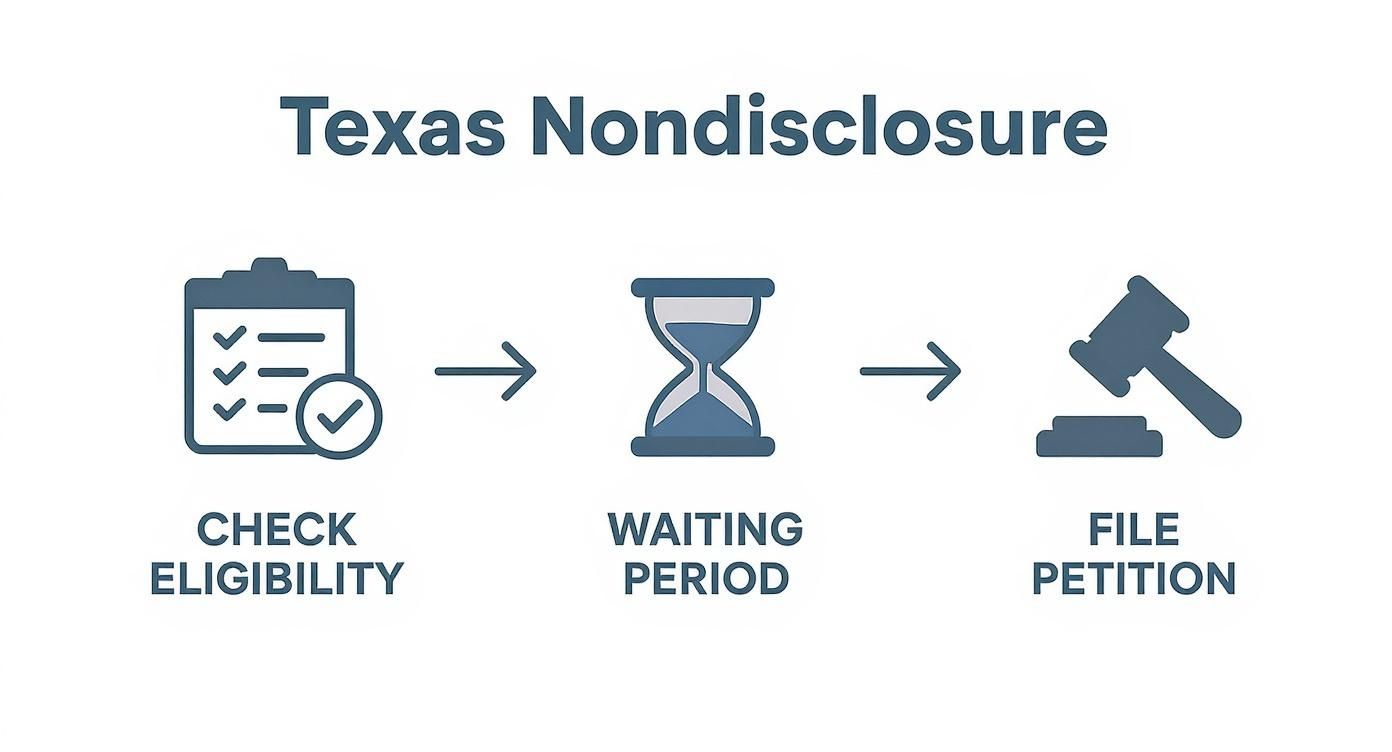
As you can see, the work begins long before you ever step foot in a courthouse. It all starts with making sure you meet every single legal requirement.
The Step-by-Step Filing Process
While no two cases are exactly alike, the core steps for asking the court for an order of nondisclosure in Texas are generally the same. Getting each stage right is absolutely critical—one small mistake can cause major delays or even get your petition thrown out.
Confirm Eligibility and Gather Your Documents: Before you do anything else, you have to be 100% sure you qualify. This means taking a hard look at your criminal history, the final outcome of your case (was it a dismissed deferred adjudication?), and confirming the required waiting period has passed. You’ll need key documents, like the court records from your original case.
Draft and File the Petition: Next up is drafting a formal legal document called a "Petition for Nondisclosure." This is your official request to the court that handled your criminal case, asking it to seal your records. It has to be filled out perfectly and filed with the right court clerk, along with the filing fee, which changes from county to county.
Notify the State: You can't just file your petition and hope for the best. The law requires you to "serve" a copy of the petition to the local prosecutor’s office. This puts the State on notice that you're seeking a nondisclosure, giving them the chance to object if they don't think you're eligible or believe sealing your record isn't in the "interest of justice."
Prepare for a Hearing (If Necessary): If the prosecutor files an objection, the judge will schedule a hearing. This is where you (or your attorney) and the prosecutor will each present your side of the story. The State might argue you haven’t met the legal criteria or that the nature of the original offense makes nondisclosure a bad idea.
The Judge's Final Decision: After reviewing your petition and listening to any arguments, the judge makes the final call. If the judge signs the order, your record gets sealed. But if your petition is denied, you might have to wait to refile—if you’re even allowed to.
Timelines, Fees, and Why Accuracy Is Everything
The whole process for getting an order of nondisclosure can take anywhere from a few weeks to several months. It really depends on the court’s schedule and whether the State decides to fight it. On top of that, you can expect filing fees to run several hundred dollars, not including any other costs that pop up.
The petitioning process is a formal legal procedure where every detail matters. A simple mistake—like filing in the wrong courthouse or miscalculating a waiting period—can lead to an automatic denial, forcing you to start all over from square one.
Because the stakes are so high, a lot of people decide it's best to work with an experienced attorney. A legal professional can handle all these complex requirements, making sure every document is drafted correctly and every deadline is hit. For families trying to move on from a tough time, this kind of legal guidance offers not just expertise, but priceless peace of mind. You can learn more about how to seal criminal records in our detailed guide, which dives deeper into your options.
Navigating Special Rules and Legal Exceptions
While the general path to an order of nondisclosure in Texas works for many, the law isn't a one-size-fits-all solution. Think of the main rules as the highway, but several specific offenses have their own off-ramps with different speed limits and destinations. Knowing these exceptions is critical, because they can completely change your eligibility, waiting periods, and the best way to move forward.
For many Texas families, a past criminal charge creates a heavy burden, especially in sensitive situations like a CPS case. A prosecutor or CPS investigator might try to use a past mistake against you, even if it has nothing to do with your parenting. Sealing that record can be a powerful way to protect your family, but first, you have to understand the specific rules that apply to you.
DWI Convictions: A Unique Path
Perhaps the most common exception involves convictions for Driving While Intoxicated (DWI). For a long time, a final DWI conviction was a permanent mark on your record that could never be sealed. Fortunately, recent changes in the law have opened a door, but it’s a narrow one with some very strict requirements.
To even be considered for sealing a first-time DWI conviction, you must meet several conditions:
- Your blood alcohol concentration (BAC) had to be below 0.15.
- You cannot have any other alcohol-related offenses on your record.
- You must have successfully completed your entire sentence, including any probation.
- A specific waiting period is required after your sentence is finished—often two years if you had an ignition interlock device for at least six months, or longer if you did not.
This pathway gives hope to many who made a one-time mistake, but it's also a perfect example of why you need to know the fine print.
Special Provisions for Veterans and Trafficking Victims
The law also recognizes that some individuals deserve unique consideration because of their circumstances. Texas provides alternative routes to nondisclosure for veterans and survivors of human trafficking, acknowledging the complex issues they often face.
For instance, a veteran who successfully completes a veterans treatment court program for certain offenses may be eligible for immediate nondisclosure. Likewise, a person who can prove their offense was committed solely because they were a victim of human trafficking can petition to have that record sealed. These provisions are designed to provide a fresh start for those who need it most.
The legal landscape around disclosure and confidentiality is always shifting. Lawmakers are constantly re-evaluating how and when information should be kept private, a theme that directly impacts criminal record relief.
We see this trend in other areas of Texas law, too. A new law known as 'Trey's Law' will soon restrict the use of nondisclosure agreements in civil settlements involving sexual abuse, showing a state-wide move toward greater transparency. You can discover more insights about how Texas restricts non-disclosure provisions in settlement agreements to understand this broader legal context. While this law doesn’t change the criminal nondisclosure process, it highlights the importance of staying current with Texas's evolving approach to privacy and public information.
Each of these exceptions reinforces a critical point: your specific situation matters immensely. An experienced attorney can identify the correct legal path for you—whether it's the main highway or a special access road—and ensure you meet every requirement for a successful petition.
Why an Experienced Attorney Is Your Strongest Ally

The path to an order of nondisclosure in Texas is paved with strict legal requirements, tight deadlines, and complex procedures. It offers the incredible reward of a fresh start, but a single misstep can send you right back to square one, feeling more discouraged than when you began.
For Texas parents trying to build a better future, the stakes are simply too high to leave things to chance. A simple administrative error—like filing your petition too soon or in the wrong court—can trigger an immediate denial. Forgetting to properly notify the prosecutor’s office of your petition can also get your case dismissed before a judge ever even sees it.
This is not a journey you should have to walk alone.
Navigating Complexity with Confidence
An experienced attorney does so much more than just fill out paperwork. They become your strategic guide, your legal shield, and your compassionate advocate through every single stage of this demanding process.
Here’s how a dedicated legal partner can make all the difference:
- Eligibility Confirmation: We start by conducting a thorough review of your complete criminal history to confirm you meet every single statutory requirement. This alone can save you the cost and frustration of a premature filing.
- Precision in Paperwork: Our team ensures your petition is drafted flawlessly, includes all necessary documentation, and is filed correctly, eliminating the risk of those common errors that cause frustrating delays.
- Strategic Advocacy: If the State objects to your petition, we get to work building a compelling case on your behalf. We'll argue why sealing your record is in the interest of justice and is absolutely crucial for your family’s well-being.
- Peace of Mind: Honestly, just knowing a professional is managing the legal complexities allows you to focus on what matters most—your family.
The legal system is intricate and unforgiving of mistakes. Having a skilled attorney isn't a luxury; it's the most effective way to protect your opportunity for a clean slate and ensure your case is presented in the strongest possible light.
Your past does not have to define your family's future. An order of nondisclosure is a powerful tool that can unlock opportunities you might have thought were gone forever, from better housing and career advancements to simply being present in your child’s life without fear or judgment.
Take the First Step Toward a Brighter Future
At The Law Office of Bryan Fagan, we understand the weight you are carrying. We see the dedicated parent striving to provide for their family, not the person defined by a past mistake. Our team combines legal precision with genuine compassion to help families just like yours move forward with confidence and dignity.
Don't let legal complexity stand between you and the fresh start you deserve. Contact The Law Office of Bryan Fagan today for a free, confidential consultation. Let’s talk about your unique situation and create a clear plan to seal your record and reclaim your future.
Your Top Questions About Texas Nondisclosure Answered
When you're trying to navigate the legal system to secure your family's future, a million questions can pop into your head. Getting clear, no-nonsense answers is the first step toward peace of mind. Here are some of the most common questions we hear from clients about getting an order of nondisclosure in Texas.
Will a Nondisclosure Wipe the Offense Off My Record?
This is probably the biggest point of confusion, and it's a critical one. An order of nondisclosure does not erase or destroy the record of your offense. What it does is "seal" it from the public.
Think of it like moving a sensitive file from an open shelf into a locked file cabinet. The general public, including most potential employers and landlords, can no longer see it. However, law enforcement and certain state agencies still have a key and can access it for specific, official reasons.
After a Nondisclosure, Can I Legally Say I Haven’t Been Arrested?
For most day-to-day situations, the answer is yes. Once a judge signs off on your order of nondisclosure, Texas law gives you the green light to legally deny the arrest and the case ever happened when dealing with private parties. That means on job applications, housing forms, or loan documents, you can truthfully state that you were not arrested or charged for that offense.
There’s a catch, though. You must disclose the information if you’re ever questioned under oath in a future criminal case or if you're applying for certain government jobs or professional licenses where that history is relevant.
How Long Does the Nondisclosure Process Actually Take?
The timeline for getting an order of nondisclosure in Texas can be all over the map. After your petition is filed with the court, you could be looking at anywhere from 30 to 90 days—or sometimes even longer—to get a final decision from the judge.
Several things can speed up or slow down the process:
- The Court's Docket: A busy court simply takes longer to get to your case.
- Prosecutor Pushback: If the State's attorney objects to your petition, a hearing has to be scheduled, which adds another step and more time.
- Filing Errors: Any mistakes in your paperwork can cause serious delays or even get your petition thrown out, forcing you to start from scratch.
The most important thing to understand is that being eligible for a nondisclosure and actually getting one are two different hurdles. Just because you qualify doesn’t mean the process is a slam dunk. Getting it right requires precision and a solid legal strategy.
What Happens if My Petition for Nondisclosure Is Denied?
Getting a denial can feel like a gut punch, but it doesn't always mean it's the end of the road. Everything depends on why it was denied. If the judge denied it because of a simple procedural mistake—like an error in the paperwork—you can often fix the problem and refile your petition right away.
But if the judge denied it "on the merits," meaning they decided that sealing your record isn't in the interest of justice, you might have to wait a statutory period, often two years, before trying again. This is exactly why it’s so critical to get it right the first time. A skilled attorney can help you steer clear of common mistakes and build the strongest possible case from the get-go.
Your past shouldn't hold your family's future hostage. An order of nondisclosure can be the key that unlocks new opportunities and provides the stability your loved ones need and deserve. The legal road can be winding, but you don’t have to walk it alone. The dedicated attorneys at The Law Office of Bryan Fagan are here to offer the expert guidance and compassionate support you need to move forward. Contact us today for a free, confidential consultation to talk about your case and take that first step toward a fresh start.