Skip to content
When Child Protective Services (CPS) knocks on your door, your world can feel like it’s shattering. The fear and confusion are overwhelming, especially when they start using legal terms like "Temporary Managing Conservatorship" (TMC). Hearing that CPS wants to ask a court for temporary legal custody of your child is a moment no parent is prepared for. It's a devastating blow that leaves you feeling helpless and terrified for your family's future.
But it is crucial to understand this: a TMC is the start of a formal legal process, not the end of your family. It is a temporary measure, triggered by serious allegations, that comes with strict court deadlines and a clear, court-ordered path to putting your family back together. This guide will walk you through what a temporary managing conservatorship with CPS in Texas means, what to expect, and the actionable steps you can take to bring your children home.
The Knock at the Door: Your First CPS Encounter

It always starts unexpectedly. A sharp knock on the door or a phone call that stops your world cold. In that single moment, seeing a caseworker from Child Protective Services on your doorstep, it’s natural to feel your life spiraling out of control.
You’re suddenly bombarded with intimidating legal terms—"removal," "petition," and "conservatorship." But the one that hits hardest is often Temporary Managing Conservatorship (TMC). Hearing that CPS wants to become the temporary managing conservator of your child can feel like a devastating blow to your family.
From Panic to a Proactive Mindset
It is absolutely crucial to understand that a TMC order is not the end of the road. It means a judge believes there’s an immediate risk to your child’s well-being and has hit a mandatory pause button. The court system temporarily takes over major decision-making for your child while the facts are investigated and a plan is put in place, as outlined in the Texas Family Code.
This is the beginning of a legal case, not the end of your family. The fear and helplessness are real, but now is the time to channel that energy into empowerment and deliberate action.
Understanding what lies ahead is your first step toward regaining control. This initial phase is all about gathering information, knowing your rights, and preparing for the critical court hearings that are just around the corner. Your goal is to turn that initial shock into a focused, proactive mindset.
To help you get oriented, it's useful to know who you'll be dealing with. A CPS case can feel like you've been dropped into a confusing new world with its own set of characters.
Key Players in Your Texas CPS TMC Case
Here’s a quick rundown of the essential people you will encounter and what their roles are in your case.
| Role | Who They Are | What They Do For Your Case |
|---|---|---|
| CPS Caseworker | The investigator or ongoing case manager from the Texas Department of Family and Protective Services. | Gathers evidence, makes recommendations to the court, and monitors your progress on the service plan. This is your primary point of contact. |
| Ad Litem Attorney | An attorney appointed by the court specifically to represent your child's best interests. | Interviews your child, parents, and others to make an independent recommendation to the judge about what is best for the child. |
| Your Attorney | A defense attorney you hire (or who is court-appointed) to represent you and protect your parental rights. | Advises you, defends you in court, negotiates with CPS, and helps you navigate every step of the legal process. |
| The Judge | The judge presiding over the family court where your CPS case is filed. | Makes all final decisions, including whether to grant TMC, what services you must complete, and when or if your child returns home. |
Knowing who these people are and what they do is the first step in demystifying the process and taking back some control.
Actionable Advice: Critical First Steps
Navigating a temporary managing conservatorship with CPS in Texas demands immediate and focused action. What you do in the first few hours and days can profoundly impact the outcome of your case. Here are the most important first steps:
- Remain Calm and Cooperative (But Do Not Admit Fault): Be polite with the caseworker, but remember that anything you say can and will be used in court. You are not obligated to let them into your home without a court order.
- Do Not Sign Anything Without Legal Advice: CPS may present you with safety plans or other documents. It is vital to have an attorney review them first, as signing can have serious and lasting legal consequences.
- Contact an Experienced CPS Defense Attorney Immediately: The system moves incredibly fast. An attorney can start protecting your rights from day one, guide you on how to communicate with CPS, and begin building a defense for your first critical court date.
Taking these steps helps you shift from feeling like a victim of circumstance to being an active participant in your own defense. The journey to reunification starts right now, and with the right legal guidance, it is a path you can successfully navigate. If you are facing a CPS investigation, contact The Law Office of Bryan Fagan for a free consultation to understand your rights and options.
Understanding Temporary Managing Conservatorship in Texas
Hearing the words Temporary Managing Conservatorship (TMC) from a CPS caseworker can feel like your world is tilting on its axis. It’s a cold, legalistic phrase that lands with a heavy weight, especially when you’re already reeling from the stress of a CPS investigation. So, what does it actually mean for you and your child?
Put simply, a TMC is a court order that temporarily hands over the legal authority for your child's major decisions to CPS. Your parental rights aren’t gone, but the court has hit the pause button. Think of it as the court temporarily holding the keys to your child’s care because it believes there’s an immediate risk. The state now has control, but the goal is to give you a clear, court-ordered path to get those keys back.
What Powers Does CPS Gain with a TMC?
Once a judge grants a TMC, CPS becomes the "temporary managing conservator," giving the agency a specific and powerful set of rights over your child's life. This isn't a total blank check, but it dramatically shifts the day-to-day authority. Knowing exactly what CPS can and can't do is the first step in regaining control.
Under the Texas Family Code, a TMC order usually gives CPS the power to:
- Designate the child's residence: CPS gets to decide where your child lives. This could be with a relative in a kinship placement or in a foster home.
- Consent to medical and dental treatment: The caseworker can authorize everything from routine check-ups to emergency medical procedures for your child.
- Consent to psychiatric and psychological treatment: If the court or CPS believes therapy or a mental health evaluation is needed, the agency can approve it.
- Make educational decisions: This includes enrolling your child in a new school and having full access to their educational records.
Seeing this list is often a sobering moment for parents. It highlights just how serious the situation is. But I want you to focus on one crucial word: temporary.
Your Rights Are Paused, Not Erased
Even with a TMC in place, you are still the parent. Your rights have been limited by a court order, not terminated. This is a critical distinction. A Temporary Managing Conservatorship is not the same as a Permanent Managing Conservatorship (PMC), and it is a long way from the termination of your parental rights under Texas Family Code Chapter 161.
A TMC order is a temporary measure, not a permanent outcome. It creates a formal, court-supervised process intended to resolve safety concerns and, in most cases, lead to the reunification of your family.
You absolutely retain the right to be involved. You have the right to visit your child—though a judge will set the terms of that visitation. You have the right to attend and participate in every single court hearing. And most importantly, you have the right to work on the service plan created for you—this is your roadmap for getting your child back home.
When CPS believes a child is in immediate danger in Texas, they will file a lawsuit seeking to be named the Temporary Managing Conservator. This legal maneuver often happens just days after a child is removed and shifts the power to make decisions about where your child lives, their medical care, and their schooling to the state. It pauses your parental rights until the court is convinced your child is safe. You can learn more about what this means in our detailed guide on conservatorship in Texas.
The path forward is about understanding this new legal reality and pouring your energy into meeting the court’s requirements. The system is designed to give you an opportunity to address the allegations and prove that you can provide a safe, stable home for your child.
Navigating The Critical First 14 Days

The moments after CPS removes your child are a whirlwind of shock and gut-wrenching fear. Your world is spinning, and suddenly you’re bombarded with legal terms and court dates that feel impossible to grasp.
This initial two-week period is one of the most intense and critical phases of any CPS case. The clock is ticking, and the law moves fast.
The entire process is strictly controlled by Texas Family Code Chapter 262. This law sets up a rapid-fire sequence of events that leads directly to a crucial court date: the Adversary Hearing. This hearing must happen within 14 days of the removal. Understanding what to expect is your first line of defense.
Why Emergency Removal Happens
Let's be clear: CPS can't just take a child from your home without a judge's order unless it's a true emergency. The law demands they have solid information pointing to an immediate danger to the child's physical health or safety. This isn't about a messy house or a minor disagreement; it has to be a situation so urgent there's no time to get a court order first.
This is a very high legal standard. Because of that, CPS must immediately go to court to justify what they did. Within one business day, the caseworker has to file a formal lawsuit and an affidavit explaining exactly why they believed your child was in imminent danger. This paperwork officially starts the countdown to your 14-day hearing.
For a closer look at the key document they file, check out our guide on the Affidavit of Removal in a Texas CPS case.
A Relatable Scenario: The 14-Day Adversary Hearing
The 14-day Adversary Hearing is arguably the single most important court date in your entire case. It's your first real opportunity to stand before a judge, challenge the removal, and fight to have your child returned home.
At this hearing, the judge has a big decision to make: grant Temporary Managing Conservatorship to CPS in Texas or order your child to be returned to you.
Think about it this way. A mother, let's call her Maria, gets home and finds her child is gone, taken by CPS after a false tip about her leaving the toddler alone. At the Adversary Hearing, Maria’s lawyer presents phone records and a sworn statement from the certified babysitter she had hired. This evidence directly attacks the "imminent danger" claim and gives the judge a powerful reason to send the child home.
The Adversary Hearing isn’t about whether you’re a perfect parent. It’s about one question and one question only: Did CPS have enough evidence to prove your child was in immediate danger at the moment they were removed? If they can't, the judge has the power to return your child to you right then and there.
Actionable Advice: How to Prepare for the Hearing
During the hearing, the CPS attorney will call their caseworker to the stand and present whatever evidence they have—photos, reports, or testimony—to prove the danger was real. Your lawyer’s job is to cross-examine that caseworker, expose the holes in their story, and present your side of what happened.
Here is what you need to do right away to get ready:
- Hire an Experienced Attorney: Do not walk into this hearing alone. A lawyer who knows CPS cases understands the strict legal standards the agency must meet and how to pick apart weak evidence.
- Gather Your Own Evidence: Start collecting anything that shows your home is safe and you are a capable parent. This can include text messages, emails, photos, school records, or statements from credible witnesses like teachers, neighbors, or family members.
- Line Up Your Witnesses: Think of anyone who has seen you with your child and can speak positively about your family. Give their names to your attorney so they can be prepared to testify if needed.
The outcome of this hearing sets the stage for everything that follows. If CPS wins, the legal fight moves into the next phase of service plans and ongoing court dates. But if you win, you can end this nightmare before it ever really gets started. What you do in these first 14 days is absolutely critical.
Your Roadmap Home: Mastering the CPS Service Plan
When the court grants CPS Temporary Managing Conservatorship (TMC), it can feel like you’ve lost control, like you're suddenly a spectator in your own child’s life. But in that same moment, the court and CPS give you something that is surprisingly powerful: the Family Service Plan.
This document is far more than a simple list of chores. It is your official, court-ordered roadmap to getting your child back home where they belong.
Think of the service plan as a personalized "to-do list," but one created specifically to tackle the exact issues that brought CPS to your door. It’s not meant to be a punishment. Under the Texas Family Code, its purpose is to give you a clear, concrete path to show the judge that you can provide a safe and stable home for your children.
Demystifying Your Court-Ordered Tasks
Looking at a service plan for the first time can be intimidating. You might be staring at a list of a dozen different things you need to accomplish, all while juggling your job, visits with your child, and the crushing stress of the case itself. Let’s break down some of the most common tasks you’ll likely see.
Common service plan requirements often include:
- Parenting Classes: These are designed to teach new skills for discipline, effective communication, and managing your child’s behavior.
- Individual or Family Counseling: This helps address any underlying emotional or psychological issues that may have played a role in the situation.
- Drug or Alcohol Assessment and Treatment: This process usually starts with an evaluation, followed by random drug tests (often called UAs) and any recommended treatment or counseling.
- Proof of Stable Housing and Employment: The court needs to see that you can provide a safe physical home and have a steady, reliable source of income.
Every item on your plan is a box you can check off. And each checked box is another step closer to reunification—it’s a powerful piece of evidence proving to the judge that you're serious about bringing your child home.
A Real-Life Example of Success
Let me tell you about a father we’ll call David. His infant daughter was removed from his care because of allegations of drug use and an unsafe home. David was overwhelmed, ashamed, and when he looked at his service plan, he saw a mountain he felt he could never climb. He had to find a new apartment, get a different job, go to weekly counseling, submit to random drug tests, and take a parenting course.
But instead of giving up, David and his attorney broke that mountain down into small, manageable hills. He started with the drug assessment, got a clean test right away, and enrolled in the counseling that was recommended. He spent his lunch breaks searching for new apartments and kept a meticulous record of every application. Every time he finished a class or passed a drug test, he sent a copy of the certificate or the result straight to his attorney.
Slowly but surely, that mountain started to shrink. By the time he had his first permanency hearing, David walked into court with a folder thick with proof of his progress. He showed the judge his new lease, his recent pay stubs, and all his certificates of completion. His proactive, systematic approach sent an undeniable message to the court. Six months later, his daughter was back in his arms.
Actionable Advice: Mastering Your Service Plan
David’s story isn’t a fairytale; it shows that success is absolutely possible. The key is to stop seeing the service plan as a burden and start seeing it as your playbook for winning your case. For more in-depth guidance on this critical document, you can learn all about the CPS Service Plan in Texas in our detailed article.
Here are some practical tips for taking control of your plan:
- Communicate Proactively: Don't wait for your caseworker to call you. Stay in regular contact, ask for referrals to services immediately, and follow up with emails to create a paper trail of your efforts.
- Document Everything: Get a binder. Seriously. In it, you will keep every certificate, attendance sheet, drug test result, and email you send or receive. This binder becomes your indisputable proof of compliance.
- Work with Your Attorney: If a service on your plan seems impossible, unfair, or completely unrelated to why your child was removed, talk to your lawyer immediately. An experienced attorney can push back on unreasonable demands and help negotiate a plan that is fair, achievable, and actually designed to help.
Your service plan is the single most important tool you have to navigate your temporary managing conservatorship CPS Texas case. By tackling it with determination and organization, you aren't just checking boxes—you are actively building the bridge that will bring your child back home.
Understanding The Court's Strict Timeline
When you're fighting to bring your child home, every single day can feel like an eternity. But in the world of Texas CPS cases, the court doesn’t measure time in feelings—it operates on a surprisingly fast and non-negotiable schedule.
This isn't just bureaucratic red tape. It's a legal framework laid out in Texas Family Code Chapter 263 designed to give your child a safe, permanent home as quickly as possible. The moment a judge grants CPS temporary managing conservatorship, a legal clock starts ticking. Your case is officially on a fast track, which creates a powerful sense of urgency for everyone, especially for you as a parent.
The Countdown To A Final Decision
The law sets a hard "drop-dead" date for a final trial. This must take place roughly one year from the day CPS was first named the temporary managing conservator. This isn't a suggestion; it's a legal mandate.
While a judge can grant a single six-month extension, they will only do so if they find it's truly in the child’s best interest. The purpose of this one-year timeline is to prevent children from getting lost in the foster care system. While the intention is good, it puts immense pressure on you to show significant, consistent progress from day one. There is simply no time to waste.
Key Milestones On The Court's Calendar
Your case will move through a series of mandatory hearings that act as checkpoints. Think of each one as an opportunity for the judge to review your progress and make critical decisions about the future of your family. Understanding these milestones helps you see the bigger picture and stay one step ahead.
Here are the critical hearings you absolutely must prepare for:
- Initial Status Hearing: This happens within 60 days of the TMC order. Here, the judge reviews the initial service plan and makes sure everyone—you, CPS, and the attorneys—understands their roles and responsibilities.
- First Permanency Hearing: This is a major review held no later than 180 days (about six months) into the case. The judge will look closely at your progress on the service plan, check on your child's well-being, and set a "permanency goal." At this stage, that goal is almost always reunification.
- Subsequent Permanency Hearings: After the first one, these follow every 120 days. At each hearing, the court keeps tracking your progress and can make changes to your service plan or visitation schedule.
- Final Trial: This is the ultimate deadline, set for about one year from the start. By this date, the judge has to make a final call: return the child to you, place them with a relative, or move toward terminating your parental rights.
This visual shows the direct path from creating a service plan to working the plan in order to achieve reunification with your child.
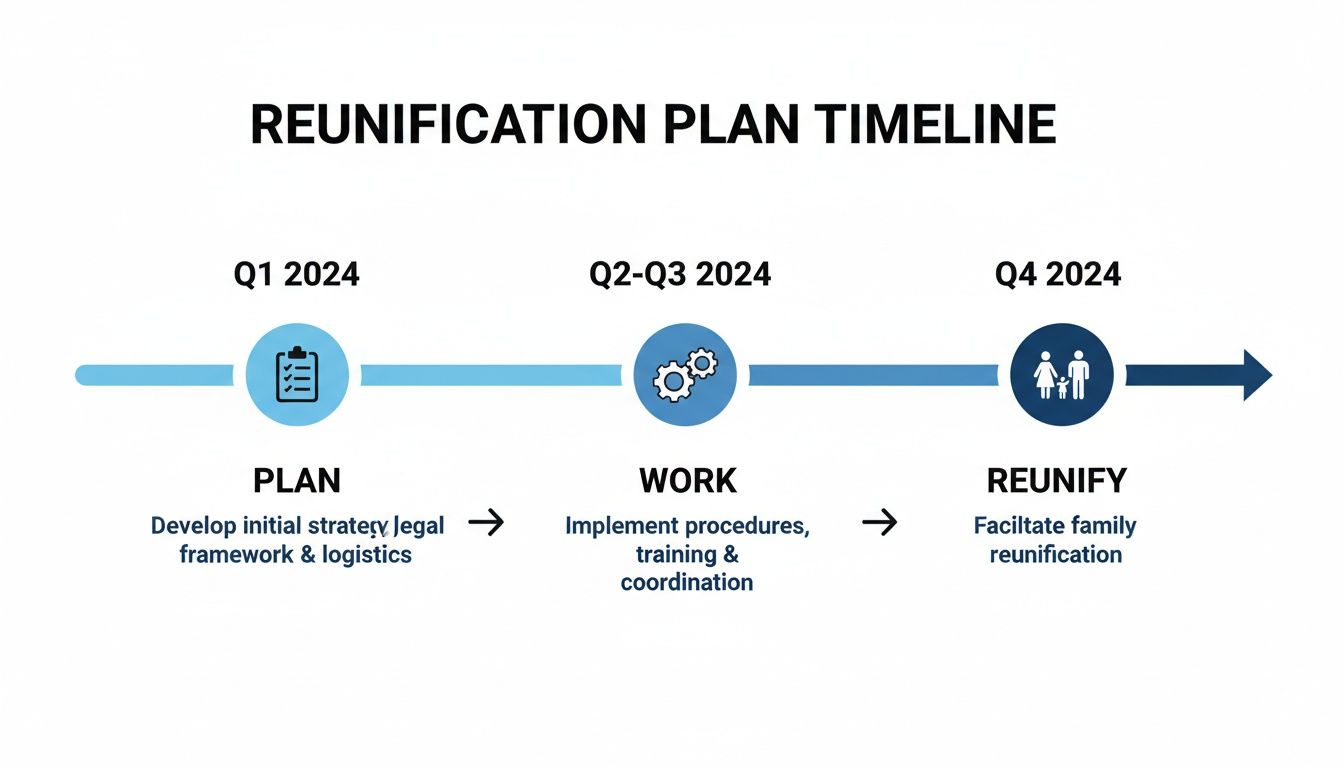
This timeline really drives home the importance of consistent effort. Every single step you take on your service plan directly contributes to the goal of bringing your family back together.
The entire journey is a high-stakes race against the clock. The court will issue temporary orders for services and visitation right at the start, and these orders are binding. Your consistent cooperation and completion of your plan—whether it’s therapy, parenting classes, or substance abuse treatment—are the most powerful evidence you have to secure reunification before that critical one-year deadline arrives. You can learn more about the legal process of intervening in a CPS case from the resources provided by TexasLawHelp.org.
The court's strict calendar isn't something you can fight; it's something you must work within. Every missed appointment and every delayed task eats away at the precious time you have. By understanding this timeline, you can use it to your advantage, stay ahead of deadlines, and show the court you are serious about bringing your child home.
How a Skilled Attorney Changes Your Case Outcome

After learning about the unforgiving timelines and demanding service plans, it's natural to feel like you're drowning. The CPS system is a confusing, fast-paced world that can feel designed to work against you. That’s why trying to handle a temporary managing conservatorship CPS Texas case by yourself isn't just difficult—it's an enormous risk to your family's future.
Let’s be clear: hiring an experienced CPS defense lawyer isn't a luxury. It’s the single most powerful step you can take to protect your family. An attorney does so much more than just appear in court. They become your shield, your strategist, and your champion in a system that too often seems to forget the human lives at its center.
Your Advocate in and Out of the Courtroom
The moment you hire an attorney, the entire dynamic of your case shifts. You're no longer a single parent standing against a massive state agency. You now have a dedicated professional fighting for your constitutional rights and holding CPS accountable to the letter of the law.
When you're facing a crisis like a CPS case, it's vital to find the right person for the job. You'll want to look for specific qualities that clients look for in an attorney to guide you through this. Your lawyer acts as a critical buffer, managing all communication with caseworkers and their attorneys. This prevents you from accidentally saying something that could be twisted and used against you later.
An experienced attorney knows the system's weak points and how to use the law to your family’s advantage. They can spot an illegally conducted interview, a poorly written service plan, or a caseworker who isn't following procedure—and they know exactly how to challenge it.
This kind of expert advocacy is priceless. For example, if your CPS case was triggered by a false allegation or a related criminal charge, your attorney can build a unified defense strategy that tackles both problems at once, ensuring one case doesn't derail the other.
Tangible Ways a Lawyer Makes a Difference
The impact of a skilled lawyer is felt at every single stage of your case. They provide specific, concrete benefits that can completely change the outcome.
An experienced lawyer will:
- Challenge CPS Evidence: At the crucial 14-day Adversary Hearing, your attorney will cross-examine the CPS caseworker, poke holes in their testimony, and present your side of the story to fight the removal from day one.
- Negotiate a Fair Service Plan: They can argue against unreasonable or unnecessary services, making sure your plan is achievable and directly addresses the original allegations—not just a generic checklist.
- Protect You During Court Dates: Your attorney will prepare you for what to expect in the courtroom, what questions you'll face, and how to present yourself as a committed, capable parent.
- Fight for More Visitation: They can file motions to increase the frequency or duration of visits with your child, because they know that maintaining the parent-child bond is absolutely essential for reunification.
Ultimately, a good attorney gives you a fighting chance. They level the playing field, make sure your voice is heard, and work tirelessly to bring your family back together.
At The Law Office of Bryan Fagan, we understand the fear and desperation you're feeling. Our team is committed to providing the compassionate, tenacious defense you and your family deserve. You don’t have to go through this alone. Call us today for a free, confidential consultation to discuss your case and find out how we can help.
Frequently Asked Questions About Texas TMC Cases
Facing a Temporary Managing Conservatorship (TMC) case is terrifying. It’s a moment where your world feels like it's spinning out of control, and you’re left with urgent, pressing questions. Here are some clear, straightforward answers to the concerns we hear most often from parents in your shoes.
Can CPS Really Take My Child Without a Court Order?
Yes, but only in a true emergency. It's called an “emergency removal,” and the law is very strict about when CPS can do this. They must have credible information that your child is facing an immediate and continuing danger to their physical health or safety.
If they take this drastic step, the clock starts ticking immediately. The law forces them to go to court within a matter of days to justify their actions at what's known as the 14-Day Adversary Hearing, as required by Texas Family Code Chapter 262.
How Long Does a Temporary Managing Conservatorship Last?
A TMC case moves fast. The law sets a firm deadline for a final trial to happen roughly 12 months after the case kicks off, according to Texas Family Code Chapter 263. A judge can grant one six-month extension, but the system is designed to find a permanent, stable home for the child within that first year.
This creates an enormous sense of urgency for parents. You have to get to work on your court-ordered services right away.
Can a Family Member Get Custody Instead of Foster Care?
Absolutely. In fact, Texas law strongly prefers placing children with relatives over putting them into the foster care system. This is what we call a "kinship placement."
It is critical for grandparents, aunts, uncles, or other close family members to step forward immediately. They need to let the caseworker know they are willing and able to help and may even need to formally intervening in a CPS case to seek conservatorship themselves.
What if I Can't Complete My CPS Service Plan?
This is a serious problem, and the consequences are significant. If you're struggling to complete your court-ordered service plan, CPS will likely argue that you aren't making enough progress and that returning your child isn't a safe option.
This can cause the agency to change its goal from reuniting your family to seeking Permanent Managing Conservatorship (PMC) or, in the worst-case scenario, the termination of your parental rights under Texas Family Code Chapter 161. It is vital that you talk to your attorney the moment you realize you're having trouble with the plan's requirements.
Navigating the complexities of a temporary managing conservatorship CPS Texas case is one of the most difficult challenges a parent can face. The fear for your child’s future can be paralyzing. But you do not have to walk this path alone. The dedicated and compassionate attorneys at The Law Office of Bryan Fagan are here to fight for you, protect your rights, and guide you every step of the way toward reuniting your family. Your family is worth fighting for. For a free and confidential consultation, contact us today.