Skip to content
The moment a Texas Department of Family and Protective Services (DFPS) caseworker physically removes your child from your home, your world stops. That knock on the door is the start of a terrifying and disorienting process. The immediate shock, fear, and confusion can feel paralyzing. For a parent, there is no greater terror.
But these first 72 hours are absolutely critical. What you do—and what you don't do—can set the entire tone for your case. This isn't the time for panic; it's the time for focused, strategic action. The clock starts ticking immediately, leading to an emergency court hearing that must happen within days. Your first goal is simple: stay calm, document everything, and call an attorney who understands how to fight for Texas families.
The First 72 Hours After a DFPS Removal
A DFPS removal in Texas kicks off when a caseworker, believing a child is in immediate danger, takes them into state custody. This initial encounter is your first chance to show you are a cooperative but informed parent. Remember, everything you say can and will be documented and used in court.
Your Rights and Actions at the Moment of Removal
When a caseworker shows up with law enforcement to remove your child, they are acting under the authority of Texas Family Code Chapter 262. This part of the law permits an emergency removal without a prior court order if they believe there's an "immediate danger to the physical health or safety of the child."
That's a high legal bar, but it can be triggered by a report that's completely inaccurate or based on a huge misunderstanding. Here’s what you need to do:
- Stay Calm and Polite: We know it feels impossible, but yelling or becoming aggressive will only be used against you. The caseworker will note it as "proof" that the home environment is unstable.
- Ask for Identification: Politely ask the caseworker and any officers for their names, titles, and business cards. Write this information down right away.
- Do Not Physically Interfere: As gut-wrenching as it is, you cannot physically resist the removal. Doing so could lead to criminal charges and will absolutely be used as evidence against you in family court.
- Ask Where Your Child is Going: You have a right to know the plan for your child. They might be placed in a foster home or, hopefully, with a relative you suggest.
Crucial Insight: Your composure during the removal is your first piece of evidence. A calm, compliant demeanor, even while you are clearly heartbroken, demonstrates that you are a parent who can handle a crisis. This creates a powerful counter-narrative to the state's claims of a dangerous home.
Document Everything Meticulously
The second that caseworker walks out your door, you need to become a world-class record-keeper. Stress will cloud your memory, so documentation is your best friend and your best defense. Grab a notebook or start a digital document immediately.
Consider a real-life scenario we've seen: A parent is accused of neglect because of a messy house during a surprise visit right after a child’s birthday party. By immediately taking time-stamped photos of the home after cleaning up the temporary clutter (like party decorations and gift wrap), they can show evidence that the "neglectful condition" was temporary and situational, not a chronic state of being.
Your documentation must include:
- The exact date and time of the removal.
- The name of the caseworker and all their contact information.
- A detailed, moment-by-moment account of what was said and done by everyone.
- The names and contact information for any family members you suggested for placement.
This proactive record-keeping is vital for the next steps. For more guidance on this initial stage, you can learn more about emergency CPS removals in Texas in our detailed article.
The Urgency of Legal Counsel
The single most important thing you can do is contact a family law attorney who has deep experience with DFPS cases—and you need to do it before your first court hearing. The clock is already ticking. An attorney can get to work immediately preparing for the Show Cause or Adversary Hearing, which has to happen within 14 days.
It’s interesting to note that while the fear of removal is immense for any parent, statewide trends have been shifting. In recent years, Texas has seen a dramatic 50% decline in the number of children removed by DFPS. This reflects a state-wide move toward providing families with services to prevent removal in the first place, rather than reacting after the fact. You can see the official DFPS removal statistics on their data portal.
The fear and helplessness you feel are completely valid, but they don't have to define your case. At the Law Office of Bryan Fagan, we're here to help you transform that fear into a powerful, legally-sound strategy for reunification. You are not alone in this fight. Contact us now for a free, confidential consultation to discuss your case and protect your family.
Preparing for Your Adversary Hearing
The Adversary Hearing is, without a doubt, the single most important day in the early life of a Texas DFPS case. It’s your first real opportunity to stand before a judge and fight for your child's return, and it happens fast—typically within 14 days of the removal.
This isn't a full-blown trial to decide your parental rights forever. The judge is focused on one critical question under Texas Family Code Chapter 262: Was DFPS right to remove your child because they were in immediate danger? If you and your attorney can show the judge that no such danger existed, they can order your child returned to you on the spot.
Who's Who in the Courtroom
Walking into that courtroom for the first time can be overwhelming. Knowing who everyone is and what they do can help you feel more in control.
- The Judge: The person in charge who makes the final decision after hearing from everyone.
- The DFPS Attorney: This is the state's lawyer. Their job is to convince the judge that your child is not safe at home and needs to stay in foster care.
- The Attorney ad Litem (AAL): The court appoints this lawyer to represent what they believe is in your child's best interest. They don't work for you or for DFPS, but for the child's safety and well-being as they see it.
- Your Attorney: This is your person. Your defender, your guide, and your advocate through this entire process.
Gathering the Evidence to Build Your Case
Simply telling the judge your side of the story isn't enough. You have to prove it. Your most important job right now, with your lawyer's help, is to collect hard evidence that directly challenges whatever reasons DFPS gave for taking your child.
For instance, say DFPS removed your child based on an anonymous, uncorroborated allegation of substance abuse. Denying it is one thing. But walking into court with a clean, voluntary hair follicle drug test from a reputable lab? That’s powerful. A single piece of paper can completely undermine the state's entire case against you.
Start gathering documents like these immediately:
- Proof of Stable Housing: A copy of your lease agreement or recent mortgage statement.
- Proof of Employment: Pay stubs showing you have a steady income to support your family.
- Witness Statements: Letters from people who know you and your child—teachers, daycare providers, neighbors, or family friends who can speak to your character as a parent.
- Important Records: Your child’s school attendance records, report cards, medical check-up summaries, or receipts showing you’ve already enrolled in services DFPS requested.
From years of experience, I can tell you that judges are moved by facts and documentation. A well-organized binder of positive evidence is far more persuasive than even the most heartfelt emotional pleas. Show, don't just tell.
This timeline gives you a sense of just how quickly everything moves in those first few days, leading right up to this hearing.
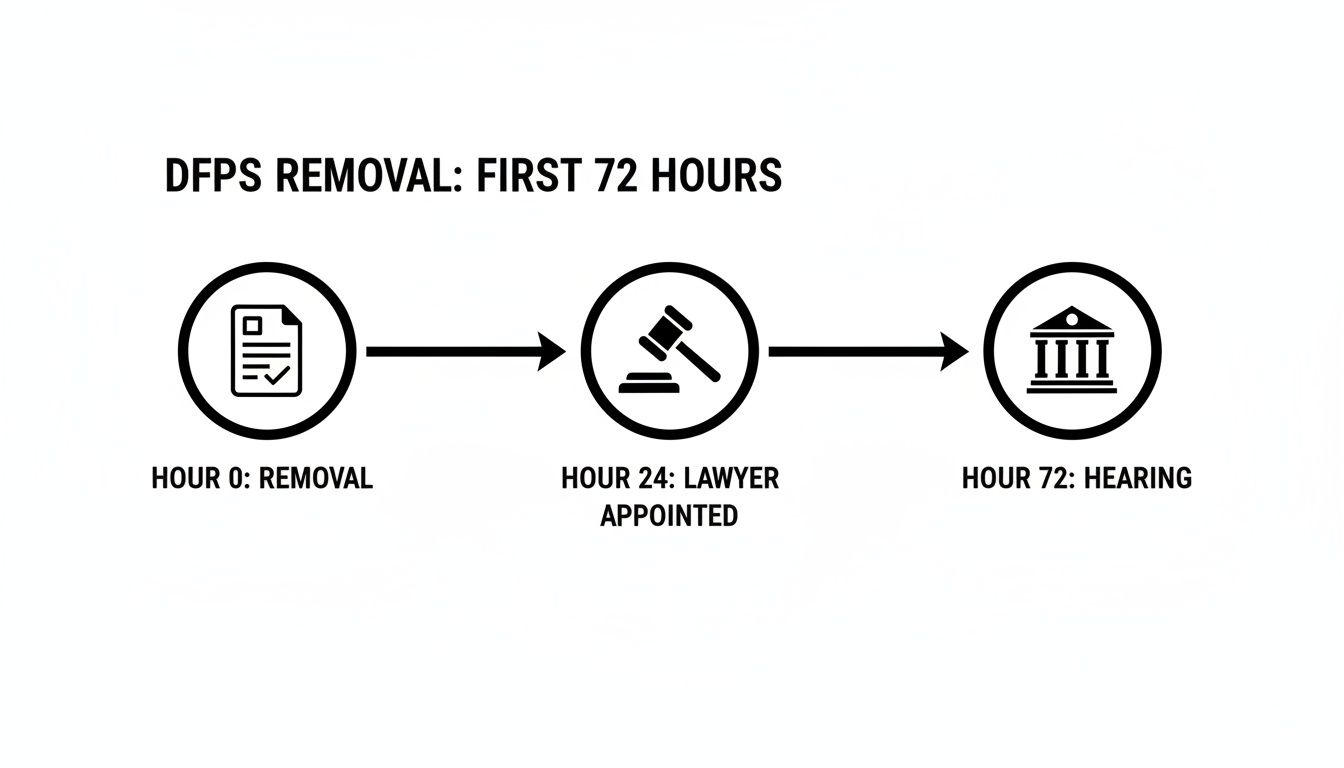
As you can see, there is no time to waste. The clock starts ticking the moment your child is removed, and getting legal help immediately is critical.
To help you keep track of the different hearings you'll face, here's a quick overview of the key court dates in a typical DFPS removal case.
Key Hearings in a Texas DFPS Removal Case
| Hearing Type | Typical Timeline | Primary Purpose | What You Should Prepare |
|---|---|---|---|
| Emergency Hearing | Within 1-3 business days of removal | To give DFPS temporary custody until the Adversary Hearing. | Your lawyer will handle most of this, but be ready to provide them with basic facts. |
| Adversary Hearing | Within 14 days of removal | To determine if DFPS was justified in removing the child. Your best chance for a quick return. | All the evidence you can gather: housing/job proof, witness letters, clean drug tests, etc. |
| Status Hearing | Within 60 days of the Adversary Hearing | The court reviews your progress on the service plan and checks on the child's well-being. | Proof of completed services (certificates, attendance logs) and continued stability. |
| Permanency Hearing | Within 180 days of removal | The court sets a long-term goal for the child: reunification, relative placement, or adoption. | A strong track record of compliance with your service plan and evidence of positive change. |
These hearings are the major milestones in your case. Being prepared for each one is essential for showing the court you're serious about getting your family back together.
How to Present Yourself in Court
Believe it or not, how you act and look in court really does matter. The judge is watching, trying to get a read on you. Be on time. Dress neatly, like you're going to a job interview.
When you speak, be calm and honest. Always address the judge as "Your Honor." Most importantly, listen to your attorney's advice. They know the judge and the system.
A strong performance at the Adversary Hearing can set a positive tone for your entire case. It can get your child home quickly or, at the very least, prove to the court that you are a credible, capable, and committed parent. For a more detailed breakdown, check out our guide on preparing for an Adversary Hearing in Texas. Preparation is your best weapon in this fight.
Executing Your Family Plan of Service for Reunification

It can feel like a punch to the gut when the judge doesn't return your child at the Adversary Hearing. We've seen that look of despair, and we understand. But this is not the end of the road. In fact, this is where your new fight begins.
The court will now order you to follow what’s called a Family Plan of Service under Texas Family Code Chapter 263. This document is your official, court-ordered roadmap to getting your children back home. Don't look at it as a list of punishments. Think of it as a series of tasks designed to prove to the court that you are a safe, stable, and committed parent. Your entire focus needs to shift to tackling every single item on this plan with everything you've got.
Breaking Down Your Service Plan Requirements
While every service plan is tailored to the specific allegations in your case, most of them contain similar building blocks. Your job is to understand what each service means and how to knock it out of the park.
You'll likely see some combination of these common requirements:
- Parenting Classes: These courses cover everything from effective discipline techniques to understanding child development.
- Individual or Family Counseling: Therapy sessions are meant to address the underlying issues that may have led to CPS involvement, like family conflict, trauma, or mental health struggles.
- Drug or Alcohol Assessment and Treatment: If there were any allegations of substance use, expect an assessment. This could lead to recommendations for AA/NA meetings or a more formal rehabilitation program.
- Home Studies: A DFPS worker will need to inspect your home to make sure it's a safe, clean, and suitable place for your child to live.
- Maintaining Stable Housing and Employment: The court needs to see that you can provide a stable foundation for your family.
The secret to success here isn’t just checking boxes. It’s about your attitude. Go into every class ready to learn. Get to know your counselors. Document everything. Every certificate you earn, every class you attend, every letter you get from a provider—this becomes a mountain of positive evidence that speaks louder than any allegation.
Proactive Communication and Meticulous Documentation
You can't just complete your services and hope the caseworker notices. You have to become your own best advocate and an expert record-keeper. Treat this like it's your job—because it’s the most important job you’ll ever have.
Here’s a real-world example we see all the time: A single dad is ordered to attend weekly therapy, but the only appointment available conflicts with his work schedule. Instead of just blowing it off, he immediately calls his attorney. The lawyer then contacts the caseworker, provides proof of the work conflict from his employer, and negotiates an alternative—finding another provider with Saturday appointments.
That simple, proactive step prevented DFPS from walking into court and claiming he was "non-compliant." This is why documentation is your shield. Keep a detailed log of every call, email, and meeting you have. For a deeper look at the nitty-gritty of these plans, you should learn more about the CPS Family Service Plan in Texas.
Challenging Unfair or Impossible Requirements
While you absolutely must comply with court orders, that doesn't mean you have to silently accept requirements that are unfair, unnecessary, or downright impossible. If your service plan has a demand you can't meet because of money, a disability, or lack of transportation, you need to speak up—and fast.
This is where your attorney steps in. They can file a motion with the court to get the plan modified. For instance, if DFPS is demanding you pay for expensive counseling that your budget can't handle, your lawyer can argue for a state-funded or low-cost provider instead. Never, ever agree to a plan you know you can't complete.
As you work through your service plan, you may also be asked to resolve disputes with DFPS through mediation. Knowing how to prepare for mediation is a skill that can dramatically change the outcome, helping you lock in agreements that are both fair and achievable.
Facing a DFPS removal case in Texas is an uphill battle, but mastering your service plan is how you start to win. At The Law Office of Bryan Fagan, we guide parents through this exact process every single day. We can help you dissect your plan, fight for reasonable requirements, and build the strongest case possible for bringing your children home where they belong. You don’t have to do this alone. Call us for a free consultation to start building your reunification strategy today.
When a CPS Case and a Criminal Charge Collide
A DFPS investigation is a nightmare. There’s no other way to put it. But when that investigation runs alongside criminal charges—like family violence, a DWI with a child in the car, or a drug possession case—the situation explodes into a legal two-front war.
Suddenly, you’re not just fighting to bring your kids home. You’re also fighting to stay out of jail.
This is, without a doubt, one of the most dangerous and complex legal battles a parent can face. Every single word you say to a DFPS caseworker can be twisted and used against you by a prosecutor in criminal court. At the same time, every detail of your criminal case will land on the desk of the judge deciding your children's future. You have to know how to protect yourself on both fronts.
The Fifth Amendment: A Double-Edged Sword
Your most powerful tool is your Fifth Amendment right to remain silent. You cannot be forced to say something that incriminates you. Simple, right? Not in this situation.
In criminal court, pleading the Fifth is standard practice. No one can hold your silence against you. But in a DFPS case, the dynamic is completely different. While it's still your constitutional right, a family court judge might interpret your silence as a sign you have something to hide. It creates an impossible choice.
This is where an attorney who understands both systems is non-negotiable. They can help you navigate this tightrope—advising you on when to talk, what to say, and when you absolutely must invoke your right to remain silent to avoid destroying one case while trying to save the other.
How One Incident Can Spark Two Fires
Let us paint a picture we see far too often. A heated argument between spouses spirals out of control. A neighbor hears shouting and calls 911. The police arrive, see marks from a physical struggle, and arrest one parent for assault family violence. Because kids were in the house, the police are required to call the DFPS hotline.
The very next day, a DFPS investigator is at the door. Citing the police report and the pending criminal charge as evidence of immediate danger, they remove the children.
Just like that, the parent is trapped in two legal nightmares at once:
- A criminal charge for assault, which carries the risk of jail time, steep fines, and a permanent criminal record.
- A DFPS removal case, where they could lose custody of their children for good.
Trying to handle one without a strategy for the other is a recipe for disaster. If you admit to the fight to show cooperation with DFPS, that can be used as a confession in your criminal case. On the other hand, if you plead guilty to the criminal charge just to make it go away, DFPS will use that plea as ironclad proof that you are a dangerous parent.
Key Takeaway: You don't just need a legal strategy; you need an integrated one. Your legal team has to manage both cases as a single, coordinated defense. The goal is a global resolution that protects both your freedom and your family.
When a DFPS case runs parallel with criminal charges, having a grasp of criminal defense is crucial. It helps you understand the stakes and the strategies needed to defend your rights across the board.
Coordinating Your Defense for a Global Resolution
So, how do you fight a war on two fronts? With a unified command. Your legal team must control the flow of information, coordinate court dates, and ensure your legal strategy is cohesive.
This is especially true when a Protective Order enters the picture. A criminal court might issue an order that bans you from contacting your partner or even going back to your own home. This creates a direct conflict with the DFPS goal of reunification, which almost always involves things like joint counseling sessions or maintaining a stable home for the children. Your attorney has to fight in both courtrooms to resolve these conflicts and create a path forward.
It’s also important to know that these cases don’t happen in a vacuum. The Texas child welfare system is constantly in flux, and those trends impact how judges and caseworkers handle intertwined criminal and CPS actions. Data shows that even when kids go home, the risk of re-entry into the system is high. For a firm like ours, these statistics shape every decision we make—from bail hearings to permanency hearings—as we work to reunify your family and keep it that way.
If you are facing the dual crisis of a criminal charge and a DFPS removal, do not try to go it alone. The stakes are simply too high. Our team at The Law Office of Bryan Fagan has deep experience in these complex, overlapping cases. We know how to build a unified defense that protects your rights in both the family and criminal justice systems.
Facing Termination of Parental Rights and the Appeals Process
Hearing the words "termination of parental rights" from DFPS is, without a doubt, the most gut-wrenching moment a parent can experience in a CPS case. It feels like the floor has vanished from beneath your feet. While reunification is always the starting goal, some cases do reach this final, devastating stage.
This is where the state, guided by Texas Family Code Chapter 161, attempts to permanently and legally sever the bond between you and your child.
The weight of that is immense, but we need you to understand this: termination is not a foregone conclusion. The law puts an incredibly high burden of proof on DFPS. They have to prove their case by "clear and convincing evidence"—a much higher and more difficult standard to meet than anything else they’ve brought forward in your case up to this point.
The High Legal Bar for Termination
For a judge to terminate your parental rights, the DFPS attorney is required to prove two very specific things.
First, they must show that at least one of the statutory grounds for termination exists. These are laid out in Texas Family Code § 161.001 and include things like endangering the child, failing to follow your court-ordered service plan, or what the law calls constructive abandonment.
Second, they must prove that termination is in the child’s best interest. This is a more subjective standard, but it forces the court to look at the total picture and decide if a child is truly better off having their legal relationship with you erased forever. It's your attorney's job to fight them on every single one of these points.
The Right to Appeal a Judge's Decision
Even if a judge rules against you and orders termination, it doesn't have to be the end of the road. You have a constitutional right to appeal that decision to a higher court.
An appeal is not a "do-over" trial; you can't present new evidence. Instead, your appellate attorney argues that the trial judge made a legal error so significant that it changed the outcome of your case.
But you have to act fast. There are very strict deadlines, and you typically have only 20 days from when the judge signs the final order to file a Notice of Appeal. If you miss this window, you lose your right to appeal forever.
I want to be perfectly clear: an appeal is an uphill battle. But it is a fight worth having. We have seen cases where dedicated, sharp appellate work has successfully overturned a termination order, giving a family the second chance they deserved. Hope is not lost, even after a devastating ruling.
This final stage of a DFPS case is where the stakes are highest. These proceedings are often the culmination of months, or even years, of investigations into allegations of neglect or abuse. The state takes these risks incredibly seriously, as tragically highlighted by data on child fatalities in Texas. The same data, which is influenced by ongoing policy changes, also tracks the risk of re-abuse for children who leave state care, underscoring the immense pressure on courts to get this final decision right. You can discover more about how policy and data intersect in Texas child welfare on aei.org.
After Reunification: Sealing Your CPS Records
For the many families who do successfully navigate this process and reunify, the end of the case is a wave of pure relief. But the shadow of the investigation can hang over you for years.
Thankfully, Texas law provides a path forward. After a certain amount of time has passed, you may be eligible to have your CPS records sealed or even expunged.
This process allows you to formally close this painful chapter and move on without the stigma of a DFPS file following you around. It is a critical step in your family’s healing journey, allowing you to rebuild your life with the privacy and peace you've earned.
A DFPS case, especially one that gets to the termination stage, is an emotional and legal marathon. We've seen families emerge resilient and whole from the darkest moments. The journey is hard, but it is not one you have to walk alone.
If you are facing the threat of termination or need to understand your options for an appeal, your next step is critical. The Law Office of Bryan Fagan is here to provide the compassionate, expert legal defense you need. Contact us today for a free, confidential consultation to protect your parental rights and fight for your family’s future.
Common Questions About Texas DFPS Removal Cases

When your family gets pulled into the DFPS system, the questions can feel like a tidal wave. It’s a terrifying and confusing time. We want to cut through the noise and give you clear, straight answers to some of the most common worries we hear from parents right after a removal in Texas.
Getting a handle on your rights and the road ahead is the first step toward bringing your family back together.
Can I Refuse to Let a DFPS Caseworker into My Home?
Yes, you absolutely have a constitutional right to refuse entry to a DFPS caseworker if they don’t have a court order or a warrant. But how you play this moment is critically important.
The key is to be polite and calm. Simply state that you are not comfortable with a search until you've had a chance to speak with an attorney. You can offer to talk with them on your front porch or agree to meet them at their office later. This protects your family’s privacy while showing you’re willing to cooperate, not obstruct.
Key Insight: Protecting your rights doesn't mean you have to be confrontational. Politely asking to speak with an attorney before letting a caseworker in isn't obstruction—it's you exercising your legal rights. It's a smart, strategic move that shows you're taking the situation seriously.
The single most important thing you can do in this situation is to call a lawyer immediately. Your attorney can then step in and communicate directly with the caseworker on your behalf.
How Long Will My DFPS Removal Case Take in Texas?
The timeline for a DFPS case can vary a lot. Under Chapter 263 of the Texas Family Code, the law sets a hard deadline to reach a final decision within 12 months from the day your child was removed. A judge can grant one six-month extension if it's in the child's best interest, pushing the absolute maximum to 18 months.
How long your specific case takes really boils down to the allegations and, more importantly, how consistently you work on your court-ordered service plan. I've seen straightforward cases resolve in just a few months when a parent is proactive and knocks out every task. On the other hand, more complex cases, especially those with related criminal charges, often run the full 12 to 18 months.
What Happens if I Don't Complete My DFPS Service Plan?
Failing to complete your Family Plan of Service—or even just failing to make a good faith effort—is one of the most damaging things you can do. You can be sure that DFPS will use any non-compliance as evidence to argue that returning your child home is not a safe option.
This can lead a judge to extend the case or, in the worst-case scenario, move toward terminating your parental rights. If you’re struggling with a requirement—whether it's because of money, scheduling, or transportation—you have to tell your attorney immediately. Your lawyer can ask the court to modify the plan or help you find resources before it turns into a major problem.
Will DFPS Place My Child With a Relative?
Yes, and this should be your number one goal if your child can't come home to you right away. Texas law has a very strong and clear preference for placing children with relatives, a practice known as kinship care. In fact, DFPS is legally required to search for and evaluate suitable family members.
Thankfully, recent changes in state policy have made it even easier for relatives to become kinship foster parents by cutting through a lot of the old administrative red tape. This is a huge win for Texas families.
The second your child is removed, you need to give your caseworker and your attorney a detailed list of every possible relative who could provide care. Think grandparents, aunts, uncles, or even close family friends who are like family. Providing names, phone numbers, and addresses is the best way to keep your child out of the traditional foster system and safe with people they know and love.
The legal labyrinth of a DFPS removal case is fraught with questions and fear. You don't have to find the answers by yourself. The experienced and compassionate attorneys at the Law Office of Bryan Fagan are here to guide you, protect your rights, and fight for your family's reunification. Contact us today for a free, confidential consultation to start building your defense.