Skip to content
The moment your heart drops—seeing your name attached to an active warrant in Houston, TX—is a terrifying experience for any parent. The wave of fear and confusion is immediate, especially when you think about what it could mean for your children and your family's future. An active warrant is a legal order from a judge giving law enforcement the authority to arrest you, but it’s crucial to remember it's not a final judgment of guilt. It's the beginning of a process, and you have the right to defend yourself.
The Moment Your World Stops: Finding a Warrant in Houston

The instant you find out there’s a warrant for your arrest, it can feel like the ground has crumbled beneath you. The rush of anxiety is overwhelming as your mind races, thinking about how this could impact your job, your children, and your entire future. We've seen firsthand the paralyzing dread this moment brings to Texas families, particularly those already dealing with the stress of a CPS case.
This is exactly why you need to hold on to one critical fact: a warrant is the beginning of a legal process, not the end. It simply means you're being accused of something, which also means you now have the opportunity to tell your side of the story and defend yourself. Taking back control starts with understanding the system, knowing your rights, and realizing you don’t have to face this alone.
Understanding the Scope of Warrants in Harris County
The challenge of managing warrants is a massive issue in our community. The Harris County justice system is grappling with a staggering backlog of arrest warrants, a situation that underscores just how urgent the need for skilled legal defense really is. This isn't just some minor administrative headache; these are serious allegations with people's futures hanging in the balance.
An investigative report recently revealed a shocking statistic: 706 individuals charged with murder had open arrest warrants just sitting in the system. To put the scale of the problem in perspective, in 2021, fewer than 10% of people with outstanding warrants were arrested each month.
This reality shows just how easily a warrant can stay active for years, creating a constant cloud of stress over your head. Whether it stems from a forgotten traffic ticket, a missed court date, or a much more serious accusation, its existence is a continuous threat to your freedom. It's also vital to understand what kind of warrant you're dealing with, as they aren't all the same. For instance, you might want to learn more about a capias warrant and what sets it apart from other court orders.
Ultimately, the most powerful thing you can do right now is get professional legal help. An experienced attorney can cut through the panic, offer a calm and steady perspective, and start building a strategic plan to tackle the warrant head-on. This is your first—and most effective—step toward protecting yourself and your family.
Decoding the Different Types of Warrants in Texas
When you're dealing with the legal system, words have very specific, powerful meanings, and "warrant" is a perfect example. Understanding that not all warrants are created equal is the very first step toward figuring out your next move. In Houston, you’ll most likely run into one of three main types, each with its own trigger and its own set of rules.
Think of it like different keys for different doors. One key might give police the authority to make an arrest, while another only allows them to search a specific room. Knowing which key the authorities are holding is absolutely critical.
The Arrest Warrant
The arrest warrant is the one most people think of first. It’s a direct order from a judge giving police the green light to take a specific person into custody. This isn't something that happens on a whim; an officer must first go to a judge and present solid evidence showing there is probable cause to believe a particular person committed a crime.
For example, say a heated argument between neighbors boils over, and one person accuses the other of assault. The police can't just make an arrest based on the accusation alone. They'll investigate, gather witness statements, and put everything into a sworn statement—an affidavit—for a judge to review. If the judge agrees there's enough there to suspect a crime took place, they'll sign an arrest warrant. That piece of paper now legally empowers any officer in Texas to arrest the person named on it.
The Bench Warrant
A bench warrant is a different animal because it comes straight from "the bench"—meaning, the judge themselves. These are almost always issued when someone disobeys a direct court order. By far, the most common reason for a bench warrant is a Failure to Appear (FTA) for a scheduled court date.
Here’s a situation anyone can imagine. You get a speeding ticket in Harris County, fully intending to deal with it, but life gets in the way and you completely forget the court date. When your name is called and you're not there, the judge can immediately issue a bench warrant for your arrest. It doesn’t matter that the original offense was minor; the warrant is for ignoring the court. You can learn more about how a Failure to Appear can lead to a warrant and the serious trouble that follows.
Here's the critical takeaway: a bench warrant can instantly turn a simple traffic ticket or a missed court hearing for a misdemeanor into a situation where you could be arrested on the spot during a routine traffic stop. This is why you can never ignore a court-ordered appearance.
The Search Warrant
Last but not least, a search warrant doesn't authorize an arrest at all. Instead, it gives law enforcement the right to search a specific place for evidence of a crime. Just like an arrest warrant, an officer has to convince a judge there is probable cause to believe that evidence tied to criminal activity will be found at the location they want to search.
A search warrant has to be incredibly specific. It will clearly spell out:
- The exact address or a detailed description of the property to be searched.
- The specific items or types of evidence police are allowed to look for.
- The timeframe in which the search has to happen.
If police suspect stolen electronics are stashed in a particular storage unit in Houston, they can’t just kick the door in. They have to lay out their evidence for a judge, who might then issue a search warrant for that specific unit, detailing that they are looking for stolen electronics. Officers are legally handcuffed to the terms of that warrant.
Types of Warrants in Houston at a Glance
To make it even clearer, let's break down the key differences in a simple table. Seeing them side-by-side helps illustrate how each warrant serves a very different purpose.
| Warrant Type | Common Reason for Issuance | What It Authorizes Police to Do |
|---|---|---|
| Arrest Warrant | A judge finds probable cause that a person committed a crime. | Take the named individual into custody (arrest them). |
| Bench Warrant | A person fails to obey a court order, most often by missing a court date. | Arrest the individual for contempt of court or failure to appear. |
| Search Warrant | A judge finds probable cause that evidence of a crime is at a specific location. | Search a designated property for specific items listed in the warrant. |
Knowing which type of warrant you might be facing is the foundation of any defense strategy. The approach for handling a bench warrant for a missed traffic court date is worlds away from the strategy needed to challenge a search warrant in a major criminal investigation. Your first step is always to understand exactly what you're up against.
How to Safely Check for Warrants in Houston
The feeling is unmistakable—a knot in your stomach, a constant sense of looking over your shoulder. The thought that there might be a warrant out for your arrest is enough to rob you of sleep and fill your days with anxiety. Finding out for sure is the only way to move forward, but how you go about it is absolutely critical.
This isn't the time to walk into a police station and just ask. That’s a rookie mistake with serious consequences. This is a moment that calls for a careful, strategic plan to protect your freedom.
Luckily, you don't have to put yourself at immediate risk to check for warrants in Houston, TX. The key is using official channels from a safe distance or—better yet—having a legal professional do the digging for you. This approach puts you back in the driver's seat, letting you plan your next steps instead of getting caught completely off guard.
Using Online Public Portals
For many non-felony warrants, a good first step is checking the online search tools provided by Harris County and the City of Houston. These portals can give you quick answers, especially for things like old traffic tickets or less serious misdemeanor cases.
- Harris County Justice of the Peace Courts: This is the place to search for warrants tied to Class C misdemeanors, like traffic violations, that are handled at the JP level.
- Harris County Criminal Courts at Law: Here, you can look for information on more serious Class A and B misdemeanors. The online records will often show if a warrant has been issued in a pending case.
- City of Houston Municipal Courts: If you're worried about city-level offenses—think unpaid parking tickets or other municipal code violations—their website has a dedicated search function for active warrants.
While these tools are a solid starting point, they don't tell the whole story. Newly issued warrants might not show up right away. And, most importantly, felony warrants are almost never listed publicly online. Law enforcement keeps those under wraps to avoid tipping off people wanted for serious crimes.
Why You Must Never Ask the Police Directly
If there's one piece of advice you take away from this, let it be this: never, under any circumstances, go to a police station to ask if you have a warrant. It might feel like the most direct path to an answer, but it's an incredibly risky gamble.
If you walk up to that front desk and an active warrant for your arrest pops up on their screen, the officers are legally required to arrest you on the spot. There’s no discussion. No chance to call a lawyer. No opportunity to go home and get your affairs in order. You will be handcuffed, booked into jail, and any control you had over the situation will be gone in an instant.
The smartest, safest path forward is to have an attorney make these inquiries for you. An experienced lawyer can discreetly contact the Harris County District Clerk's office or other relevant agencies to confirm if a warrant exists—including those sensitive felony warrants—without ever revealing your location or plans.
This professional buffer is essential. It shields you from a surprise arrest and allows your attorney to immediately start building a strategy, like arranging for a voluntary surrender and getting a bond set in advance.
The Texas legal system is a complicated and constantly shifting machine. Houston's warrant process is tangled up in broader judicial trends, with both civil and criminal filings on the rise, making the role of a criminal defense lawyer more crucial than ever. Recent statewide data revealed a 16% jump in new civil filings, pushing them to an all-time high and showing just how slammed our courts are. In this environment, a warrant for a minor issue can quickly spiral out of control if you don't have precise guidance. You can learn more about the scale of the Texas judicial system from the Texas Judiciary’s FY2023 Annual Statistical Report.
I Have a Warrant. What Should I Do Right Now?
That gut-wrenching moment you discover there's a warrant out for your arrest feels like the floor has dropped out from under you. Your first instinct might be to panic. Or maybe you'll try to ignore it, just hoping it somehow vanishes on its own.
But let me be direct: the choices you make in the next few hours and days are absolutely critical. They will shape what happens to your freedom, your family, and your future. The single most important first step is to stay as calm as possible and call an experienced criminal defense attorney before you do anything else.
This is not a time for guesswork or wishful thinking. A lawyer acts as your shield, your guide, and your advocate, preventing a potentially traumatic and very public arrest. Instead of waiting for that dreaded knock on your door or getting pulled over during a routine traffic stop, your attorney can arrange a controlled, dignified process to handle the warrant.
This process is often called a "walk-through" or a pre-arranged surrender, and it's coordinated entirely by your legal team. It transforms a frightening, unpredictable event into a scheduled, orderly procedure.
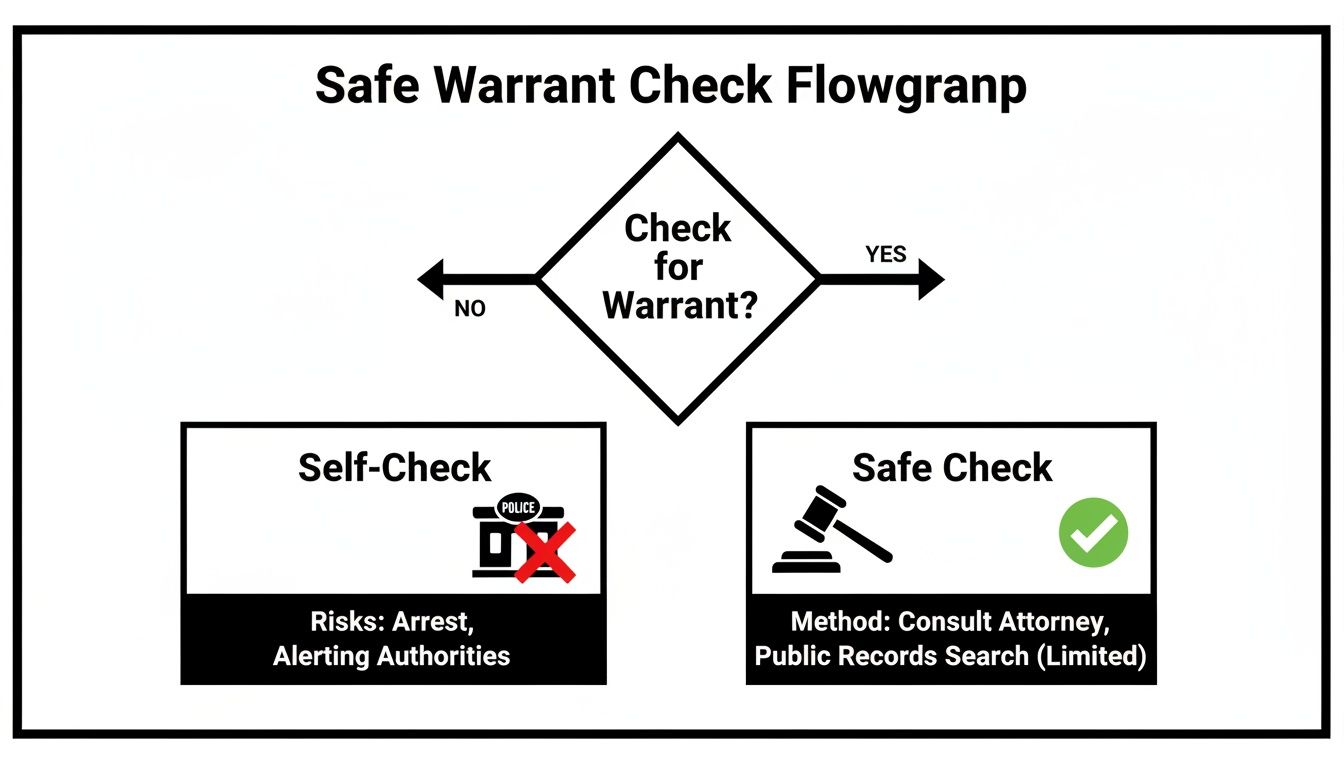
As you can see, the path forward is clear. While checking for a warrant on your own might seem like the quickest route, it carries the massive risk of an immediate arrest on the spot. Bringing an attorney into the loop first is the only way to ensure your safety and give you strategic control right from the start.
The Power of a Pre-Arranged Surrender
Picture this: you're at your kid's school play, in the middle of an important meeting at work, or just having dinner with your family when police show up to arrest you. The humiliation and fear of that moment can be absolutely devastating. A walk-through completely avoids this kind of public spectacle.
Your attorney will contact the authorities on your behalf to schedule a specific time for you to turn yourself in. This gives you time to get your affairs in order, arrange for childcare, and mentally prepare. You walk into the courthouse or jail on your own terms—not in handcuffs in front of your neighbors. This simple act immediately sets a more respectful tone for your entire case.
Navigating the Bail and Bond Process in Harris County
Once you've surrendered, the next immediate goal is getting out of jail so you can fight your case from the outside. This is where the bail and bond process comes in. Bail is simply the amount of money the court requires to ensure you’ll show up for future hearings. Your attorney's role here is invaluable.
Even before you turn yourself in, a skilled lawyer can start working to get a bond pre-arranged. They can advocate with the judge for a reasonable bond amount by presenting you as a responsible member of the community who isn't a flight risk. This proactive step can dramatically shorten the time you spend in custody, sometimes cutting it down to just a few hours.
An attorney will explain your options clearly:
- Cash Bond: This means paying the full bail amount directly to the court.
- Surety Bond: You pay a fee (usually 10% of the total bail) to a bail bondsman, who then posts the full amount on your behalf.
- Personal Recognizance (PR) Bond: In some cases, a judge might release you on your word alone, with no money required. A good attorney can argue for this highly favorable outcome.
The justice system in Houston is massive. It processes an incredible number of cases, many of which are kicked off by warrants in Houston, TX. Just to give you a sense of the scale, Texas data shows that from mid-2011 to late 2025, over 335,000 people faced criminal charges that led to 222,000 convictions for all sorts of offenses, from assault to drug crimes. You can see the broad warrant-driven enforcement patterns in the data from the Texas Department of Public Safety. With that kind of volume, you need an advocate who can make your case stand out.
Getting out on bond is about more than just comfort; it's about being able to build a strong defense. It allows you to keep working, support your family, and work closely with your legal team. Knowing the right questions to ask a criminal defense lawyer from the very first conversation is key to finding the right person to guide you through this. Taking these immediate, strategic steps puts you back in control and ready to face what's ahead.
Building Your Defense Against a Warrant and Charges

That heart-stopping moment when you find out there’s a warrant with your name on it is terrifying. But it's critical to take a deep breath and understand what a warrant actually is—and isn't. A warrant is not a conviction. It’s simply the starting pistol for a legal battle. It means the state has pointed a finger; now, it’s your turn to build a defense and protect your future.
This is exactly when a sharp Houston defense attorney becomes the most important person on your team. Their first job is to start dismantling the state's case, brick by brick, beginning with the warrant itself. A real defense doesn't just kick in at trial—it starts the second you hire a lawyer.
Challenging the Warrant Itself
One of the first places a good attorney looks is at the warrant's validity. For any warrant to be legal, it has to be built on a solid foundation of probable cause, backed up by a sworn statement called an affidavit. This document is what law enforcement gave the judge to convince them your arrest was necessary.
If that foundation is shaky, the whole case can come tumbling down. An experienced lawyer will pour over that affidavit, hunting for any crack or flaw, like:
- Evidence that’s just too thin to establish probable cause.
- False or misleading statements made by the officer in the report.
- Information that came from an unreliable informant.
If your attorney finds any of these problems, they can file a motion to quash the warrant. This is a formal request to the judge to throw the warrant out. If it works, it can get key evidence suppressed or, in some cases, get the entire case dismissed before it even gets rolling.
A Relatable Scenario
Think about a Houston parent caught in the middle of a messy CPS investigation. A simple misunderstanding during an interview gets twisted around in the final report. Based on that one flawed piece of information, a warrant is issued. That parent feels trapped, thinking the system has already decided they’re guilty.
But this is where a defense attorney changes the game. They can get a copy of that affidavit and show the court how the warrant was built on a misinterpretation, not hard facts. By clearing up the situation and attacking the weak basis for the warrant, an attorney can work to get the whole thing resolved, protecting the parent's record and keeping their family intact.
Beyond the Warrant: Evidence and Negotiation
Even if the warrant itself is rock-solid, the fight is far from over. Your attorney’s focus will then pivot to the evidence connected to the actual criminal charges. They'll scrutinize how evidence was gathered, attack the credibility of witnesses, and make sure none of your constitutional rights were stepped on along the way.
Your defense attorney is also your chief negotiator with the Harris County District Attorney's Office. Prosecutors are juggling hundreds of cases at a time. A lawyer who shows up prepared can tell your side of the story in a powerful way, pointing out the holes in the state’s case to push for a dismissal or a major reduction in charges.
When building your defense against warrants in Houston, TX, hiring the right law firm is your first and most important move. It’s also wise to understand their approach to service; knowing how a firm handles client communication can tell you a lot about their dedication to your case.
Protecting Your Future After a Successful Outcome
Winning your case doesn't always mean the story is over. The arrest and charges can hang around on your record, popping up on background checks for years and costing you jobs or housing. Your attorney can help you take the final steps to truly leave it all behind.
Two of the most powerful tools for this are:
- Expunction: This process essentially vaporizes the records of an arrest and charge, making it like it never happened.
- Nondisclosure: This seals your record from public view, meaning most private employers will never see it.
Getting a good result on the warrant and the charges is the main battle. Taking that last step to clear your name for good is how you truly win the war and get your future back.
Let Us Help You Navigate This Difficult Time
Facing a warrant is a genuinely frightening experience, but it’s a challenge you don't have to navigate on your own. If you take anything away from this guide, let it be this: act quickly, get professional legal advice, and know that a positive resolution is absolutely within reach. Your freedom and your future are far too important to leave up to chance.
Here at The Law Office of Bryan Fagan, our team has spent years defending clients against criminal charges right here in Houston and across Texas. We’ve seen firsthand the immense stress an active warrant can put on a person, especially when their family's well-being is hanging in the balance.
Your Dedicated Legal Partner
We're here to listen to your side of the story without judgment. Our job is to protect your constitutional rights every step of the way and build a powerful strategy aimed at safeguarding your family and your future. We are committed to giving you clear, honest communication and unwavering support from the moment you pick up the phone. When you're in a situation like this, knowing how a firm handles its clients is crucial; solid law firm client communication strategies are the mark of a well-run, client-first practice. We make it a priority to be accessible and responsive to you throughout this entire difficult process.
Take that first step toward getting some peace of mind and taking back control of your life. Don't just wait for law enforcement to show up at your door. An arrest can happen at any time, but building a proactive defense can completely change the outcome.
Contact our office today for a free, confidential consultation to talk about your situation. Let us show you how we can help you start moving forward with confidence.
Got Questions About Houston Warrants? We Have Answers.
When you're staring down the possibility of an active warrant, your mind can feel like it's running a marathon. Questions pop up faster than you can answer them, and the anxiety can be overwhelming. Getting clear, straight answers is the first step toward getting a handle on the situation and making a solid plan. Here are some of the most common concerns we hear from families dealing with warrants in Houston, TX.
Think of this as your immediate briefing. Understanding these key points can help you feel a little less in the dark and a lot more in control.
How Long Does a Warrant Stay Active in Texas?
This is a huge question, and the answer is simple but serious: a warrant in Texas never expires. It stays active indefinitely until one of two things happens: you are arrested, or a judge formally recalls or withdraws it.
That means a warrant from years ago—maybe for something you've completely forgotten about—can pop up and turn your life upside down at any moment. It won't just fade away with time. This is exactly why it's so critical to deal with it head-on instead of just hoping it disappears.
Can I Be Arrested for a Warrant During a Routine Traffic Stop?
Yes, absolutely. In fact, this is one of the most common ways people discover they have an outstanding warrant and end up in handcuffs. When an officer pulls you over for something as simple as speeding or a broken taillight, running your driver's license is standard procedure.
If an active warrant flags their system, that traffic stop instantly escalates into an arrest. The officer is legally required to take you into custody right then and there, no matter what the original reason for the stop was. It can be a shocking and deeply embarrassing experience, especially if you have your family in the car with you.
What Happens if I Have a Warrant for an Old Traffic Ticket?
It's a huge mistake to brush off a warrant for an old traffic ticket as "no big deal." Those unpaid tickets can quickly lead to a bench warrant, which then triggers a hold in the Omni system.
An Omni hold is a real problem. It can block you from renewing your driver's license or vehicle registration, creating a domino effect of issues in your daily life. The best move is to let an attorney handle it. They can often resolve both the warrant and the ticket—sometimes without you ever having to step into a courtroom—and save you from a needless arrest over a minor violation.
Will a Warrant Show Up on a Background Check?
An active warrant can show up on a deep-dive criminal background check. But what's more certain is that the arrest that eventually comes from that warrant absolutely will.
This can create long-term headaches, potentially blocking your ability to:
- Land a new job
- Rent a house or apartment
- Get professional licenses
- Qualify for certain loans
The only way to start cleaning this up is to address the warrant and the original charge. Depending on how that case is resolved, you might be able to pursue an expunction or have the record sealed later on. But taking care of the warrant is always the first, non-negotiable step on that path.
The fear and unknown that come with a warrant are immense, but you don't have to figure this out on your own. At The Law Office of Bryan Fagan, PLLC, our compassionate and experienced attorneys are here to protect your rights and walk you through every step toward the best possible outcome. Take that first step toward getting your peace of mind back and contact us for a free, confidential consultation. Let us help you put this behind you for good.