Skip to content
The moment you find out there’s a warrant for your arrest, your world can feel like it's tilting on its axis. That feeling of panic—the sudden, cold fear of what this means for your job, your freedom, and most frighteningly, your children—is overwhelming. If you're a parent, especially one already navigating the complexities of a CPS case, discovering a capias charge can feel like a nightmare.
Let's be clear from the start: a capias charge isn't a new criminal offense. It's a court order for your arrest, usually triggered because you missed a court date or didn't follow a judge's instructions. That sounds serious, and it is, but understanding what you're dealing with is the first step toward getting it resolved and protecting your family. This guide is here to provide the clear, reassuring guidance you need right now.
Texas Capias Charge: How It Affects Your Family
The moment you learn there’s a capias warrant out for you is often terrifying. It might be a notice in the mail you almost threw away, or worse, a shocking discovery during a routine traffic stop. The fear hits you instantly: What does this mean for my kids? Who will take care of them if I'm arrested? If CPS is already involved, will they use this against me to take my children away?

That sinking feeling is a completely normal reaction. The key thing to remember, though, is that a capias warrant is fundamentally different from an arrest warrant for a new crime. Think of it as the court's way of saying, "We need you to show up, and this is how we're going to make sure it happens." It’s a procedural issue that has escalated, not a new accusation against your character.
Why Courts Issue These Warrants
A judge doesn't issue a capias on a whim. It happens for specific reasons, almost always stemming from a failure to follow through on a legal obligation. These orders are surprisingly common. In Texas alone, courts issued roughly 215,000 capias warrants in a single recent year, many for simple misdemeanors or even traffic tickets. You can learn more about the history and technical definitions of these warrants on study.com.
The most common triggers for a capias warrant include:
- Failing to Appear (FTA): This is the big one. If you miss a scheduled court date, a judge can issue a capias to have you brought in.
- Unpaid Fines or Fees: Ignoring court-ordered fines can lead to a specific type of capias aimed at collecting that payment.
- Violating Probation: If you don't stick to the terms of your probation, like skipping a meeting with your officer, a capias can be issued. This is especially dangerous in a CPS case, as it can be framed as an inability to follow court orders.
A Relatable Scenario for Texas Parents
Picture a single mom, Maria, who is already working hard to comply with a CPS safety plan. A few months ago, she got a speeding ticket. Between juggling work, parenting classes, and visits with her two kids, the court date completely slipped her mind. One afternoon, an officer is at her door, explaining she has a warrant out for her arrest because she failed to appear. Maria is horrified, her mind racing with one thought: CPS will find out about this and say I’m an unfit parent. Who will pick up my kids from school?
This situation, while frightening, is fixable. Maria’s problem isn't a new crime; it's an unresolved legal issue that has gotten more serious. By understanding this, she can move from panic to problem-solving. A capias is a serious matter that needs your immediate attention, but it’s absolutely a situation you can navigate and resolve with the right legal help, protecting your family and your CPS case in the process.
Decoding a Texas Capias: What Kind of Warrant Are You Facing?
When you hear the term “capias warrant,” it’s easy to feel a knot in your stomach. It sounds serious because it is. But just like not all illnesses require the same medicine, not all capias warrants are issued for the same reason. Figuring out which type has your name on it is the first and most critical step toward resolving the problem and explaining it to a CPS caseworker.
Think of it this way: a capias is like getting a final-notice letter from the court, but this one comes with the threat of arrest. The specific type of capias tells you exactly what the original issue was about and why things have escalated to this point. For parents involved with CPS, being able to clearly articulate what happened is crucial to preventing misunderstandings.
Common Types of Texas Capias Warrants
Let's break down the most common warrants we see in Texas and what triggers them.
The Capias Pro Fine
This is probably the most frequent type of capias issued across the state. A Capias Pro Fine is the court’s way of collecting unpaid debts. It’s issued when you’ve already been found guilty of something—often a traffic ticket or a low-level misdemeanor—and have failed to pay the court-ordered fines, fees, or other costs.
Imagine you got a speeding ticket, agreed to a payment plan with the court, and then life got in the way and you missed a few payments. A judge can issue a Capias Pro Fine to have you arrested and brought in to settle that unpaid balance. It’s the court’s ultimate collection tool.
The Capias on Indictment or Information
This type of capias is much more serious because it marks the formal beginning of a criminal case against you. A Capias on Indictment is issued after a grand jury has reviewed evidence and decided there’s enough probable cause to charge you with a felony.
Similarly, a Capias on Information is used for misdemeanor charges filed directly by a prosecutor. In either situation, this warrant is an order for law enforcement to find you, arrest you, and bring you before the court for your first official hearing, called an arraignment. It's the starting gun for the entire court process.
The Capias for Failure to Appear (FTA)
Here’s another incredibly common one. If you were arrested, released on bond, and then simply missed a mandatory court date, the judge will almost certainly issue a capias for your arrest. This isn't just about forgetting an appointment; from the court's perspective, it's a direct defiance of a court order.
This warrant also comes into play if you violate other conditions of your bond, which can be similar to breaking the rules of probation. You can learn more about those kinds of requirements in our guide on how probation works in Texas.
Types of Texas Capias Warrants Explained
This table compares the common types of capias warrants issued in Texas, explaining what triggers them and what they mean for you.
| Type of Capias | Reason for Issuance | Common Scenario |
|---|---|---|
| Capias Pro Fine | Failure to pay court-ordered fines or costs after a judgment. | You missed payments on a traffic ticket fine you agreed to pay. |
| Capias on Indictment | A grand jury has formally charged you with a felony. | You're being formally charged with a serious crime and must appear in court. |
| Capias on Information | A prosecutor has formally charged you with a misdemeanor. | A less serious criminal charge has been filed, requiring your court appearance. |
| Capias for FTA | You missed a required court date after being released on bond. | You were out on bail for a DWI and didn't show up for your hearing. |
Understanding which type of capias you’re facing is key. In a CPS case, the difference between a capias for an unpaid ticket and one for a new felony charge is monumental. Each one requires a slightly different strategy to resolve it and to protect your parental rights under Texas Family Code.
While these legal tools are used globally, the sheer volume of capias warrants issued in the United States is staggering. For instance, authorities in Florida recorded over 150,000 capias warrants in just one year, with many stemming from simple traffic violations and unpaid fines. You can explore more about the national context of these warrants on criminaldefenseattorneytampa.com.
Once you've identified the specific type of capias you're up against, you and your attorney can build a targeted plan to tackle the root cause, get the warrant lifted, and manage the situation with CPS.
Why a Judge Issues a Capias and What Happens Next
Judges don't issue a capias warrant lightly. Think of it as a last resort—a deliberate move made when someone has ignored the court's authority. While missing a court date is the most frequent trigger, a few other simple missteps can quickly snowball into an arrest order with your name on it.
For any parent, but especially one trying to maintain stability for their family during a CPS case, understanding these triggers is absolutely vital. The court doesn't see these as minor mistakes; they see them as a direct failure to respect the legal process itself. Under the Texas Family Code, any sign of instability can be used by CPS to argue against reunification.
Common Triggers for a Capias Warrant
A capias can be ordered for much more than just forgetting to show up to court. Here are the most common reasons a judge will put pen to paper on one:
- Violating Probation Terms: If a judge ordered you to complete community service, attend counseling, or simply check in with a probation officer and you dropped the ball, a capias is often the result.
- Failing to Pay a Fine: Just like we covered with a Capias Pro Fine, ignoring court-ordered fines and fees will eventually catch up with you in the form of a warrant.
- Not Completing a Required Class: Sometimes a judge's order includes taking a specific course, like for a DWI or an anger management issue—services that often overlap with a CPS safety plan. Failing to provide proof of completion is a direct violation of that order.
Any of these actions can turn a manageable legal problem into a much more serious situation. And if you're involved with CPS, an outstanding warrant is a huge red flag—it can be used as evidence that you're unstable or irresponsible, making your fight to keep your family together that much harder.
The Arrest and Booking Process
So, what happens once that capias is officially in the system? Sooner or later, you'll cross paths with law enforcement. It might be during a routine traffic stop for something as simple as a broken taillight, or it could be an officer showing up at your home or workplace.
Once you’re taken into custody, you'll be transported to the local jail for booking. It’s a standard procedure, but it can be jarring and traumatic. Here’s what it typically involves:
- Identification: Your fingerprints and photograph (a mugshot) will be taken to officially record your identity.
- Personal Property: All your belongings will be collected, cataloged, and stored for you.
- Screening: You'll be asked a series of questions about your health and personal background.
After you're booked, you’ll be held until you can appear before a magistrate judge. This initial appearance, often called an arraignment, is where the charges are formally read and your rights are explained. It's also where the judge sets the terms for your release, including the bail amount. Knowing what happens at an arraignment hearing is critical, because this single step sets the tone for the rest of your case. The whole point of this process is to get you back into the legal system to finally deal with the original issue that led to the warrant in the first place.
How to Proactively Resolve a Capias Warrant and Protect Your Kids
Finding out there’s a warrant for your arrest can make you feel like your world is spinning out of control. But this is the exact moment to take charge, not to wait for the inevitable knock on the door. Ignoring a capias warrant is never the answer. It only guarantees a more disruptive and stressful arrest down the road—one that your children might witness. By acting now, you get to manage this situation on your terms.
The goal is to resolve this quietly and efficiently, showing both the criminal court and the family court that you are responsible and proactive. This is one of the most powerful things you can do to protect yourself in a CPS case.
Your Actionable Advice: The Attorney-Assisted Walk-Through
For any parent, the thought of being arrested at home or work is an absolute nightmare. This is where having an experienced attorney in your corner becomes priceless. We can arrange what’s known as an attorney-assisted walk-through, a process specifically designed to make turning yourself in as quick, discreet, and painless as possible.
Instead of waiting for an unpredictable arrest, your attorney coordinates with the court and law enforcement for you to turn yourself in at a pre-arranged time. This strategic move offers huge advantages for parents:
- Avoids Trauma for Your Children: You will not be arrested in front of your children, neighbors, or coworkers, preventing unnecessary fear and trauma.
- Minimizes Jail Time: The whole process is streamlined. You're booked and released quickly, often in just a few hours, which helps you avoid spending the night in jail and disrupting your family's routine.
- Maintains Control and Shows Responsibility: It demonstrates to the court—and to CPS—that you are taking this seriously and acting responsibly. This can positively shape how your case is seen from the very beginning.
This infographic really simplifies why a capias gets issued in the first place—it all boils down to a missed court requirement.
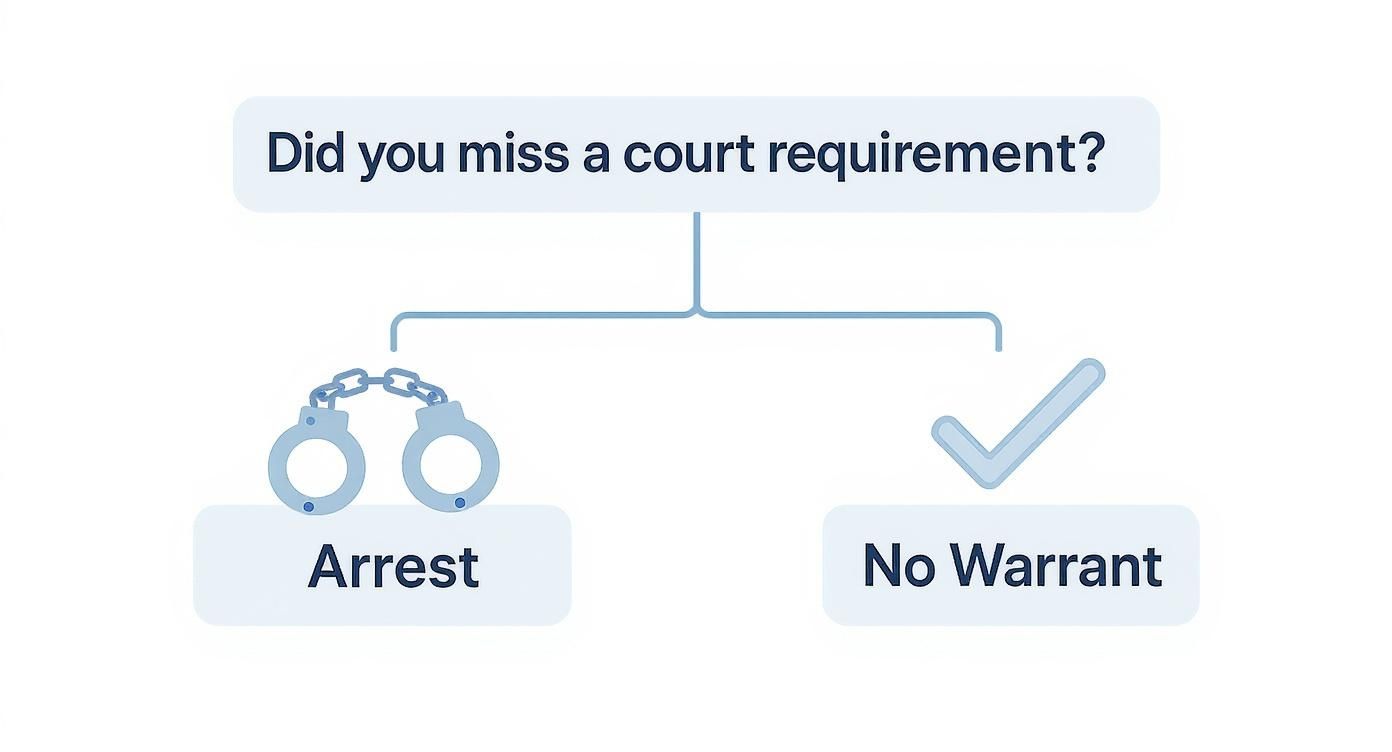
As you can see, fulfilling your obligations keeps you in the clear. Just one missed step, however, and you’re facing the risk of an arrest—a risk no parent in a CPS case can afford to take.
A Parent's Proactive Approach
Think about David, a father of two who was already dealing with a stressful CPS investigation under Texas Family Code Chapter 262. He learned he had a capias for an old, unpaid traffic fine he'd completely forgotten about. He panicked, worried that CPS would use this against him to argue for the termination of his parental rights under Chapter 161. So he called an attorney.
Together, they set up a walk-through. David went to the courthouse on a Tuesday morning, was processed, and was back home in time to pick up his kids from school. By handling the warrant discreetly and efficiently, he stopped it from becoming a major weapon for CPS in his family court case and protected his family from the trauma of seeing him arrested.
Taking proactive steps like an attorney-assisted walk-through demonstrates responsibility and a commitment to resolving legal matters. It shifts the narrative from someone evading the law to someone actively working to comply with it—a crucial distinction in any CPS hearing.
This process turns a terrifying situation into a manageable one. It minimizes the disruption to your job, your family, and your peace of mind, letting you focus on the most important thing: fighting for your family.
Your Legal Strategies for Fighting a Capias Charge
Once you’ve taken proactive steps to deal with the immediate threat of arrest, the game plan shifts. We move from short-term crisis management to finding a long-term solution. Dealing with the capias warrant is only half the battle; you still have to face the original legal problem that started it all. This is where having a skilled attorney becomes your greatest asset.
Having a legal professional in your corner isn't just about having someone show up to court with you. It's about building a solid defense, fiercely protecting your rights, and working toward an outcome that keeps your family’s future safe. Your lawyer’s job is to minimize penalties and cut through the complexities of the court system on your behalf, especially when the stakes are as high as they are in a CPS case.
Filing a Motion to Recall or Quash the Warrant
One of the first strategic moves an attorney can make is to file a motion to get the warrant thrown out. This isn’t just asking the judge for a do-over; it's a formal legal argument, presented with evidence, directly to the court.
There are two main motions we use in these situations:
- Motion to Recall the Warrant: This is exactly what it sounds like. We’re asking the judge to take back, or "recall," the capias. A common and powerful argument here is that you never got proper notice of your original court date. For instance, if the court summons was mailed to an old address you no longer live at, we can argue that your failure to appear wasn't intentional—you simply didn't know you had to be there.
- Motion to Quash the Warrant: A Motion to Quash takes things a step further. Here, we challenge the legal validity of the warrant itself. We might argue that there was a critical procedural mistake when it was issued or that there wasn't a strong enough legal reason to issue it in the first place.
If we're successful with one of these motions, the warrant gets lifted. This is a huge relief, as it allows you to focus on the underlying case without the constant stress of a potential arrest hanging over your head.
Managing Expectations About Your Record
It's absolutely crucial to understand this: getting a capias warrant recalled is not the same as clearing your record. The original charge—whether it was a simple traffic ticket, a misdemeanor, or something more serious—still exists and needs to be resolved. On top of that, the record of the capias itself might stick around.
A common misconception is that resolving a warrant magically erases it from your history. In Texas, the rules for expunction (the legal process to permanently destroy a record) are incredibly strict, and having a capias often makes you ineligible. This is a vital, honest conversation you need to have with your attorney right from the start.
An experienced attorney can walk you through every option available, from negotiating plea bargains to finding other resolutions that might eventually allow for a nondisclosure, which seals the record from public view. For parents tangled up with CPS, any blemish on your record can be a major roadblock in permanency hearings (Chapter 263) or termination proceedings (Chapter 161), making sharp legal guidance even more critical. If you're worried about a criminal charge, it helps to know the different ways it can be handled; you can read our guide on how to get criminal charges dropped for more insight.
Ultimately, tackling a capias charge requires a two-part strategy: first, you neutralize the immediate danger of being arrested, and second, you build a strong defense for the original case. With a compassionate and experienced legal advocate on your side, you can face this challenge head-on and fight for the best possible outcome for you and your family.
Your Next Steps to Protect Your Family and Future
Nothing throws your world off its axis quite like facing a capias charge, especially when you have a family depending on you. The mix of fear and confusion can be paralyzing, but please hear this: you have the power to take back control, starting right now. It all begins with understanding the charge, dealing with the warrant head-on, and building a solid legal defense to protect your parental rights.

This isn’t something you should ever face alone. Taking decisive, well-informed action is the single best way to protect your family’s stability and stop this legal issue from spiraling into a CPS nightmare. Don't let uncertainty call the shots.
Your Immediate Action Plan
To help cut through the stress, here’s a straightforward checklist of your immediate priorities. Following these steps will help you regain a sense of control and start moving toward a solution.
- Do Not Ignore the Warrant: The problem won't just vanish. Ignoring a capias only guarantees an eventual, and often public and traumatic, arrest. That kind of scene can cause much more harm to your CPS case and your family's peace of mind.
- Gather All Your Information: Pull together any documents or notices you have from the original case. This includes ticket numbers, old court dates, or any letters you've received. Every single detail helps your attorney build a stronger case for you.
- Consult an Experienced Attorney Immediately: This is the most important step you can take. A lawyer who understands both criminal defense and Texas CPS law can explain the specifics of your capias charge, arrange for a discreet "walk-through" to avoid a public arrest, and start mapping out a legal strategy to fix the underlying problem while protecting you in family court.
Why Seeking Legal Help is Non-Negotiable for Parents
For any parent—and especially for one with CPS involvement—any legal trouble can feel like a direct threat to your family. A capias warrant can be twisted by CPS to question your judgment and stability, making a tough situation infinitely worse and jeopardizing your fight for reunification.
A good attorney acts as your shield. They defend you in criminal court while also helping to manage the fallout on your family law case. As you search for the right lawyer, understanding criminal defense marketing strategies can give you some useful context for finding someone who can truly help with a capias charge.
Your response to this situation matters. By proactively addressing the warrant with legal guidance, you demonstrate responsibility to the court—a fact that can significantly influence the outcome of your case and protect your parental rights under the Texas Family Code.
Taking that first step is always the hardest, but it’s also the most critical. You don't have to carry this weight by yourself. Our team is here to provide the compassionate and experienced legal guidance you need to get through this challenge and get your life back on track.
The weight of a capias charge can feel immense, but you don't have to face it alone. At The Law Office of Bryan Fagan, we understand what’s at stake for you and your family, especially when CPS is involved. We are here to provide the strategic defense and empathetic support you need to resolve this and move forward with confidence. Contact us today for a free, confidential consultation to discuss your case. https://texascpslawyer.net