Skip to content
Yes, CPS can often talk to your child at school in Texas without your permission. But that power has important legal limits, and one of the biggest is this: your physical presence at the school can change whether consent is required.
If you're reading this after a call from the school, a text from your child, or a knock at the door, you're probably scared and trying to figure out what CPS is allowed to do. That fear is real. Parents often feel blindsided because a school interview can happen before they ever get a chance to respond. The good news is that Texas law does set rules, and once you understand those rules, you can make calmer, smarter decisions for your family.
That Phone Call from School You Never Wanted
One of the most unsettling moments a parent can face is hearing that a CPS investigator wants to speak with their child at school, or already has. You may wonder whether the school should have called you first, whether you can stop the interview, and whether this means CPS is about to remove your child.
For many families, the confusion starts because school and home work differently under Texas law. A parent may know CPS can't walk into their home and start interviewing a child there without permission, then assume the same rule applies at school. It often doesn't.

A common example looks like this. A mother is at work when the elementary school counselor calls and says a CPS investigator is on campus. The child has already been taken to a private office. The parent says, "I don't consent." The school replies that the interview is already underway. That parent isn't overreacting by panicking. She's running into a part of Texas CPS practice that many families don't know exists.
What matters most at the start: stay calm, write down names, times, and what the school told you.
Parents asking can CPS talk to my child at school in Texas usually need more than a yes-or-no answer. They need to know when consent matters, when it doesn't, what schools can do, and what steps they should take immediately after contact. If your family is already dealing with this situation, this guide on what to do if CPS contacts your child's school can also help you understand the next move.
The fear parents usually have
Most parents aren't just worried about the interview itself. They're worried about what the interview means.
- Will CPS remove my child today
- Did the school violate my rights
- Can I demand to be there
- What should I say to my child afterward
Those are the right questions. The answers start with the legal authority behind school interviews.
The Legal Authority Behind CPS School Interviews
Texas gives CPS investigators real legal authority to investigate reports of abuse or neglect. That authority doesn't come from school policy or a principal's discretion. It comes from state law.
Under Texas Family Code Chapter 261, specifically §261.302(b)(1), CPS investigators may interview an alleged child victim at any reasonable time and place, including school, without parental consent if the parent isn't present. The Texas Attorney General's 1998 Opinion DM-0476 also states that school officials don't have legal authority to refuse a lawful interview request from CPS, as explained in the DFPS handbook discussion of school interviews.
Why the law gives CPS this power
The state built this rule around child safety. If CPS receives a report alleging abuse or neglect, investigators are allowed to speak with the child in a setting where the child is available and where the conversation can happen promptly and privately. School is often the most practical place.
That doesn't mean CPS can do anything it wants. It means Texas law lets investigators move forward with a school interview in certain circumstances, even when a parent hasn't given advance permission.
For parents who want a fuller picture of how the case usually unfolds after that first contact, The Texas CPS Investigation Process Explained gives a step-by-step breakdown of how a Texas CPS investigation unfolds and a parent's rights at each stage.
What the school can and can't do
Many parents believe the school principal can say no. In most cases involving a lawful CPS request tied to an abuse or neglect investigation, school staff don't have that veto power.
A simple comparison helps:
| Situation | Who decides |
|---|---|
| Routine school discipline issue | School administrators |
| CPS interview during a Chapter 261 investigation | CPS, under state authority |
| Child removal from home | Usually a court, unless there's an emergency |
The school still plays a role. Staff may escort the child, provide a private room, and document who came on campus. But the school usually isn't the legal gatekeeper once CPS invokes its statutory interview authority.
Schools often cooperate because the law treats the interview as part of a state investigation, not as an optional school meeting.
Parents often feel angry with the school. That reaction is understandable. But in many situations, the better question isn't "Why did the school allow this?" It's "Did CPS follow the specific rules that apply to school interviews?" That leads to the most misunderstood part of the law.
For more background on how Texas child welfare law fits together, including the broader legal structure around CPS cases, see this overview of understanding the legal framework of child welfare.
Parental Consent and The Critical Presence Rule
Many guides cause confusion for parents. The rule isn't just "CPS can talk to your child at school" or "CPS needs your consent." The key answer turns on presence.

Under Texas Family Code Chapter 261 and DFPS investigation guidelines, CPS caseworkers in Texas can interview a child at school without prior parental consent if the parent isn't present during the interview, as discussed in this explanation of Texas CPS school interview authority.
What the presence rule means in plain language
If you're physically present at the school when CPS wants to interview your child, consent matters. If you're not physically present, the investigator may proceed without first getting your permission.
That distinction is easy to miss, but it's the hinge point.
Think about it this way. Presence acts like a switch. When the parent is there, the consent requirement turns on. When the parent isn't there, that consent barrier usually isn't there.
A practical example
Suppose your middle school calls and says CPS has arrived. You leave work and get to campus before the interview starts. In that setting, your presence can change the legal analysis because consent is required if you're there.
Now change one fact. CPS arrives, the school brings your child into an office, and you're across town at work. In that setting, the interview may happen before you ever get there.
That single difference confuses families because it feels arbitrary. But legally, it's a major dividing line.
A video explanation can also help if you learn better by hearing the issue discussed out loud.
What a refusal at home does and doesn't do
Parents also get tripped up here. If you refused a home interview, that doesn't automatically create a permanent shield against any school interview under all circumstances.
But CPS also isn't allowed to play games with the rules. Texas guidance recognizes an important limit: the agency can't try to "get around" a parent's refusal by shifting locations in a way that violates the consent rule for the active investigation. This is one reason written documentation matters so much.
Practical rule: A refusal is strongest when it's clear, documented, and tied to the current investigation.
Here is the simplest way to remember it:
- Parent present at school: consent is required.
- Parent absent from school: CPS may interview without prior consent.
- Parent has clearly objected during the active investigation: that objection needs to be documented and handled carefully, not ignored casually.
Parents should also understand that rights during a CPS matter don't stop with the school interview. A broader guide to your rights during a CPS investigation can help you prepare for the next conversations with investigators.
What Happens After a CPS School Interview
After the interview, most parents ask the same question: what happens now?
The first concrete safeguard is notice. If CPS interviews a child at school without the parent's knowledge, the Texas DFPS Parents' Guide to Investigations says the investigator must attempt to contact the parent and notify them of the interview within 24 hours, as noted in this discussion of when CPS must notify a parent after speaking with a child.

The first day after the interview
That 24-hour contact requirement matters because it limits how long the agency can keep the parent out of the loop. You may receive a phone call, voicemail, or another direct contact attempt from the investigator. When that happens, don't ignore it, but don't rush into a panicked conversation either.
Write down:
- The investigator's name
- The agency office
- The allegation described
- When the school interview occurred
- Any request for a home visit or follow-up meeting
If you missed the call and learned about the interview another way, document that too.
Does a school interview mean CPS can remove my child
No. A school interview and a removal are not the same thing.
Texas law sets a much higher bar for removal without a court order. Under Texas Family Code §262.104, CPS may remove a child without prior judicial approval only in an emergency involving immediate danger to the child's physical health or safety and no time to get a court order, as explained in this overview of Texas CPS authority and emergency removal limits.
That means a routine school interview does not automatically give CPS the right to take your child from your home.
A school interview may be the beginning of an investigation. It is not, by itself, proof that removal is about to happen.
What usually comes next
The next steps often include a request to speak with you, a request to see the home, or follow-up interviews with other adults connected to the child. If a court case develops, other parts of the Texas Family Code can become important, including Chapter 262 on removal procedures, Chapter 263 on court review and permanency timelines, and Chapter 161 on termination of parental rights.
That doesn't mean every school interview turns into a lawsuit. Many don't. But once CPS is involved, your words and choices begin to shape the record.
A calm response helps:
- Ask for the allegation in plain language
- Request contact information for the investigator
- Avoid arguing with school staff
- Get legal advice before making major statements
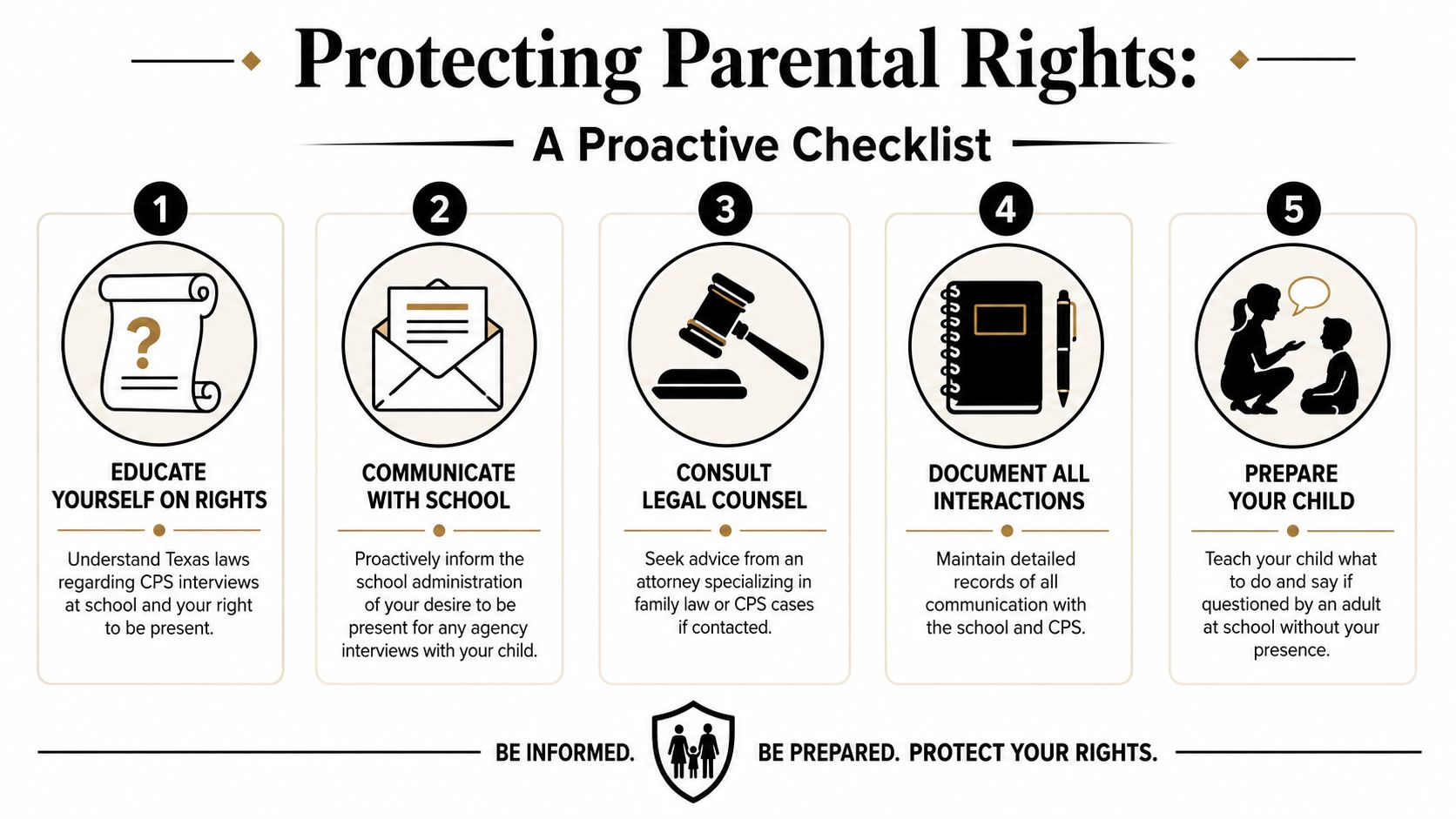
Proactive Steps to Protect Your Parental Rights
Once you know the presence rule, the next question becomes practical. What can you do before or after CPS shows up at school?
Texas parents can take written steps by telling school personnel that CPS or law enforcement shouldn't see or speak to their child unless the parent is contacted first or is physically present during the interaction, as discussed in this post about written notice to school personnel regarding CPS access. That kind of notice is not absolute. A court order or immediate danger can change things. But it can still create an important administrative barrier and a paper trail.
A written notice you can give the school
Parents often feel powerless because they think they must wait for CPS to act first. That's not true. You can communicate expectations to the school now.
A short written notice might say:
I am the parent or legal guardian of [child's name]. I request that school personnel contact me immediately if CPS or law enforcement asks to see or interview my child at school. I request that no interview take place unless I am contacted first or physically present, unless a court order or emergency legally requires otherwise. Please place this notice in my child's file and share it with the principal, counselor, and front office staff.
Keep the language calm. Don't attack the school. Don't make legal threats you can't back up.
What to say to school staff on the phone
You don't need a long speech. Use clear, simple wording.
- Ask for names first: "Please tell me the name of the investigator, the principal, and anyone with my child."
- State your position clearly: "I want to be contacted before anyone speaks with my child, and I am on my way."
- Request documentation: "Please note in the file that I do not consent unless I am present, unless there is a court order or emergency."
- Stay professional: anger may feel justified, but a controlled tone helps you later.
What to say to your child afterward
This part matters. Parents sometimes make the mistake of interrogating the child or pushing for details in a way that sounds leading.
A better approach is supportive and open-ended:
- Start with reassurance: "You're not in trouble."
- Keep it neutral: "Do you want to tell me what happened at school today?"
- Avoid scripting: don't tell the child what to say next time.
- Watch behavior: note fear, confusion, trouble sleeping, or sudden withdrawal.
If your child is very upset, write down what you observe instead of trying to force a full conversation.
Build a paper trail
A CPS case often turns on documentation. Parents who keep records put themselves in a stronger position.
Use one folder, notebook, or digital file for:
| Keep track of | Why it matters |
|---|---|
| School contacts | Shows who told you what and when |
| CPS messages | Preserves timing and wording |
| Written notices | Proves you asserted your position |
| Medical or counseling records | May help explain family circumstances |
One practical option if you need legal guidance early is Law Office of Bryan Fagan PLLC, which handles CPS-related matters and family situations that intersect with child protection investigations.
Prepare for the next interaction
Parents usually help themselves most by slowing down and getting organized.
- Don't sign quickly: if CPS asks you to sign something, read it fully first.
- Don't guess: if you don't know an answer, say so.
- Don't volunteer extra details: answer the question asked.
- Do ask for time to speak with counsel: that is often the smartest next step.
Why You Should Speak with a CPS Defense Attorney Immediately
A CPS investigation can affect far more than one school interview. It can shape how the agency views your home, your credibility, your parenting, and your future relationship with the court if the case escalates. Early mistakes are hard to undo.
The law in this area is full of narrow distinctions. The presence rule is one of them. The difference between a voluntary conversation and a statement that creates problems later can be small. The difference between a temporary safety concern and a court filing under Chapters 262 or 263 can happen quickly.
What an attorney actually helps you do
A lawyer doesn't just "fight CPS" in the abstract. A good attorney helps you make disciplined decisions.
That may include:
- Communicating with investigators so you don't say more than necessary
- Preparing for interviews with CPS, school staff, or court personnel
- Reviewing safety plans or service requests before you agree
- Responding if removal is threatened
- Defending your parental rights if the case moves toward litigation involving Chapter 161
The earlier you get advice, the more options you usually have.
Why timing matters
Many parents wait until after a removal, a court filing, or a damaging statement. By then, the case record may already contain avoidable problems.
If CPS has contacted your child's school, already interviewed your child, or asked to meet with you next, this is the right time to get legal advice. You don't need to wait until the situation feels worse. Acting early is often the most protective choice for both you and your child.
If you're facing a CPS investigation and need clear answers about school interviews, parental consent, emergency removal, or the next court step, contact Law Office of Bryan Fagan PLLC for a free consultation. A calm legal strategy can make a major difference, and you don't have to sort through this alone.