Skip to content
When CPS shows up, most parents don't feel strategic. They feel cornered. A stranger is asking questions about your children, your home, your parenting, and every answer seems loaded with risk.
That fear is real, but it doesn't mean you're powerless. In Texas, CPS cases can be challenged on evidence, procedure, and deadlines. In some cases, the strongest path to dismissal isn't arguing louder that the allegations are false. It's showing the court that the state failed to follow the rules, failed to prove its case, or failed to give your family the process the law requires.
Parents often ask how to get a CPS case dismissed in Texas as if there is one magic form or one perfect hearing. There isn't. Dismissal usually comes from disciplined work. You protect your words early, build your own record, track the court's deadlines, and force DFPS to justify every step it takes.
A common scenario looks like this: a parent cooperates fully because they think honesty alone will fix everything. Months later, the case file contains scattered statements, incomplete records, missed context, and a service plan that keeps growing. The parent feels like they've done everything asked, but the case still hasn't gone away. That's when strategy starts to matter more than hope.
That Knock on the Door Your First Moments with CPS
The first visit often sets the tone for everything that follows. A caseworker may sound polite, but the stakes are still serious. What you say, what you allow, and what you sign can shape the record long before a judge ever hears your side.
One mother I've seen in this situation did what many caring parents do. She invited the investigator in immediately, tried to explain every family stressor at once, and agreed to requests she didn't fully understand because she thought cooperation would make CPS leave faster. Instead, her own words became part of a story she never meant to tell.
What matters in the first conversation
Your job in that moment isn't to win the whole case on the porch. Your job is to stay calm, learn the allegation, avoid guessing, and keep the interaction measured.
Practical rule: Early CPS contact is not the time to over-explain. Short, accurate answers are safer than emotional speeches.
Parents sometimes think refusing to talk at length makes them look guilty. Usually, the bigger danger is talking too much without understanding what CPS is investigating. If you aren't clear on how to handle that first encounter, this guide on responding when CPS shows up at your door in Texas walks through the immediate decisions that can affect the rest of the case.
Shift from panic to record-building
The strongest parents in CPS cases are not always the loudest. They're often the ones who start documenting early.
That means writing down who came to the home, what was said, what documents were requested, and what deadlines were mentioned. It also means resisting the urge to treat the visit like an informal misunderstanding that will clear itself up. Sometimes it does. Often, it doesn't.
Dismissal starts with recognizing that CPS is creating a file about your family. You need to create one too.
The CPS Process Where Dismissal Opportunities Arise
A Texas CPS matter moves through stages. Dismissal can happen at more than one point, but the kind of dismissal depends on where the case stands.

Investigation and administrative closure
Some cases end before a lawsuit is filed. CPS investigates, interviews family members, reviews the home, and decides not to seek court action. That isn't the same thing as a court dismissal, but for many families it's the first exit point.
If the agency doesn't have enough reliable proof, if the allegation falls apart under scrutiny, or if the safety concerns can be addressed without litigation, the case may stop there. This stage rewards disciplined parents. Clean records, clear communication, and stable conditions matter.
When DFPS files in court
If DFPS believes court intervention is necessary, the case changes. Chapters 262 and 263 of the Texas Family Code become central because the court enters temporary orders, sets hearings, and starts a legal timeline that can create dismissal opportunities later.
Many parents lose ground by assuming each hearing stands alone. It doesn't. Judges often look at the entire pattern, including compliance, credibility, and whether the state is moving the case toward a lawful final resolution.
A useful parent-facing roadmap is The Texas CPS Case Timeline From Start to Finish, which gives every stage and deadline in a Texas CPS case, mapped out for parents.
The main dismissal points
Here is where dismissal opportunities usually arise:
| Stage | What may lead to dismissal |
|---|---|
| Before suit | CPS closes the matter because the allegations don't hold up or court action isn't justified |
| Early court phase | A legal motion challenges weak facts, missing proof, or procedural defects |
| Later court phase | DFPS can't support continued intervention with credible evidence |
| Deadline stage | The case reaches the statutory dismissal point without trial or a valid extension |
A CPS case is not one long blur. It is a sequence of deadlines, filings, hearings, and proof problems. Each stage creates different pressure on the state.
Dismissal is not always the same thing
Parents often use the word dismissal to describe several different outcomes. That causes confusion.
- Administrative closure means CPS ends its investigation without asking the court for continuing intervention.
- Court dismissal means the judge ends the case.
- Role removal or registry relief deals with whether your name remains tied to a finding after the case itself is over.
Those are different goals. You need to know which one fits your situation before you decide what to file and when.
Legal Grounds for Dismissing a CPS Case in Texas
A judge won't dismiss a CPS case because the process feels unfair in a general sense. The court needs a legal basis. In practice, the strongest dismissal arguments usually fall into two categories. CPS can't prove the case, or CPS failed to proceed lawfully.
Weak evidence and burden problems
Not every allegation becomes a sustainable court case. A report may sound severe at intake and then weaken once records, witness statements, school information, medical history, or context come into focus.
A denial by itself usually isn't enough. A denial supported by records, consistent testimony, clean testing when testing is relevant, and stable living evidence is much harder for the state to push past. Chapter 262 issues often begin with emergency concerns. If those concerns no longer stand up under scrutiny, the legal basis for continued intervention can weaken.
Procedural defects matter
Some parents focus only on disproving the accusation and miss another route. The state has rules too.
If DFPS mishandles notice, fails to support its requested relief, or tries to move the case forward without doing what the Family Code requires, that can provide grounds for dismissal or for limiting what the agency can seek. Due process arguments are not technical distractions. In the right case, they go to the heart of whether the state should still be in your family's life at all.
The Chapter 263 dismissal deadline
The most important statutory dismissal ground in many court cases is the Chapter 263 deadline.
Texas Family Code Section 263.401(a) requires dismissal on the first Monday after the one-year anniversary of DFPS being appointed temporary managing conservator, unless trial has already started or the court grants one 180-day extension for extraordinary circumstances, as explained in this discussion of dismissal after service plan completion in Texas CPS cases.
That deadline is not a suggestion. It exists to keep cases from remaining open indefinitely while parents live under temporary orders and uncertainty. If DFPS has not started trial and has no valid extension, the case becomes subject to dismissal for failing to reach a final judicial resolution in time.
What extraordinary circumstances usually means
The state doesn't get endless extra time because the case is inconvenient. The extension requires extraordinary circumstances, and the total case length can reach 18 months only if the court grants that single extension under the standard described above. The court must also provide formal notice of the approaching dismissal date 60 days beforehand, as noted in the same source.
That timing matters because it creates a concrete litigation checkpoint. Counsel should know the dismissal date early, not after it passes.
Chapter 161 changes the stakes
Chapter 161 becomes critical when the case is moving toward termination of parental rights. At that point, dismissal strategy has to account for the fact that the state may try to convert a temporary conservatorship case into a termination case. Once termination is on the table, every hearing, filing, and evidentiary choice matters more.
A parent who understands the legal grounds for dismissal can stop reacting emotionally to each new demand and start asking the right question. Can DFPS still prove what it is asking the court to do?
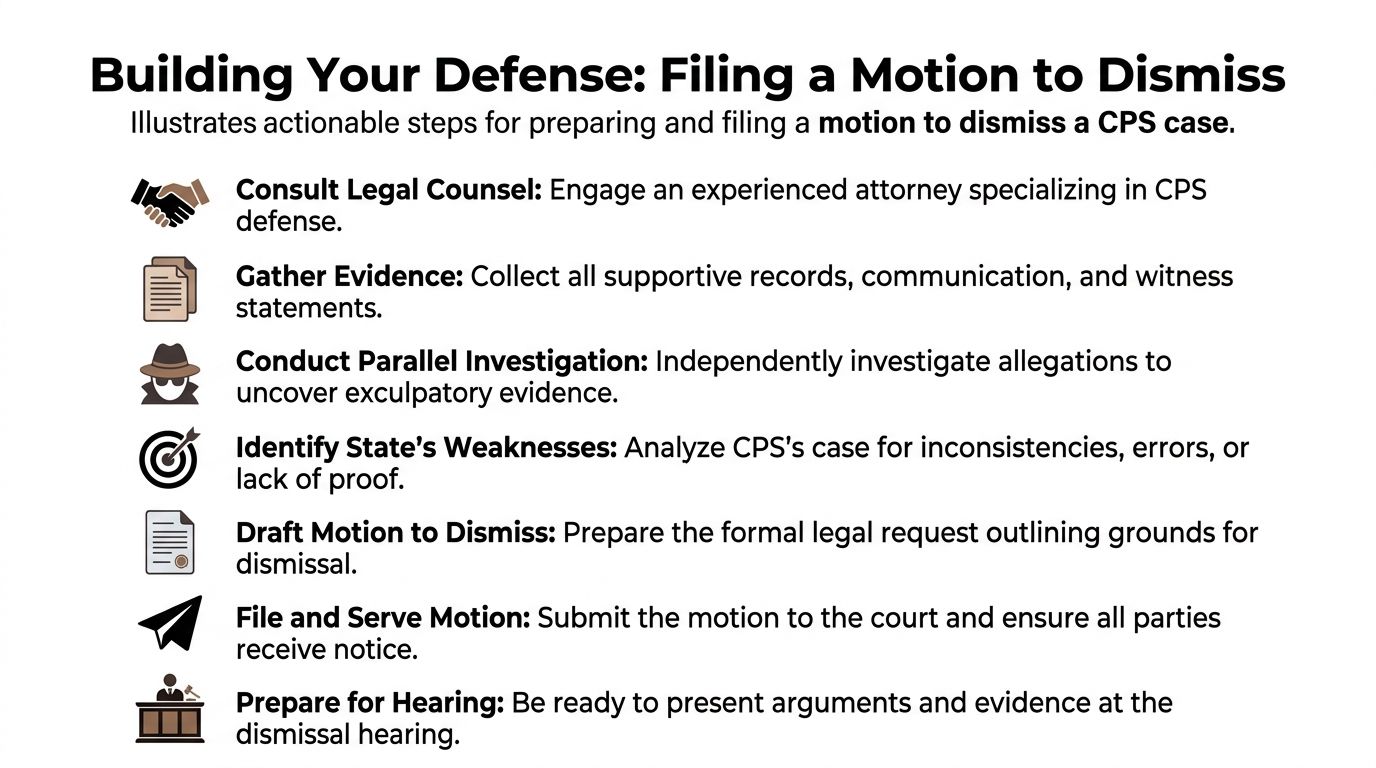
Building Your Defense Filing a Motion to Dismiss
A strong motion to dismiss is built long before the hearing. By the time your lawyer asks the court to throw the case out, the record should already show two things clearly. CPS cannot prove the legal basis for keeping the case open, or CPS handled the case in a way that denied you fair process.
What a motion to dismiss needs
In Texas CPS court, a motion to dismiss has to do more than complain that the investigation felt unfair. It should identify the legal defect, tie that defect to the case history, and ask for specific relief. That may mean dismissal based on missed deadlines, lack of evidence, defective pleadings, failure to meet statutory requirements, or due process problems that affected your ability to defend yourself.
Precision matters.
If the issue is procedural, the motion should point to hearing dates, service dates, notices, court orders, and any missing accommodations or missing disclosures. If the issue is factual, the motion should attach records and affidavits that directly answer the allegations. Judges respond better to a clean timeline and focused exhibits than to a stack of unorganized documents.
Build your own record, not just a rebuttal
Many parents spend months reacting to CPS paperwork instead of building their own case file. That is a mistake. A dismissal strategy often depends on proving not only that CPS is wrong, but that CPS cut corners, ignored important facts, or pushed the case ahead without giving the parent a fair chance to participate.
Start a separate defense file and keep it current. Save every service plan, safety plan, court order, email, text message, referral, visitation log, and notice. If you asked for an interpreter, disability accommodation, modified services, transportation help, or a different testing schedule, preserve that request and the response.
That paper trail can become the heart of a dismissal motion.
For example, if a parent has a documented disability and CPS keeps requiring services that parent cannot access without accommodation, the problem is not only service compliance. The problem may be that CPS built its case on a process that was unfair from the start. The same is true when CPS changes requirements verbally, fails to give clear notice of hearings, or relies on allegations without turning over the records needed to answer them.
Parents who want a more detailed guide on organizing proof can review how to build a strong defense against CPS allegations.
What to gather first
Gather records that do one of two jobs. They either prove stability, or they prove a procedural failure.
Useful materials often include:
- Dated home photos and basic household records that show safe sleeping arrangements, utilities, food, and working conditions in the home.
- School and daycare records that show attendance, performance, behavior, and who has been involved with the child's care.
- Medical and counseling records relevant to the allegations, including provider recommendations and attendance history.
- Employment and housing records that show routine, income, and stability.
- Drug test results and service records if substance use or noncompliance is part of the state's theory.
- Emails, texts, and letters from CPS or providers that show inconsistent instructions, lack of notice, or changed expectations.
- Accommodation requests and supporting medical documentation if disability affected your ability to complete services, communicate, attend visits, or understand requirements.
- Affidavits from witnesses with direct knowledge of the home, the child's care, or CPS case activity.
Do not wait until the week of the hearing. A paper trail built over several months carries more weight than records gathered in a panic after a trial setting appears.
Evidence alone is not enough
The court still needs a legal reason to dismiss.
I often tell parents that a binder of good documents helps only if someone connects each document to a rule, statute, deadline, or constitutional protection. A clean drug test may rebut one allegation. A series of ignored accommodation requests may support a much stronger argument, that the case should not continue because CPS denied meaningful access to the process. Those are different arguments, and they require different drafting.
That is also why parents should be careful about informal agreements. If a caseworker says, "just finish this extra service and we will revisit things later," get that request in writing. If transportation problems, literacy issues, language barriers, or disability made compliance harder, raise it early and document it. Silence lets the state frame the record.
What tends to help, and what usually hurts
Some defense choices strengthen a dismissal motion. Others give CPS room to argue that any problem was the parent's fault.
What usually helps:
- Written communication that confirms requests, objections, and misunderstandings.
- Prompt objections to inaccurate reports or changing service demands.
- Consistent attendance at hearings, visits, and services that are accessible and relevant.
- Requests for accommodation made early and repeated when ignored.
- A focused motion that targets a specific legal defect instead of attacking everything at once.
What usually hurts:
- Relying on verbal promises from CPS.
- Bringing disorganized records to court.
- Waiting months to complain about notice or access problems.
- Assuming service completion by itself requires dismissal.
- Treating procedural violations as minor details when they may be one of the strongest issues in the case.
Counsel turns facts into relief
This is the stage where legal counsel changes the outcome in practical terms. A lawyer can compare the file against the statute, the court's orders, DFPS practice, and basic due process requirements. Sometimes the best motion argues weak evidence. Sometimes it argues that CPS failed to give proper notice, failed to accommodate a parent's disability, failed to preserve fairness in service planning, or built the case on shifting requirements that the court should not reward.
The Law Office of Bryan Fagan PLLC handles Texas CPS-related matters, including cases where dismissal may rest on both factual defense and procedural defects.
Advanced Strategies to Challenge the States Case
Sometimes the state's weakest point is not the accusation itself. It is the way CPS handled the case.

Due process can be a dismissal strategy
Most parents are told to fight by denying the allegations and finishing services. Those steps matter, but they are not the only battlefield. In some cases, the better question is whether CPS provided fair process before asking the court to keep control over your family.
That includes notice issues, inconsistent investigative work, ignored exculpatory evidence, and failures to accommodate disability. A procedural challenge can shift the conversation from whether CPS is suspicious of you to whether CPS followed the law at all.
One practical area that deserves more attention is disability accommodation. Recent developments show that 2024-2025 case filings increasingly include motions requiring CPS to provide disability accommodations before proceeding, with some cases resulting in dismissal when CPS fails to comply. The same juvenile law source notes that families with disabled members face 3x higher CPS investigation rates, yet only 12% of dismissal guides mention ADA compliance as a potential ground, discussed in Defending the CPS Case How to Level the Playing Field.
What ADA-related challenges can look like
A parent with cognitive limitations may need communication adjusted. A parent with mobility limitations may need services or visitation structured differently. A child with disabilities may require evaluations, transportation support, or other accommodations that affect the fairness of the case plan.
If CPS ignores those realities and then blames the family for noncompliance, the issue is no longer just evidence. It becomes a due process problem. In the right case, that can support a motion to compel accommodations, a challenge to the service plan, or a dismissal argument if the agency's failures poisoned the process.
A service plan is not fair simply because it exists. It must be realistic, accessible, and lawfully administered.
This is also where detailed evidence review matters. Parents often benefit from learning how to challenge CPS evidence in a Texas case because the same records that undermine the allegations can also expose procedural shortcuts.
A short overview of courtroom strategy can help frame these issues:
Negotiation is part of dismissal practice
Not every dismissal comes from a dramatic ruling after a contested hearing. Some happen because the state sees the weaknesses in its own case.
A strong defense file can create room for negotiation with the agency's lawyer. If your records undercut the safety concerns, if your compliance is documented, and if procedural flaws are clear, DFPS may become more willing to narrow issues, end certain requests, or agree that continued litigation isn't justified.
That doesn't mean you should chase informal promises. It means a prepared case gives your lawyer an advantage. In CPS court, that advantage comes from records, dates, and legal pressure, not from asking the other side to be reasonable.
After Dismissal Clearing Your Name and Moving Forward
A court dismissal is a major relief. It ends the active lawsuit. But for some parents, it doesn't fully clean up what CPS left behind.

Dismissal and registry status are different issues
This distinction catches families off guard. You can win in court and still need to address a CPS finding connected to your name.
If CPS made a reason to believe finding, you may need an administrative challenge to pursue role removal from the DFPS Central Registry. That matters for reputation, future background checks, and jobs involving children or vulnerable people.
The deadline that cannot be missed
Texas parents facing a reason to believe finding must file a written request for administrative review or fair hearing within a strict 45-day window from the date they receive the official notice, as described in this explanation of challenging a CPS finding and Central Registry placement.
That deadline is not flexible in the ordinary sense. Missing it can mean losing the administrative path to remove your name from the registry.
Practical steps after the case ends
Once dismissal is signed, take deliberate follow-up steps:
- Get the final order. Keep a complete, file-stamped copy of the dismissal order.
- Review all notices from CPS. Don't assume the lawsuit's end resolves every administrative issue.
- Calendar the appeal deadline immediately. If there is a reason to believe finding, treat the 45-day clock as urgent.
- Request records strategically. You may need the investigative file to identify factual or procedural errors that support review.
- Protect future opportunities. If your work involves childcare, education, healthcare, or similar fields, registry issues can matter long after the court case ends.
Winning the court case and clearing your name are related goals, but they are not always the same legal task.
Moving your family forward
Families usually need more than a signed order. They need space to stabilize. Children may still be anxious. Parents may still feel watched. Ordinary routines can take time to rebuild.
That part matters too. Keep the paperwork, follow through on any remaining legal steps, and focus on restoring normal structure in the home. A dismissed case does not define your family, but handling the aftermath carefully can protect you from future problems tied to the same record.
If your family is dealing with CPS and you need clear answers about dismissal, deadlines, or whether procedural violations could change the course of your case, contact Law Office of Bryan Fagan PLLC for a free consultation. A calm, informed legal review can help you understand what options you have right now and what steps may protect your parental rights going forward.