Skip to content
When a school calls and says CPS has contacted them about your child, most parents feel the same thing first: panic. Your mind jumps straight to removal, court, or the worst thing you've ever heard on the news. That reaction is normal. It's also the moment when calm, disciplined action matters most.
If you're reading this right after a call from a principal, counselor, or school nurse, treat the situation like the opening phase of a legal investigation. In Texas, CPS may interview a child at school without prior parental consent, and the interview may be recorded. The investigator must attempt to contact the parent within 24 hours after that interview, according to the Texas DFPS parents' guide to investigations. That window is short. What you do before CPS reaches you directly can shape the record that follows.
A school contact doesn't automatically mean the allegations are true. It does mean the process is moving. Schools are common entry points into child welfare cases because staff are mandated reporters, and school personnel have been frequent reporters in child welfare systems, as discussed in this county-level CPS prevalence study. The practical lesson for Texas parents is simple: don't argue with the school, don't give a long explanation, and don't assume you can smooth this over with one emotional phone call.
The Phone Call from School Your First Moves
A common scenario looks like this: the assistant principal says CPS called or arrived, staff are “just cooperating,” and they want to let you know something is happening. Parents often make one of two mistakes right there. They either unload every family detail in a rush, or they become so angry that the school stops hearing anything except the anger.
Neither response protects your family.
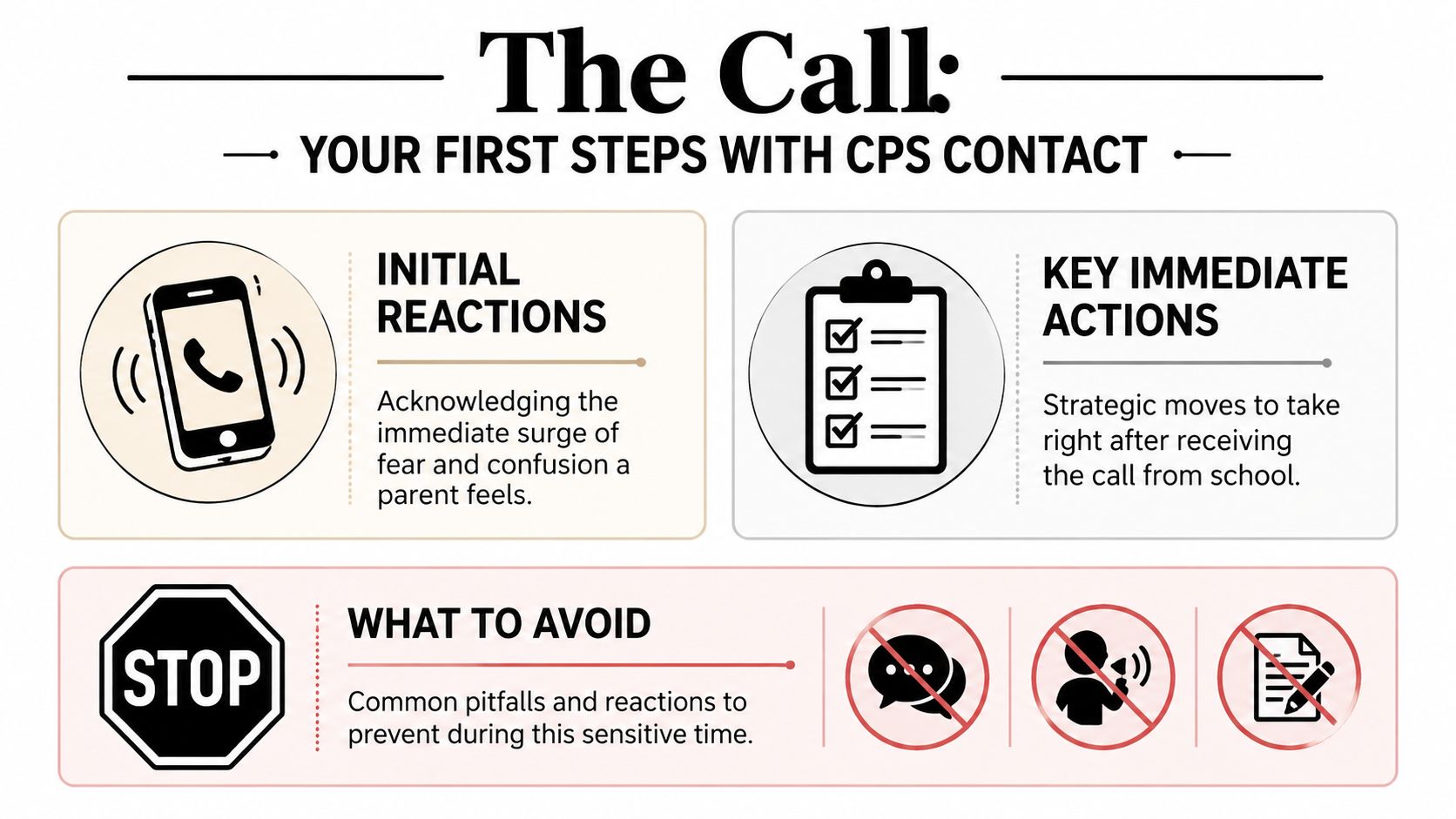
What to say in the first call
Keep it short and controlled. You're trying to gather facts, preserve records, and stop informal discussion.
Use language like this:
Please tell me exactly who contacted the school, what they requested, whether my child was interviewed, whether anything was recorded, and what records were disclosed. Please keep a written log of all contacts and disclosures.
Then add this:
I'm asking that any further requests be documented in writing and routed through counsel before additional records or background information are discussed.
That tone matters. You're not telling the school to obstruct anything. You're preserving accuracy.
Your first-hour checklist
Handle the first hour like a document-control problem.
- Identify the players. Get the name and title of everyone at the school who spoke with CPS.
- Ask what happened already. Was there a child interview, a records request, or both?
- Request a disclosure log. Ask for the date, time, identity of the requester, what was asked for, and what was released.
- Tell the school to preserve records. Attendance, discipline, counseling notes, nurse logs, emails, and teacher communications may all matter.
- Stop informal conversation. Don't ask the school to “tell CPS your side.”
- Call counsel quickly. If you need a starting point on process, review how Texas CPS investigates reports step by step.
What doesn't work
Parents often think cooperation means giving the school a full family history. It doesn't. School staff may want to help, but they are not your legal advocates. Once a staff member starts summarizing family stress, discipline at home, medical history, custody conflict, or an old misunderstanding, that narrative can become part of the investigative file.
A parent once described it to me this way: “I thought if the counselor understood everything, she could fix it.” In reality, broad explanations often create more witnesses, more statements, and more opportunities for small inconsistencies.
Practical rule: Treat the school as a record holder, not your spokesperson.
Your Legal Rights When CPS Interviews a Child at School
The call usually comes after the interview has already happened. A principal or counselor says CPS was on campus and spoke to your child. At that moment, the legal question is straightforward. In Texas, CPS can interview a child at school without first getting a parent's permission.
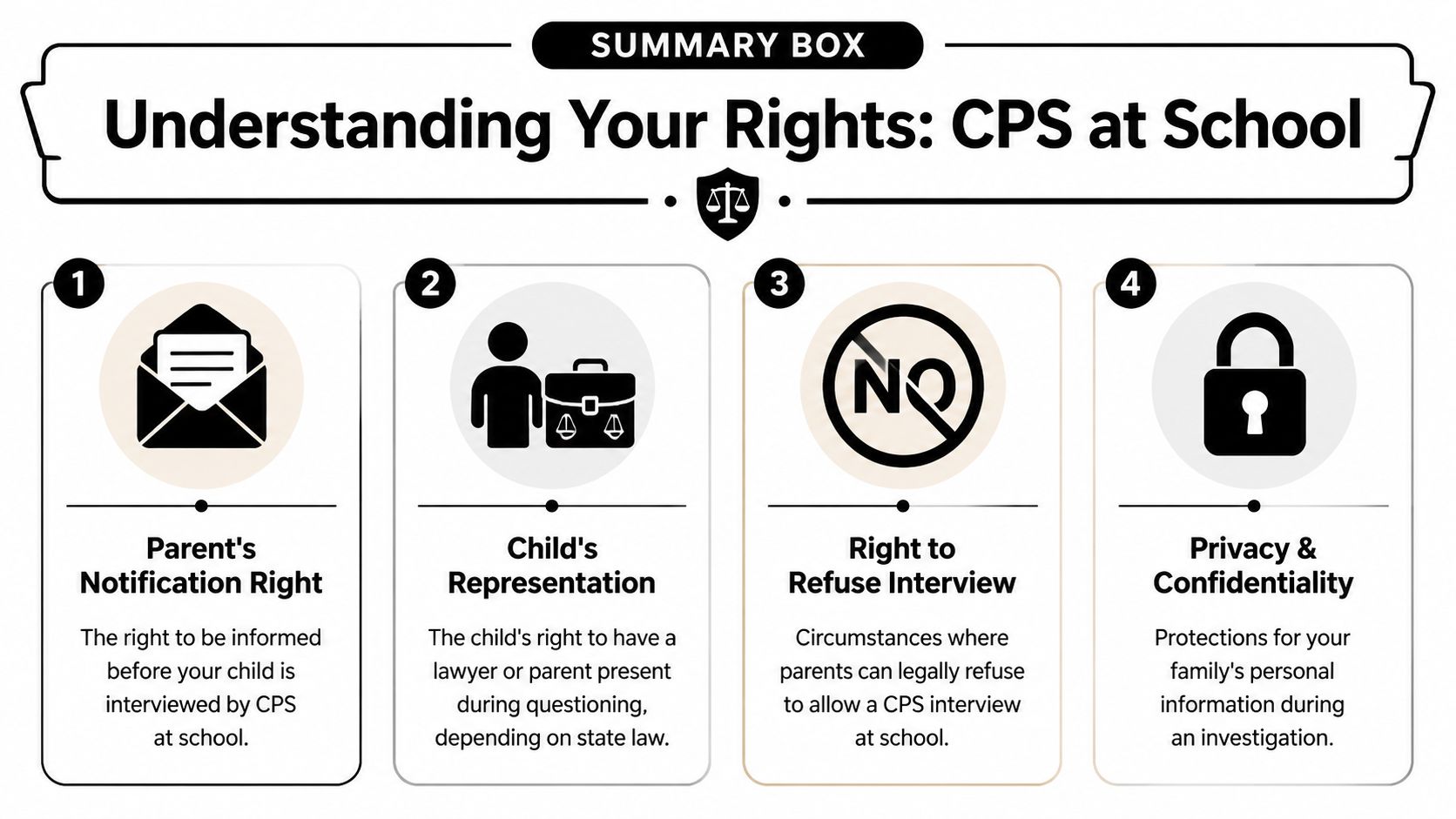
That does not mean you are powerless. It means your window to influence what happens next is short, and your job is to protect the record before assumptions harden into “facts” inside the file.
What the legal framework means on day one
Texas Family Code Chapter 262 becomes important if CPS later seeks emergency orders, court supervision, or removal. Texas Family Code Chapter 161 matters if a case escalates to termination issues. Many school-contact cases never get close to that point, but lawyers read the early stage differently than parents do. The first school interview, the first teacher summary, and the first parent response often shape how the rest of the investigation is framed.
So focus on the immediate problem. What authority did CPS have at school, what information did they likely gathered, and what can you still control in the next hour?
Rights you still have after a school interview
Once you learn CPS has spoken with your child at school, these rights matter:
- You can hire counsel immediately. You do not need to wait for CPS to call you directly.
- You can ask what allegations are being investigated. The investigator may not give full detail right away, but you are allowed to ask for the nature of the concerns.
- You can decline to answer some questions when CPS contacts you. That choice can protect you or hurt you, depending on the facts, so it should be a deliberate decision.
- You can demand accurate communication. Do not guess about dates, injuries, medical issues, discipline, or what your child “must have meant.”
- You can start building your own file. Keep a timeline, preserve messages, and document every contact with the school and CPS.
That last point matters because CPS records are built fast. If the first written summary contains mistakes, those mistakes tend to get repeated by the next worker, the next supervisor, and sometimes the next court filing.
What you usually cannot stop
Parents often ask whether they can force the school to undo the interview, block future contact, or require CPS to include them before speaking to the child again. Usually, the answer is no, at least not at that moment.
A school will usually cooperate with CPS unless a court order, district policy, or attorney involvement changes the process. That is why panic hurts and documentation helps. The better use of your energy is to identify what was said, who was present, whether notes were taken, and whether records were shared.
Be careful if you record calls
Many parents want to record school calls or CPS calls once they realize what is happening. That instinct makes sense, but do it carefully and legally. Before recording any conversation, especially one that may involve another state or a school employee, review how to stay compliant with call recording laws.
For a fuller explanation of what parents can and cannot do during this stage, read your rights during a CPS investigation in Texas.
The strongest position is controlled communication, a clean timeline, and a file of your own before CPS defines the story for you.
How to Manage the CPS Investigation Interview
Once CPS reaches you directly, the risk shifts. The school interview may have happened before you knew about it. Now the investigator is testing your reaction, your consistency, and whether your statements match what the school, the child, and any reporter already provided.

This is the point where many parents hurt their own case by talking too much, agreeing to vague wording, or trying to sound cooperative before they understand the accusation. In practice, the first parent interview often shapes the written narrative that follows. If your explanation is scattered, defensive, or speculative, that version can stay in the file long after you calm down and realize what you should have said.
Start with three goals. Slow the conversation down. Identify the exact allegation. Avoid making factual statements you cannot support.
Control the interview instead of reacting to it
A CPS investigator may sound casual. Do not mistake that for an informal conversation. This is evidence gathering.
Answer only the question asked. If the investigator says, “Tell me what happened,” do not fill ten minutes with background, family conflict, old arguments, and unrelated stress. Ask what incident they are referring to. Make them pin down the subject.
Keep your answers short and accurate:
- Ask for the specific allegation. General accusations invite broad answers and broad answers create problems.
- Use your own words. If an investigator uses loaded language, correct it politely instead of adopting it.
- Do not guess about dates, injuries, school concerns, or what your child said. “I don't know” is better than a bad estimate.
- Do not explain other people's motives. You usually do not know why a teacher, ex-partner, or neighbor made a report.
- Pause before answering. A short pause prevents careless admissions and unnecessary detail.
One sentence can change the file. A parent who says, “I may have grabbed his arm harder than I meant to, but he was acting out,” has now given CPS language they can quote. A safer response is, “I do not abuse my child. If you are asking about a specific event, tell me the date and what is being alleged.”
Use a prepared script
Parents do better when they decide on their language before the call gets tense. A simple script works:
I am willing to cooperate. I want to understand the allegation clearly. I do not want to speculate, and I want counsel involved before any detailed interview.
That response is calm and firm. It does not make admissions. It does not pick a fight. It also signals that you are paying attention to how the record is being built.
If you need help preparing for the wording and traps that come up in these conversations, review best strategies for answering Texas CPS questions in an interview.
A short video may also help you prepare for the tone and pace of these interactions:
Cooperation has limits
Cooperating with CPS does not require you to accept inaccurate summaries, sign papers on the spot, or answer every broad question without preparation. It usually does mean staying reachable, being civil, and responding in a controlled way.
That balance matters. If you become hostile, the investigator may describe you as evasive or volatile. If you become overly eager to explain everything, you may hand over facts that are incomplete, mistaken, or easy to take out of context.
A better approach is measured cooperation. Confirm basic logistics. Ask what the allegation is. Request time to gather your thoughts or speak with counsel before giving a detailed statement. If legal help is needed, a Texas parent may consult private counsel, including the Law Office of Bryan Fagan PLLC, before sitting for a full interview.
Gathering Evidence to Protect Your Family
Once the first shock passes, start building your own file. Don't wait for CPS to define your family through snippets from a school interview, a teacher note, or a misunderstood report.
A strong response is based on targeted record management. Public guidance on child welfare investigations emphasizes notifying the school principal and registrar that requests should be routed to legal counsel and asking for a log of disclosures so school staff don't accidentally expand the investigative record, as explained in the ACLU of Southern California's child welfare rights guidance.
Build your parent file
Create one folder, digital or paper, and organize it by category.
- School records. Report cards, attendance summaries, disciplinary notices, special education documents if applicable, and teacher communications.
- Medical records. Pediatric visits, vaccination records, therapy attendance, prescription information, and discharge instructions if there was a recent injury or illness.
- Home-condition proof. Current photos of sleeping arrangements, food in the kitchen, working utilities, and safety features relevant to the allegation.
- Caregiving history. Calendars, pickup logs, childcare schedules, and messages showing who cared for the child and when.
- Communication history. Emails, texts, and parenting-app messages if a coparent, relative, or school employee may have triggered the report.
Think like a fact witness
The best evidence is boring, specific, and easy to verify.
A parent saying, “I'm a good mother” carries less weight than school attendance records, a recent well-child check, and messages showing the child was picked up on time, taken to appointments, and supervised by known caregivers. If the concern involves bruising, missed school, hygiene, or emotional state, gather materials that address that exact issue. Don't dump everything you have into one pile and hope someone sorts it out later.
Ask for preservation, not favors
When dealing with the school, avoid requests like “Please tell CPS they have this all wrong.” Instead, ask for concrete preservation steps:
| School contact | What to request |
|---|---|
| Principal | Preserve emails, meeting notes, and administrator communications |
| Registrar | Log all record requests and all disclosures made |
| Counselor | Preserve notes and identify whether CPS requested an interview or records |
| Nurse | Preserve visit logs and health-related documentation |
Keep your evidence chronological. A clean timeline often tells the story better than an emotional statement.
Understanding Potential Outcomes of a CPS Investigation
Parents usually calm down once they understand the possible endings. Uncertainty is often harder than the facts.
The hard part is that many public resources focus on the interview itself and say very little about the gap before the parent is contacted. New York child protective guidance reflects that gap in practical detail, which is one reason parents should move quickly to get advice as soon as they learn the school was contacted, as seen in the New York CPS FAQ.
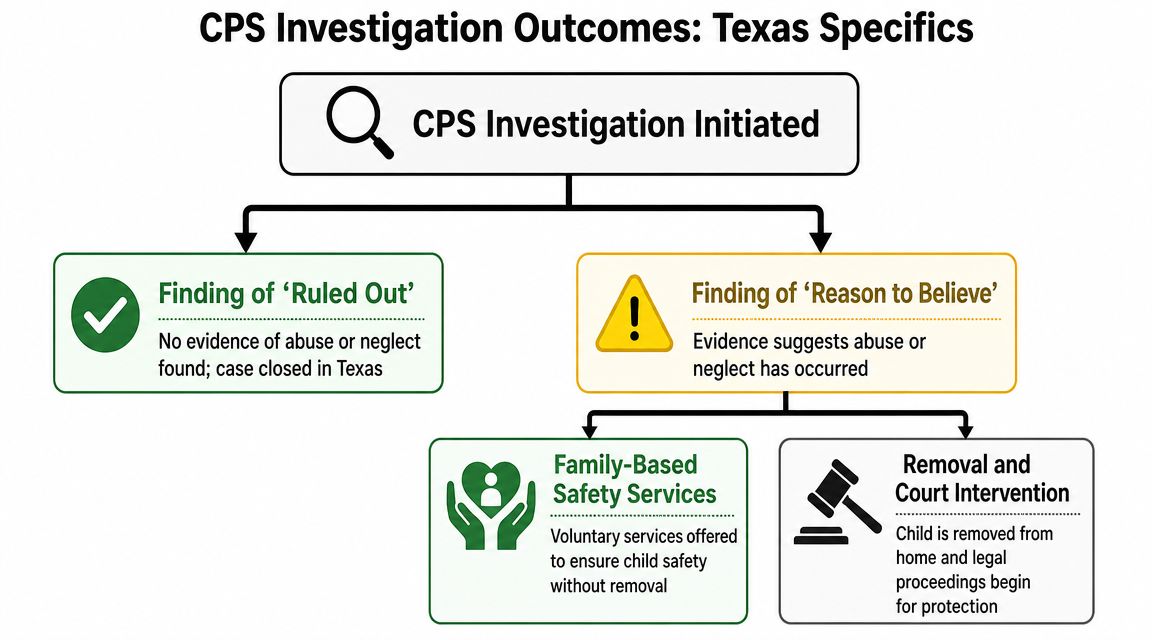
Common investigation findings
In Texas practice, parents often hear terms such as Ruled Out, Reason to Believe, or Unable to Determine. The labels matter, but what matters more is what happens next.
| Possible result | What it usually means |
|---|---|
| Ruled Out | CPS did not substantiate abuse or neglect and may close the matter |
| Unable to Determine | CPS does not reach a clear conclusion and the result may still affect how the agency views future reports |
| Reason to Believe | CPS believes the allegation is supported and may push for services, monitoring, or court action |
What follows an adverse finding
A Reason to Believe finding doesn't mean your case is over. It means the case may shift into a more serious phase. That can involve requests for services, safety planning, family-based intervention, or in more severe situations, litigation under Chapter 262. If CPS later seeks long-term restrictions or termination, Chapter 161 becomes more relevant.
Some families also benefit from outside support while the legal issues are addressed. If communication in the household has broken down, structured relationship counseling for families can help stabilize daily life without replacing legal strategy.
What parents should do based on the result
- If the case is closed: keep your records anyway. Future reports are easier to address when your file is organized.
- If the finding is unclear: ask counsel what review or response options exist.
- If CPS pushes services or court action: don't assume every “voluntary” step is harmless. Read before signing and get legal advice.
A CPS finding is not just a label. It changes leverage, deadlines, and the decisions you need to make next.
Taking Control and Securing Your Family's Future
The parents who protect themselves best are not always the loudest or the most confident. They are usually the most organized. They understand that a school contact is not just a misunderstanding to clear up casually. It is the beginning of a record.
That mindset becomes even more important if your case grows beyond the investigation stage. Texas Family Code Chapter 263 governs many of the review and permanency procedures that apply once a case is in court. If your family reaches that stage, progress depends on something very practical: documented compliance, consistent messaging, and a realistic plan for your child's safety and stability.
What taking control actually looks like
Control doesn't mean controlling CPS. It means controlling your own side of the case.
- Protect the record. Keep communications short, factual, and preserved.
- Protect the child. Don't coach your child on what to say. Do make sure they feel safe, calm, and supported.
- Protect the timeline. Respond promptly, but not impulsively.
- Protect your future options. Don't sign safety plans, releases, or statements you haven't fully understood.
A parent in this position may also need to support a child emotionally while the adults handle the legal side. If your child is overwhelmed, a simple family-centered resource on That's Okay youth mental health safety planning can help you think about emotional stability at home during a stressful investigation.
A relatable example
Take a parent who learns at 10:15 a.m. that CPS spoke with the school counselor. By noon, that parent has already made things worse if they have called three teachers, texted the other parent accusing them of making a false report, sent the principal a long email explaining family history, and posted online asking what to do.
The stronger version of that same day looks different. The parent confirms whether the child was interviewed, requests a disclosure log, asks the school to preserve records, contacts counsel, gathers medical and school documents, and waits to speak carefully once CPS makes direct contact. Same facts. Very different file.
The larger point
What to Do If CPS Contacts Your Child's School is not mainly about winning an argument with the school. It's about slowing down a process that moves quickly and making sure your family is not defined by rushed statements, incomplete records, or fear.
If CPS is already asking questions, the case may affect school records, home visits, court hearings, custody issues, and in serious cases, parental rights. Early legal guidance often makes the biggest difference because the first version of events tends to stay in the file.
If CPS has contacted your child's school, don't try to manage the investigation alone. A calm, early response can protect your rights, your record, and your relationship with your child. Contact Law Office of Bryan Fagan PLLC for a free consultation to discuss what has happened, what CPS may do next, and how to respond without making the situation worse.