Skip to content
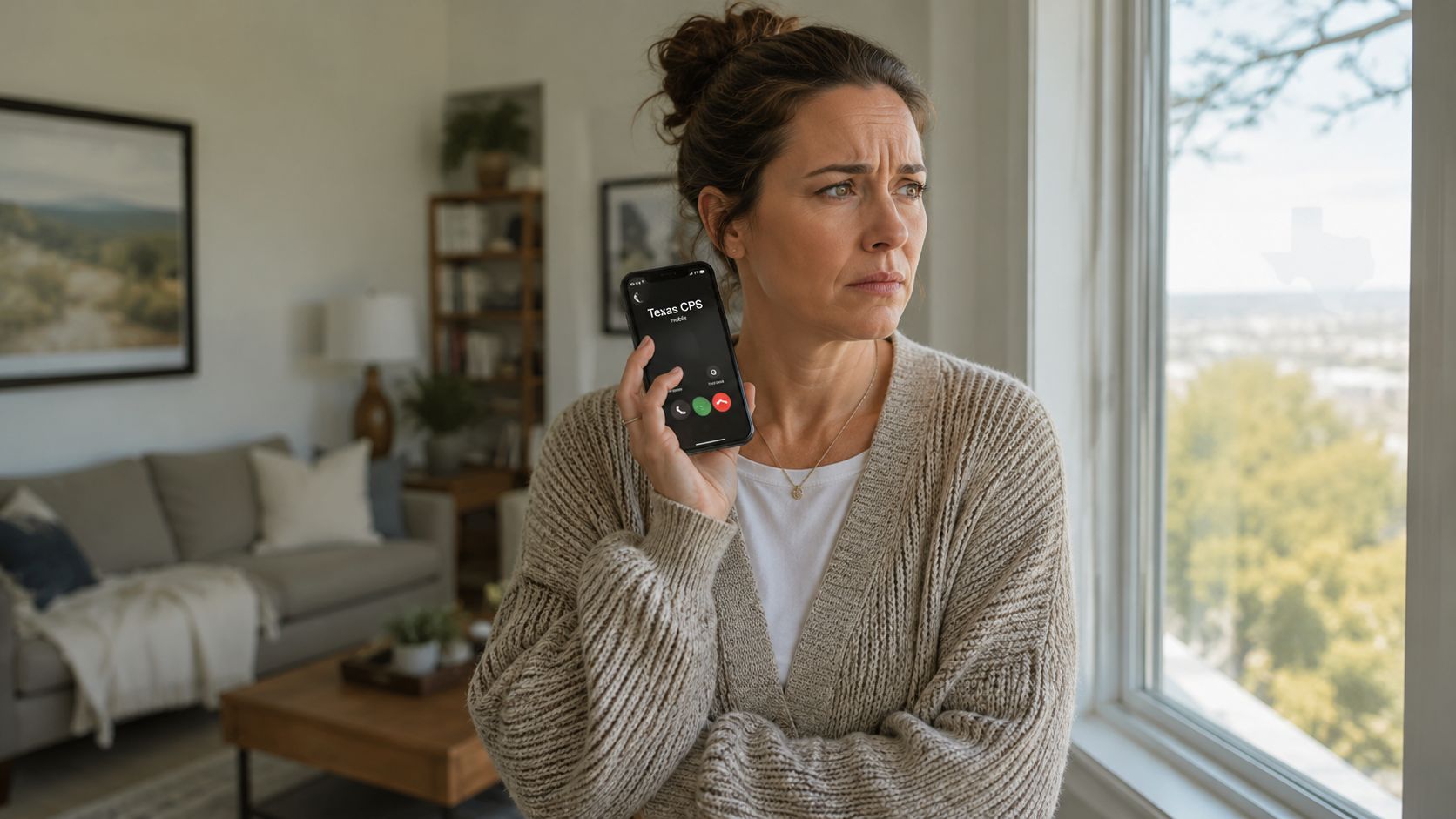
You're in another state. Your phone rings. The caller says they're with Texas CPS, and they're asking about your child.
Most parents freeze at that point. Some get angry. Some assume there must be a mistake. Others think they should get in the car, drive to Texas, and fix it in person by sheer force of will. That reaction is understandable. It can also create new problems if you move before you understand what Texas is doing and what the court expects from you.
A Texas CPS case involving an out-of-state parent is serious, but it isn't hopeless. It has rules, deadlines, and pressure points. If you understand them early, you can protect your rights, show the court you are a real placement option, and avoid mistakes that make reunification harder.
The hardest part for many parents is distance. You may love your child, want immediate contact, and still feel shut out because the case is happening in Texas. That doesn't mean you have no voice. It means you need to act in a way that fits Texas procedure, interstate placement rules, and the court's timeline under the Texas Family Code.
That Unsettling Phone Call from Texas CPS
The first call often feels surreal. You live in Oklahoma, Colorado, Louisiana, or somewhere farther away. The child may be with the other parent, a relative, or already in temporary care in Texas. A caseworker asks where you live, whether you can take the child, whether you've had prior involvement with child welfare, and whether you can submit to a home study.
For many parents, the first instinct is to defend themselves against accusations they haven't even heard clearly yet. The better first move is simpler. Stay calm. Get the caseworker's full name, phone number, email, office, the child's current location if they'll provide it, the court information if a case has been filed, and the next hearing date if one exists.
This situation is more common than many parents realize. A national study found that roughly 1 in 3 children will experience a CPS investigation, which shows that CPS involvement is not a rare event and that early action matters, especially for parents living in another state, as reported in the PubMed Central study on cumulative CPS contact.
A familiar scenario
A father in New Mexico gets a call that his child has been removed in Texas after allegations involving the custodial parent's home. He hasn't seen the child as often as he wanted because of distance and conflict with the other parent. He assumes Texas will contact him again if they need anything.
That assumption can cost him. In the early phase of a CPS case, silence gets interpreted in the worst possible way. It can look like lack of interest, instability, or inability to step forward.
Practical rule: If Texas CPS contacts you, respond promptly and in writing after the call. A short, clear email confirming that you want to be considered for placement can matter.
What helps and what hurts right away
Some responses move a case forward. Others create friction immediately.
- Helpful: Confirm your relationship to the child, ask for the cause number, request hearing information, and say you want placement considered.
- Helpful: Start gathering identification, proof of address, proof of employment or income, and any prior court orders.
- Unhelpful: Arguing with the caseworker for an hour about the other parent's history without providing documents or a practical plan.
- Unhelpful: Threatening to take the child across state lines before Texas approves placement.
The point isn't to say less. It's to say the right things early. Texas CPS and the court want to know whether you are available, stable, reachable, and ready to follow process.
Understanding Jurisdiction and the ICPC
Texas usually takes the lead because the child is in Texas, the allegations arose there, or the removal occurred there. That's why a parent living elsewhere often feels like they're being pulled into a legal system they didn't choose. In practice, Texas controls the case until a court says otherwise.
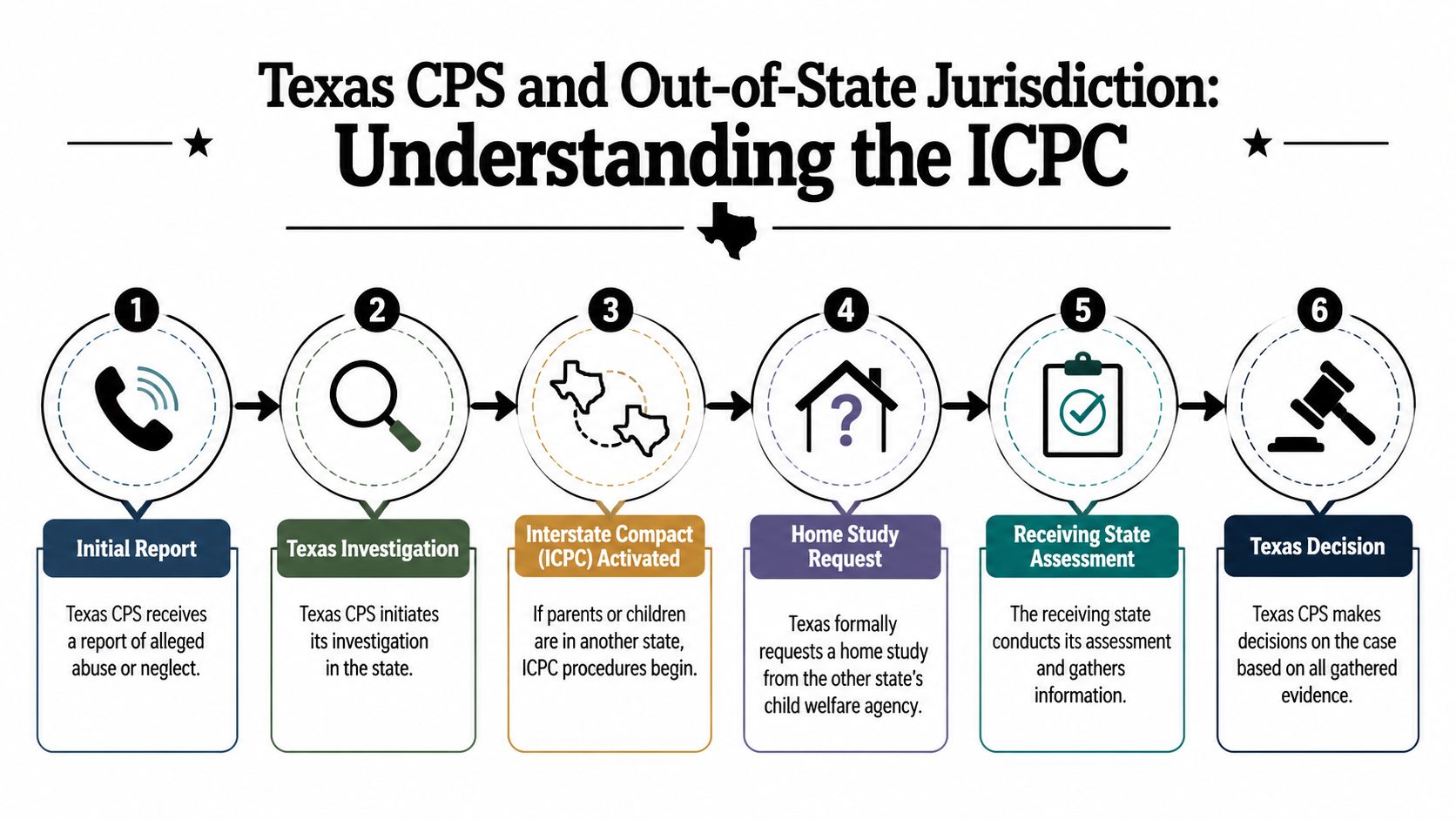
Then the interstate issue appears. If Texas is considering placing the child with you in another state, the case usually triggers the Interstate Compact on the Placement of Children, often called the ICPC. The easiest way to think about it is this. It's the formal clearance process states use before a child is sent across state lines for placement.
Why Texas won't let you just pick up your child
Parents often say, “I'm the parent. Why can't I just come get my child?” The legal answer is that custody rights and interstate placement compliance aren't always the same thing inside a live CPS case.
Texas treats an unauthorized interstate move seriously. If a parent or caregiver moves a child into Texas from another state without prior ICPC approval, Texas treats that as an illegal placement, and the Texas Interstate Compact Office must request the child's return to the sending state if the paperwork is not completed, according to the Texas DFPS ICPC handbook provisions.
That rule tells you something important about the reverse situation too. Even if you believe you have strong custody rights, crossing state lines without following the court process can backfire.
The early court stage matters
In a removal case, the first hearings often shape the case more than parents expect. If you want to understand why those first days matter so much, The 14-Day Adversary Hearing: A Parent's First Chance gives a useful overview of why the adversary hearing is the most critical early battle in a CPS removal case.
Texas isn't asking whether you love your child. Texas is asking whether it can lawfully and safely place your child with you right now.
Here's the trade-off. If you push too hard without respecting the process, Texas may see you as impulsive or noncompliant. If you wait too long, the case can move ahead without your voice. The workable middle path is immediate, organized cooperation.
How Texas Coordinates with Your Home State
Once Texas identifies you as a possible placement, your home state usually becomes part of the picture. That doesn't mean your own state takes over the case. It means your local child welfare agency may act as the investigating arm for Texas on specific tasks, especially a home study.
A realistic example helps. Say you live in Colorado and Texas CPS calls to say your child has entered care in Texas. A few days later, someone from your county or state agency contacts you and says Texas has requested information about your home. That local worker is not replacing Texas. They're gathering facts that Texas will use.
What the home study often involves
A home study usually focuses on whether your residence is safe, whether you can meet the child's daily needs, and whether there are concerns that would affect placement. The exact process differs by state, but most parents should expect requests for documents, interviews, and some form of home assessment.
Parents often do better when they prepare before the first visit.
- Housing proof: Lease, mortgage statement, utility bill, or other proof that shows where you live.
- Identity and relationship records: Birth certificate, acknowledgment of paternity if applicable, prior custody orders, and photo ID.
- Financial stability: Pay stubs, employment verification, or other proof that you can support the child.
- Practical readiness: School options, sleeping arrangements, childcare plans, medical access, and transportation.
What your local agency is really reporting back
Your local worker is functioning as Texas's eyes and ears. They're not just checking whether your home is clean. They're often evaluating whether you follow through, answer calls, show up on time, provide records, and speak responsibly about the case.
That means a parent can hurt their chances without any dramatic misconduct. Missed appointments, hostile calls, incomplete paperwork, and inconsistent explanations all raise concern.
If your home state worker asks for something, treat it like a court-related deadline, even if it arrives by voicemail or email instead of formal order.
A better way to handle the conversation
Many parents make one of two mistakes. They either overshare every grievance they've ever had with the other parent, or they say almost nothing because they distrust the system. Neither approach works well.
Use a narrow, disciplined approach:
- State that you want placement.
- Answer questions directly.
- Provide documents quickly.
- Explain any past issues briefly and truthfully.
- Focus on the child's immediate safety and stability.
If there's something in your background that may come up, such as an old criminal case, prior CPS history, or a prior period of instability, don't assume it will stay hidden. Address it with context and evidence of change. Parents usually get more traction from candor and documentation than from denial.
Emergency Hearings and Your Immediate Actions
You may still be processing the call from Texas when the first court date is already on the calendar. That is how these cases work. The court moves quickly after a removal, and an out-of-state parent can lose valuable time by waiting for a formal packet to arrive in the mail.
The first hearing often sets the tone for everything that follows. The judge is deciding who will have temporary control over the case, what immediate safety concerns exist, and whether CPS will keep managing the child's placement while the case continues. If you are not there, even by phone or video, the court gets an incomplete picture of your role, your availability, and your plan for the child.
For an out-of-state parent, the immediate goal is straightforward. Get yourself in front of the court, get your request for placement on the record, and make it clear that you want ongoing contact with your child.
Why this hearing carries so much weight
In a Texas removal case, early hearings are not just procedural checkpoints. They are where the court starts forming opinions about urgency, credibility, and whether a parent is prepared to act. Distance can make a good parent look uninvolved if no one explains the facts clearly and early.
That problem can be fixed, but speed matters.
A parent who appears and speaks carefully can usually make several points clear right away:
- You want the child considered for placement with you
- You are ready to cooperate with any home study or background check
- You want visitation, calls, or other contact started now
- You want notice of every future hearing and filing
- You dispute any suggestion that you failed to care about the child or disappeared
If you need a clearer picture of what Texas courts examine at this stage, this guide to adversary hearings in Texas CPS cases is a useful starting point.
What to do in the first 48 hours
Start with tasks that create proof.
Call the district clerk and confirm the court number, cause number, hearing date, and hearing time. Ask whether the hearing will be in person, by Zoom, or by telephone. Then email the CPS caseworker and, if you have names for the attorneys, copy them too. State your full name, your relationship to the child, your current address, your phone number, and that you are requesting placement, notice, and contact with the child.
Keep that email short. Keep it calm. Save it.
Next, gather the documents you may need on short notice: identification, proof of address, proof of employment or income, and any records that show stable housing or a support system. If there is a fact CPS may view as a problem, such as an old charge, prior CPS history, or a gap in contact, prepare a brief explanation with supporting records if you have them. Do not wait to be accused before getting organized.
What judges and CPS notice immediately
Parents sometimes assume the first hearing is too early to matter because the court does not know them yet. In practice, the opposite is often true. Early conduct tells the court whether you are likely to follow through.
Judges notice whether you appeared. Caseworkers notice whether you answered calls and sent documents. Attorneys notice whether you are focused on the child or on fighting every grievance from the past.
That does not mean you need a polished speech. It means you need a clear position. State that you want your child safe, you want to be considered now, and you are prepared to comply with the court's requirements.
Avoid the mistakes that cost parents time
Two patterns cause real damage in these early days. One is silence. The other is emotional overreaction in writing, by text, by email, or on a recorded call with CPS.
A better approach is disciplined and specific:
- Confirm the hearing details yourself.
- Ask how to appear remotely if you cannot get to Texas in time.
- Put your request for placement and visitation in writing.
- Keep a folder with every email, call log, and document you send or receive.
- Show up prepared to answer direct questions about housing, work, childcare, and safety.
If you are trying to keep communications organized during a stressful interstate case, some parents also use privacy-minded tools to reduce confusion. One example is Safety that runs along. No noise, no control, just Safe..
A parent who acts quickly, stays measured, and creates a paper trail is in a stronger position than a parent who waits for Texas to tell them what to do next.
Protecting Your Parental Rights from Afar
You may be hundreds of miles from the Texas courthouse, but the case is still judging your follow-through. From the court's perspective, distance explains logistics. It does not excuse delay, missed services, or silence.
The parents who protect their position in these cases do three things early. They get organized, they respond in writing, and they make Texas deal with them as an active parent, not a distant afterthought.
For many out-of-state parents, hiring Texas counsel is the practical turning point. A Texas lawyer can appear at hearings, press the caseworker for answers, object when assumptions start hardening into recommendations, and make sure your request for placement stays in front of the court. Informal updates are not enough in a CPS case. You need someone who can act inside the Texas process while you handle requirements in your home state.

If you are trying to keep messages, call logs, and location-related communication organized without creating more confusion, some parents use privacy-minded tools for that purpose. One example is Safety that runs along. No noise, no control, just Safe..
The documents that usually matter most
Start with records that answer the court's basic question: can this parent provide a safe, stable home now or soon?
- Proof of legal relationship: Birth certificate, acknowledgment of paternity, custody orders, child support orders, or prior family court records.
- Proof of housing: Lease, mortgage statement, utility bill, and, if requested, photos showing where the child would sleep and who lives in the home.
- Proof of income and routine: Pay stubs, employer letter, work schedule, and a realistic childcare plan if you work outside the home.
- Proof of stability: Counseling records, substance abuse treatment records, negative drug test results, or certificates for completed classes, if those issues are part of the case.
Send documents in labeled PDFs or clearly named photo files. A well-organized packet helps your lawyer and leaves less room for CPS to say they are still waiting on information.
The service plan issue parents underestimate
Out-of-state parents often assume Texas cannot require much from them until placement is resolved. That assumption causes problems. If CPS or the court asks you to complete services, treat that request seriously and clarify the details fast.
Services may include counseling, psychological evaluations, drug testing, parenting classes, domestic violence work, or other tasks tied to the allegations. In Texas cases, these requirements often become part of the Family Service Plan, and the record of whether you complied can shape later rulings on reunification, conservatorship, and visitation.
If a service is impossible to complete as written because you live in another state, do not ignore it. Ask for a written alternative, a comparable provider in your state, or a modified deadline. Parents who need a clearer picture of the reunification process can review this guide on how to get your child back from CPS.
What effective advocacy looks like
The Law Office of Bryan Fagan PLLC handles Texas CPS matters. For an out-of-state parent, that usually means having someone who can address the Texas court process while you complete tasks back home and keep your record clean.
What helps most is consistent, documented effort.
| Issue | What helps | What hurts |
|---|---|---|
| Communication | Brief written follow-up after calls | Emotional texts, arguments, and missed responses |
| Placement request | A direct written request to be considered for placement | Assuming CPS already knows your position |
| Services | Fast enrollment and proof of attendance or completion | Waiting until the next hearing to start |
| Visitation | Asking for a set schedule and remote options if needed | Accepting vague promises without confirmation |
| Hearings | Appearing every time and being ready with updates | Missing hearings because travel is difficult |
Parents still have rights here. They also have work to do. The stronger approach is simple: stay visible, stay organized, and give the Texas court a clear record that you are ready to parent.
The Texas CPS Timeline and Interstate Delays
Time is the pressure point most out-of-state parents don't fully appreciate until months have passed. Texas removal cases run on a court clock, not on the pace of your work schedule, your travel ability, or your home state's bureaucracy.
Texas law requires CPS to seek a hearing within 14 days of removal, and the case should ideally reach a final order within 12 months. For out-of-state parents, ICPC work happens inside that same period, so placement delays can eat up time that might otherwise go toward reunification, as explained in this discussion of Texas CPS deadlines and litigation timing.

Why delay is dangerous
A parent may do many things right and still lose ground if paperwork sits, home study scheduling drags, or services begin late. The court keeps moving. Review hearings happen. Permanency planning develops. The child settles into a placement. Judges start asking whether progress is happening in real time.
That's where Chapter 263 pressure starts to matter. If the case gets close to dismissal or final order and your home study, services, or placement decision still isn't complete, the court may make long-term decisions before your interstate process catches up.
The foster care reality behind the urgency
These cases often stay under court oversight for meaningful periods of time. In 2023, 360,531 children and youth were living in foster care, 188,290 exited care that year, and just under 45% of those exits were reunifications with a parent or primary caretaker. The same source also reports that more than 15,000 youth left foster care in 2023 without reunifying with parents or finding another permanent home. It also notes a historical decline from about 559,000 children in 1998 to 368,000 in 2022, a 34% decrease, while average time in care rose to about 24 months in recent years, according to the Annie E. Casey Foundation child welfare and foster care statistics.
Those figures don't predict what will happen in your case. They do show why parents can't treat delay as harmless.
The practical response to the timeline
The best response is front-loaded effort.
- Start services immediately if requested, even if you still disagree with parts of the case.
- Follow up on interstate paperwork regularly and politely.
- Document every completed step so your lawyer can put progress in front of the court.
- Track the larger case calendar using a resource like this guide to the Texas CPS timeline and what parents should expect.
In Texas CPS cases, waiting for the system to catch up is rarely a strategy. It's usually a risk.
Frequently Asked Questions for Out-of-State Parents
Can I go to Texas and take my child home if I already have a custody order
Not safely without checking the CPS case status first. A prior custody order matters, but once Texas has an active CPS case or removal order, the court and CPS process control what happens next. Acting on your own can create a new allegation that you ignored the court.
What if my home state thinks I'm fine, but Texas still won't place the child with me
That happens. A favorable local assessment helps, but Texas still decides placement in the pending case. The issue may be paperwork, unresolved allegations, missing paternity documentation, concerns about services, or court rulings already made in Texas.
How do I get visitation from another state
Ask early and in writing. Courts and caseworkers may allow video visits, phone contact, supervised in-person visits, or a structured schedule that fits distance. If contact isn't happening, raise it through counsel and at hearings instead of waiting for the caseworker to volunteer a plan.
What if the Texas parent is blocking information or refusing to cooperate
Don't make that your only argument. Courts hear parental conflict every day. Focus on what you can prove. Your housing, your history with the child, your ability to provide care, your hearing attendance, and your compliance with requests matter more than trading accusations.
Could my rights be terminated even if I live out of state
Yes. Distance alone doesn't terminate rights, but failing to engage, missing services, ignoring hearings, or waiting too long to establish yourself as a viable parent can put you in danger under the Texas Family Code, including the termination framework found in Chapter 161.
If you're dealing with CPS and an out-of-state placement issue, don't wait for the next call and hope it clarifies itself. A Texas case can move quickly, and the earlier you act, the more options you usually have.
If Texas CPS has contacted you and you live in another state, get legal advice specific to your situation as soon as possible. The Law Office of Bryan Fagan PLLC offers free consultations for parents facing Texas CPS cases. A confidential conversation can help you understand where the case stands, what deadlines matter next, and what you can do now to protect your relationship with your child.