Skip to content
When a parent searches can CPS take my child in Texas, they usually aren't doing casual research. They're scared, sleep-deprived, and trying to figure out whether the person who just called, texted, or showed up at the door can remove their child today.
That fear is real. CPS cases move fast, the language is confusing, and many parents make serious mistakes in the first few hours because they think cooperation means saying yes to everything. It doesn't.
Texas law gives CPS power, but it also gives parents rights. Those rights matter most at the beginning. If you understand what CPS can legally do, what it cannot do, and where families get trapped by “voluntary” agreements, you put yourself in a much stronger position right away.
That Knock at the Door Your Worst Fear Realized
A common scene looks like this. It's late afternoon. You've just gotten home, your child is hungry, and someone knocks. A caseworker says there's been a report. They want to come in, look around, and talk to your child alone.
Most parents freeze at that moment.
Some get angry. Some start explaining everything at once. Some sign papers because they think refusing will make them look guilty. That reaction is understandable, but it's dangerous. A CPS investigation is not a normal conversation. It's a legal event with real consequences for your family.
Take a parent accused by an ex of drug use during a custody fight. The allegation may be false, exaggerated, or missing context. CPS still may open an investigation. The caseworker may sound calm and reasonable. That doesn't mean the risk is low. It means you need to slow down and act carefully.
Practical rule: The first goal is not to “win over” the investigator. The first goal is to avoid giving up rights you didn't know you had.
If CPS has contacted you, focus on staying calm, being polite, and getting informed before you agree to anything. A useful starting point is this guide on how to respond when CPS shows up at your door in Texas.
You are not powerless. You are also not dealing with a harmless misunderstanding. Both things are true.
The Legal Threshold for Removing a Child in Texas
Parents often assume CPS can take a child whenever a caseworker feels concerned. That is wrong. Texas law does not allow arbitrary removals.
Under Texas law, CPS may remove a child only through two legal pathways: with a court order supported by a sworn affidavit showing imminent danger, or in an emergency where immediate removal is necessary to prevent serious harm, followed by judicial review within one business day. The burden of proof is on CPS, not on you, as explained by Texas Law Help's CPS investigations guide.
What imminent danger really means
“Imminent danger” doesn't mean a caseworker is uneasy or disapproves of your parenting style. It means a serious risk to the child's physical or mental safety that can't wait.
Think of it this way. A messy home is not the same as a home with immediate danger. A parenting disagreement is not the same as a threat of serious harm. Suspicion is not evidence.
For emergency removals without a court order, DFPS must show exigent circumstances, meaning there is reasonable cause to believe the child faces imminent danger of physical or sexual abuse if left at home. Before removing, DFPS must weigh specific factors, including whether there was time to get a court order, the severity of the alleged abuse, and whether there is a risk the parent may flee with the child, as discussed in this Chapter 262 hearing outline.
What CPS has to prove
Texas Family Code Chapter 262 matters here. So does the practical evidence standard used early in these cases. If CPS removes first and asks questions later, the agency still has to justify that decision in court almost immediately.
A useful companion read is what evidence does CPS need to remove a child in Texas. If you're already dealing with a removal, Emergency CPS Removal in Texas: What Parents Must Know gives a straightforward look at what happens next and the strict deadlines under Chapter 262.
A CPS worker can investigate a report. That does not mean the worker automatically has legal grounds to remove your child.
Two pathways at a glance
| Pathway | What CPS needs | What happens next |
|---|---|---|
| Court-ordered removal | Sworn affidavit and judicial approval showing imminent danger | Child may be removed under the order |
| Emergency removal | Immediate necessity to prevent serious harm | Court review must occur within one business day |
If you remember one point, remember this. CPS needs evidence and legal authority. It does not get to remove a child just because an investigator feels uncomfortable.
The Investigation and the Voluntary Safety Plan Trap
The biggest trap for Texas parents usually isn't the dramatic emergency removal. It's the paper put in front of them while a caseworker says, “If you cooperate, we can keep this out of court.”
That paper is often a Family Safety Plan.
Why this catches families off guard
A safety plan sounds temporary and harmless. It may ask you to let a relative keep the child, move out of your own home, supervise all contact, or accept house rules created by CPS. Many parents sign because they think it's better than “fighting” the agency.
Sometimes it may reduce immediate conflict. But parents need to understand what they are giving up.
Many families are pressured into signing a Family Safety Plan that functions like a removal without judicial oversight. Parents often aren't told they can refuse these plans without legal counsel, and signing may include clauses that waive the right to the critical adversary hearing that would otherwise occur after a formal emergency removal.
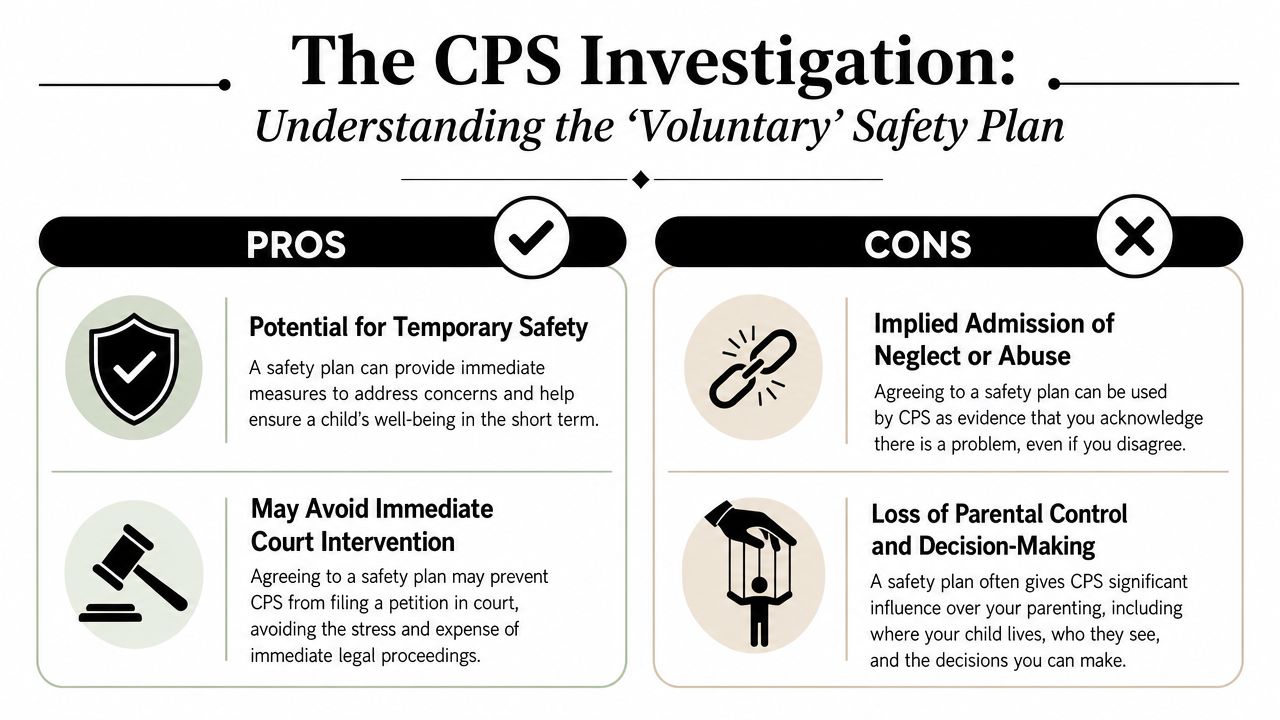
Voluntary on paper, coercive in practice
Black-letter law and real life often diverge. On paper, a safety plan is voluntary. In practice, parents often sign under pressure because they fear immediate removal if they hesitate.
That's why I tell parents to treat a safety plan like a legal document with custody consequences. Because that's what it can become.
Read this closely. A safety plan is not the same as a court order. A judge has not approved it. You may still feel forced into it. That's exactly why you shouldn't sign one casually.
A helpful resource on this issue is CPS safety plans in Texas.
Cooperation is not blind consent
You can be respectful without surrendering control. You can answer basic questions without signing away your rights. You can tell a caseworker you want legal advice before agreeing to any placement, supervision rule, or written plan.
Here's a practical comparison:
- Formal removal: CPS takes legal responsibility to justify its action in court.
- Safety plan: You may hand over real control while avoiding the hearings that force CPS to prove its case.
- Result: Families sometimes lose the protections they would have had if CPS had removed the child openly.
If a caseworker says, “Just sign this and we can work it out later,” stop. Later is when parents discover they've already given away the ground they needed to stand on.
Child interviews and home access
During an investigation, CPS may also want to inspect your home and speak with your child. Parents should approach both issues carefully. What you allow, when you allow it, and under what conditions can affect the case record from the start.
The main point is simple. Don't confuse being calm with being passive. A CPS investigation is where facts get framed, and those first impressions can carry forward into court, service plans, and reunification decisions under Chapters 263 and 161.
Navigating the First 14 Days and the Court Timeline
If CPS removes your child, the clock starts running immediately. Those first two weeks matter more than most parents realize because during this period CPS must justify the removal and your lawyer can begin pushing for return, placement options, and visitation.
The first deadline
Texas procedure does not let CPS remove a child and then disappear with the case. If DFPS removes a child without a court order, it must file suit and request an initial hearing by the next business day. Then the bigger deadline arrives.
Within 14 days after an emergency removal, a full adversary hearing must be held. At that hearing, the court must order the child returned unless CPS presents evidence that would satisfy a person of ordinary prudence and caution that a continuing danger exists and that reasonable efforts were made to prevent removal, according to Texas Public Policy Foundation's discussion of Section 262.201(g).
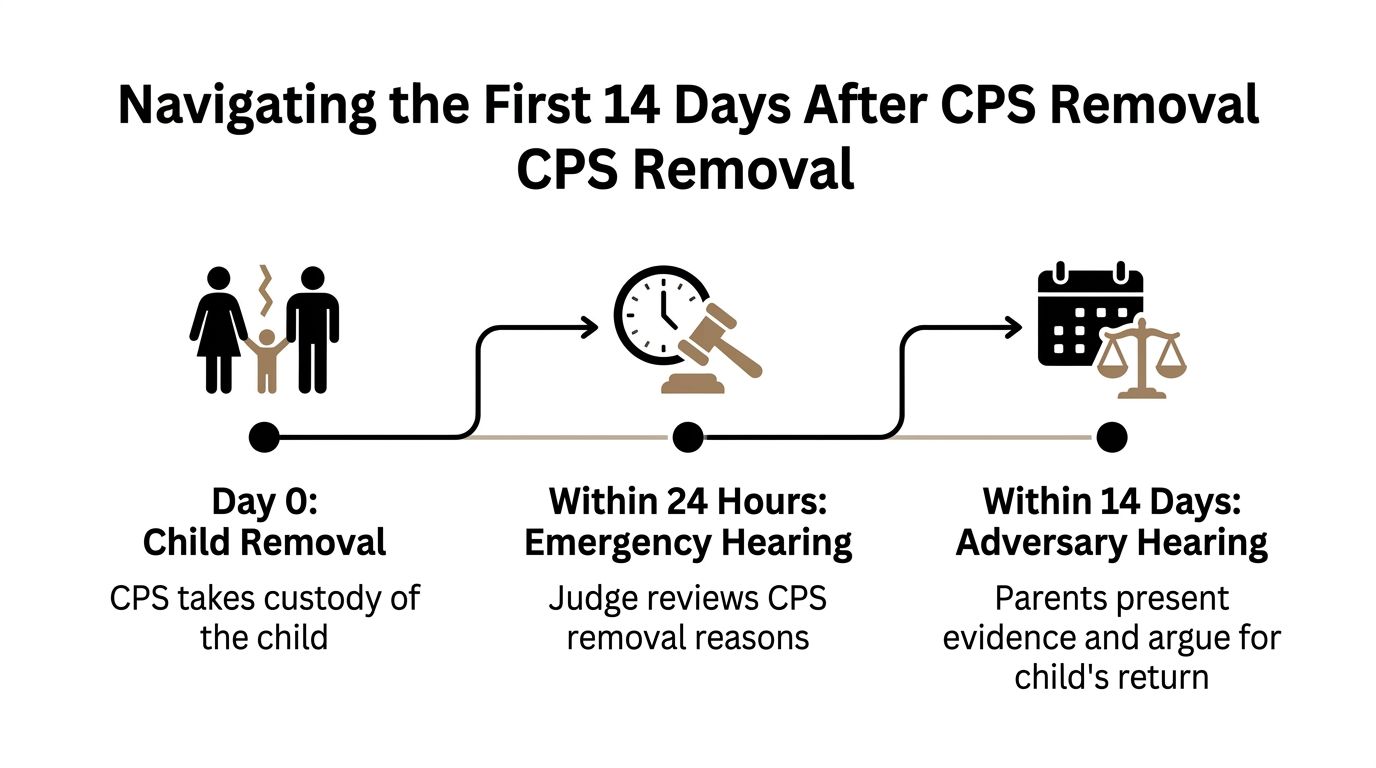
What happens on the timeline
The early process usually looks like this:
Removal happens
CPS takes the child under a court order or claims an emergency justified immediate action.Very early court review
The agency has to get in front of a judge quickly if there was no prior order.Adversary hearing within 14 days
This is your first major chance to challenge the removal.
What the judge is deciding
At the adversary hearing, the judge is not deciding the entire future of your family. The judge is deciding whether CPS should keep temporary control for now.
That question turns on concrete issues:
- Was there real danger
- Was removal urgent
- Did CPS try reasonable alternatives first
- Is there still a continuing risk if the child returns home
Bring the facts that answer those questions. That may include text messages, medical records, school information, names of safe relatives, proof of housing, proof of sobriety, or testimony that undercuts the original allegation.
Courtroom reality: The 14-day hearing is often the parent's best early opportunity to force CPS to defend its story under oath.
Why Chapter 263 starts to matter quickly
After the initial hearing phase, Chapter 263 shapes review hearings, permanency planning, and the pace of the case. If the case continues, deadlines, service tasks, and placement decisions begin to stack up fast. If a parent falls behind early, CPS may later use that history to argue for prolonged separation or even termination under Chapter 161.
That's why the early hearing is not a minor procedural stop. It sets the tone for everything after it.
Your Essential Parental Rights in a CPS Case
Parents lose ground in CPS cases when they assume they have no say. That is false. You have rights, and you should use them.

One of the most important facts to understand is this: parents are entitled to a court-appointed attorney if they are indigent and CPS has filed a suit. They also retain visitation rights unless restricted by a court order, and they must be involved in creating a written Family Service Plan to guide reunification, as outlined in Texas Law Help's guide to your rights when CPS is called.
Rights you should assert early
These are not courtesy requests. They are legal protections.
- Ask for counsel immediately if CPS has filed suit and you cannot afford a lawyer.
- Demand clarity on visitation if your child has been removed. CPS does not get to cut off contact on its own if a court order doesn't authorize that restriction.
- Read the Family Service Plan carefully before treating it like a checklist you must blindly accept.
- Show up to every hearing and keep records of every communication, visit, and service request.
A written service plan can help reunification, but it can also become the roadmap CPS later uses against you if deadlines are missed. Under Chapter 263, compliance and progress get watched closely. Under Chapter 161, serious noncompliance can become part of a termination case.
Use your rights like tools
Parents often make one of two mistakes. They either become combative and stop engaging, or they become so intimidated that they agree to everything. Both choices can backfire.
A better approach is firm participation. You attend. You document. You ask questions. You correct errors in writing. You request visitation details. You insist on understanding what is court-ordered and what is merely suggested.
Here's a useful video explanation of parental rights in a CPS case:
A short rights checklist
| Right | Why it matters |
|---|---|
| Court-appointed lawyer if eligible | You need someone to challenge evidence and protect deadlines |
| Visitation unless a court restricts it | Ongoing contact supports reunification and keeps the bond visible |
| Participation in the Family Service Plan | You need to know what is required and object to unfair terms |
If you're asking, “Can CPS take my child in Texas?” the better follow-up question is, “What rights do I need to assert today so they don't keep my child longer than the law allows?”
What to Do Immediately When CPS Contacts You
When CPS contacts you, stop trying to sound “helpful” and start acting deliberately. The first few steps matter.
Your immediate checklist
- Stay calm and polite. Rudeness won't help you, but panic talking won't either.
- Get names and contact information for every caseworker, supervisor, and law enforcement officer involved.
- Don't sign documents on the spot. That includes safety plans, releases, and informal agreements.
- Write everything down. Keep a timeline of calls, visits, allegations, requested actions, and who said what.
- Separate facts from explanations. Don't guess, ramble, or volunteer unrelated details.
- Ask whether there is a court order. If there isn't one, that changes the conversation.
Texas parents also need to know this point clearly. Parents have an explicit legal right to refuse services offered by DFPS unless a court has ordered them. Refusing services does not legally change DFPS's responsibility, but parents must be notified about what steps DFPS may take if services are refused, according to the DFPS CPS handbook.
If substance use is part of the allegation
If the report involves alcohol or drug use, get serious immediately. Don't wait for CPS to define the issue for you. Start gathering treatment records, test results, prescriptions, and proof of counseling or recovery efforts.
If you need help talking with your children about addiction in an age-appropriate way while your case is unfolding, Capo Canyon Recovery's family addiction guide offers practical communication advice that many parents find useful.
Get legal advice before your next major conversation with CPS, not after you've signed a document you didn't understand.
How a Texas CPS Defense Attorney Protects Your Family
The hardest part of a CPS case is not always the courtroom. It is the pressure before court, when parents are tired, scared, and pushed to “cooperate” without anyone explaining what they can refuse.
A good Texas CPS defense attorney steps in early and changes that dynamic. Your lawyer reviews proposed safety plans before they box you into restrictions that were never ordered by a judge. Your lawyer makes CPS state its legal basis instead of relying on vague claims about “concerns.” Your lawyer also prepares you for the first hearing, challenges weak or hearsay-heavy allegations, and pushes back when a service plan turns into a punishment list instead of a case-specific response.
That matters because CPS cases are built through records, statements, and signed agreements. Parents often hurt their own case long before a judge hears evidence.
Good defense work is practical. Your attorney helps you gather records that address the allegation, line up safe and credible relatives for possible placement, protect visitation, and stop informal side agreements from becoming permanent expectations. If CPS is using pressure instead of a court order, your lawyer should say so plainly and force the issue into the proper legal channel.
You also need someone who sees the trap beneath the paperwork. A “voluntary” plan can still separate you from your child, restrict who lives in your home, or hand control to CPS without the agency proving immediate danger to a court. Many parents sign because they think refusal will automatically make them look guilty. That is a serious mistake. A lawyer helps you decide when cooperation helps and when it gives away ground.
If alcohol use is part of the case, deal with it directly and get credible support fast. Alcoholism treatment for parents may be a useful starting point while you work to protect your relationship with your child and show real stability.
Do not wait until after you have signed a safety plan, missed a hearing, or agreed to conditions you do not understand. In a Texas CPS case, early legal advice often determines whether the case stays limited or grows into a long fight over possession, services, and termination risk.