Skip to content
Your phone rings during work. The school says your child had an injury. A few hours later, someone from CPS is at your door asking questions, looking serious, writing notes, and telling you they “just need to take a quick look around.”
Most parents in that moment feel the same three things at once. Fear. Confusion. Urgency.
You may be wondering whether you have to let them in, whether you have to answer every question, or whether saying the wrong thing could put your child at risk. Those questions are normal. They also matter more than most parents realize.
If you're asking what are my rights with CPS in Texas, the answer depends on where you are in the case. Your rights at the front door are different from your rights at a removal hearing. Your rights during an investigation are different from your rights during a service plan or termination case. Knowing that timeline can help you protect your family without making a hard situation worse.
The Knock at the Door That Changes Everything
A CPS case usually doesn't begin in a courtroom. It begins in a living room, on a porch, or through a phone call that makes your stomach drop.
A mother opens the door after dinner and sees a caseworker holding a clipboard. The worker says there has been a report and asks to come inside. Her child is in the next room. Her spouse is still at work. She wants to cooperate, but she also feels cornered and doesn't know what she's allowed to say no to.
That moment is where many parents lose their footing. Not because they did anything wrong, but because stress makes it hard to think clearly. A calm voice from CPS can sound like a command. A request can feel like an order.
Why this moment feels so overwhelming
CPS investigations move fast. Parents often don't know who made the report, what exactly was alleged, or what happens if they hesitate. Some are afraid that asserting any right will make them “look guilty.” Others talk too much because they hope explaining everything will make the problem disappear.
Neither extreme helps.
You can be respectful without giving up your legal protections.
The better approach is informed, steady, and deliberate. Ask what the allegation is. Ask the purpose of the visit. Avoid guessing, arguing, or volunteering details before you understand the situation. If CPS is already at your door, this practical article on how to respond when CPS shows up at your door in Texas gives a useful starting point.
What parents need most right away
You need two things. First, you need to know your rights at each stage. Second, you need to know how to use those rights in real life, under pressure, with a caseworker standing in front of you.
That's where many families find relief. Once you understand the sequence of a Texas CPS case, the process becomes less mysterious. It's still serious, but it stops feeling impossible.
Your Four Fundamental Rights in Any Texas CPS Case
Before you think about hearings, court dates, or service plans, start with the foundation. Texas parents facing CPS involvement have core protections that matter from the first contact forward.
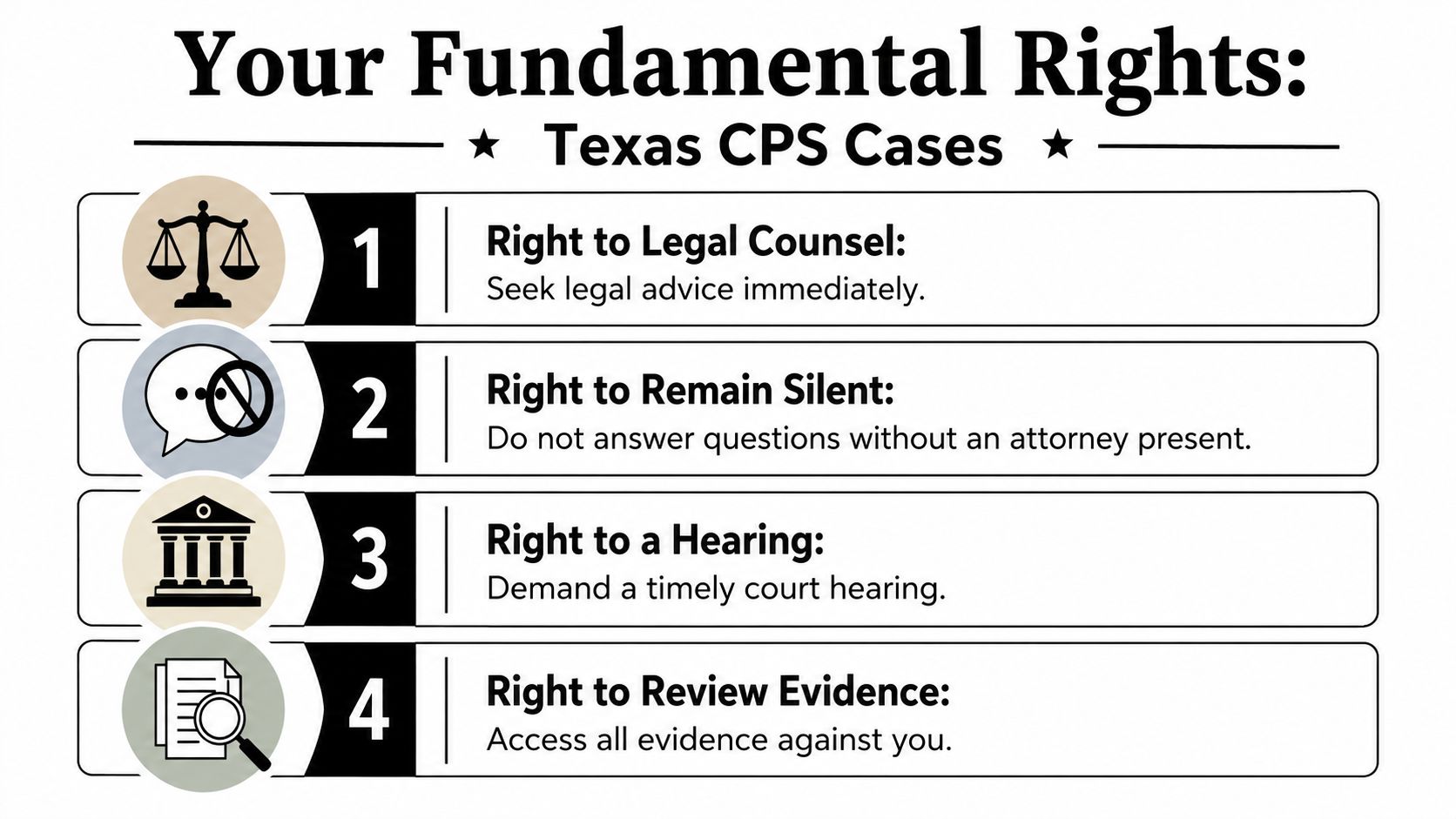
Under Texas Family Code, parents facing a CPS investigation hold four specific constitutional rights that caseworkers must respect: the right to be informed of the allegations and the purpose of the investigation, the right to have an attorney present during questioning or court proceedings, the right to refuse home entry without a valid court order or warrant, and the right to challenge CPS findings in court by presenting defense evidence, as explained by Dodson Law Offices on what CPS can and cannot do in Texas.
What those rights mean in plain language
These rights sound formal, but they're practical.
- You have the right to know why CPS contacted you. You can ask what allegation was made and what the investigation is about.
- You have the right to an attorney. You don't have to handle interviews or hearings alone.
- You have the right to refuse entry without proper legal authority. A caseworker doesn't get automatic access to your home.
- You have the right to challenge CPS in court. If CPS makes claims about your family, you can present your side and your evidence.
Many parents benefit from reading your rights during a CPS investigation before they speak in depth with CPS.
One point that confuses parents
Some readers notice that people often talk about a “right to remain silent,” a “right to a hearing,” or a “right to review evidence.” Those ideas matter in practice, but the four rights above are the specific set identified here from Texas-focused guidance. The key is not memorizing labels. The key is recognizing that you are not required to surrender your voice, your home, or your defense just because an investigation has begun.
A helpful resource on this point is Your Rights During a CPS Investigation, which focuses on the core legal rights every Texas parent has when CPS comes to the door.
Practical rule: Ask questions early, answer carefully, and involve a lawyer before a stressful interview turns into evidence.
The First 48 Hours Navigating the Investigation
The first 48 hours can feel like a blur. A caseworker calls, asks to come by, or shows up at your door, and suddenly every word feels loaded. In Texas CPS cases, this early stage often sets the tone for everything that follows, so the goal is simple: slow the process down enough to make informed choices.

A CPS investigation usually starts with information gathering. The caseworker may want to see your child, ask for interviews, inspect the home, or request records. That can make parents feel as if they have to say yes to everything immediately. You do not.
A good way to understand this stage is to picture a gate. During the first two days, you are deciding what information goes through that gate, when it goes through, and whether legal advice should come first. Calm, careful decisions here can prevent confusion later.
Cooperation should be deliberate
You can be respectful without giving broad consent on the spot. That distinction matters.
A parent can say:
“I want to cooperate, and I want to speak with an attorney before answering detailed questions or allowing entry.”
That response does not make you look hostile. It shows that you understand the seriousness of the case and want to handle it carefully.
What usually happens in these first two days
CPS often tries to do several things quickly. It may contact both parents, ask to interview the child, request a home visit, and gather names of relatives, doctors, teachers, or other adults around the child. Parents are often caught off guard because the process moves faster than expected.
That speed is one reason the first 48 hours matter so much. If you answer casually, agree out of panic, or sign something you do not understand, those choices can shape the file that follows your family through the case.
Questions parents ask right away
| Question | Short answer |
|---|---|
| Do I have to let CPS into my home? | Not without your consent, a warrant, or a court order, unless emergency circumstances apply under Texas law. |
| Do I have to answer every question immediately? | No. You can pause before a detailed interview and get legal advice. |
| Can CPS talk to my child? | CPS may try to interview your child early. The details matter, and legal advice can help you respond wisely. |
| Should I sign papers right away? | No. Read them first and make sure you understand what rights or permissions you may be giving up. |
Parents who want a deeper walkthrough of the early phase often read the Texas CPS investigation process explained.
A practical roadmap for the first 48 hours
At this stage, many parents need more than general advice. They need to know what to do first, second, and third.
- Get the caseworker's information in writing. Write down the name, phone number, office, and anything the worker says the case is about.
- Ask what allegation is being investigated. A bruise, a school report, a missed medical visit, or a discipline complaint can lead to very different responses.
- Pause before giving a full statement. Early statements often happen when parents are scared, tired, or angry. Those are poor conditions for careful communication.
- Treat home entry and document requests as legal decisions. A request is not the same as a requirement.
- Contact a lawyer quickly. Early legal advice can help you decide how to respond to interviews, inspections, and paperwork.
That sequence matters. It works like triage in an emergency room. You first identify the problem, then protect against immediate harm, then make informed decisions about treatment.
A short explainer can also help if you need to hear this process discussed out loud:
A mistake that hurts parents early
Some parents believe that saying yes to everything will make the case close faster. Sometimes the opposite happens. A rushed interview can create inconsistencies. A broad home search can raise side issues unrelated to the original report. An offhand comment can be written into the file without the context you meant.
If you are asking, what are my rights with CPS in Texas, the first 48 hours give you one of the most important answers. You have the right to slow down, understand the allegation, and respond with care instead of fear.
A Real-Life Scenario The Misunderstood Playground Injury
The Garcias are an ordinary Texas family. Their eight-year-old son falls from playground equipment at school and develops a deep bruise on his side and a scrape near his shoulder. He says he fell. His parents take him home, monitor him closely, and plan a pediatric visit the next morning because he seems sore but alert.
At school the next day, a staff member sees the bruise and becomes concerned. A report is made to CPS. By afternoon, a caseworker contacts the family.
Mrs. Garcia is shaken. Mr. Garcia wants to explain everything immediately. They both feel insulted because they know the injury was an accident. That emotional reaction is common. It's also where many parents make statements that later become part of the file.
How the Garcias handled it well
Instead of reacting defensively, they stayed measured.
- They asked for clarity. What allegation had been made, and what was CPS trying to verify?
- They did not consent to a broad home search on the spot. They understood that a request to enter is still a request.
- They stated they wanted to speak with an attorney before a detailed interview.
- They gathered records. The pediatric appointment, the school timeline, and photos of the injury all helped create context.
Calm parents often appear more credible than frightened parents who overexplain.
Why this example matters
A misunderstanding can become a formal investigation even when no abuse occurred. That doesn't mean CPS automatically has the legal right to do whatever it wants, and it doesn't mean the parent should act offended and refuse every interaction.
The stronger model is disciplined. Respectful. Documented.
The Garcias did not “fight” by raising their voices. They protected themselves by understanding limits, preserving evidence, and getting legal guidance before stress turned a playground injury into a damaging narrative.
Emergency Removal and the Critical 14-Day Hearing
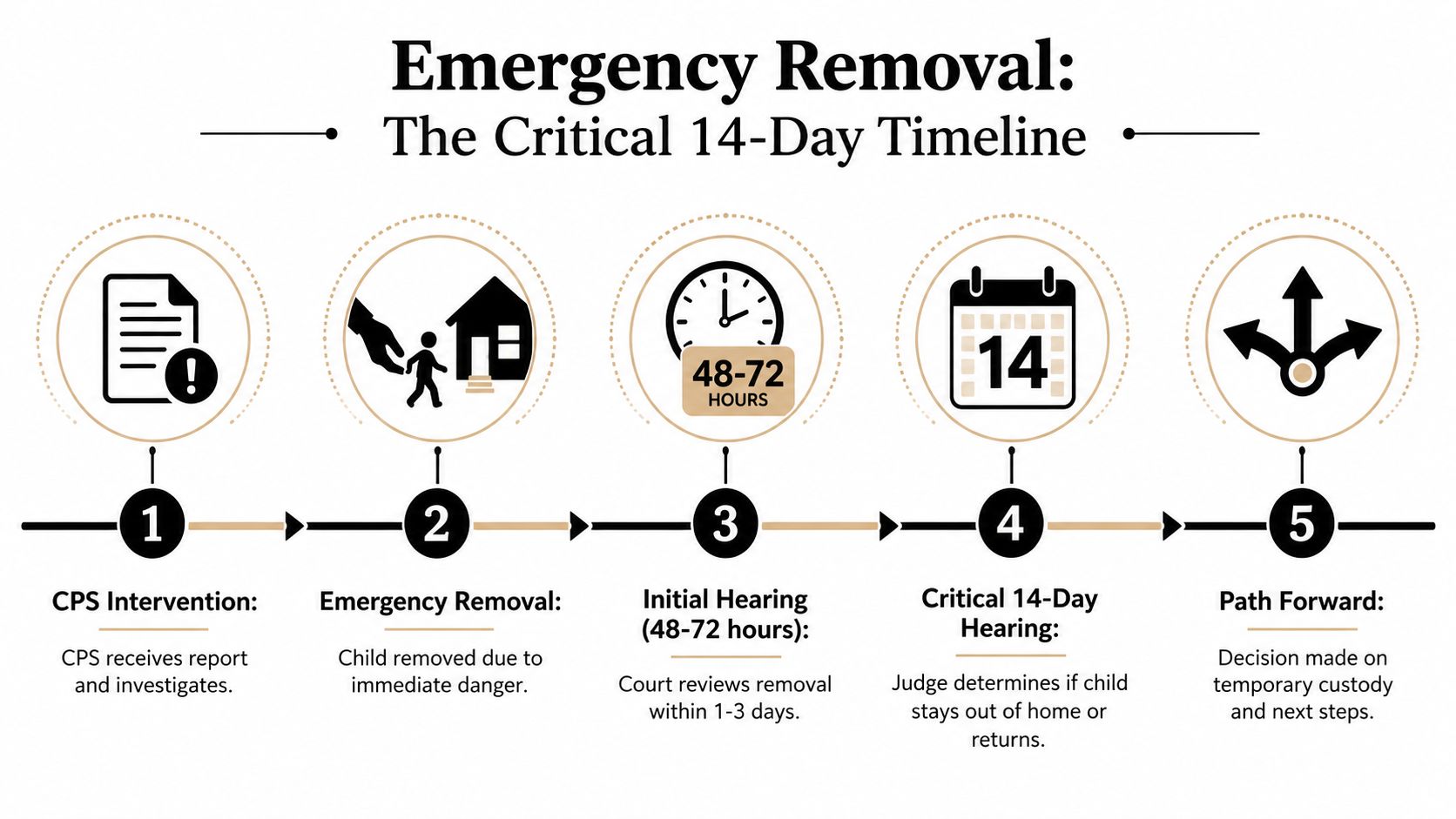
A removal changes the case overnight. One day you are dealing with calls, questions, and requests. The next day your child is gone, a judge is involved, and the clock starts running.
Under Texas Family Code Chapter 262, CPS cannot remove a child only because a report was made or a caseworker is worried in general terms. The agency must meet legal requirements tied to immediate danger and emergency authority under sections such as 262.101 or 262.104. In plain language, the law is supposed to reserve removal for situations the state believes cannot safely wait.
What changes once CPS removes a child
At this stage, your rights still exist, but the way you use them becomes more urgent and more formal. A removal case works like a fast-moving train. If you wait too long to respond, it gets much harder to change direction.
One of your first protections is the full adversary hearing, often called the 14-day hearing. Texas law generally requires that hearing shortly after removal under Family Code section 262.201. The judge must decide whether CPS had a legally sufficient reason to take the child, whether the danger was serious enough to justify that step, and whether efforts were made to avoid removal if possible.
This hearing matters because early impressions stick. Judges, lawyers, and caseworkers begin forming the case story here.
What rights matter most at this stage
Parents are often so shocked by the removal that they focus only on getting the child home immediately. That reaction is understandable. But the better approach is to protect several rights at the same time.
You have the right to know what CPS is alleging in the court papers. You have the right to challenge whether the claimed emergency was real and immediate. You have the right to present evidence, identify witnesses, and point to safer alternatives to foster care, such as a suitable relative or family friend. You also have the right to be represented by an attorney, and if you qualify, to ask for a court-appointed one.
For many families, the most practical short-term goal is not an instant return home on day one. It is preventing weak allegations from hardening into a court record and showing the judge there is a safe, specific plan.
What to do before the 14-day hearing
Start gathering proof the same day you learn a hearing is coming. Delay helps the written affidavit. It rarely helps the parent.
Focus on the items that answer the court's immediate questions:
- Read the petition and affidavit carefully. Look for dates, names, injuries, prior history, and statements that are incomplete or wrong.
- Collect records that create context. Medical records, school notes, text messages, photos, counseling records, and names of adults who saw what happened can all matter.
- Identify safe placement options early. A grandparent, aunt, adult sibling, or close family friend may be better for your child than stranger foster care if the court does not order immediate return.
- Show stability. Bring proof of housing, employment, sobriety efforts if relevant, and any steps already taken to address the concern.
- Get legal advice quickly. Parents often need a focused explanation of the Texas CPS emergency removal process and hearing timeline.
What judges are looking for
The judge is not deciding the entire case at this hearing. The judge is deciding whether CPS had enough legal basis to remove the child and keep the child out of the home for now.
That difference confuses many parents.
A parent may walk into court ready to explain their whole life story. The court is usually asking narrower questions first. Was there an immediate safety threat? Was there time to use a less drastic option? Is there a safer placement available right now? A clear, organized answer to those questions usually helps more than a long emotional defense.
The 14-day hearing often shapes the court's first lasting impression of both the facts and the parent.
If your child has been removed, treat the first hearing like the foundation of the entire case. A weak foundation can be repaired, but it takes more time, more money, and more risk.
Navigating the Court Process Service Plans and Termination
After the first hearings, many parents expect the case to settle down. Instead, it often turns into a long test of consistency. The courtroom may feel quieter, but every month still matters. Progress is measured through service-plan tasks, visits with your child, drug testing if ordered, counseling, housing, work history, and whether you follow court orders on time.

This is the stage where many parents feel lost because the danger is less obvious. A missed class may not seem serious. An unsigned release may feel minor. A late arrival to visitation may seem explainable. In court, those small events can stack up and shape how the judge sees your reliability.
A CPS case at this point works a lot like building a record one brick at a time. Each completed service, clean test, documented visit, and respectful interaction adds support. Each missed requirement can give CPS another point to raise at the next hearing.
What your rights look like during the middle of the case
Your rights do not disappear because the case has moved past removal. They show up in different ways.
You still have the right to know what CPS is asking you to do. You have the right to review your service plan with your attorney before agreeing to it. You have the right to ask for clarification if a task is vague, unrealistic, or unrelated to the safety concern that brought CPS into your life. You also have the right to present proof of your progress and to challenge inaccurate claims before the court makes bigger decisions.
That timing matters. Early in a case, your rights are often about protecting your home, your words, and your child from unnecessary removal. In this stage, your rights are about building a clear record and correcting the record when CPS gets something wrong.
Service plans can help or hurt, depending on how you handle them
A service plan is not just paperwork. It becomes a roadmap the court may use to judge whether reunification is realistic.
Some parts of a plan will be straightforward, such as parenting classes or counseling. Other parts may raise fair questions. Why is this evaluation required? How many sessions must be completed? What counts as successful participation? If transportation, work hours, illness, or childcare makes compliance difficult, raise that issue early through counsel instead of falling behind in silence.
Parents often run into trouble when they treat the service plan like a suggestion instead of a court-centered document. Judges usually care less about promises and more about proof.
A simple way to organize this stage is to focus on three lanes:
| Lane | What to do |
|---|---|
| Compliance | Finish services, testing, classes, and evaluations as ordered |
| Proof | Save certificates, sign-in sheets, emails, text messages, receipts, and calendar notes |
| Communication | Ask questions early, confirm changes in writing, and tell your lawyer about problems fast |
Permanency hearings are progress checks, not formalities
Texas courts review these cases over time under Chapter 263. Those hearings are meant to answer practical questions. Is the child safe where the child is now? Is the parent making measurable progress? Is return home realistic soon, or is the case drifting toward another outcome?
Parents sometimes walk into a permanency hearing thinking, "I have been trying hard. The judge will understand." Effort matters, but documented effort matters more. If you completed counseling, bring the records. If you missed a visit because CPS changed the time, keep the message showing that change. If you relapsed but re-entered treatment immediately, your lawyer needs that information and the supporting documents.
If substance use is part of the case, the court will usually look for a pattern of honesty, treatment, testing, and follow-through. Some families also read broader treatment information, such as this guide to Rhode Island recovery options, to understand how structured recovery programs are commonly described. In a Texas CPS case, the key question is still local and specific. What steps have you taken, and can you prove them?
Termination is the most serious point in the case
By this stage, many parents ask the same question in a more urgent way: what are my rights with CPS in Texas if the agency wants to end my parental rights?
You still have powerful rights, but you must use them. Texas law does not let CPS terminate parental rights just because the case has gone on for months or because the parent made mistakes. CPS must prove a legal ground for termination under Chapter 161 and must also prove that termination is in the child's best interest. The burden of proof is clear and convincing evidence, which is higher than the standard used in ordinary civil disputes.
That standard protects families, but it does not protect a parent who stops participating.
Here is where confusion often hurts parents. Loving your child is important, but the court will also look at conduct it can verify. Did you complete the plan? Did you visit consistently? Did you address the safety issue that started the case? Did you stay in contact with your lawyer? Did you create a stable home the child could safely return to?
What usually strengthens a parent's position
Steady action usually matters more than emotional explanations.
- Complete services as early as you reasonably can.
- Keep your own file with every certificate, test result, email, and court paper.
- Arrive on time for hearings and visits.
- Speak carefully in court and in messages to CPS.
- Tell your lawyer immediately if a requirement is impossible, inaccurate, or unfair.
- Stay focused on your child's safety, routine, medical needs, school progress, and emotional well-being.
The Law Office of Bryan Fagan PLLC handles CPS-related matters that overlap with family law and protective issues in Texas. If you are in this stage of the case, legal guidance is often less about one dramatic courtroom moment and more about making sure months of effort are properly presented to the judge.
A CPS case is cumulative. Judges often decide based on the pattern a parent creates over time, not a single good hearing or a single bad day.
At this point in the roadmap, your rights include the right to participate fully, the right to challenge CPS evidence, the right to present your own evidence, and the right to insist that the court apply the correct legal standard before entering permanent orders.
You Are Not Alone Taking the Right Steps to Protect Your Family
By the time a parent reaches this point, the biggest need is usually clarity. Not more panic. Not more rumors from social media. Clarity.
The rights that matter most in a Texas CPS case depend on timing. At the start, it's about protecting your home, your words, and your ability to get counsel. During removal, it's about preparing for the hearing that can shape the entire case. During the court process, it's about building a record that shows safety, compliance, and credibility.
A realistic note about suing CPS
Some parents want accountability after they believe CPS overreached. That instinct is understandable, but the legal path is difficult.
While parents can file complaints with DFPS's Office of Consumer Affairs for rights violations, the civil lawsuit path is complex and requires proving constitutional violations or actions beyond CPS's legal authority. Recent data from 2024 indicates that only 12% of emotional distress claims against CPS in Texas succeeded, according to this guide on fighting CPS and understanding emotional distress claims.
That doesn't mean parents are powerless. It means the strongest move is often early defense, not waiting to seek relief after the damage is done.
Practical next steps for your family
If your case also involves substance use concerns, treatment planning can become part of the bigger picture for reunification. Families looking for broader recovery resources may find this guide to Rhode Island recovery options helpful as an example of how treatment pathways are organized, even if your case is here in Texas.
Use this short checklist if CPS has contacted you:
- Ask for the allegation clearly. Don't respond to vague claims.
- Pause before consenting. Entry, interviews, and documents all matter.
- Collect records early. Medical, school, therapy, and communication records can become key evidence.
- Attend every court date and meeting. Silence or absence often gets interpreted against you.
- Speak with a lawyer quickly. Early legal advice can change the direction of the case.
You don't have to guess your way through this. You don't have to rely on what a neighbor said happened in someone else's case. And you don't have to face CPS alone.
If CPS has contacted you, investigated your home, or removed your child, get specific legal advice as soon as possible. The attorneys at Law Office of Bryan Fagan PLLC can help you understand where your case stands, what rights apply right now, and what steps may protect your family moving forward. Contact the firm for a free consultation and get clear answers specific to your situation.