Skip to content
A CPS case can feel like the floor disappeared under your feet.
One hearing goes badly. A judge signs temporary orders. Your child is placed somewhere you didn't expect, your visits are restricted, or the court relies on information you know is incomplete or wrong. You leave the courtroom stunned, trying to understand how something so serious could happen so fast.
For many parents, the worst part is the feeling that there's no immediate way to fix it. A normal appeal usually comes later, after much more of the case has unfolded. But CPS cases don't wait. Children grow. Bonds strain. Time lost with your child can never be fully returned.
That's where the idea of a cps writ of mandamus texas parents sometimes hear about becomes important. The name sounds cold and technical. In real life, it means something much more human. It can be a last-resort request to a higher court to step in when a trial court has made a serious legal mistake and waiting for a regular appeal would cause harm that can't be undone.
Think of a mother whose child was removed after allegations tied to a pending criminal investigation, but the court never gave her a fair chance to challenge key facts at the first critical stage. Or a father whose nearby, safe relative was ignored for placement while the case drifted in the wrong direction. In those moments, parents don't need jargon. They need to know whether the law offers any emergency path to correct a clear wrong.
It sometimes does. The path is narrow, and the standard is demanding, but it exists. Understanding how it works can replace some of that helplessness with something steadier: a plan.
Your World Turned Upside Down by a CPS Ruling
The moment after a bad CPS ruling is usually a blur.
You may remember only pieces of it. The judge's words. Your attorney leaning over to explain what just happened. A caseworker gathering papers. The drive home where nobody in the car knows what to say.
For a parent, the ruling can feel final even when it isn't. That's especially true in cases under Texas Family Code Chapters 262 and 263, where temporary decisions about removal, placement, visitation, and hearings can shape everything that follows. If a termination case later develops under Chapter 161, those early rulings can cast a long shadow.
When the system feels bigger than you
A common example goes like this. A parent is accused of creating an unsafe home. CPS seeks removal. At the hearing, the court acts quickly, and the parent believes the judge relied on a one-sided report or skipped over a legal requirement that mattered. By the time the parent understands what happened, the child is already out of the home and the next court date feels far away.
That kind of moment creates two separate problems.
One is emotional. You miss your child and fear what comes next.
The other is legal. You need to know whether the order is painful, or legally defective in a way a higher court can address right now.
When a trial court makes a serious legal error in a CPS case, waiting until the end of the case may be too late to protect the parent-child relationship.
A narrow form of hope
A writ of mandamus isn't a magic reset button. It won't erase every bad ruling or reopen every hearing.
But in the right case, it can function like a precise key for a jammed lock. It asks an appellate court to correct a trial court's clear legal error before more damage is done.
That matters because CPS litigation moves fast. Parents often assume they have to endure every harmful order until final judgment. Sometimes that's true. Sometimes it isn't.
A parent who understands that difference is in a stronger position. Not because the road is easy, but because uncertainty is often hardest when you don't know what tools even exist.
What Is a Writ of Mandamus in a Texas CPS Case
A writ of mandamus is an order from a higher court telling a lower court or public official to follow the law.
In a Texas CPS case, it usually means asking an appellate court to step in because the trial judge made a serious legal mistake and there isn't an adequate ordinary appeal available at that moment. Texas courts have authority to issue mandamus in the circumstances described by Texas Constitution Article V and Government Code §22.221(b)(1), and the filing procedure is governed by Texas Rule of Appellate Procedure 52.
Think of it as an emergency brake
Most court errors are handled through a normal appeal later. Mandamus is different.
A better analogy is an emergency brake. You don't use it for every bump in the road. You use it when letting the situation continue would cause immediate and lasting harm.
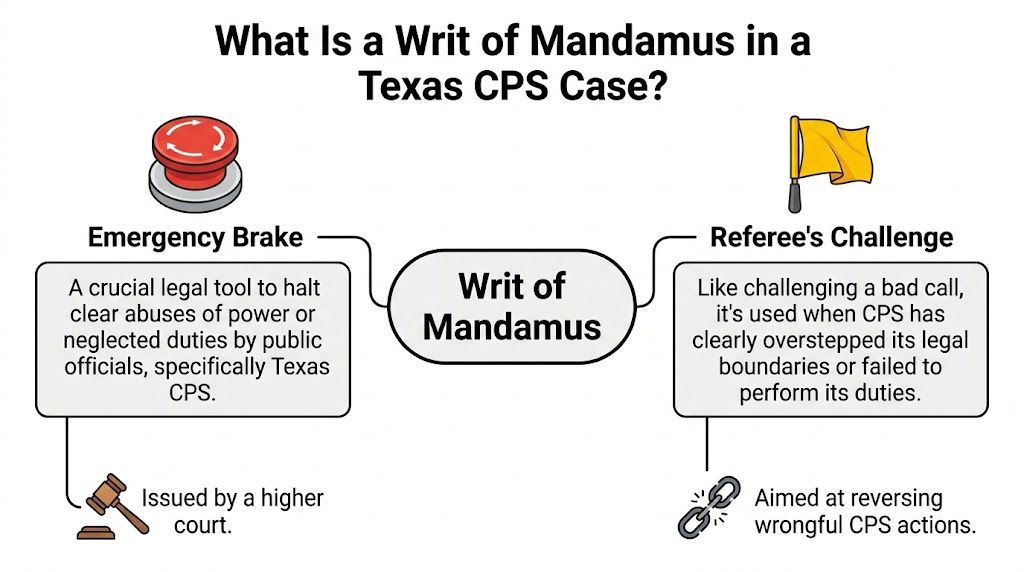
Another helpful comparison is a referee's challenge. You're not asking the higher court to replay the whole game. You're asking it to review one call that was so clearly wrong, and so important, that the game can't fairly continue without correction.
That distinction matters. A mandamus petition is not a complaint that the judge was unfair in a general sense. It is a focused legal argument that the court failed to do what the law required, or acted outside the rules.
What it is not
Parents often hear "appeal" and "mandamus" used in the same conversation, and that creates confusion.
They are not the same thing.
- A regular appeal usually challenges a final order or judgment.
- A mandamus petition targets a serious error during the case when waiting would not protect your rights.
- A rehearing request asks the same court to reconsider. Mandamus asks a higher court to intervene.
If you're comparing these options, this guide on a Texas CPS appeal helps explain where mandamus fits in the bigger picture.
Later in the section, it also helps to hear a short explanation in a different format.
Why parents hear about it in CPS cases
CPS cases involve urgent orders affecting custody, placement, access, services, and safety. Some of those rulings can cause harm long before a final judgment exists.
Texas law also recognizes mandamus in family-related proceedings. In suits affecting the parent-child relationship, Texas Family Code §109.001(a) authorizes appellate courts to make orders necessary to preserve the safety and welfare of the child during an appeal-related context. In practical terms, that is one reason mandamus becomes part of the conversation in high-stakes CPS litigation.
Practical rule: If the problem can be fixed later through a normal appeal, mandamus usually isn't the right tool. If the harm will happen now and can't truly be undone later, a lawyer may evaluate mandamus much more seriously.
Scenarios Where a Mandamus Can Help Your Family
The easiest way to understand mandamus is to look at moments when a normal wait-and-see approach may be too dangerous.
Take a grandmother placement situation. A child is removed under Chapter 262. The child's maternal grandmother lives nearby, has a stable home, and is ready to care for the child. But the court signs temporary orders sending the child far away based on a flawed report, without properly addressing the available family placement option. If the ruling rests on a serious legal error, and the parent-child relationship will be harmed while the case drifts forward, mandamus may become part of the strategy.
That doesn't mean every bad placement decision qualifies. It means some do, especially when the complaint is legal and immediate, not emotional disagreement.
Common examples parents should recognize
Mandamus discussions often arise in CPS cases like these:
- A legally required hearing doesn't happen on time. In Chapters 262 and 263, deadlines and hearing requirements matter because delay can shape custody and service planning in ways that are hard to reverse.
- The court blocks access to critical evidence. If a discovery ruling prevents a parent from obtaining material needed to challenge CPS allegations, waiting until final judgment may not cure the damage.
- Temporary orders contradict controlling law. A parent may face restrictions or rulings that don't line up with governing legal standards.
- The judge refuses to act on a clear duty. Some court actions are discretionary. Others are duties the law requires the court to perform.
- A relative placement issue is distorted by related allegations. If criminal accusations or protective order issues spill into the CPS case and affect placement or access decisions improperly, the legal error can become more complex and more urgent.
A realistic family example
Consider a father accused of domestic violence after a heated incident, with a protective order request pending in one court and a CPS case moving in another. He denies the allegations. CPS pushes the position that his sister can't be considered for placement because of collateral concerns tied to the family's history.
If the trial court adopts that position without following the correct legal framework, the problem may be bigger than one bad ruling. It can alter where the child lives, how often the parent sees the child, and what narrative hardens early in the case.
In that kind of setting, mandamus is sometimes the only tool that matches the urgency.
Situations that usually do not fit
It's just as important to know when mandamus probably isn't the answer.
A petition is generally weaker when the complaint is only that:
- The judge believed the other side.
- The evidence could have supported more than one result.
- The parent wants a second opinion on a hard call.
Mandamus is for a clear legal error, not for every painful ruling.
If your instinct is "the judge got it wrong," the next question is more precise: "Did the judge violate a legal rule in a way that can't be adequately repaired later?"
That question often changes everything.
The High Bar for Success Legal Standards and Key Cases
Texas appellate courts treat mandamus as an extraordinary remedy. That phrase matters because it tells you how judges approach these petitions. They are not designed for close calls.
The core standard was reinforced in In re Texas Department of Family & Protective Services, 210 S.W.3d 609 (Tex. 2006), where the court stated mandamus is proper only to correct a clear abuse of discretion when there is no adequate remedy by appeal, as discussed in the Texas District and County Attorneys Association article on the writ of mandamus.
Clear abuse of discretion
This doesn't mean the judge made a decision you dislike.
It means the ruling falls outside the legal boundaries the judge was required to follow. In plain English, the court didn't just choose between two reasonable options. The court acted without following the controlling rules or principles.
A simple way to think about it is this. If two trained judges could reasonably disagree, mandamus becomes much harder. If the law required one path and the trial court took another, the argument becomes stronger.
No adequate remedy by appeal
This is the second wall parents run into.
Even if the trial court was wrong, an appellate court still asks whether an ordinary appeal later could fix the problem. If the answer is yes, mandamus usually fails.
In CPS cases, this issue is often practical. If waiting months for a standard appeal means a parent loses critical time with a child, misses a placement opportunity, or suffers a case-shaping disadvantage that a later reversal can't fully repair, the argument for mandamus becomes more serious.
The standard in plain language
The legal test becomes easier to understand when you reduce it to the questions judges ask.
| Legal Standard | What It Means for Parents | Example in a CPS Case |
|---|---|---|
| Clear abuse of discretion | The trial judge didn't just make a hard call. The judge departed from the law's required path. | The court enters a temporary ruling while ignoring a controlling legal requirement for that type of decision. |
| No adequate remedy by appeal | Waiting until the case ends won't truly repair the harm. | A parent loses meaningful time, access, or placement opportunities that can't be recreated later. |
Ministerial duty and the paper record
Some mandamus petitions focus on what lawyers call a ministerial act. That means a duty so clear the court had no lawful choice but to perform it correctly. The related authorities discussed in the earlier source also note concepts like demand and refusal, though those issues depend on the posture of the case.
Another point parents often miss is that mandamus lives and dies on the record. Appellate courts don't conduct a new live hearing just because a parent feels wronged. They look at what was filed, what was said, what was ordered, and whether the documents support relief.
Strong feelings don't win mandamus petitions. A clean legal issue and a strong record do.
That is why even a deserving complaint can fail if the hearing transcript, exhibits, or written orders don't clearly show the problem.
Why this standard protects and frustrates
The high standard serves a purpose. Trial courts need room to manage cases without constant appellate interruption.
But for families, it can feel harsh. A parent may be living through a ruling that is damaging, yet still not meet the narrow legal threshold for mandamus. That's one reason careful analysis matters so much before filing. The question isn't whether the ruling hurt your family. The question is whether it fits this precise legal framework.
The Step-by-Step Process for Filing a Writ of Mandamus
Once a lawyer determines mandamus may be appropriate, the process becomes a race for precision.
The governing rule is Texas Rule of Appellate Procedure 52. At a high level, the filing usually includes the petition itself, the supporting record, and required certifications. If those pieces are incomplete, the court may deny relief quickly.

What gets filed
The petition is the legal story of what went wrong. It identifies the parties, describes the challenged ruling, explains the law, and tells the appellate court exactly what relief is requested.
The record is just as important. It may include:
- The signed orders the parent is challenging
- Relevant pleadings filed in the trial court
- Hearing transcripts showing what happened and what objections were raised
- Exhibits and documentary evidence that support the legal issue
- Certification materials required by the appellate rules
For many parents, the most surprising part is this: the appellate court is largely confined to what is in that record. If a critical fact isn't in the papers, it may as well not exist for mandamus purposes.
Why delay can be deadly
Unlike a standard appeal, mandamus doesn't have the same kind of fixed notice deadline. But that doesn't mean you can wait comfortably.
Delay can trigger the doctrine of laches, which means a court may deny relief because the party waited too long. In CPS cases, waiting also creates a practical problem. The longer an order stays in place, the harder it can be to convince an appellate court that emergency intervention is still justified.
If you're trying to understand the larger appellate mechanics, this practical guide on how to file a CPS case appeal gives useful context.
What the path often looks like
Every case differs, but the sequence often looks like this:
- Spot the legal error quickly. Counsel reviews the order, hearing history, and statutes.
- Assemble the record. This includes transcripts, orders, motions, and exhibits.
- Draft the petition carefully. Mandamus is won or lost on framing. The issue must be narrow, sharp, and legally supported.
- Request emergency relief if needed. In some situations, temporary relief is necessary while the court considers the petition.
- Await a response or ruling. The appellate court may request a response from the other side, deny the petition, or act more quickly if the circumstances demand it.
Why experienced drafting matters
Mandamus isn't forgiving.
A weak petition often fails not because the family lacked a real problem, but because the filing didn't present the issue in the exact way appellate judges require. Missing materials, unclear legal theories, or a record gap can sink a strong underlying complaint.
That is why parents should treat mandamus less like filling out forms and more like building a surgical legal argument.
Risks Versus Rewards Weighing the Strategic Decision
A mandamus petition can be powerful. It can also be a poor choice if filed for the wrong reason.
Parents deserve a clear-eyed answer about that. This remedy is hard to win. A survey discussed in the St. Mary's Law Journal found a 10.3% grant rate for Texas mandamus proceedings based on data from 1988 to 1998, which underscores how rarely courts grant this relief and how demanding the standard is, as noted in the St. Mary's Law Journal survey.

The risks are real
Filing isn't cost-free emotionally or strategically.
A petition requires urgent legal work, a polished record, and careful briefing. It can also add tension to a case that is still active in the trial court. Parents sometimes worry, with good reason, about returning to the same courtroom after asking a higher court to intervene.
Other risks include:
- Time pressure: The issue must be analyzed and filed quickly.
- Narrow scope: Even a strong petition usually addresses one legal point, not every problem in the case.
- Possible denial without full explanation: Appellate courts do not always give families the detailed answer they hope for.
The reward can justify the fight
For the right case, the benefit is enormous.
If the ruling rests on a serious legal error and immediate harm is unfolding, mandamus may be the only realistic way to protect the parent-child relationship before the case hardens around a bad order. Correcting one critical mistake early can change the direction of the entire CPS matter.
That is why the low success rate shouldn't scare families away from the remedy altogether. It should encourage discipline.
A strategic question, not a panic decision
The best way to think about mandamus is not "Should we fight harder?" It is "Is this the right battlefield?"
A thoughtful lawyer weighs:
- the clarity of the legal error
- the quality of the record
- whether later appeal would be inadequate
- how the petition fits the broader CPS strategy
Decision point: Mandamus makes sense when the issue is both urgent and legally clean. It is much less useful when the case is fact-heavy, murky, or driven mainly by disagreement over the judge's view of credibility.
Parents often feel pressure to do something immediately. Sometimes the strongest move is filing. Sometimes the stronger move is building a better trial-court record for the next hearing. Strategy matters as much as urgency.
Why Your Criminal Defense Firm's Experience Matters in a CPS Case
Many CPS cases aren't purely family law cases. They are mixed cases.
A child removal may begin with allegations of drug possession, a DWI arrest, an assault accusation, or an application for a protective order. Once that happens, your CPS case isn't moving on one track. It is moving on several at once, often in different courts, with different evidence rules, deadlines, and risks.
The criminal issue can reshape the CPS issue
A pending charge doesn't have to end in a conviction to affect a CPS case. It can influence how the court views safety, placement, visitation, and credibility.
That overlap matters for relatives too. The issue is not always just whether a parent can regain possession. Sometimes the fight is over where the child should go while the case continues. The material provided on this topic notes that a low-risk conviction could affect relative placement under Texas Family Code §264.754(c), and in the right circumstances that kind of decision may become part of a mandamus fight, as discussed in this piece on mandamus relief in Texas family law cases.
Why combined legal judgment matters
A lawyer handling only one side of the problem may miss how the pieces interact.
For example:
- A DWI allegation may trigger immediate CPS scrutiny even before the criminal case is resolved.
- A drug possession case can affect service plans, testing demands, and temporary possession arguments.
- A protective order proceeding may generate findings or restrictions that spill directly into visitation or placement.
If you're trying to evaluate counsel for that kind of overlap, this guide on how to choose a criminal defense attorney is a useful starting point.
Parents also benefit from practical resources on law-firm standards and trust. Articles like Ensuring Compliance And Ethics In Your Law Boutique help explain why clear systems, confidentiality, and ethical decision-making matter so much in sensitive cases involving children and accusations of wrongdoing.
Questions to ask when criminal allegations are part of the CPS case
When interviewing counsel, ask direct questions:
- How will the criminal case affect what I say or don't say in the CPS case?
- Could a protective order hearing create problems in my custody or visitation arguments?
- If the trial court makes an urgent error, do you evaluate appellate remedies like mandamus?
- How do you protect relative placement options when a family member has a record issue or pending allegation?
Those questions can reveal whether a legal team sees the whole board or only one square at a time.
Frequently Asked Questions About Texas Writs of Mandamus
How much does it cost to file a writ of mandamus
There isn't one standard price.
Cost depends on the complexity of the legal issue, how quickly the filing must be prepared, the size of the record, and whether transcripts have to be obtained and reviewed on an emergency basis. A mandamus petition is usually more involved than many parents expect because the appellate court needs a polished legal argument and a complete record.
What happens in my main CPS case while the writ is pending
Usually, the trial-level CPS case continues unless the appellate court grants temporary relief or some other order affects the timeline.
That means hearings, services, placement decisions, and deadlines may keep moving. Parents should assume they still need to comply with existing court orders unless a court changes them.
Keep showing up, keep following lawful orders, and keep documenting your efforts. Filing a mandamus does not give you permission to disengage from the underlying CPS case.
What if the writ of mandamus is denied
A denial doesn't always mean your concern lacked merit. It may mean the issue didn't fit mandamus, the record wasn't strong enough, or the appellate court believed ordinary remedies were still available.
Your lawyer may then focus on protecting the record in the trial court, seeking reconsideration where appropriate, preparing for a later appeal, or adjusting strategy for upcoming hearings under Chapters 263 or 161 if the case continues toward permanency or termination issues.
How quickly can a decision be made
Mandamus is often faster than a normal appeal because it is designed for urgent problems.
Still, timing varies. Some petitions receive rapid attention. Others involve responses, supplemental filings, or a slower review depending on the court and the issue. The best approach is to prepare as if speed matters from the start.
Do I need an appellate lawyer, a CPS lawyer, or a criminal lawyer
Sometimes you need coordinated judgment across all three areas.
A CPS mandamus issue may come out of a family-law ruling, but the facts driving that ruling may involve criminal allegations or protective order litigation. The key is not the title on the lawyer's business card. The key is whether the legal team can see how each part of the case affects the others.
Is mandamus my last chance
Not always. But in some cases, it is the only tool that fits the moment.
That is why parents should seek legal advice early, while the record can still be shaped and urgent errors can still be evaluated before delay becomes its own problem.
If you're facing a CPS ruling that feels wrong, you don't have to guess whether a mandamus petition is realistic. The Law Office of Bryan Fagan PLLC helps Texas families evaluate urgent CPS issues, criminal allegations that overlap with child welfare cases, and the best path forward. Contact the firm for a free consultation to talk through your specific situation and get clear, compassionate guidance about your options.