Skip to content
When CPS calls about drug use, most parents make the same mistake first. They try to talk their way out of it. They explain, minimize, apologize, or agree to whatever the investigator asks because they think cooperation alone will make the problem disappear.
It usually doesn’t.
A cps case for drug use texas defense is rarely just about one drug test. It’s about what CPS thinks that test means for your child’s safety, what you said before you had counsel, what documents you can produce quickly, and whether a criminal investigation is developing at the same time. In Texas, those pieces can collide fast. A statement meant to calm a CPS worker can create trouble in court or with law enforcement. A rushed safety plan can lock you into admissions that are hard to undo. A missed test can look worse than a positive one.
Parents also need to know this. Drug use allegations do not automatically mean you are an abusive parent, and they do not end your case on day one. Texas courts still require evidence, procedure, and a clear link between concerns about substance use and actual danger to a child. That gives you room to defend yourself, but only if you move carefully and early.
I’ve seen the difference between panic and strategy. The families who do best usually start the same way. They stop talking without guidance. They gather records. They treat every interaction as if both family court and a prosecutor may eventually read it. And they build a story supported by proof, not promises.
The First 48 Hours Your Immediate Actions After CPS Contact
The first call or knock at the door can feel unreal. Your stomach drops. You start thinking about your children sleeping in another house by the end of the day. That fear is real, but your next steps matter more than your fear.
Texas CPS cases involving drug use move quickly. According to Texas CPS drug testing protocols and defense guidance, caseworkers may require drug testing within 48 hours after identifying a child safety threat tied to substance use, and lab-confirmed results are then verified by a Medical Review Officer within two business days. The same source states that parental refusal is often treated as an admission issue that can trigger court action, and that cases involving attorney-guided voluntary treatment show 65% family preservation compared with 30% without.

What to say when CPS first contacts you
Keep it short. Be polite. Don’t try to win the case in the doorway or over the phone.
Use language like this:
- Acknowledge the contact: “I understand you’re investigating.”
- Ask for specifics: “What allegations are being made?”
- Request counsel: “I want to speak with an attorney before answering detailed questions.”
- Stay neutral: “I’m not refusing to cooperate. I want legal advice before I respond.”
That last sentence matters. Parents often worry that asking for a lawyer makes them look guilty. It doesn’t. It makes you look careful.
Practical rule: Your first job is to avoid making a permanent statement during a temporary panic.
What not to do in those first two days
The biggest errors usually happen before the first hearing is ever scheduled.
- Don’t agree to an on-the-spot safety plan without review. These plans can sound informal, but they can shape the whole case.
- Don’t volunteer drug history. A broad confession creates problems in both CPS and criminal court.
- Don’t hand over your phone casually. Texts, photos, and search history can be taken out of context.
- Don’t coach your child. Telling a child what to say often backfires.
- Don’t disappear. Silence without counsel looks different from vanishing.
A common early scenario looks like this. A mother gets a call from CPS after a neighbor reports drug use in the home. She’s terrified and wants to explain that she only used after the children were asleep and that the home is clean. The better move is to confirm receipt of the call, ask what the allegations are, state that she is getting counsel, and begin gathering proof of sobriety, childcare arrangements, housing, and medical records instead of making broad admissions.
Your first defense file
Within the first day or two, start building a folder. Paper or digital is fine, but make it organized.
Include:
- Drug test records you already have
- Prescriptions and pharmacy records
- Names of sober caregivers and relatives
- School attendance records
- Photos of the home as it is
- Work schedules and pay records
- Any communication from CPS
If testing is requested, get legal advice fast about how to handle it. Refusal can create serious problems, but blind compliance without understanding the stakes can also hurt you if there’s a parallel criminal issue.
The first 48 hours are about control. Not control over CPS. Control over your own words, documents, and decisions.
Understanding the DFPS Investigation and Timeline
Once the initial shock passes, the next problem is uncertainty. Parents often don’t know who is making decisions, how long the investigation lasts, or what CPS is looking for. That confusion can lead to bad choices.
In Texas, CPS drug testing is not random. According to Bryan Fagan’s discussion of Texas CPS drug testing protocols, testing is triggered by specific reports, urine testing is the most common form for recent use, hair testing can show patterns for up to 90 days, and DFPS reported a 43% increase in Child Protective Investigations involving active substance abuse between 2016 and 2019. That same discussion notes that testing often occurs during the usual 30-day investigation period.
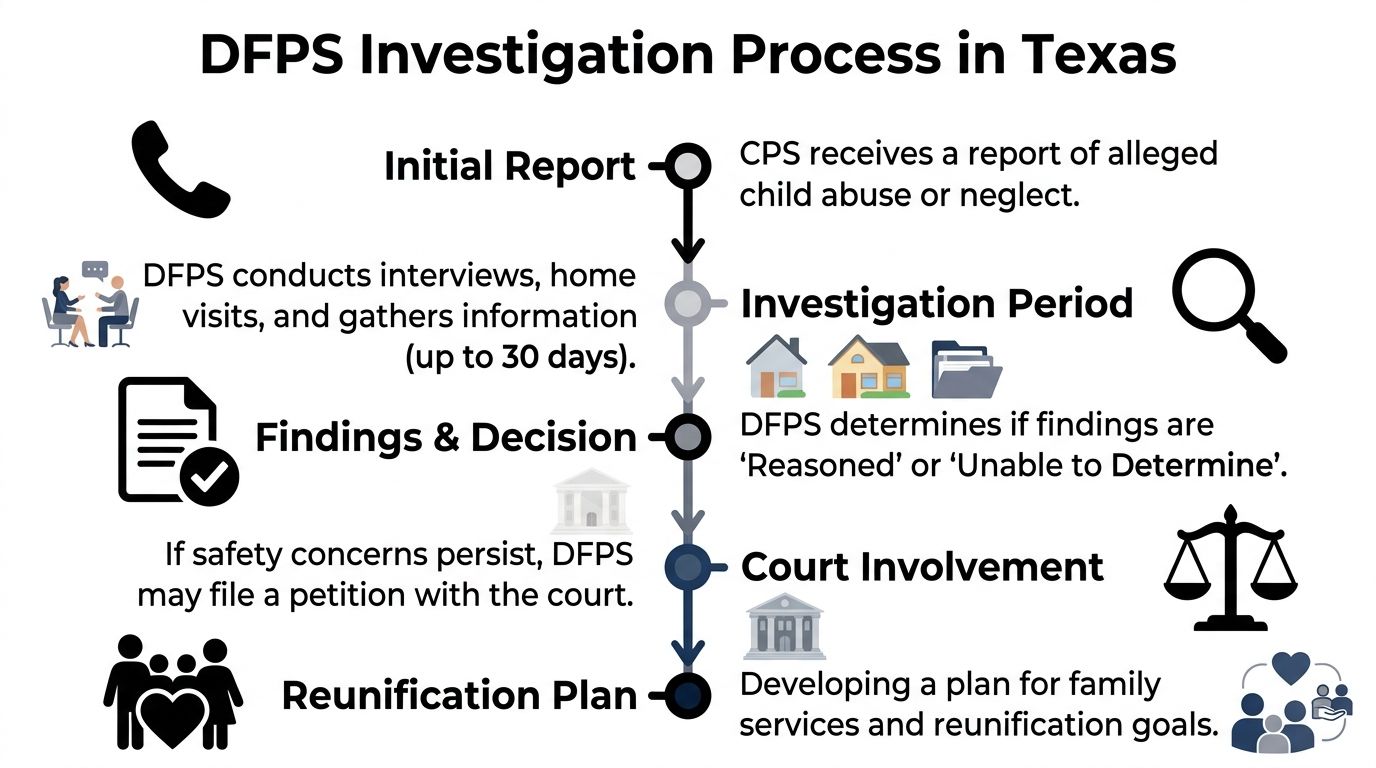
What the DFPS timeline usually looks like
For most families, the investigation follows a recognizable path. A helpful overview appears in this guide to the Texas CPS timeline and what parents should expect.
Here is the practical version:
| Stage | What happens |
|---|---|
| Report received | CPS gets an allegation from a teacher, neighbor, medical provider, relative, or another source. |
| Initial contact | An investigator calls or appears in person, asks about the child, and may request interviews or testing. |
| Information gathering | CPS may speak with the child, parents, relatives, and other collateral contacts. They may inspect the home and review records. |
| Testing and assessment | Depending on the allegation, CPS may request urine, hair, or saliva testing. |
| Disposition | CPS decides whether the allegation is supported, unsupported, or unclear enough for further action. |
| Court filing if needed | If CPS believes immediate or ongoing danger exists, the case may move into court under Chapter 262. |
The test type matters
Not all drug tests answer the same question.
- Urine testing is commonly used when CPS is looking for recent use.
- Hair testing is used when CPS wants a longer pattern and may reach back up to 90 days under the source above.
- Saliva testing may be used when immediacy matters.
That distinction matters in defense work. A result showing historical use does not automatically prove current impairment while caring for a child. CPS may still argue risk, but the defense response should match what the test shows.
A strong defense doesn’t just ask, “Was the test positive?” It asks, “What does this specific test prove, and what does it not prove?”
What Chapters 262 and 263 mean in plain English
Parents hear chapter numbers and tune out. Don’t. These chapters shape your case.
- Chapter 262 deals with removal and emergency court involvement. If CPS wants the court to authorize taking or keeping your child out of the home, this chapter is central.
- Chapter 263 governs review, permanency, and the court’s management of the case after removal.
- If the case worsens enough to threaten your legal relationship with your child, Chapter 161 becomes critical because it addresses termination grounds.
That’s why an investigation phase should never be treated casually. What you do before court often determines what happens in court.
A practical reading of DFPS conduct
CPS investigators are not your therapist, and they are not your criminal defense lawyer. They are gathering information for a child safety decision. Some parents mistake a calm conversation for an informal process. It isn’t.
If your case involves alleged drug possession, paraphernalia, a prior arrest, or statements from other adults in the home, assume every fact may end up in more than one forum. That mindset helps you stay disciplined.
Building Your Defense Evidence Experts and Your Story
Most parents focus too much on one question. “How do I pass the test?” That matters, but it’s not enough. CPS decides cases by building a risk picture, not by looking at one lab result in isolation.
Texas CPS defense in drug cases relies on six key factors in risk assessment, and the DFPS-based guidance cited here says that proactive defenses, including character witnesses, proof of stable employment, and serial negative drug tests, can lead to 75% reunification within 12 months compared with 25% for passive compliance. It also warns that agreeing to a safety plan without legal review can inflate neglect findings by 60%, according to the DFPS policy discussion referenced here.

The six-part risk picture
The six factors include personal observations, medical or criminal history, collateral interviews, home environment, drug results, and case records. You should build evidence for each one.
Here’s what that looks like in practice:
- Personal observations: If CPS says you appeared impaired, respond with context, witness accounts, work logs, or medical explanations where appropriate.
- Medical or criminal history: Gather prescriptions, discharge summaries, treatment completion records, and any court paperwork that accurately frames prior events.
- Collateral interviews: Identify the people who know your parenting. Employers, daycare staff, teachers, sponsors, counselors, clergy, and relatives can matter.
- Home environment: Use current photos, lease records, utility bills, food receipts, and childcare plans.
- Drug results: Review the collection process, the timing, and whether confirmatory testing was done.
- Case records: Keep a timeline of every call, visit, requested task, and completed task.
Your story needs documents
A parent once came in after testing positive and assumed the case was lost. It wasn’t. The main issue was whether the child was unsafe. She had stable housing, family support, regular school attendance for the child, clean follow-up tests, and proof she entered treatment quickly. The defense was not “nothing happened.” The defense was “the child is safe, the concern is being addressed, and the risk picture is not what the initial report suggested.”
That approach is usually stronger than denial for the sake of denial.
Case lesson: Judges and caseworkers hear promises every day. They pay more attention to records, dates, and follow-through.
Evidence that actually helps
Some proof carries more weight than parents expect.
- Employer letters can help if they confirm attendance, stability, and reliability.
- Treatment records can help if they show prompt enrollment and participation.
- Negative follow-up tests can matter more than an emotional explanation.
- Calendar logs showing who cared for the child, when, and where can rebut vague neglect claims.
- Parenting records such as school pick-up logs, pediatric appointments, and therapy attendance can support your role as a functioning caregiver.
Generic character letters are less useful than specific ones. “She is a good person” is weak. “I supervised her at work for two years, she arrives on time, and I’ve observed her consistently handle childcare exchanges appropriately” is better.
Use professionals carefully
Not every expert belongs in every case, but some do. Substance abuse counselors, treating physicians, and qualified testing professionals can help explain the difference between use, history, and current parenting risk. If criminal exposure exists, your family lawyer and criminal defense lawyer should coordinate before any evaluation is arranged.
Firms also rely on case organization tools and secure document workflows to keep records consistent across hearings, testing, and service tasks. Parents trying to stay organized may also find broader workflow ideas in LegesGPT's legal tech insights, especially when they need a better system for storing communications, deadlines, and signed records.
A short video can also help you understand how these cases are approached in real life.
What works and what doesn’t
At this juncture, many defenses split.
Usually helps
- Prompt treatment
- Careful documentation
- Honest, limited communication through counsel
- Sober support people
- Serial proof of stability
Usually hurts
- Angry texts to the investigator
- Last-minute excuses
- Missed services
- Informal side deals with CPS
- Letting shame keep you from getting evaluated
If you’re defending a cps case for drug use texas defense, your goal is not to sound sympathetic. Your goal is to present a supported, organized, credible record that answers the primary concern of the case.
Navigating Court Hearings and Reunification Plans
If DFPS files in court, the case changes. The investigator’s questions are no longer the only issue. Now deadlines, hearings, and court orders drive the process.
According to Texas Appleseed’s report on parental substance use and family preservation in Texas CPS cases, Texas is a low-removal state compared with the national average, but parental substance use is a contributing factor in the majority of cases where children enter foster care. The report also notes that nearly all of those removals are categorized as neglectful supervision, most affected children are under age six, and earlier attorney appointments help keep more families safely together.

The hearings that matter most
When a child has been removed or DFPS seeks court control, parents usually face a sequence of hearings under Chapters 262 and 263.
Adversary hearing
This is often the first major fight after emergency action. The court examines whether DFPS had enough basis to keep the child out of the home and what immediate protections are needed.
Bring organized proof, not loose explanations. Testing records, housing documents, caregiver options, and treatment enrollment can all matter.
Status hearing
The court reviews the service plan and your progress. If something in the plan is unclear, unrealistic, or inconsistent with your criminal defense position, address it early.
Permanency hearings
The court wants to know whether the child can return safely, whether progress is real, and whether the case is moving toward reunification or something worse.
Your service plan is not paperwork
Parents often treat the Family Service Plan like a list to get through later. That’s dangerous. In many cases, it becomes the judge’s measuring stick.
A typical plan may involve:
- Substance treatment or assessment
- Counseling
- Parenting classes
- Stable housing verification
- Regular testing
- Visitation compliance
If relapse or recovery is part of your reality, structure matters. A treatment provider with a genuine aftercare model can be more persuasive than a rushed enrollment form. For families looking for a practical roadmap to lasting recovery, resources that focus on sustained sobriety can support both the parent and the court presentation when used thoughtfully with legal guidance.
Recovery work helps most when it is documented, consistent, and tied directly to child safety concerns the court is evaluating.
How to document compliance the right way
Don’t assume CPS or your lawyer will automatically collect every proof item for you. Keep your own record.
Use a simple checklist:
- Save every certificate
- Keep attendance logs
- Screenshot portal confirmations
- Store clean test results in date order
- Write down every visit with your child
- Track every service referral and completion date
Chapter 161 is the line you do not want to cross
When parents ignore the plan, stop visiting, continue using without treatment, or let the case drift, the risk escalates from temporary removal to possible termination. Chapter 161 cases are among the most serious in Texas family law because they can permanently sever the legal relationship between parent and child.
That’s why court compliance must be strategic, not passive. If a service request conflicts with your rights in a criminal matter, that conflict should be addressed through counsel. But doing nothing is often the worst option.
Coordinating Your CPS and Criminal Defense Strategy
Many parents frequently fall into a trap. They treat the CPS case like a family issue and the criminal case like a separate problem. In reality, one can feed the other.
If police were called to the home, if drugs or paraphernalia were found, if you were arrested, or if someone claims you used while supervising a child, assume the family case and the criminal case are connected. A statement made to “show cooperation” with CPS can later appear in a police report, affidavit, or courtroom. That is why a unified strategy matters.
The main conflict parents miss
CPS wants information. A criminal prosecutor also wants information. Your interests are not the same as theirs.
A parent might say, “Yes, I used, but never around my child,” hoping that honesty will satisfy the investigator. In a CPS case, that may still trigger arguments about supervision, judgment, or home safety. In a criminal case, it may amount to an admission that would have been better handled through counsel.
That doesn’t mean you should be combative. It means every statement should be deliberate.
Defense positions must match
Your factual position should not change from one arena to the other without a reason grounded in law and evidence.
For example:
| Issue | In CPS court | In criminal court |
|---|---|---|
| Drug possession allegation | Focus may be on child safety and whether the child was endangered | Focus may be on whether possession can be proven and whether evidence was lawfully obtained |
| Positive test | Focus may be on actual parenting risk, not just the result | Focus may be on admissibility, chain of custody, and corroboration |
| Home condition claim | Focus may be on neglectful supervision or safety planning | Focus may be on who had access, control, or knowledge |
That alignment is critical. You don’t want one lawyer pushing broad admissions to look cooperative while another lawyer is trying to challenge the same facts in a criminal courtroom.
Common defenses in parallel cases
Several defense themes come up often in drug-related CPS matters.
- Use does not automatically equal neglect. The state still needs to connect concerns to child safety.
- The allegation may be retaliatory. Ex-partners, relatives, or neighbors sometimes make reports during custody or family disputes.
- The test result may be incomplete without context. Timing, contamination arguments, prescriptions, and confirmation procedures can matter.
- Chain of custody issues can weaken the weight of a test. If sample handling is flawed, reliability becomes a legitimate issue.
- The underlying problem may be untreated addiction, not intentional danger. That distinction can matter in service planning and court presentation.
Coordination changes outcomes
When lawyers coordinate early, they can decide who speaks, what records to release, how to approach testing, whether treatment should begin immediately, and how to explain that treatment without creating unnecessary criminal exposure.
That coordination is especially important when the case touches both criminal allegations and family safety concerns. Parents looking for counsel on the CPS side of that overlap can review how a Texas DFPS attorney handles these cases before making major decisions.
The Law Office of Bryan Fagan PLLC handles criminal matters that intersect with family and CPS issues, including drug allegations, protective orders, and related court proceedings. In a parallel-case setting, that kind of overlap matters because the defense has to protect your parental rights without casually damaging your criminal position.
If your case has both CPS and criminal risk, don’t let one side of the case “solve” itself at the expense of the other.
Frequently Asked Questions About Texas CPS Drug Cases
Can CPS force me to take a drug test without a court order
CPS may ask, but that doesn’t mean every request is automatically enforceable in every circumstance. The safest response is not a snap yes or no. Get legal advice immediately, because refusal can be used against you in the family case, while automatic compliance can create issues if there is criminal exposure.
Will a positive marijuana test automatically mean my child is removed
No. A positive result does not automatically equal removal. In these cases, the primary legal fight is usually whether there is evidence that your child was endangered, neglected, or left without safe supervision.
What is a false positive and how do I fight it
A false positive is a test result that reports drug use inaccurately. The defense response depends on the facts, but common steps include requesting documentation, reviewing confirmation procedures, checking prescription or medication issues, and examining whether the sample handling was reliable. Don’t argue about the science casually. Get the records first.
What happens if I relapse while my case is open
Relapse can damage a case, but hiding it often causes more damage. The right response usually involves immediate legal guidance, quick treatment action, and a plan for how to present the issue without making the situation worse. Courts respond differently to a parent who relapses and re-engages than to a parent who disappears, lies, or stops complying.
Can CPS drug test my child
That issue can become highly sensitive and fact-specific. If CPS says your child needs testing, treat it as a major legal event, not a routine request. Ask what legal authority they are relying on, what they suspect the test will show, and whether court involvement is being sought.
Should I sign the safety plan if it lets my child stay with family
Not until your lawyer reviews it carefully. A safety plan can look like a temporary compromise, but the wording may create admissions or obligations that shape later findings. If the plan is reasonable and strategically sound, counsel may tell you to sign. The point is to make that choice with your eyes open.
Do I need two lawyers if I’m also facing charges
Sometimes yes, sometimes no. The key is coordination. If one lawyer handles both sides, that can simplify communication. If separate lawyers are involved, they need to work from the same factual and strategic framework so your defense in one case doesn’t undermine the other.
What should I be doing today if my case just started
Start a clean paper trail now. Save every communication. Get your records together. Don’t discuss the facts widely with friends or family by text. Don’t post online. Don’t assume the investigator is only focused on child welfare if the allegations involve drugs, paraphernalia, or possible possession.
If CPS is investigating your family or you’re trying to defend both a child welfare case and a drug-related criminal allegation, get legal advice before another interview, test, or hearing. The Law Office of Bryan Fagan PLLC helps Texas parents respond quickly, protect their rights, and build a coordinated defense. Contact the firm for a free consultation and get a clear plan for what to do next.