Skip to content
A CPS investigator shows up at your door. Your stomach drops. You start replaying every school absence, every call from the attendance office, every hard morning with your child, and you wonder whether one bad stretch has suddenly become a legal case.
That fear is real, especially when the allegation involves cps educational neglect texas issues. Many parents aren’t refusing to educate their children. They’re dealing with a teenager who won’t get in the car, a child with anxiety, a school that isn’t following an IEP, a family crisis, or a misunderstanding that escalated faster than it should have. The problem is that CPS often enters the picture before a parent fully understands what is being alleged and what rights still remain.
Educational neglect cases also aren’t rare side matters. In 2022, Texas CPS screened in 207,429 referrals for child abuse and neglect, and neglect made up 74.8% of all confirmed cases, according to the Texas child welfare profile published by CWLA. That means allegations involving inadequate care, including school attendance problems, are part of the most common pathway into a CPS investigation.
Parents need more than definitions. They need a strategy. They need to know what works, what can backfire, and how to respond when CPS claims a child is at risk because of attendance, enrollment, or unmet educational needs. In Texas, delay is costly. Calm, documented action is powerful.
Answering the Door to a CPS Investigator What Happens Now
It is 6:20 p.m. Dinner is half-started, your teenager is in their room, and a CPS investigator is standing on the porch asking about school absences. In that moment, many parents make the same mistake. They treat the visit like a misunderstanding that can be cleared up with a quick conversation.
That approach can cost you.
By the time CPS comes to the door, the agency is already assessing risk, and in school attendance cases the concern is often not only what happened last month. The investigator may also be looking for signs of future risk. Will this child keep missing school? Is the parent making realistic efforts? Is there a plan for a resistant teenager, anxiety-related absences, transportation problems, or conflict with the school over services? Those details matter because educational neglect cases often turn on whether CPS believes the problem is being addressed or allowed to continue.
Start with control and calm.
Practical rule: Be polite, gather information, and make deliberate decisions.
Ask for the investigator’s full name, office, phone number, and supervisor. Ask what the allegation is in plain terms. Is the report about truancy, failure to enroll, special education issues, missed meetings, or a teen who refuses to attend? Write down the date and time of the visit and what was said. Parents forget details fast when adrenaline is high.
If the investigator asks to come inside, pause before consenting. Texas parents do have rights at the door, and the answer is not always yes. This explanation of whether you can refuse CPS entry in Texas covers that issue directly.
Teen cases need special care. CPS sometimes treats a teenager’s noncompliance as proof of parental failure, even when the parent has been calling the school, arranging counseling, waking the child up, taking away privileges, and trying to get the child in the car every morning. I have seen good parents get into trouble because they talked loosely, minimized their efforts, or agreed with an investigator’s framing without realizing it. A better response is specific. State what has happened, what you have done, what barriers exist, and what steps are already in place this week.
You do not need to fight on the porch. You do need to avoid casual statements that sound like resignation, such as “I can’t make him go” or “we’ve basically given up.” CPS may hear those words as future risk. A stronger and more accurate answer is that the family is actively addressing the attendance problem through school contact, medical or mental health support if needed, supervision, and a concrete plan for the next school day.
The first contact sets the tone for the whole case. Respect helps. Documentation helps more.
What Legally Constitutes Educational Neglect in Texas
The phrase educational neglect sounds broad, and that’s part of why parents panic. The legal issue is narrower than many people think. In Texas, the question usually isn’t whether your child had a rough semester or missed a few days. CPS is looking for a pattern that suggests a parent failed to make sure the child received an education and that the child’s welfare was put at risk.

The three-part problem CPS tries to build
A useful way to think about these cases is as a three-legged stool. If one leg is weak, the case may wobble.
Unexcused absences or non-attendance
Many educational neglect investigations begin when a child racks up excessive unexcused absences. Reports are often triggered at around 10% of school days, such as 18 days in a 180-day year, as discussed in this overview of Texas CPS neglect investigations.
A claimed parental failure
CPS doesn’t just look at absences. It asks whether the parent failed to act. Did the parent ignore school notices? Refuse to enroll the child? Fail to seek necessary educational support? Not every attendance problem is parental neglect.
Risk to the child
Texas Family Code Chapter 261 concerns abuse and neglect reporting and investigation. In practice, CPS tries to connect attendance issues to a broader claim that the child’s welfare is at risk. That is where many cases become more subjective than parents expect.
School problem versus CPS problem
Schools deal with attendance issues every day. CPS should not be a substitute for school problem-solving, but in real life the line gets blurry.
A child missing school because of documented illness, bullying, transportation breakdowns, disability-related struggles, or severe family disruption is different from a parent refusing to provide schooling. That distinction matters. It also has to be proved with records, not just explained verbally after the fact.
A school attendance concern becomes more dangerous when the paperwork tells one story and your family has no documents showing the rest of the truth.
That’s why early documentation can change the case. Medical notes, email chains, attendance appeals, ARD or IEP records, counseling records, and proof that you asked the school for help can all matter. If you need a broader overview of the neglect framework, this resource on understanding CPS and child neglect prevention and response gives helpful context.
What works and what doesn’t
Parents often hurt their own case by leading with emotion alone. “I’m trying my best” may be true, but it doesn’t answer CPS’s file.
What tends to work better:
- Paper records: attendance notes, doctor excuses, school emails, enrollment documents
- Specific explanations: “My child missed these dates for these documented reasons”
- Proof of follow-through: tutoring, counseling, school meetings, transportation arrangements
What usually doesn’t work:
- Blaming the child only: especially in teen cases
- Blaming the school without records: sometimes the school is wrong, but you still need evidence
- Signing plans you don’t understand: those documents can shape the rest of the case
One more point matters here. Early legal intervention can change the course of these cases. The same Texas CPS investigation resource notes that legal intervention can lead to dismissal in over 70% of cases before a formal hearing. That doesn’t mean every case disappears. It means the opening phase matters more than most parents realize.
The CPS Investigation Timeline From Report to Resolution
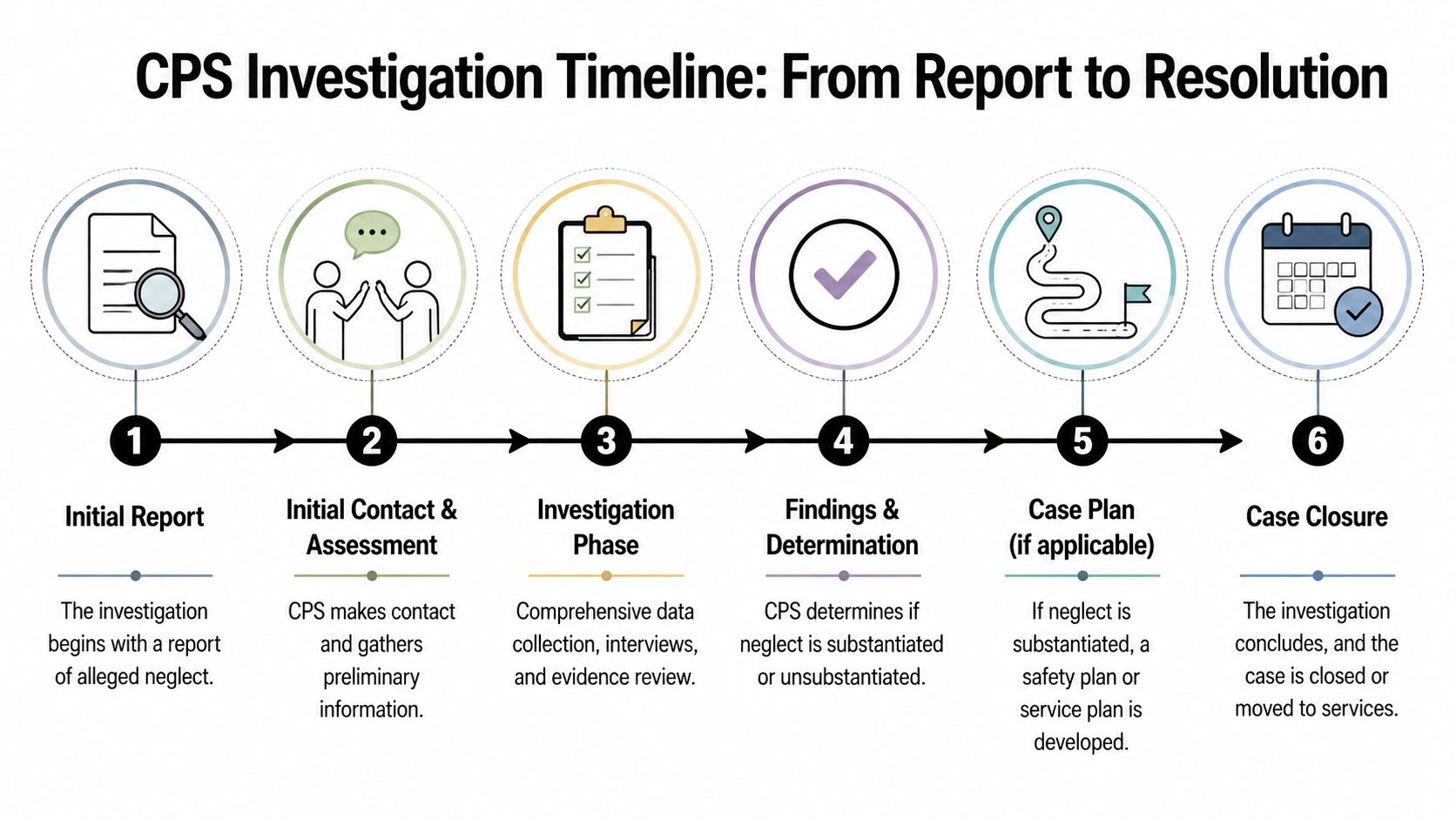
A school files a report after repeated absences. A parent assumes it is an attendance issue that can be cleared up with a few doctor notes. Then CPS starts asking about supervision, mental health, home stability, and whether the pattern could get worse. That is how many educational neglect cases expand. In Texas, the timeline matters because CPS is often building a future-risk theory long before a parent realizes the scope of the allegation.
How the case usually starts
In educational neglect matters, the report often comes from a school employee, counselor, or another mandated reporter who believes the child is not getting adequate access to education. Under Chapter 261, the reporter does not have to prove neglect. Suspicion is enough to trigger CPS screening.
If CPS assigns the case, the investigator usually starts with records and interviews. School attendance data, withdrawal records, discipline history, special education documents, and prior school contacts can all become part of the file quickly. Teen cases are especially easy for CPS to oversimplify. A sixteen-year-old who refuses school, runs away, struggles with anxiety, or resists parental control can still generate allegations that the parent failed to act effectively.
That distinction matters. CPS may frame a teen's school refusal as a parenting problem unless the parent can show a documented pattern of intervention.
What investigators are assessing in the early stage
The first phase is about more than missed school days. The investigator is deciding whether the attendance issue stays narrow or becomes a broader neglect case.
Common pressure points include:
- Present safety concerns: lack of supervision, untreated mental health issues, substance use in the home, or unsafe living conditions
- Future risk allegations: whether CPS believes the attendance pattern will continue or worsen without agency involvement
- Parental response: whether the parent took concrete steps such as school meetings, counseling, transportation fixes, medical care, or truancy interventions
- Teen-specific control issues: whether the parent has realistic authority over an older child and whether the record shows sustained efforts instead of passive acceptance
- Consistency of records: whether school records, medical records, and the parent's explanation match
Families who understand the Texas CPS timeline and what parents should expect make better decisions early, because they can see what each contact is building toward.
The usual path from report to finding
Many cases follow a predictable progression, even if the exact pace varies by county and investigator:
| Phase | What usually happens | Where cases often turn |
|---|---|---|
| Intake and screening | CPS decides whether the report meets criteria for investigation | The allegations may already be broader than the parent expects |
| Initial investigation | Interviews, school contacts, record gathering, home visit requests | Casual statements and incomplete explanations can shape the file early |
| Risk assessment | CPS decides whether the problem appears isolated or ongoing | Teen resistance is often recast as parental failure if records are thin |
| Safety or service planning | CPS may ask for written commitments, services, or monitoring | Signing broad terms can create new compliance problems |
| Findings decision | CPS classifies the allegation and decides whether to close, monitor, or escalate | A finding can remain harmful even if no court case is filed |
| Court involvement, in some cases | Removal, temporary orders, or ongoing court review if CPS believes the risk justifies it | The focus often shifts from attendance to overall parental fitness |
The practical trade-off is simple. Cooperation can help, but unplanned cooperation can widen the case. Parents should answer with care, document what they have done, and avoid treating every request as routine.
Safety plans, service plans, and pressure to agree
If CPS believes the child faces continuing risk, the agency may push for a Safety Plan or later a Family Service Plan. In educational neglect cases, these plans often require attendance monitoring, counseling, parenting classes, psychological services, or repeated school check-ins.
Some terms are reasonable. Some are broader than the actual allegation. I have seen educational cases turn into a running list of obligations that had little to do with getting the child back into school and everything to do with testing long-term compliance. That is a serious concern in teen cases, where no parent can physically force an older child into a classroom every morning.
The legal question is usually whether the parent responded reasonably and persistently, not whether the parent achieved perfect attendance.
What happens if CPS goes to court
Educational neglect does not automatically lead to removal, but it can. Under Chapter 262, Texas courts handle emergency removals and the first hearings after removal. Once that happens, the timeline shortens and the record forms quickly.
If the child remains in the case, Chapter 263 governs many of the review and permanency steps. Those hearings focus on progress, compliance, and whether the child can safely remain at home or return home. Chapter 161 addresses termination of parental rights. Many educational neglect cases never reach that point, but parents should understand how fast a narrow school-based report can become a much larger case once CPS starts alleging ongoing danger or future neglect.
Do not assume CPS will solve the underlying problem
Families often expect that a founded case will lead to meaningful support. Sometimes it does. Sometimes the agency makes a finding and offers little that effectively fixes the attendance barrier, especially where the underlying problem is a teenager's mental health crisis, school refusal, disability-related conflict, or instability outside the parent's control.
A Texas Public Radio report on DFPS service trends described a sharp increase in founded cases where families received no services or ongoing monitoring. Parents should plan accordingly.
Build your own timeline. Keep your own records. Show the steps you took before CPS arrived and the steps you are taking now. In these cases, the strongest defense often is not arguing about the past alone. It is proving that future risk is being addressed with specific, documented action.
Your First 48 Hours A Strategic Response Plan
The first two days matter because they shape the evidence file before you even know what’s in it. If you’re in the middle of a cps educational neglect texas investigation, this is the time to stop reacting and start organizing.

What to do immediately
Start with control, not panic. You do not need to solve the entire case on day one. You need to preserve your position.
- Write down every contact: note dates, times, names, phone numbers, and what was said
- Gather school records: attendance reports, report cards, disciplinary notices, counselor emails, ARD or IEP documents
- Collect excuse records: doctor notes, therapy records, discharge paperwork, transportation issues, housing disruption records
- Keep communication short and polite: don’t fill silence with explanations that haven’t been thought through
- Ask for the allegations in clear terms: not your interpretation, their wording
What not to do
Parents often make mistakes because they want to appear cooperative. The problem is that unplanned cooperation can produce inaccurate statements, broad home access, and signed agreements that weren’t carefully reviewed.
Avoid these common errors:
- Don’t guess: if you don’t know an answer, say you need to review records
- Don’t sign on pressure alone: a document can follow you through the case
- Don’t coach your child: that can create a new issue
- Don’t delete messages or records: preserve everything
- Don’t turn the interview into a family history session: answer narrowly
Say this if you need a safe script: “I want to cooperate appropriately, but I’d like legal guidance before answering detailed questions or signing anything.”
A short explanation from a lawyer can help you hear the issue differently before you make a decision. This overview is worth watching if you’re at that crossroads:
Build a same-day case folder
Use a simple folder system on your phone, computer, or in a physical binder. Don’t overcomplicate it. Label sections by topic.
Try these categories:
- School communications
- Medical and mental health
- Attendance explanations
- Housing and transportation
- CPS contacts
- Names of witnesses or helpers
This kind of organization does two things. It helps your lawyer evaluate the case fast, and it keeps you from relying on memory when the pressure rises.
The right tone wins more than the right speech
You do not need to sound polished. You need to sound steady.
That means no shouting, no sarcasm, and no trying to “teach CPS a lesson” at the door. It also means no apologizing for things that aren’t true just to smooth over tension. A respectful boundary is stronger than emotional overexplaining.
Parents who do best early are usually the ones who understand a hard truth. Being nice is good. Being strategic is better.
Common Scenarios That Can Lead to a CPS Report
A parent can be trying hard and still end up accused of educational neglect. I see that often in Texas cases involving older kids, disability-related attendance issues, and families already under stress. CPS may read a pattern of absences as proof of future risk. The core question is usually more specific: what did the parent do, what barriers were present, and what records exist to show the problem was being addressed?
The teenager who refuses school and the parent gets blamed
A 15-year-old starts missing first period. Then full days. The school records truancy. At home, the parent is dealing with panic attacks, explosive arguments, threats to run away, vaping, depression, or a teen who physically refuses to get in the car.
These cases are often mishandled because a teenager is not a kindergartener. Parents do not have the same day-to-day control over an older child, especially one with mental health issues, delinquent peers, or a history of family conflict. CPS may still frame the case as if the parent chose not to act.
The defense has to focus on effort and judgment. Show the calls to counselors, attendance meetings, therapy intake, medical appointments, discipline attempts, transportation arrangements, and requests for school intervention. Future-risk allegations get weaker when the file shows the parent recognized the problem early and kept trying reasonable solutions.
The child with disabilities or mental health needs whose attendance record looks worse than the reality
Some reports start with absences but turn into criticism of parenting. That happens in cases involving autism, ADHD, anxiety, depression, trauma, medication changes, or a school placement that is not working.
The attendance printout rarely tells the full story. It does not show the child vomiting from panic before school, melting down after repeated sensory overload, or missing class because a provider changed medication and the side effects were severe. It also does not show whether the school delayed evaluations, failed to follow accommodations, or ignored warnings that the child needed a different plan.
Parents in this situation need a record that explains the absences in plain English. ARD paperwork, evaluation requests, doctor notes, therapist recommendations, emails to staff, and logs of missed transportation all help. If you are trying to show a structured learning routine at home during a crisis or transition, a tool like this ultimate homeschooling guide can also help document that education did not stop just because school attendance became unstable.
The homeschooling family that cannot prove what instruction looked like
Homeschooling is legal in Texas. Suspicion grows when a family withdraws a child from school during an attendance dispute and has little paperwork to show what happened next.
I have seen families homeschool for valid reasons. Bullying. Safety concerns. A failed special education placement. Serious anxiety. A parent may make a lawful decision and still draw a report if the timing looks abrupt and the records are thin.
The problem is usually proof, not legality. Keep a written schedule, curriculum information, reading lists, work samples, and any withdrawal records. In these cases, CPS often tests for future risk by asking whether the child is likely to continue falling behind. Clear records answer that question better than verbal assurances.
The family crisis that gets reduced to “parent failed to ensure attendance”
Attendance problems often follow a disruption no one bothered to write down in the report. Eviction. Family violence. Hospitalization. Loss of a car. A parent working nights after losing housing. A grandparent stepping in during a medical emergency.
Those facts do not erase absences, but they matter a great deal. Texas CPS workers are trained to assess safety and risk, and a bare attendance label can make temporary instability look like chronic neglect if the family does not quickly fill in the missing facts.
That is why these cases should be framed carefully. Identify the crisis, tie it to dates, show what the parent did to keep the child connected to school, and document what changed once the emergency eased. A strong response does not deny the disruption. It shows the disruption had a cause, the parent acted reasonably under the circumstances, and the risk of continued educational harm is lower than the report suggests.
Building Your Defense and Protecting Your Parental Rights
A CPS educational neglect case is often decided by the quality of the record the parent can produce in the first days and weeks. Good intentions help no one if the file is thin, the timeline is unclear, or the school’s version goes unanswered.
The legal goal is straightforward. Show that the allegation is overstated, legally incomplete, or disconnected from the full facts. In teen cases, that often means proving the difference between a parent who stopped trying and a parent dealing with school refusal, mental health symptoms, disability-related conflict, transportation breakdowns, or a child old enough to resist every plan put in place.
Build evidence around the allegation CPS is actually making
Parents often hand over a stack of papers and hope something in it helps. A better defense starts with the state’s theory and answers it point by point.
If CPS is focused on attendance, collect records that explain absences, tardies, interventions, and what the parent did after each school contact. If the concern is failure to obtain services, collect proof of evaluation requests, follow-up messages, appointments, waitlists, and any barriers outside the parent’s control.
The strongest files usually include:
- School records: attendance printouts, warning letters, teacher emails, counselor notes, meeting notices, discipline records
- Medical and mental health records: therapy attendance, medication management, discharge summaries, provider recommendations, missed appointment explanations
- Special education records: ARD paperwork, Section 504 plans, evaluation requests, denial letters, service logs, dispute emails
- Home stability records: housing notices, utility interruptions, repair issues, police reports, hospital paperwork, transportation failures
- Parent action records: text messages, call logs, calendars, tutoring receipts, online learning screenshots, makeup work submissions
For families dealing with disability-related school problems, legal defense and school advocacy often need to happen at the same time. Navigating special education for your child can help a parent identify what requests should be documented and what follow-up the school should have received.
Why teen cases are often misunderstood
Teen educational neglect cases are harder than cases involving a young child who is not being taken to school. A 16-year-old with anxiety, depression, substance use, trauma, or repeated school conflict can refuse to get in the car, leave campus, ignore assignments, or sabotage interventions. CPS may still ask whether the parent exercised enough control.
That question needs a careful answer. Texas does not expect magic. It does expect reasonable parental action. A parent’s defense improves when the file shows repeated efforts to get the teen to school, obtain counseling, request evaluations, adjust placement, communicate with staff, and respond when one approach failed.
I often tell parents to document the struggle, not just the rule. “I told him to go” is weak evidence. “I emailed the counselor at 7:10 a.m., took him to his intake appointment on Tuesday, requested a schedule change on Thursday, and enrolled him in credit recovery the following week” is much stronger.
Chapters 262, 263, and 161 can change the stakes quickly
An attendance-based case can turn into a court case faster than many parents expect.
Chapter 262 covers emergency action and the early removal process. If CPS claims the child faces immediate danger, the family may be in court before the parent has had time to organize records or correct misunderstandings.
Chapter 263 controls review hearings and deadlines in cases under court supervision. Once a service plan exists, the court measures whether the parent completed tasks, maintained contact, and fixed the conditions that brought CPS into the home.
Chapter 161 addresses termination of parental rights. Educational neglect allegations do not automatically lead there, but families make a serious mistake when they treat the case as minor after court involvement begins. Failure to follow orders, missed services, or a broader endangerment finding can put the parent-child relationship at risk.
Future risk allegations need a direct response
Many educational neglect cases are really arguments about prediction. CPS may say the child is likely to keep falling behind, likely to disengage further, or likely to face broader harm if the family is not pushed into services or court oversight.
Texas law has drawn criticism for allowing state intervention based on predicted future harm in some circumstances, a due process concern discussed in this analysis of Texas CPS due process concerns. In practice, that means a weak attendance pattern can be framed as a larger safety and stability problem unless the parent answers the prediction with concrete facts.
That is why nuance matters most. The response should not stop at “my child is fine.” It should show why the feared harm is less likely now than it was when the report was made.
Use a simple framework:
| CPS claim | Defense question |
|---|---|
| Child is at educational risk | What records show the child is receiving instruction, treatment, tutoring, or school support right now? |
| Parent failed to act | What did the parent request, schedule, report, or attempt, and on what dates? |
| The problem will continue | What has changed since the report, and what objective proof supports that change? |
| Services are needed | What evidence shows actual neglect rather than a temporary crisis, school dispute, or teen resistance? |
| Court involvement is necessary | What less intrusive options are already in place or available? |
Courts take risk seriously. They should. Risk still has to be tied to evidence.
What strengthens a defense, and what damages one
Parents usually ask whether they should cooperate or fight. The better question is how to protect rights while building credibility.
What tends to help:
- Getting legal advice before signing broad releases or giving detailed statements
- Organizing records by date, not by drawer or device
- Admitting real hardship without adopting CPS’s legal labels
- Showing what has already improved
- Following through on agreed steps the parent can safely complete
What often damages the case:
- Missing school conferences, CPS meetings, or court settings
- Giving different explanations to the investigator, the school, and the court
- Sending hostile messages to teachers, counselors, or caseworkers
- Signing plans the parent does not understand and then failing to complete them
- Assuming CPS cannot act unless it proves a fully developed neglect history at the start
A defense example that often changes the outcome
A father is raising a teenage daughter with depression and panic symptoms. She refuses school, misses classes, and starts falling behind. The attendance office records absences. A report is made. On paper, the case can look like a parent who stopped ensuring attendance.
The file tells a different story. He has therapist notes, medication appointments, school emails requesting a modified day, records of an evaluation request, transportation logs, and proof that he tried virtual coursework when in-person attendance broke down. He also has messages showing the school knew about the mental health crisis before the report was made.
That does not erase the missed days. It does change the case from disregard to documented, imperfect, persistent effort under hard conditions. In real practice, that distinction can affect whether CPS closes the case, seeks services, or asks a court to step in.
The strongest defense is rarely dramatic. It is disciplined, specific, and built early enough to counter the “future risk” story before it hardens into the official version of your family.
Taking Control and Moving Forward With Your Family
A CPS educational neglect case can make a parent feel judged before they’ve been heard. That feeling is common, but it doesn’t have to control the outcome. The families who recover best are usually the ones who act early, document carefully, and stop treating the case like it will disappear on its own.
If your child is struggling, your job isn’t to look perfect. It’s to show the truth clearly. That means records, planning, and steady follow-through. It also means asking for help in the right places. For day-to-day family stability, some parents benefit from practical positive parenting guidance that supports calmer routines and better communication at home while the legal side is being addressed.
The good news is that an allegation is not a final judgment. A report is not proof. An investigator’s concern is not the same thing as a court order. You still have room to act.
Move quickly. Stay calm. Protect your rights. And build your response around evidence, not panic.
Frequently Asked Questions About Educational Neglect
Can CPS remove my child for school absences alone
It depends on the facts alleged and how CPS frames the risk. Some educational neglect cases stay at the investigation level. Others become more serious if CPS claims the absences are part of broader neglect or danger. Parents should never assume school attendance allegations are too minor to create removal risk.
Should I let CPS interview my child right away
That decision should be made carefully. Parents often agree too quickly because they don’t want to appear uncooperative. The smarter approach is to understand the allegation, the setting of the interview, and your legal position before consenting whenever possible.
If my teenager refuses school, is that automatically my fault
No. Teen attendance cases are often more complicated than the report suggests. A teen’s mental health, conflict in the home, bullying, unstable housing, or school failure to intervene can all matter. The key issue is whether you can show your own efforts to address the problem.
What if the school never listened when I asked for help
Save every email, meeting request, note, evaluation request, and response. In many cases, school records become central evidence. If the school ignored disability needs, safety concerns, or repeated requests for intervention, that context can become an important part of your defense.
Do I have to sign a safety plan
Not automatically. You should understand exactly what the plan says, what it requires, and how it might be used later. Signing without legal review can create obligations that are difficult to challenge later.
Can an educational neglect case affect my parental rights permanently
Yes, if the case escalates into court and a parent does not respond effectively. While many cases do not reach that stage, Texas CPS litigation can move from investigation to service plans, court oversight, and in extreme cases, requests that affect custody or parental rights. Early action matters.
If CPS is investigating your family over educational neglect, you don't have to sort through it alone. The Law Office of Bryan Fagan PLLC helps Texas families respond quickly, protect their rights, and build a clear strategy before a school attendance issue turns into a deeper legal crisis. Contact the firm for a free, confidential consultation and get a plan specific to your case, your child, and your next step.