Skip to content
A CPS medical neglect investigation usually starts in one of the worst moments a parent can imagine. Your child has a health issue. You've already been making hard decisions, juggling appointments, prescriptions, work, insurance problems, and advice that doesn't always line up. Then a caseworker calls or shows up at the door and asks questions that make you feel like you're being treated as a danger to your own child.
That fear is real. So is the confusion. Many parents hear the phrase "medical neglect" and immediately assume CPS has already decided they did something wrong.
That isn't how these cases work.
In Texas, a report is the start of an investigation, not the end of your rights. In many medical neglect cases, the decisive work happens early, before removal, before court, and before a case narrative hardens against you. The parents who protect themselves best are often the ones who get organized fast, stay calm, and respond with records instead of panic.
If you're dealing with cps medical neglect defense texas issues right now, the most important point is this. You still have room to influence what happens next.
That Knock on the Door Understanding Your Fear and Your Rights
A common scenario looks like this. A child with a chronic condition misses a follow-up appointment after a parent spends days trying to get transportation lined up. Or a parent declines one treatment recommendation and asks for another specialist. A nurse, hospital social worker, or physician gets worried and makes a report. Then CPS arrives, often without much warning.
For the parent, it feels personal right away. For CPS, it begins as a safety inquiry.
Those are not the same thing.
What most parents are feeling in the first hour
When CPS contacts you, you may feel two conflicting pressures at once. One is the urge to explain everything immediately. The other is the urge to shut the door and say nothing. Neither extreme usually helps.
A better response is controlled cooperation. Be respectful. Be measured. Don't guess. Don't argue medicine with a caseworker at the doorstep. Don't volunteer a long emotional history that has nothing to do with the allegation.
What matters most in the first contact is whether you can move the case from suspicion to documentation.
Practical rule: Your first goal is not to win an argument. Your first goal is to slow the situation down and make the facts visible.
Rights matter even when you're trying to cooperate
Parents often think exercising rights will make them look guilty. That's not how good defense works. You can be cooperative and still be careful.
That usually means:
- Ask who the caseworker is: Get the person's full name, office, phone number, and email.
- Ask what the allegation is: You need the issue described clearly enough to gather the right records.
- Ask what they want first: Is it an interview, a home visit, medical releases, or contact with providers?
- Take notes immediately: Write down the date, time, what was said, and any deadlines.
- Pause before signing anything: Read each form. If you don't understand it, tell them you want legal advice first.
A parent who says, "I want to cooperate, and I also want to make sure I answer accurately," usually presents much better than a parent who reacts from panic.
A calmer way to think about the next few days
Texas CPS cases move quickly, but they don't become stronger just because a report was made. A report may come from a genuine concern, a misunderstanding, or a provider who saw one bad moment without seeing the full pattern of care. Your job is to show the full picture.
That can include medication refill records, discharge instructions, appointment confirmations, text messages with providers, school nurse notes, and proof that you sought follow-up care.
You are not powerless here. You are being evaluated, but CPS is also required to support its conclusions with evidence. The sooner you start acting like someone building a record, the more control you regain.
What Constitutes Medical Neglect Under Texas Law
A medical neglect allegation often starts with a hard conversation in a hospital room, a missed follow-up, or a provider who believes a parent is not doing enough. Texas law does not label every missed appointment, treatment dispute, or insurance delay as neglect. The legal question is narrower and more fact-specific.
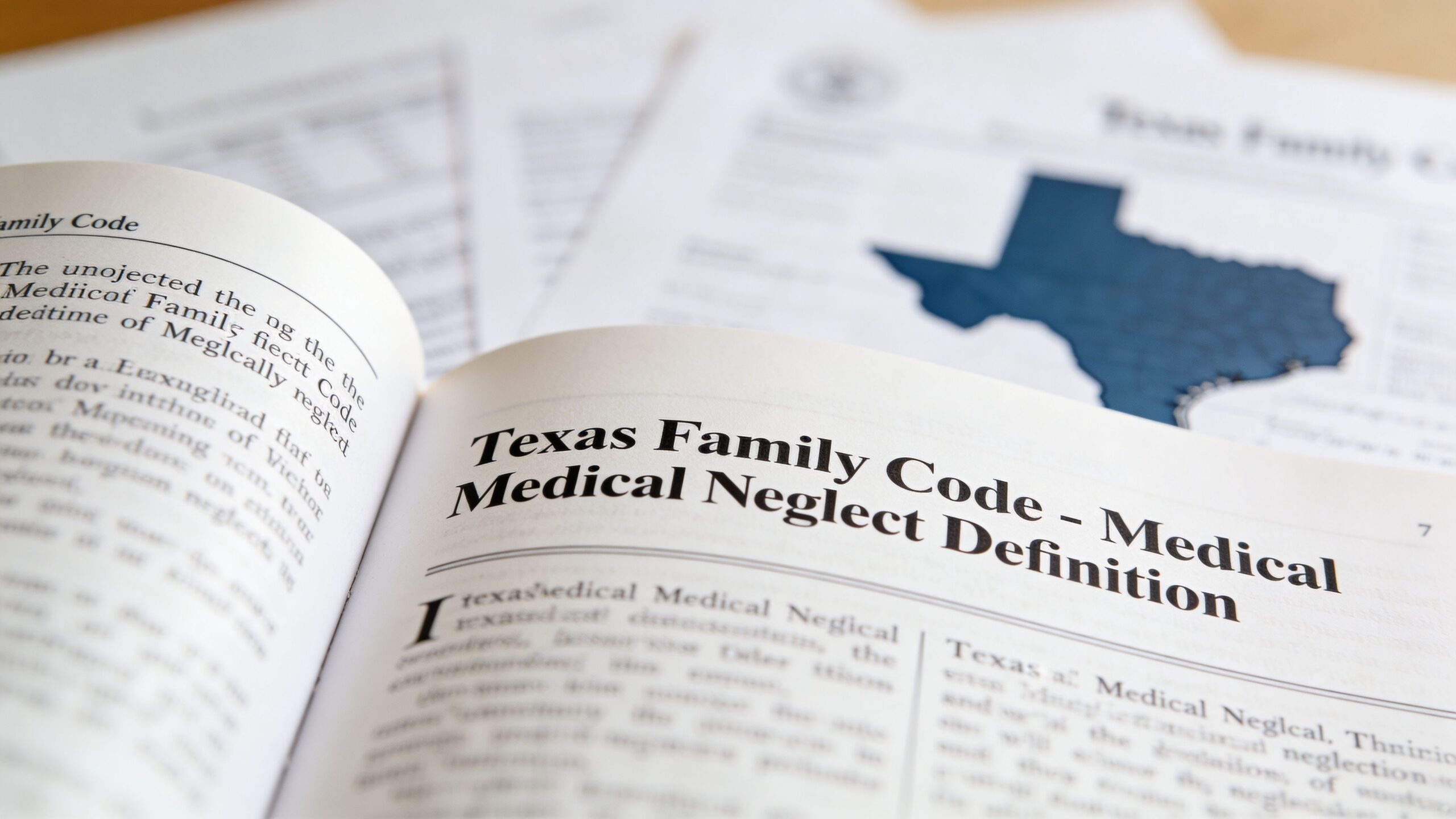
Under Texas Family Code § 261.001(4)(A)(ii), medical neglect generally means a parent failed to seek, obtain, or follow through with medical care in a way that caused actual harm or created a real risk of harm to the child's physical or mental condition. For parents in the first weeks of a CPS case, that definition matters because it gives you a defense framework early. If you can document why care was delayed, what steps you took, and how your child was monitored in the meantime, you are already addressing the core issue CPS has to prove.
The legal issue is harm, not just disagreement
A parent can question a recommendation, ask for a second opinion, or face a delay that comes from money, transportation, or insurance problems. Those facts do not automatically prove neglect. CPS still has to examine whether the child faced serious danger because care was not obtained or followed.
Texas regulations give caseworkers a structure for that review. Under 40 Tex. Admin. Code § 707.469 and its medical neglect factors, the agency looks at the seriousness of the child's condition, the level of pain or impairment involved, whether the parent understood the need for treatment, whether there was a pattern of refusal or delay, and whether the lack of care directly endangered the child.
That is why records matter so much during the first 45 days.
If your child missed a specialist visit because the insurer denied authorization, preserve the denial letter, call logs, referral requests, and any messages asking for an earlier appointment. If you are dealing with repeated denials, this guide to understanding health insurance appeals can help you organize the paper trail CPS may later need to see.
What CPS tends to focus on
In practice, medical neglect investigations usually turn on a short set of questions. Caseworkers may ask them in different ways, but the themes are consistent:
- How serious was the child's condition at the time care was missed or delayed?
- Did the parent know prompt treatment was needed?
- Was this a one-time problem or part of a repeated pattern?
- Did the child suffer actual harm, worsening symptoms, or a clear risk of worsening?
- Do the records show the parent was trying to get care, adjust treatment, or seek another medical opinion?
Parents often make the mistake of answering these concerns with general statements like "I was doing my best." That is understandable, but it is rarely enough. Specific proof carries more weight. Pharmacy refill histories, discharge instructions, appointment records, text messages with providers, school nurse notes, transportation receipts, and insurance correspondence can all show that the situation was more complicated than a hotline report suggests.
What does not automatically amount to medical neglect
Many reported families are caring for children with chronic or medically fragile conditions. Those cases can look messy on paper even when the parent is engaged and trying hard. Diabetes management can involve missed numbers and dosage adjustments. Seizure care can involve changing medications. Feeding issues, respiratory problems, transplant follow-up, and premature birth complications often require multiple specialists, shifting instructions, and repeated insurance approvals.
CPS may still investigate those facts. But a difficult course of treatment is not the same as abandonment of care.
Texas law also leaves room for good-faith decisions, including efforts to obtain second opinions and certain religious-freedom protections recognized by statute. The stronger position is the one you can document. For a broader explanation of how these cases are evaluated, this resource on child neglect investigations by CPS gives useful background.
Why this definition matters to your defense
During the investigation phase, the goal is not to argue abstract legal theory. The goal is to show, with records, that your child was not left without care and that any delay or dispute had a real explanation.
Strong early defense themes often include:
- You acted in good faith and stayed involved in the child's care
- You sought treatment, follow-up, medication, or specialist input
- Any interruption had a documented cause, such as denial of coverage or scheduling barriers
- There was no pattern of dangerous refusal
- The evidence does not show the required link between your conduct and actual harm or a substantial risk of harm
That is how parents regain control early. They stop treating the allegation like a moral accusation and start addressing it as an evidence problem.
The CPS Investigation Process for Medical Neglect Allegations
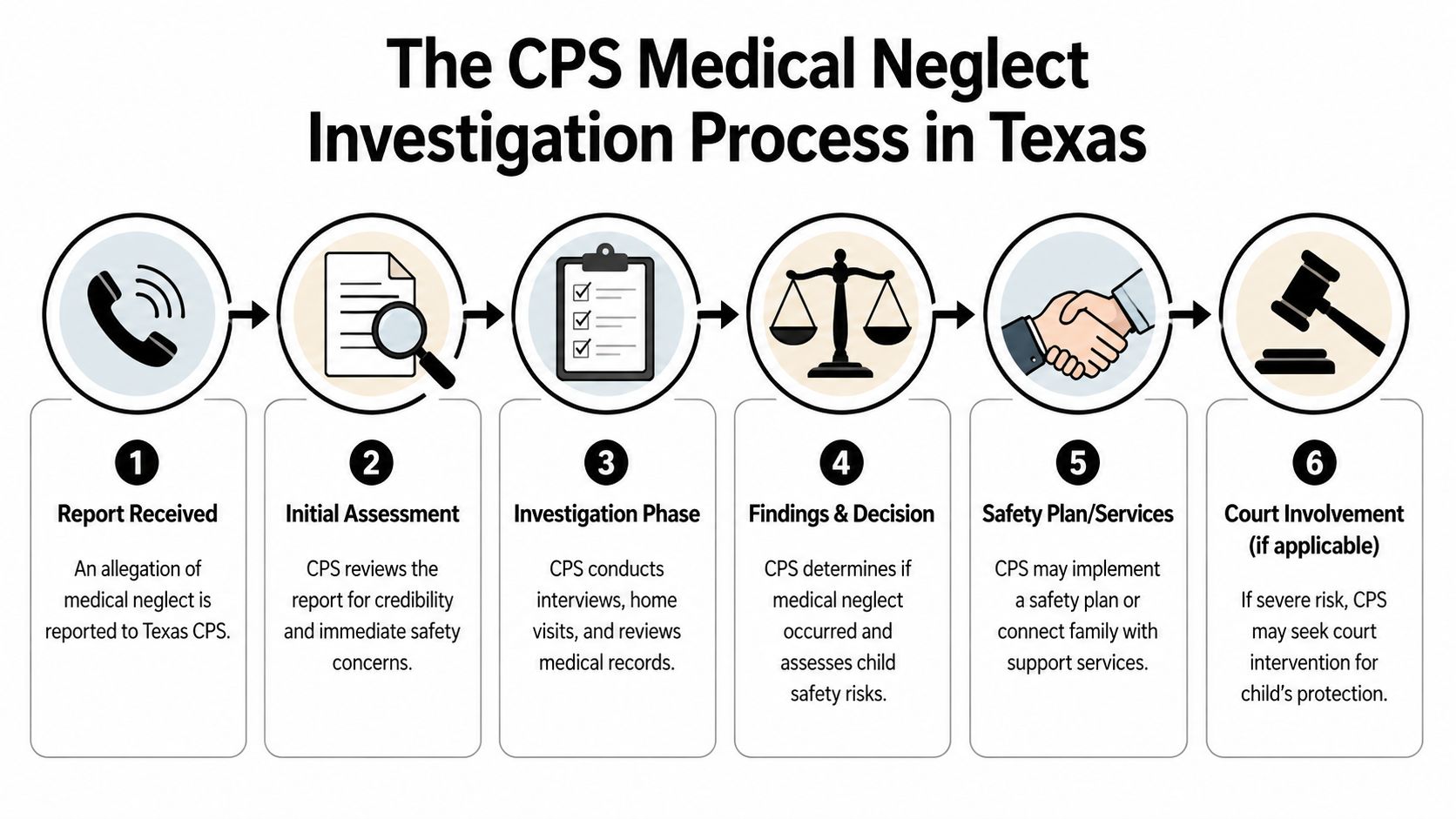
The investigation phase is where many families have the best chance to keep a case from turning into removal. That's especially important because fewer than 1 in 4 Texas CPS investigations in fiscal year 2025 resulted in findings of abuse or neglect. That same report also notes the 2026 establishment of the Family Early Defense Network through a $14 million grant, reflecting growing recognition that early legal help can be more effective than fighting only after removal.
That should change how you think about the first 45-day investigation phase. This period isn't a formality. It's where facts get framed.
Step one starts before you feel ready
The report reaches CPS first. A screener decides whether the allegation should be assigned for investigation. If it is, a caseworker will usually make contact by phone, at your home, at school, or sometimes in a medical setting.
At that point, the caseworker is trying to answer two immediate questions. Is there a present safety threat, and does the allegation justify deeper review?
You don't control the report. You do control how clearly you respond once the investigation opens.
What to do during the first contact
The first conversation should be calm, short, and deliberate. You're not there to give a full life story.
Use this approach:
Confirm the allegation category
Ask what concern has been reported. "Missed medication" and "refused emergency care" are very different accusations.Identify the scope of the request
Ask whether CPS wants to see the child, inspect the home, interview other caregivers, or obtain records.Set an organized tone
Tell the caseworker you want to cooperate and provide accurate documentation.Start your own file immediately
Put every paper, prescription label, portal message, discharge note, calendar entry, and provider name in one place.
A parent who responds with structure makes it harder for the case to drift into assumptions.
The home visit and interviews
During a medical neglect investigation, the home visit often has a dual purpose. CPS wants to assess safety generally, and it wants to see whether the parent's story lines up with the child's medical needs. If the allegation involves oxygen, insulin, formula, medications, mobility equipment, or specialist follow-up, expect those issues to become part of the visit.
That doesn't mean the home has to look perfect. It does mean the essentials should be visible and functional.
Consider focusing on:
- Medication organization: Keep current prescriptions, dosing instructions, and refill information together.
- Medical equipment: If the child uses equipment, make sure it is present, clean, and reasonably accessible.
- Written instructions: Keep discharge summaries and follow-up recommendations easy to find.
- Caregiver consistency: If relatives help, know who gives medications, who attends appointments, and how handoffs happen.
If your child has a complicated condition, don't assume the caseworker understands it. Explain it in plain language and back it up with records.
Medical releases and provider contact
Caseworkers often ask parents to sign releases so they can speak with doctors, hospitals, therapists, pharmacies, and schools. This is an area where strategy matters. Blindly signing broad releases can expand the file well beyond the issue under investigation. Flatly refusing can create avoidable conflict.
The better path is usually targeted cooperation. Find out which providers are relevant and what time period is in dispute. If possible, produce key records yourself in a neat packet. That lets you shape the factual narrative with complete documents rather than snippets.
For a broader practical roadmap, this step by step guide to the Texas CPS investigation process gives helpful background.
The 45-day window is your chance to narrow the case
In many investigations, the caseworker forms an early impression and then looks for facts that support it. That's why parents need to provide not just explanations, but proof tied to dates.
Useful items often include:
- Appointment history
- Portal messages asking for follow-up
- Insurance denials or prior authorization delays
- Pharmacy logs
- School nurse communications
- Specialist referrals
- Transportation issues documented by texts or emails
- A timeline showing what happened and when
Don't send a disorganized stack if you can avoid it. A short index or chronology can make a huge difference.
What works and what usually backfires
These investigations reward calm credibility.
What tends to work:
- Answering the actual allegation
- Supplying records quickly
- Correcting errors politely
- Showing a current care plan
- Consulting counsel early when the facts are medically dense
What tends to fail:
- Arguing with every provider involved
- Posting about the case online
- Changing your explanation repeatedly
- Minimizing a serious episode that is already documented
- Assuming the truth will "speak for itself" without records
By the end of the investigation, CPS is deciding whether the evidence supports a finding and whether any safety plan, services, or court action should follow. In medical neglect cases, parents usually help themselves most by acting like recordkeepers from day one.
A Parent's Story A Medical Neglect Scenario
Maria and Daniel were caring for their son, who had recurring breathing complications after a difficult infancy. He used home equipment, saw more than one specialist, and had periods where his treatment plan changed quickly depending on his symptoms. The family wasn't ignoring care. They were trying to keep up with it.
Then came a bad week.
A school staff member became alarmed when their son showed up tired, with a lingering cough, and didn't have a medication form updated the way the school expected. A hospital visit followed. One provider believed the parents had not followed through correctly. A CPS report was made before the family even got home.

Panic gave way to a paper trail
At first, Maria did what many parents do. She talked too much. She tried to explain the full medical history over the phone, while upset, and without any records in front of her. The caseworker's questions made her feel accused, and she could hear herself getting defensive.
By the next day, the family changed course.
They built a folder with discharge paperwork, prescription histories, specialist recommendations, appointment confirmations, and messages showing that they had been trying to get follow-up care scheduled. They also asked one treating physician to write a short statement clarifying that the child's condition was complex and that treatment adjustments were common.
That changed the tone of the case.
The details that made the difference
The allegation sounded simple. "The parents failed to provide necessary medical care." The records showed something else. They showed repeated efforts to obtain care, a disagreement between providers about timing, and a family responding to a medically fragile child in real time.
The family also stopped answering every question informally by text and phone. They became respectful but more organized. If CPS asked about a missed follow-up, they sent the scheduling record. If CPS asked about medication compliance, they provided refill information and doctor instructions. If the caseworker misunderstood the timeline, they corrected it in writing.
Good parents sometimes look disorganized in crisis. Documents help separate stress from neglect.
How cases like this often resolve
This scenario is hypothetical, but it reflects a pattern seen often in practice. A family facing a frightening accusation doesn't necessarily need a dramatic trial to protect itself. It often needs a disciplined early response.
The strongest point in Maria and Daniel's favor wasn't a perfect medical history. It was their ability to show that they had not abandoned their child's care. They had sought treatment, followed instructions where they could, tried to resolve barriers, and gathered support from qualified providers when concerns arose.
That is what cps medical neglect defense texas work often looks like in real life. Not theatrical courtroom moments. Care logs. timelines. second opinions. corrected misunderstandings. less talking. better proof.
Building Your Defense Common Strategies and Evidence
A strong defense begins with a basic truth. CPS files tend to reward whatever is documented best. If your family has been providing care but the story is scattered across pharmacy records, discharge instructions, text messages, school communications, and memory, you need to assemble it fast.
That matters even more in medical neglect allegations because these reports often involve children with serious health conditions. Historically, 82.5% of confirmed Texas CPS cases are neglect-driven, but medical neglect is a small subset. National studies show 91% of medical neglect reports involve children with chronic illnesses. The same source notes that House Bill 567 from 2021 and House Bill 730 raised the evidentiary bar for CPS. In practice, that means the defense should force the case to focus on evidence rather than alarm.
The most useful evidence is often ordinary
Parents sometimes think they need a dramatic expert opinion on day one. Sometimes you do need one later, but most investigations turn first on ordinary records.
The best starting toolkit usually includes:
- A care log: Write down medication administration, symptoms, calls to providers, missed appointments and why they were missed, urgent care visits, and follow-up steps.
- Medical records packet: Gather discharge summaries, after-visit notes, lab results if relevant, referrals, and treatment instructions.
- Pharmacy proof: Refill histories and prescription labels can rebut claims that no effort was made to medicate the child.
- Communication archive: Save portal messages, emails, and texts with doctors, nurses, schools, therapists, and insurers.
- Calendar timeline: A one-page chronology helps a caseworker or lawyer understand the case without guessing.
A clean packet beats a chaotic explanation almost every time.
Second opinions can help when used correctly
A second opinion is not a magic wand. It does not erase a genuine medical crisis. But in many cases, it does something valuable. It shows that a parent was engaged, thoughtful, and trying to make informed decisions rather than refusing care blindly.
That distinction matters most when the allegation is built around disagreement.
If you're pursuing another opinion, make sure the new provider receives the relevant records. Ask for written impressions when appropriate. If the issue involved insurance delays, note that too. One organized explanation can do more than ten emotional phone calls.
Communication strategy matters
Parents often hurt their own cases by swinging between over-sharing and silence. Neither is ideal.
A better method is this:
- Be respectful in every interaction
- Answer the allegation asked
- Correct mistakes in writing
- Avoid speculation
- Don't sign broad documents without understanding them
- Don't attack the reporter, even if you think the report was unfair
The Law Office of Bryan Fagan PLLC is one option families use when they need help organizing records, responding to investigators, and preparing for hearings that may follow.
The parent who can show steady effort usually stands in a stronger position than the parent who insists everything was "fine" when records show a complicated reality.
Medical Neglect Allegations Potential Consequences
| Aspect | Civil Case (Family Court) | Criminal Case (Criminal Court) |
|---|---|---|
| Primary concern | Child safety, supervision, placement, services, parental rights | Whether the parent's conduct violated criminal law |
| Who brings the case | CPS through the state in family court | Prosecutor in criminal court |
| Main evidence focus | Medical records, risk to child, parent compliance, safety planning | Mental state, causation, witness testimony, records, statements |
| Possible result | Safety plan, services, temporary orders, removal, reunification plan, termination attempt | Charges, plea negotiations, trial, probation, or other criminal penalties |
| Parent's immediate task | Show child can remain safe without removal | Protect constitutional rights and avoid damaging admissions |
| Why coordination matters | Statements in family court can affect later case decisions | Statements to investigators can affect both criminal and CPS exposure |
What usually doesn't work
Some defense ideas feel satisfying in the moment but damage credibility.
These usually backfire:
- Refusing all communication out of fear
- Cleaning up records after the fact instead of preserving them accurately
- Giving inconsistent explanations to school, hospital, and CPS
- Treating a provider dispute like a personal feud
- Ignoring a current medical issue because the report feels unfair
The most effective defense is rarely flashy. It is disciplined, chronological, and focused on one question. Can you prove that you were trying to protect and care for your child?
Navigating the Court System If Your Child Is Removed
If CPS removes your child, the emotional shock is immediate. Parents often feel like the case is already over. It isn't. Removal starts a court process, and what happens next matters a great deal.

The first hearing comes quickly
In Texas, one of the most important early settings is the adversary hearing, often called the 14-day hearing, during which the court reviews whether CPS should continue holding the child and what temporary orders should apply.
At that stage, legal standards matter. Earlier in the process, CPS may be operating under a lower evidentiary burden in emergency and temporary proceedings. If the case later moves toward termination of parental rights, the burden becomes higher. For parents trying to understand how judges evaluate these cases, this discussion of the burden of proof in a Texas CPS case is a useful reference.
What parents should do before that hearing
Time is short, so focus on what a judge can evaluate quickly.
Bring your lawyer or prepare to discuss:
- Current medical records
- A clear treatment plan for the child
- Evidence that barriers to care are being addressed
- Names of relatives or caregivers who can help if needed
- Any provider statements supporting the parent's good-faith efforts
Judges look for a practical path to safety. If your plan is realistic and documented, that helps.
A short visual explanation may also help families understand the hearing process and what to expect as a CPS case moves through court.
The case doesn't stop at one hearing
After the adversary hearing, the court may set status and permanency hearings. In many cases, parents receive a service plan. That plan may include medical compliance requirements, classes, evaluations, counseling, or other steps tied to reunification.
Treat the service plan seriously. If part of it doesn't make sense medically, raise that early and through counsel. Don't ignore it because you disagree.
Court review is not just about what happened before removal. It is also about whether the parent is taking credible steps now.
Keep the focus on reunification, not outrage
Parents often want the court to hear every unfair detail immediately. Some of that matters, but judges also need a manageable path forward. If your child was removed in a medical neglect case, the practical questions become urgent. Is there a safe treatment plan now? Are providers aligned? Is the parent complying? Can placement with family work while the case continues?
Those answers often carry more weight than anger alone.
Texas Family Code Chapters 262, 263, and 161 shape this process from removal to permanency to any termination request. The important thing is not to freeze. Once the case reaches court, consistency becomes even more valuable.
Take Control of Your Case Today
The phone rings at 4:30 p.m. A CPS investigator says she needs to discuss your child's medical care and wants records before the end of the week. For many parents, that is the moment panic takes over. It is also the moment a defense should start.
In Texas medical neglect cases, the first 45 days often shape everything that follows. If you wait to explain your decisions until a removal hearing is set, you may be trying to repair a record that was written without you. The stronger approach is to build your record early, while the investigator is still deciding whether the allegation can be ruled out, designated reason to believe, or pushed toward court.
Start with proof, not explanations alone. Gather appointment records, prescription history, discharge instructions, messages with doctors, insurance denials, transportation problems, second-opinion requests, and a timeline of what happened and why. If a treatment decision was delayed for a reason other than disregard, show it. If you asked questions because the risks were serious, document that. CPS often views gaps in care harshly unless the parent can tie each gap to a real-world reason and a reasonable response.
A clear response usually includes a few immediate steps:
- Create a dated medical timeline
- Request complete records from every provider involved
- Save texts, portal messages, and pharmacy records
- Follow up on missed care and get the next appointment scheduled
- Ask providers to clarify recommendations in writing when possible
- Speak with counsel before giving detailed written statements in a complex case
Cooperation matters. So do boundaries. You can be respectful, prompt, and child-focused without guessing at answers, accepting inaccurate summaries, or handing over disorganized records that create more confusion.
Some families also face substance use treatment issues, relapse concerns, or court-ordered services that affect how CPS reads the case. In that setting, outside reading with insights on legal implications for rehab can help you spot problems that may spill into the medical neglect investigation.
The goal is simple. Give CPS and, if necessary, the court a clean, documented picture of a parent who is addressing the child's medical needs with care and judgment. That kind of record can prevent removal before it becomes the next fight.
If CPS has contacted you about medical neglect, speaking with counsel early can help you protect your rights, organize the right records, and respond before the case escalates. Contact Law Office of Bryan Fagan PLLC for a free consultation and clear guidance on the next step for your family.