Skip to content
You look at your phone, then your calendar, then the time. The hearing was this morning.
Maybe you were at work and couldn't get away. Maybe your ride fell through. Maybe you wrote the date down wrong. Maybe you were so overwhelmed by the CPS case that one more notice, one more appointment, one more demand just blurred together. However it happened, the panic feels immediate. You start thinking, “What happens if you miss a CPS court date? Did I just lose my child forever?”
Take a breath. Missing a CPS hearing is serious, but it is not the same thing as giving up your case. What matters now is what you do next. In Texas CPS cases, judges work on tight legal timelines, and the court can move forward without you. That means delay hurts. Fast, organized action helps.
Texas parents often confuse a court setting with a meeting from a caseworker. They are not the same. A CPS court hearing is where a judge can make binding decisions about removal, placement, visitation, services, reunification, and in some cases the path toward termination under Texas Family Code Chapters 262, 263, and 161. If you missed court, your first job is triage. Find out what happened, what orders were entered, and what your lawyer needs from you right now.
That Sinking Feeling When You Miss a Court Date
Maria had been juggling everything at once. She was trying to keep her job, complete services, answer calls from CPS, and make it to visits with her children. One morning she realized the hearing she thought was next week had already happened. Her stomach dropped. She didn't know whether to call the caseworker, the clerk, or no one at all.
That reaction is common. Parents in CPS cases already feel watched, judged, and exhausted. Missing court can make you feel like the worst has already happened, even before you know the facts.

What matters most in the first few hours is this. Don't disappear. Parents sometimes panic and avoid the court, CPS, or their attorney because they're afraid a warrant has already been issued. That usually makes the situation worse.
What panic tells you, and what you actually need to know
Panic says:
- “I'm in trouble, so I should wait and see.”
- “If I call, I'll make it worse.”
- “Maybe nothing happened and I shouldn't draw attention to it.”
What you need to know is much simpler:
- Did the judge proceed without you
- Did the court sign orders
- Was any warrant issued
- What is the next hearing date
- What does your lawyer need from you right now
Missing court is serious, but silence is usually the bigger mistake after the miss.
If you're worried about whether a missed hearing could lead to a failure-to-appear issue, this overview of FTA warrants in Texas helps explain the basic idea in plain language.
A better first reaction
A better reaction sounds like this: “I missed court. I need facts, not guesses.”
That shift matters. Once you move from fear to information, you can start protecting your position. In many CPS cases, the damage comes less from the missed date itself and more from the time that passes afterward with no response, no explanation, and no request for relief.
Why a CPS Court Hearing Is Not Just Another Appointment
A CPS hearing is a formal court proceeding. It isn't like a check-in with a caseworker, a parenting class, or a scheduling phone call. When your case is in court, the judge is managing legal deadlines and making orders that affect your family.
Under Texas child-protection practice, the court can move forward without the parent present. That's one reason these cases feel harsh. They don't pause just because life got chaotic.
Court deadlines are real deadlines
Texas parents sometimes assume family court works slowly. In CPS cases, that assumption is dangerous. Other states show the same kind of structured schedule. Michigan requires a review hearing within 182 days after removal and then review hearings every 91 days after that, according to Michigan Legal Help's CPS process guide. The point isn't that Texas uses Michigan procedure. The point is that child-protection cases run on fixed timelines, not open-ended delays.
That matters because a missed hearing isn't treated like a casual reschedule. It can immediately affect custody, visitation, services, and placement decisions.
For a practical look at how these hearings fit into the larger process, this guide to Texas CPS status hearings is helpful.
What the judge is deciding
In a CPS case, the court may be dealing with issues such as:
| Court concern | Why your presence matters |
|---|---|
| Child safety | You may need to answer concerns directly |
| Placement | The judge may consider where your child will stay |
| Visitation | The court may set, limit, or change visits |
| Services | You may be ordered to complete tasks and deadlines |
| Reunification progress | The judge evaluates whether return is realistic |
A caseworker can make recommendations. The judge makes orders.
Practical rule: If the hearing is on the court calendar, treat it as a decision day, not an appointment.
Why judges care about attendance
Courts often read attendance as engagement. That doesn't mean every missed appearance proves you don't care. Emergencies happen. Work conflicts happen. Transportation breaks down. But if no one explains your absence promptly, the court may see only one fact. You were told to come to court, and you weren't there.
In a Chapter 262 removal case or a Chapter 263 review setting, that can change how the judge views your reliability going forward.
The Three Immediate Consequences of Missing Court
The fastest way to understand the risk is to focus on what can happen right away. Not every case will involve all of these outcomes. But these are the consequences parents need to think about first.
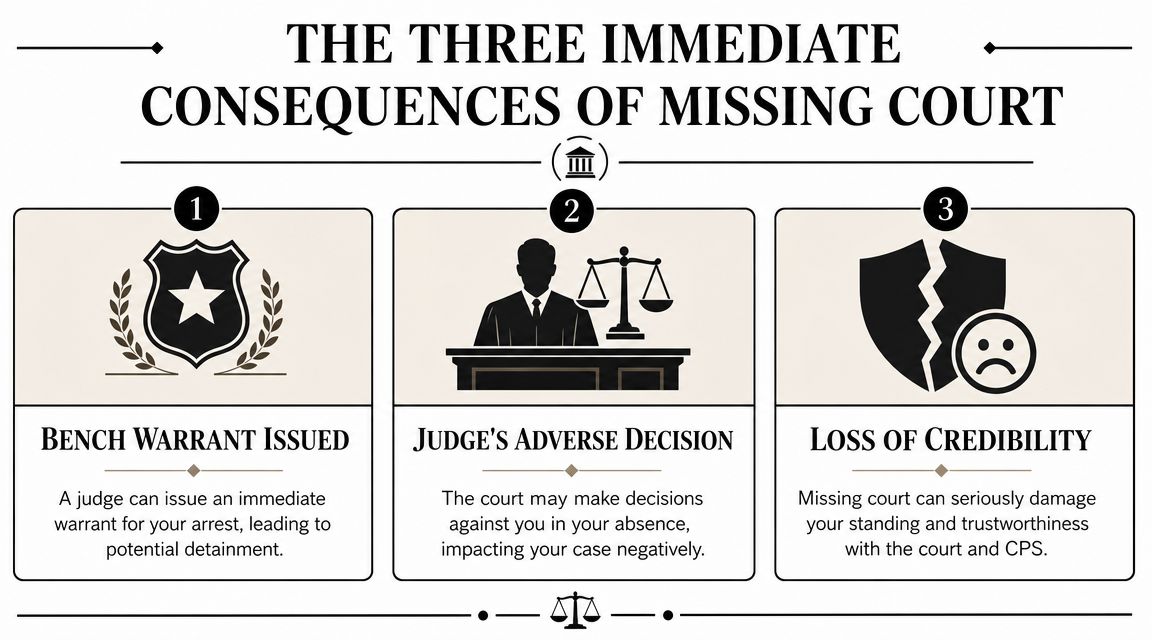
A bench warrant may be issued
A missed CPS court date can trigger an immediate bench warrant and allow the judge to proceed without the parent present, as explained in this discussion of missing a CPS court date. In plain English, that means the court may direct law enforcement to bring you before the court.
That possibility scares people for good reason. A bench warrant is not just a warning. It can lead to detention.
This is also why some Texas parents search for answers about default judgments in Texas. They want to know whether the court can act without them. In many CPS settings, the answer is yes.
The judge may enter orders without hearing your side
The same legal explanation notes that when a parent doesn't appear, the hearing can become a one-sided event where CPS's position goes unchallenged. That can increase the risk of default-style orders affecting custody, visitation, services, or placement.
Think about the practical problem. If CPS tells the court you missed visits, haven't started counseling, or still haven't addressed housing concerns, and you are not there to explain the truth, the judge only has one version of events in front of them.
A parent might have a valid explanation:
- A hospital visit
- A last-minute work issue
- A notice sent to the wrong address
- Proof that services were completed but not yet reported
If you aren't there, that explanation may never reach the judge that day.
Your credibility can take a hit
The absence itself can become part of the record. Courts may see nonappearance as disengagement. That doesn't automatically decide the case, but it can affect how the judge evaluates future explanations, requests, and promises.
Parents sometimes get confused, often asking, “Can they really hold one mistake against me?” A better question is, “How will the court interpret this in context?”
If your case already involves concerns about consistency, supervision, sobriety, or follow-through, missing court can deepen those concerns.
A missed hearing doesn't just remove your voice from that day's discussion. It can also change how the court hears you the next time you speak.
What about contempt
In some cases, courts may also treat nonappearance as contempt-related conduct, especially if there was a direct order to appear and no adequate explanation follows. The exact response depends on the court, the history of the case, and what orders were already in place. The safest assumption is that the court will treat the absence as serious and expect a prompt response.
How a Judge Can Advance the Case Without You
The biggest legal risk is not just punishment. It's procedural acceleration. The case keeps moving, and it moves with CPS doing most of the talking.
In Texas, initial hearings after removal are typically held within 72 hours, according to this discussion of missed CPS hearings and early court settings. That short timeline means an early missed hearing can shape the whole case before you've had a fair chance to stabilize, gather documents, or explain what happened.
What procedural acceleration looks like
A review or permanency hearing is supposed to update the court on parental compliance, safety planning, placement, and whether the child can remain with or return to a parent. If you're absent, the judge may rely mainly on CPS reports and the existing court file.
That can lead to orders involving:
Temporary placement decisions
The court may keep your child in foster care or another temporary arrangement.Visitation changes
The judge may limit, structure, supervise, or postpone visits.Service requirements
You may be ordered to complete counseling, evaluations, classes, testing, or other tasks.Future hearing settings
The court can schedule the next stage whether you were present or not.
A realistic example
Suppose a parent misses what they think is “just a status hearing.” CPS tells the court the parent has only partly complied with services and missed recent communication. The parent finished one class, has proof of employment, and has a family member ready for placement consideration. None of that is presented because the parent isn't there and counsel hasn't had time to gather the documents.
The court then keeps the current placement in place, adjusts visitation, and orders additional steps.
That doesn't mean the case is over. It means the parent now has to undo or modify orders that were made without their input.
Why early hearings matter so much
Texas Family Code Chapters 262 and 263 create a structure in which early hearings affect later ones. The first orders often become the foundation for service plans, visitation patterns, and judicial expectations. Once the case starts moving in a certain direction, it can take real work to change that direction.
A missed hearing can also reduce your practical influence. It's harder to ask the court for flexibility, a placement review, or expanded visitation after the judge has just seen an empty chair where you should have been.
Your Step-by-Step Action Plan to Mitigate Damage
This is the part that matters most if you missed court today or recently. You need a triage plan. Not a vague reminder to “call your lawyer.” A real sequence.

Independent legal guidance notes that after missing a hearing, a parent needs to quickly determine whether a default order was entered and how to request relief. It also notes that parents have a right to counsel and may be entitled to emergency hearings in some situations. You can read that discussion in this article about missing a Family Court date and immediate next steps.
Do these five things first
Contact your attorney immediately
Call. Leave a voicemail. Send an email. Send a text if that's how your attorney's office communicates with clients. Say the date and time of the hearing, that you missed it, and why.Find out exactly what happened in court
Don't assume. Ask whether the court proceeded, whether any orders were signed, and whether any warrant was issued.Document your reason for missing the hearing
Save hospital papers, work messages, tow receipts, screenshots, childcare issues, or proof that notice was unclear. Your explanation is stronger when it's documented.Ask what filing may be needed
Depending on the posture of the case, your attorney may discuss a motion to reset, a request to reconsider, or another filing to address orders entered in your absence.Show immediate engagement after the miss
Start or continue services. Respond to CPS. Attend the next setting. Be available. Courts notice what you do after a mistake.
What to say when you call
If you freeze up on the phone, keep it simple:
“I missed my CPS hearing today. I need to know if the judge signed any orders, whether a warrant was issued, and what I need to do next. I can send proof of why I missed.”
That's enough. You do not need a perfect speech.
If you don't have a lawyer
If you don't have counsel yet, get legal help quickly. In Texas CPS cases, timing matters. One option for parents needing representation in a child-protection matter is Law Office of Bryan Fagan PLLC, which handles CPS-related cases and consultations in Texas.
What not to do
| Don't do this | Why it hurts |
|---|---|
| Ignore the problem | The court may keep moving without your input |
| Rely on the caseworker alone for legal advice | The caseworker is not your attorney |
| Invent an excuse | False explanations damage credibility badly |
| Miss another date | Repeated absences are much harder to fix |
Long-Term Impacts on Reunification and Parental Rights
A missed hearing can have effects that last beyond that one day. The actual danger is often the story that starts to form around the absence.
If CPS argues that you are inconsistent, not engaged, or not following through, a missed court date may be used to support that narrative. That matters because the court, not just CPS, often has the final say on reunification.

Reunification can slow down even if you completed services
A point many parents miss is that finishing services doesn't automatically bring your child home. In at least some jurisdictions, child-protection guidance shows CPS may, but is not required to, condition a child's return on a written promise to appear in court. That discussion appears in the New York OCFS CPS manual. The broader lesson applies here. Court attendance can become part of the reunification problem itself.
So a parent may say, “I did my classes, I did my testing, I did everything they asked.” But if the court now sees the parent as unreliable about hearings, reunification can still stall.
Credibility affects almost every later issue
Once a judge starts doubting a parent's consistency, that doubt can appear in later decisions about:
- Expanded visitation
- Trial home placements
- Modified restrictions
- Extensions or flexibility on deadlines
- Whether the parent is likely to follow court orders
Under Texas Family Code Chapter 161, a broader pattern of non-engagement can become dangerous territory in a termination case. One missed date does not automatically terminate parental rights. But one missed date that turns into repeated nonappearance, poor communication, and incomplete compliance can become part of a larger record that hurts you badly.
The question isn't only “What happened when I missed court?” It's also “What story will the record tell about me by the end of this case?”
The good news
Judges also see recovery. When a parent responds fast, provides proof, attends every later setting, completes services, and stays in contact with counsel, one missed hearing doesn't have to define the case.
Common Questions About Missed CPS Court Dates
What if I had a real emergency
That can matter a lot. Courts are more likely to consider relief if you can show good cause for the absence and back it up with records. Save every document you have and get it to your lawyer quickly.
Will I automatically be arrested
Not automatically. A warrant must be issued before law enforcement acts on it. But the risk is real enough that you shouldn't guess. Find out immediately whether the court issued a bench warrant.
What if I was only a witness
That's different from being a parent or respondent in the case. A parent's absence can affect custody, visitation, services, and the court's view of engagement. A witness may face a different problem, often tied to whether they were subpoenaed and what orders applied to them. The consequences can still be serious, but they are not always the same as for a parent whose rights are directly at issue.
Can a missed CPS court date be fixed
It often can't be erased, but the damage can sometimes be reduced. Fast action matters. Your lawyer may be able to seek a reset, ask the court to reconsider, or address orders entered while you were absent.
Should I call CPS or the court first
If you have a lawyer, call your lawyer first. If you don't, you may need to contact the clerk to confirm what happened and then get legal advice right away. Don't rely on assumptions.
What's the biggest mistake after missing court
Waiting. The longer you delay, the more likely it is that the missed hearing shapes the rest of the case.
If you missed a CPS court date in Texas, you don't have to guess what comes next. A lawyer can help you find out what orders were entered, whether a warrant exists, and what can still be done to protect your relationship with your child. Contact Law Office of Bryan Fagan PLLC for a free consultation and get clear guidance on your next step.