Skip to content
If you're watching the calendar in a Texas CPS case, the one-year mark can feel like a second trial date. Parents often call our office at that stage with the same question in different words: Is this almost over, or can CPS keep this going?
That fear is understandable. By the time a case gets close to a year, you've likely been through hearings, service plans, visits, classes, drug testing, reviews, and constant uncertainty about your child and your future. You may have heard that CPS cases "have to end" in a year. You may also have heard that the court can "just extend it."
Both ideas contain part of the truth.
Texas law gives parents an important time limit in many CPS conservatorship cases, but it also gives the court a narrow way to extend the case. The key question usually isn't just whether an extension is possible. It's why CPS is asking for one, what evidence supports it, and whether the request meets the legal standard.
The Weight of the One-Year Mark in a Texas CPS Case
You may be living this right now. The original removal hearing is a blur in your memory. Since then, you've worked services, attended visits, changed jobs, found counseling, or moved in with family to create a safer home. Then someone says the case is "coming up on dismissal," and suddenly every court date feels loaded with meaning.
For many parents, the one-year point brings two emotions at once. Relief, because Texas doesn't allow these cases to drift forever. Panic, because no one seems to explain clearly what happens if CPS says it needs more time.
A mother might think, "I've done almost everything. Why are they still saying we're not done?" A father might hear "extension" and assume the judge has already decided. Neither reaction is unusual.
Why this deadline feels so intense
A CPS case affects nearly every part of daily life. Work schedules revolve around services and visits. Family members give advice that may or may not be right. Court language can sound technical when what you're really asking is simple: When will the judge decide where my child will live?
Texas built these deadlines to push cases toward a final answer. Parents need clarity. Children need stability. Courts aren't supposed to supervise families indefinitely.
If you're unsure where your case falls on the calendar, reviewing a Texas CPS case timeline can help you match your hearings to the larger process.
Practical rule: The date that matters most is rarely the date you "feel" a year has passed. It's the legal deadline tied to the court's temporary managing conservatorship order.
A relatable example
Suppose a parent has completed parenting classes, tested clean, and attended visits consistently. But one specialized psychological service was delayed because the provider couldn't finish the evaluation process in time. CPS may argue the case should continue. The parent may believe the delay wasn't their fault.
That disagreement is where many extension fights happen. Not in broad slogans about "best interests," but in the specific facts about what caused the delay, whether it was unusual, and whether the law allows more time.
Understanding the One-Year Dismissal Deadline
Texas uses a deadline in these cases much like a shot clock in sports. Once the court appoints DFPS as temporary managing conservator, the clock starts. If trial on the merits hasn't begun by the first Monday after the one-year anniversary, the suit is automatically dismissed unless a statutory exception applies, according to DFPS guidance on dismissal deadlines.
That matters because this isn't just a scheduling preference. It's a legal stop point built into the case.
What the deadline is tied to
The starting point is not the first investigation contact and not the date CPS first visited your home. The default dismissal clock is tied to the date DFPS was appointed temporary managing conservator, often shortened to TMC.
From there, the court must either:
- Begin trial on the merits before the dismissal date
- Enter an order that fits a statutory exception
- Or the case faces automatic dismissal
This is one reason parents get confused when hearings are reset. A reset hearing isn't the same thing as beginning trial.
A scheduled court date does not automatically save the case. The legal question is whether trial actually commenced or a valid exception was ordered.
Why Texas uses a hard deadline
The point is finality. CPS isn't supposed to keep a family under court supervision because the system moves slowly. The rule forces everyone involved, including CPS, lawyers, and the court, to move toward a final outcome.
That doesn't mean every case ends neatly at one year. But it does mean the law puts pressure on the system to act.
Standard Texas CPS Case Timeline
| Milestone | Deadline |
|---|---|
| DFPS appointed temporary managing conservator | Starting point for dismissal clock |
| Case dismissal point if no trial has begun and no valid exception applies | First Monday after the one-year anniversary of the TMC order |
| Possible extension if court makes required findings | One extension of up to 180 days |
Where parents often get tripped up
Parents often hear phrases like "we'll just set another hearing" or "the judge can keep it open." That's not how the statute works. A hearing date on the calendar doesn't by itself avoid dismissal. Neither side can agree around the deadline if the statutory requirements aren't met.
The practical lesson is simple. Track the TMC date, track the dismissal date, and ask your lawyer exactly what event CPS says preserves the case.
If no trial has started and no proper order exists, dismissal can become a real issue. That can shape strategy in a major way, especially when CPS asks for more time near the edge of the deadline.
How CPS Legally Extends a Case Past One Year
A parent often learns about an extension request late in the case, sometimes after months of working services and counting down to the dismissal date. Then CPS says it needs more time. That moment feels like the finish line just moved.
Texas law does allow that finish line to move, but only in a narrow, court-approved way. The judge can extend the case once, for up to 180 days, and only if the judge makes two specific findings. First, extraordinary circumstances must justify keeping the court's temporary order in place. Second, the extra time must serve the child's best interest.
That matters because an extension request rises or falls on proof, not on general statements that the case is "not ready."
CPS has to ask for the extension and prove it
An extension is a motion, a hearing, and a written order. It works a lot like asking a referee to add extra time at the end of a game. The referee does not do that because one side asks. The referee needs a rule-based reason, and that reason has to be stated on the record.
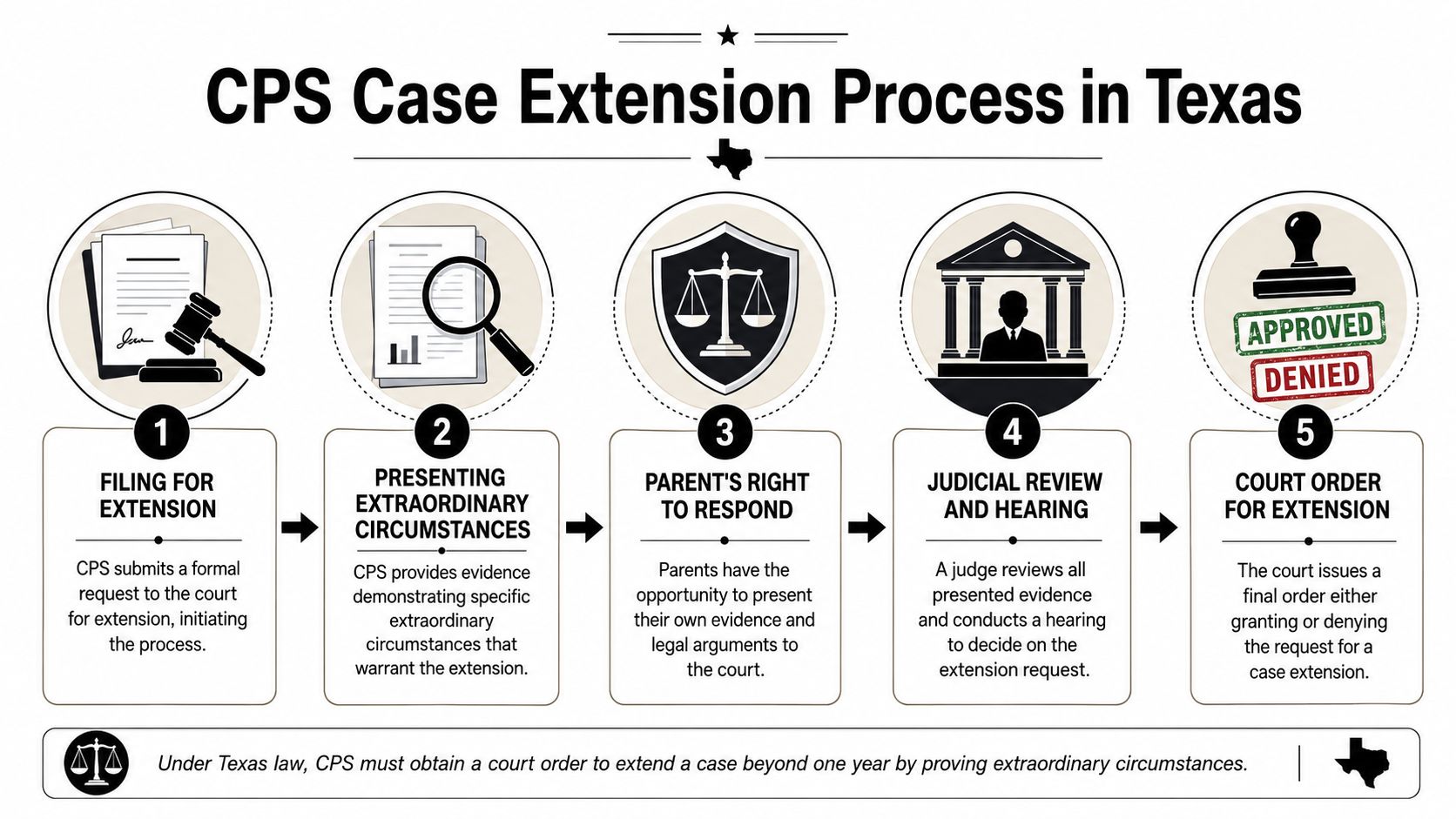
In practice, the process usually looks like this:
- CPS files or presents a request asking the court to keep the case past the dismissal date.
- CPS identifies the supposed extraordinary circumstances with records, testimony, or both.
- The parent's attorney challenges the request by pointing out weak proof, ordinary delay, or missing findings.
- The judge holds a hearing and decides whether the legal standard has been met.
- The judge signs a written order granting or denying the extension.
Parents sometimes miss how early this issue starts building. What happens at earlier hearings can shape the record the judge later reviews, which is why it helps to understand what a status hearing does in a Texas CPS case.
The judge must make two findings, and both have to be supported
Courts do not grant an extension because services are incomplete in a general sense. They look for a legally sufficient reason to keep the case open.
The required findings are:
- Extraordinary circumstances
- Best interest of the child
If CPS proves only one, the request should be denied. That is where many extension fights are won or lost. A judge may agree that something unusual happened, but still ask a hard follow-up question: why does more time help this child rather than prolong uncertainty?
What actually persuades a court at this stage
This is the practical part many parents do not hear explained clearly enough. The hearing usually turns on the quality of the explanation and the paper trail behind it.
A weak request often sounds like this: the parent still has services left, visits have been inconsistent, and the case needs more time. Those facts may describe many CPS cases. Ordinary delay, slow referrals, crowded provider schedules, or a parent's incomplete progress do not automatically become extraordinary circumstances just because the deadline is close.
A stronger request ties the delay to a specific unusual event and shows why the court cannot safely make a final decision without a short extension. Judges tend to focus on details such as timing, documentation, whether the problem was outside the normal course of the case, and whether anyone could have addressed it sooner.
In other words, the court is not just asking, "Do you want more time?" The court is asking, "Why did this case become different from the usual case, and what evidence proves it?"
The extension has a firm outer limit
Even when the judge grants more time, the case does not stay open indefinitely. Texas law allows one extension period, not repeated renewals. For many families, that means the outside edge of the case is roughly 18 months from the original temporary managing conservatorship date, depending on how the calendar falls and whether the case ends sooner.
That limit matters. It gives parents a concrete point to track and a reason to press for a clear written order with the correct findings and dates.
Key point: An extension hearing is a real legal contest. The side with the clearer evidence, the sharper timeline, and the stronger explanation usually has the better chance of winning.
What Qualifies as Extraordinary Circumstances?
A parent often hears the phrase extraordinary circumstances and assumes it means, "The case is complicated, so the court can give everyone more time." That is usually too broad. Courts treat this phrase like a narrow emergency exit, not a second standard timeline.

Texas appellate decisions, including In re D.R., show that judges look for a circumstance that is unusual, case-specific, and serious enough that the court cannot responsibly finish the case by the deadline. The core question is practical: what happened here that falls outside the normal problems seen in CPS cases?
Facts that tend to support an extraordinary-circumstances finding
Courts are more likely to grant an extension when the evidence shows a late-developing event that materially affects safety, reunification, or the court's ability to make a final ruling. Examples can include:
- A newly identified mental health condition that was not reasonably known earlier, where treatment or evaluation is now necessary to assess parental functioning safely
- A specialized psychological or psychiatric evaluation that could not be completed through ordinary scheduling and bears directly on the child's placement or return
- A sudden medical crisis, hospitalization, or comparable emergency that interrupts a parent's ability to participate despite prior effort
- The unexpected loss or unavailability of a key witness or provider whose testimony or records are needed for the court to decide the case fairly
- A significant late change in the child's condition or placement needs that requires new evidence before final orders can be entered
The pattern matters. Judges usually want to see something unusual, important, and tied to a concrete reason the case cannot be decided safely on the current record.
Facts that often lose these motions
Many extension requests fail because they describe ordinary case friction. Busy providers, delayed referrals, crowded dockets, unfinished services, and general case complexity are common in CPS litigation. A judge may view those problems as management issues rather than extraordinary circumstances.
The same is true when the evidence shows the problem could have been addressed months earlier. If CPS waited too long to request an evaluation, or if a parent delayed participation without a strong outside cause, the motion becomes harder to win.
The evidence usually decides the outcome
Labels do very little in these hearings. Proof does the work.
A strong extension request usually answers four specific questions with documents and testimony: What changed? When did it change? Why was it outside the normal course of the case? Why does that change make a short extension necessary for the child's best interest?
That evidence may include treatment records, provider letters, referral dates, waitlist communications, sworn testimony, visitation history, and a clear timeline showing who acted promptly and who did not. A judge comparing two stories will often focus less on emotion and more on whether the record shows an unusual event, diligence, and a clear reason the court needs more time.
For parents, this point matters because it shows where to focus. If CPS asks for an extension, look past broad statements such as "services are incomplete" or "the case is not ready." Ask what exact circumstance is being called extraordinary, what documents support it, and whether the problem falls outside the ordinary course of a CPS case.
A Parent's Story Navigating an Extension Request
Maria's case was nearing the dismissal date. She had finished her parenting class, kept steady housing, and attended visits consistently. The major unfinished item was a specialized counseling program that started late because the referral process stalled.
When CPS asked for an extension, Maria heard only one thing: "This case isn't ending." She thought the judge had already made up his mind.
Her lawyer told her to slow down and focus on the actual issue before the court. The question wasn't whether the case felt incomplete. The question was whether the reason for delay was extraordinary and whether CPS could prove that more time was legally justified.
What Maria and her attorney gathered
Maria's attorney helped her organize documents showing:
- Consistent participation in every service that had been made available
- Visitation records showing she appeared and followed the rules
- Communication history reflecting that she had been asking about the counseling referral
- Housing and employment proof showing broader stability
That changed the conversation. Instead of looking like a parent who failed to engage, Maria looked like a parent who had been moving forward while one service lagged behind.
The hearing outcome
In a case like Maria's, a judge might deny the extension if CPS can't show an unusual reason for the delay. In another courtroom, a judge might decide a short continuation is appropriate because one missing evaluation is necessary before a final decision.
The larger lesson is the same in either result. Parents aren't powerless when CPS asks for more time. A strong response focuses the court on evidence, responsibility, and whether the legal standard is met.
Maria left the hearing with something many parents need most: not certainty, but a clearer sense that facts and preparation can still shape the outcome.
Your Legal Rights and Options When Facing an Extension
The extension hearing is often the first moment a parent realizes the one-year deadline is not automatic protection. CPS can ask for more time, but a judge still has to decide whether the law allows it. That hearing matters because the question is usually narrower than parents expect. The court is not deciding every problem in the case that day. The court is deciding whether there is a legally sufficient reason to keep the case open past the dismissal deadline.
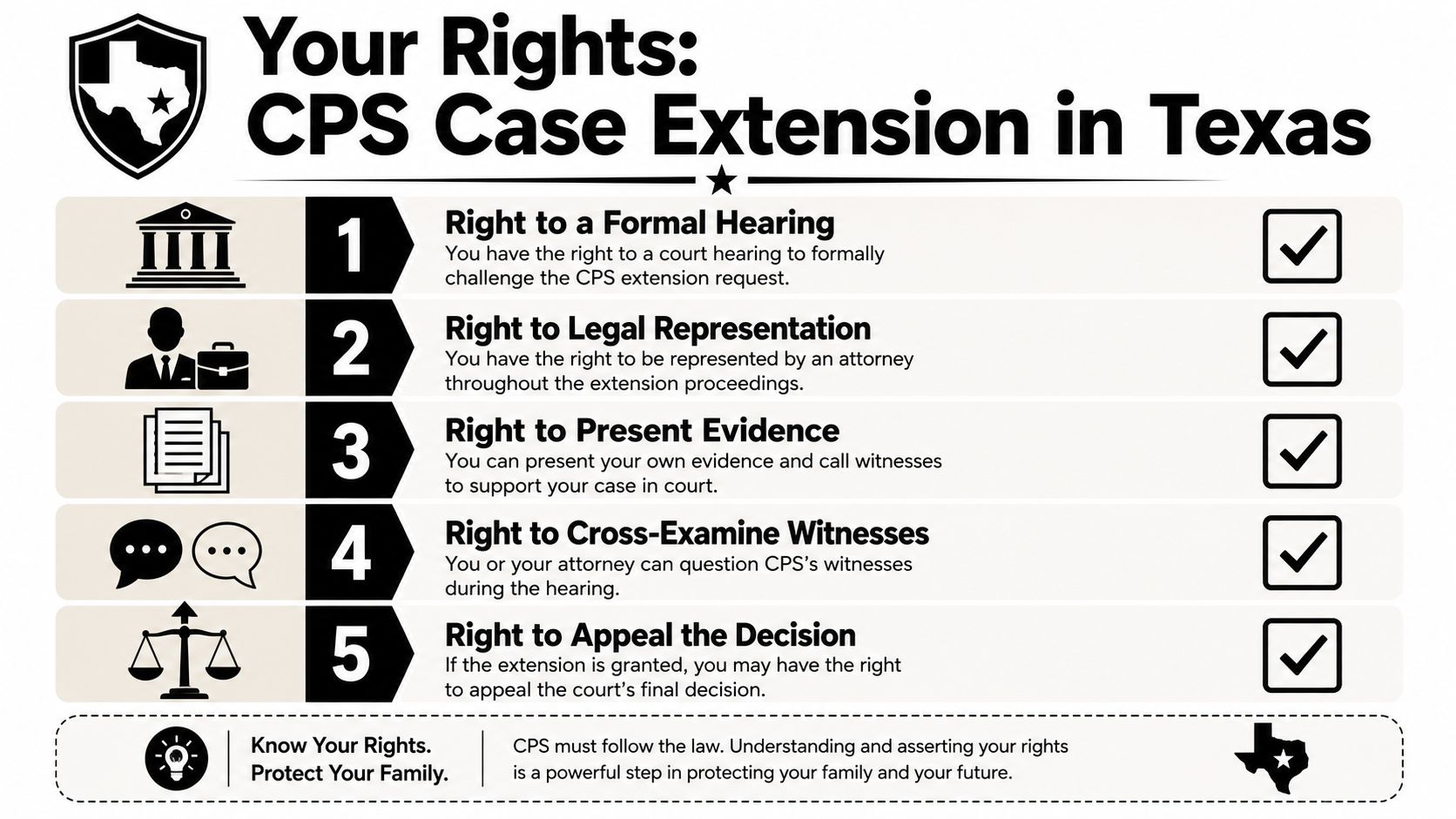
A useful way to understand the hearing is this. It works like a checkpoint at the end of a long road. CPS does not get through by saying the case feels unfinished. CPS has to show the kind of unusual facts that justify more time, and the parent has the right to test that claim with evidence, witnesses, and legal argument.
Rights that matter at the extension hearing
- You have the right to a real hearing. The judge should make the decision on the record, based on evidence and argument, not assumptions or informal discussion.
- You have the right to see and challenge CPS's reason for requesting more time. Ask what extraordinary circumstance CPS is claiming and what proof supports it.
- You have the right to present your own evidence. Records showing completed services, attendance, referral delays, or inaccurate case notes can change how the court views responsibility for the remaining issues.
- You have the right to question witnesses. If a caseworker blames you for delay, your attorney can ask who made the referral, when it was made, what follow-up happened, and whether the delay was ordinary case management.
- You have the right to argue that the legal standard is not met. A problem can be real without being extraordinary. That distinction often decides the motion.
- You may have the right to seek dismissal if the deadline was missed. If trial did not begin on time and no valid extension order was signed, that issue can be serious and time-sensitive.
The video below gives added context on CPS court process and parent concerns.
What helps a parent oppose or limit an extension
Judges usually want specifics. General statements like "I'm doing better" or "CPS caused delay" rarely carry much weight by themselves. A clearer record does.
Useful proof often includes:
- A dated service timeline showing when each service was requested, scheduled, started, and finished
- Messages and emails showing you asked for referrals, transportation help, visitation changes, or provider information
- Completion records for classes, counseling, treatment, testing, or evaluations
- Visitation records showing consistency, preparation, and parent-child contact
- Witnesses with direct knowledge such as counselors, sponsors, relatives, supervisors, or service providers
- Court orders and family service plans that help show what was required and whether you complied
One focused question should guide your preparation: did something unusual prevent the case from being resolved on time, or did the delay come from the kind of scheduling, referral, and follow-up problems that happen in many CPS cases?
That is where legal strategy matters. Sometimes the strongest position is to oppose the extension outright because CPS cannot tie the delay to extraordinary circumstances. In other cases, a parent may ask the court to narrow any extension, limit the issues to be completed, or set firm dates so the extra time does not become open-ended. If you need help assessing those choices, a Texas CPS lawyer for extension hearings and dismissal deadline issues can review the court orders, dates, and evidence with that specific question in mind.
Law Office of Bryan Fagan PLLC publishes information about Texas CPS hearings, timelines, and parent rights.
Taking Control of Your CPS Timeline with an Advocate on Your Side
The one-year mark in a Texas CPS case is one of the most important dates in the entire process. It can protect your family from open-ended supervision, but it can also become the point where CPS asks the court for more time. When that happens, the core conflict usually centers on whether the facts are unusual enough to qualify as extraordinary circumstances.
That distinction matters. Courts don't grant valid extensions because a case feels unfinished. They grant them only when the law allows it. For a parent, that means deadlines, court orders, service records, and hearing preparation all matter more than rumors or hallway talk.
What you can control
You can't control the court's docket or every CPS decision. You can control how prepared you are.
Focus on these steps:
- Know your key dates. Ask for the TMC date, the dismissal date, and any hearing date related to extension or trial.
- Keep every record. Save certificates, emails, texts, visit notes, and treatment documents.
- Ask direct questions. If CPS wants more time, ask what extraordinary circumstance they are claiming.
- Prepare your response early. Don't wait until the last hearing to organize your proof.
- Get legal guidance. A deadline issue can change the direction of the whole case.
If you need a starting point for finding help, this guide to working with a Texas CPS lawyer can help you understand what an attorney does in these cases.
When parents understand the deadline, they stop treating the extension request like a mystery and start treating it like a legal issue that can be challenged.
No article can tell you exactly what a judge will do in your courtroom. But understanding the rule, the exception, and the evidence courts look for can reduce panic and replace it with a plan. That alone can make a difficult moment more manageable.
If your CPS case is nearing the one-year deadline, don't wait for the next hearing to find out where you stand. The Law Office of Bryan Fagan PLLC offers free consultations for Texas families dealing with CPS investigations, conservatorship cases, extension requests, and reunification concerns. If you're worried that CPS is trying to keep your case open longer than the law allows, reach out for a confidential consultation and get clear guidance about your timeline, your rights, and the steps you can take now.