Skip to content
The knock at the door often comes in the middle of ordinary life. Your child is eating breakfast, you're trying to answer work messages, and suddenly a CPS investigator is asking to come inside. In a few minutes, the ground shifts. You start wondering whether your children are safe, whether you should answer every question, and how long the State has to build a case against you.
That fear is real. So is the confusion.
Texas CPS cases move on strict legal timelines, and those timelines matter because each stage requires CPS to justify what it is doing. Time alone doesn't win their case. They still have to prove enough, at the right moment, to keep moving forward. If you understand the deadlines and the proof required at each stage, you stop reacting blindly and start protecting your family deliberately.
Your World Turned Upside Down The Moment CPS Arrived
A parent in this position usually isn't thinking about statutes or court procedure. They're thinking, "Is my child about to be taken?" "Do I have to let this person in?" "What if someone made a false report?" Those questions come fast, and panic makes it hard to separate what feels urgent from what is.

Consider a common scene. A mother answers the door after a report from an ex-partner. The investigator sounds calm, but the questions are pointed. Is there food in the home? Has the child missed school? Is anyone using drugs? Before long, the parent is agreeing to things she doesn't fully understand because she thinks cooperation alone will make the problem disappear.
Sometimes cooperation helps. Unstructured, anxious cooperation often doesn't.
The fear is emotional and practical
CPS involvement doesn't just threaten custody. It can disrupt your job, your housing, your family relationships, and your mental health. Many parents also carry shame, even when the report is exaggerated or false. If the stress from the investigation is surfacing old trauma responses, getting support outside the legal process can help you stay clear-headed. For some parents, effective therapy for emotional abuse becomes part of staying stable enough to make good decisions.
You don't need to be perfect to protect your rights. You need to be organized, calm, and informed.
What matters right away
When parents ask how long CPS has to prove its case in Texas, they're usually asking two different questions at once:
- How long can CPS investigate before deciding whether to escalate things
- How long can a court case last if CPS files one and seeks continued control over the child
Those are different clocks. They also involve different levels of proof.
Early on, CPS is assessing danger and deciding whether to close the matter, offer services, or seek court action. Later, if a lawsuit is filed, judges start making decisions based on evidence presented in hearings, and the final stakes can include reunification, conservatorship orders, or even termination of parental rights.
Knowing which clock you're on changes everything.
The First Deadlines The Initial Investigation Phase
Before there is a courtroom, there is an investigation. That stage begins when a report is received, not when the investigator first speaks with you. Texas parents often lose valuable time because they assume nothing important is happening until they get formal court papers. By then, CPS may already have formed strong opinions about the home.
Under DFPS guidance, Priority I reports must begin within 24 hours, Priority II reports must be initiated within 72 hours, and investigations are generally expected to be completed within 30 days from the date the report is received. DFPS also notes that supervisors can approve extensions when needed. You can review that timeline on the Texas DFPS investigations page.
What CPS is trying to establish
At this point, CPS isn't yet trying to win a final court order. The agency is trying to decide whether it believes there is immediate or ongoing risk to the child. That means investigators look for practical signs of safety or danger, such as:
- Condition of the home: Is it stable, clean enough, and appropriate for a child?
- Caregiver functioning: Does the parent appear able to supervise, feed, transport, and protect the child?
- Consistency of the explanation: Do the child's condition, school issues, medical records, or witness statements line up with what the parent says?
- Protective capacity: If there is a problem, is the parent already addressing it in a believable way?
A short investigation window cuts both ways. CPS has limited time to gather information, but families also have limited time to correct false impressions.
What works during this phase
Parents often think the key is to say as little as possible or, on the other extreme, to talk nonstop and hand over everything immediately. Neither approach works consistently.
A better approach looks like this:
- Document the basics early: Gather school records, medical records, names of caregivers, and any texts or emails that explain the allegation.
- Keep communication professional: Be respectful, but don't guess, ramble, or volunteer speculation.
- Ask what the allegation is: You can't respond intelligently if you don't understand what CPS is investigating.
- Get guidance fast: If you're unsure how to respond, review practical information about how long CPS has to investigate in Texas and talk with counsel before the situation hardens.
Practical rule: The first version of your family story that CPS hears often shapes the rest of the case. Make sure it is accurate, documented, and calm.
The Court's 12-Month Clock Texas's CPS Lawsuit Timeline
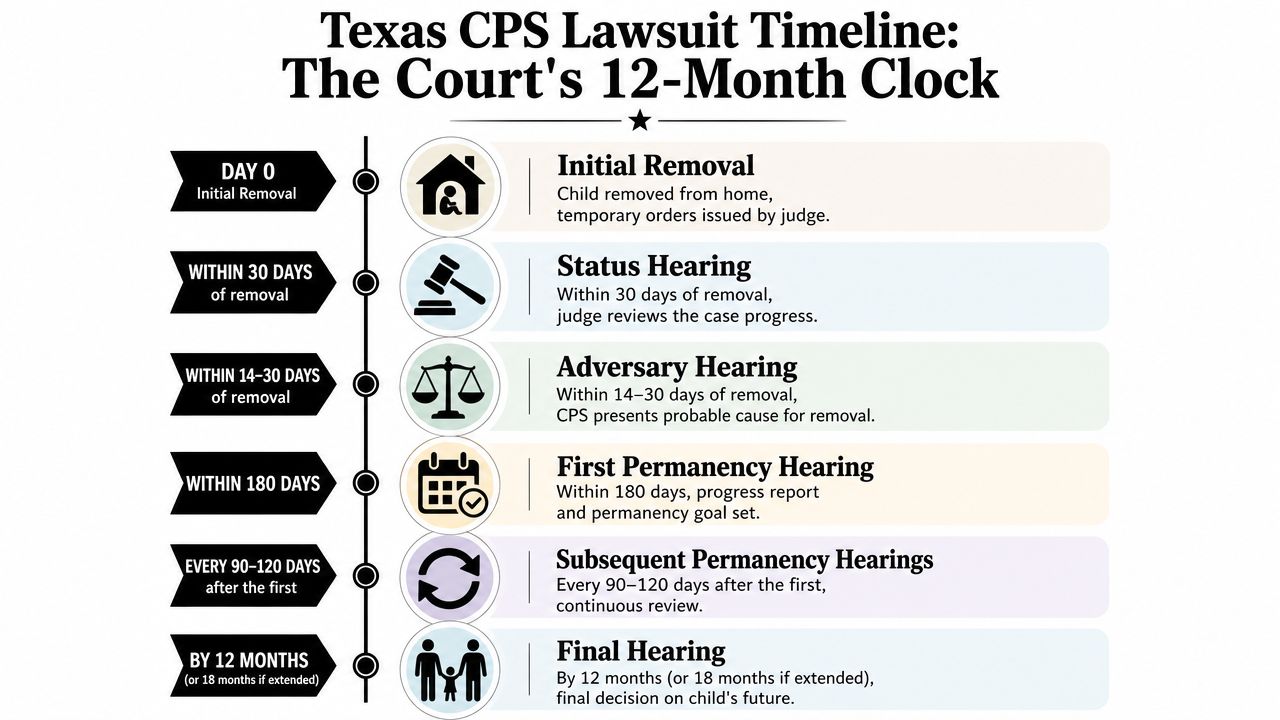
If CPS files a lawsuit and is appointed temporary managing conservator, the pace changes. The case is no longer moving on an internal agency schedule. It is now running on a statutory court deadline, and that deadline is unforgiving.
Texas law requires the court to reach a final order within 12 months after DFPS is appointed temporary managing conservator, with only a one-time 180-day extension for extraordinary circumstances. In practice, that means the outside timeline is about 18 months total in the unusual case that receives an extension. Texas Law Help also notes that parents have only 12 months to show the court their children can be safely returned. That timeline is explained in Texas Law Help's overview of CPS investigations.
Why this deadline changes strategy
A CPS court case doesn't reward delay. Parents sometimes assume they can "show improvement later" after things calm down. That is one of the most dangerous mistakes in these cases. If the court is measuring whether the child can be returned safely, every week matters.
The court is watching for action, not promises. If the concern is drug use, missed medical care, unsafe relationships, untreated mental health issues, or unstable housing, the judge expects to see movement. Waiting until the end of the case to become compliant usually looks less like progress and more like last-minute damage control.
Where parents lose time
The legal clock may say 12 months, but the usable time is less. Families often spend the opening stretch in shock, trying to understand service plans, visitation rules, and hearing dates. By the time they realize how serious the case is, valuable opportunities to build proof have already passed.
Common time traps include:
| Problem | Why it hurts |
|---|---|
| Delayed enrollment in services | It creates a paper trail of noncompliance |
| Missed visits with the child | It gives CPS an argument about inconsistency |
| Informal side agreements | They rarely protect you if they aren't reflected in court records |
| Assuming an extension will be granted | Extensions are narrow and not automatic |
The deadline is enforceable, but it must be enforced
The 12-month dismissal framework can protect families, but courts don't always act on timing issues without someone raising them clearly. If your case is approaching the end of the statutory period, you need someone tracking whether CPS has a valid basis to continue. Parents dealing with that question should understand the rules around an extension of a CPS case beyond one year in Texas.
A calendar date is never just a calendar date in a CPS case. It is a pressure point. It affects what CPS must prove, how quickly you must respond, and whether the State still has the legal ability to keep the case alive.
More Than Time What CPS Must Actually Prove to a Judge
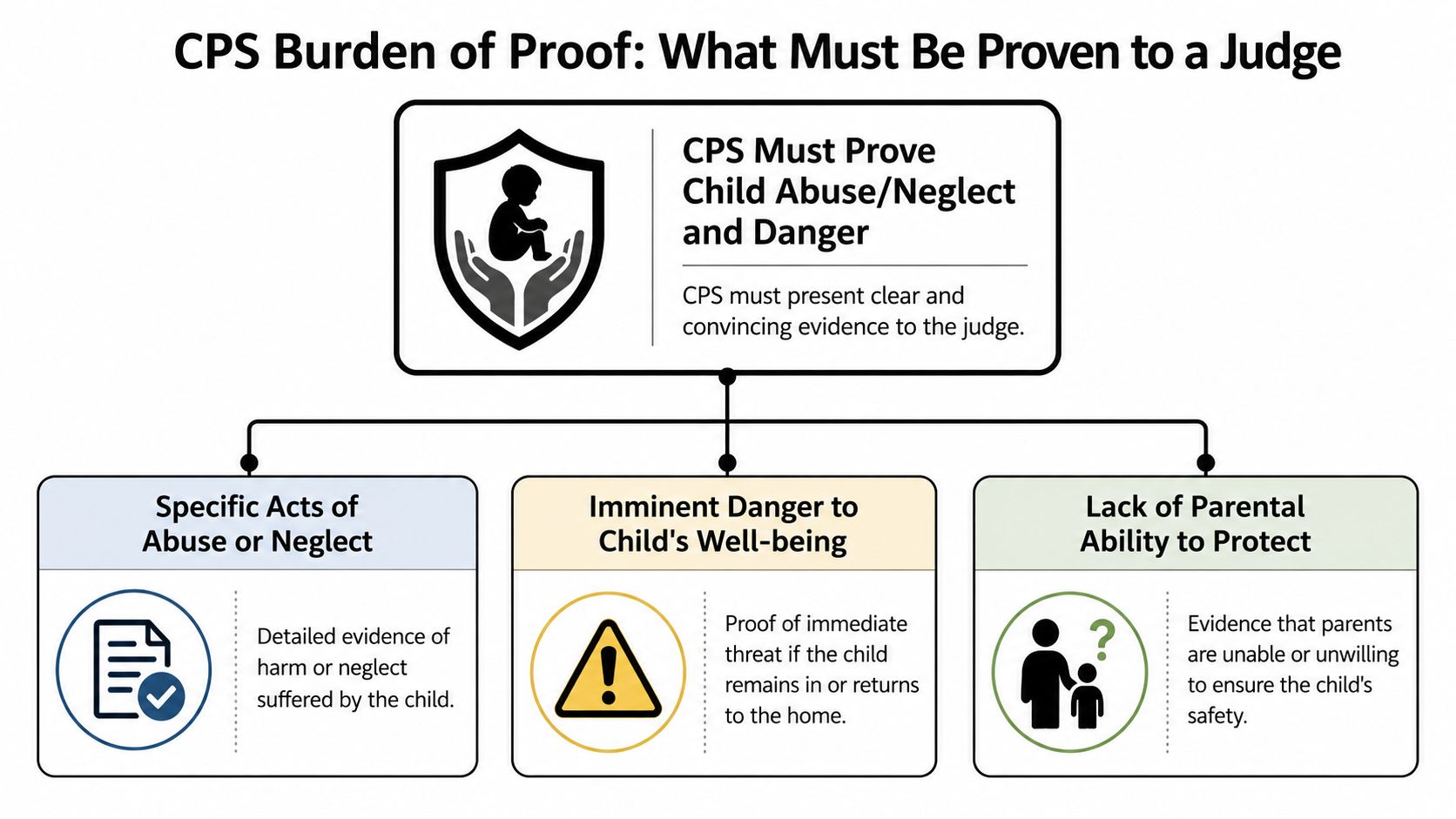
Parents often hear deadlines and think the case is mostly procedural. It isn't. A CPS case turns on evidence. The clock tells everyone when decisions must be made. The burden of proof tells the judge whether CPS has earned the result it wants.
The lower standard used in much of the case
In many hearings, CPS must show enough evidence that its position is more likely true than not. Lawyers often call that preponderance of the evidence. The simplest way to picture it is a set of scales. If CPS can tip the scale even slightly in its favor, it may satisfy that burden for that stage.
That matters because early hearings are often built from fast-moving facts. A judge may hear from investigators, review reports, and decide whether CPS can keep temporary orders in place. If the parent's side is undocumented or disorganized, CPS may appear more credible even when the full story is more complicated.
The higher standard when termination is sought
When CPS asks to terminate parental rights, the law demands much more. Termination is one of the most serious things a court can do. The agency must meet the clear and convincing evidence standard.
That is not the same as suspicion. It is not the same as a worker saying they have concerns. It requires stronger proof that the legal grounds for termination exist and that termination is in the child's best interest. Parents need to hear this clearly because many walk into CPS court believing allegations alone will automatically end their rights. They won't. CPS must prove its case.
Allegations start cases. Evidence decides them.
What judges actually evaluate
Judges don't just look at whether something bad happened once. They evaluate whether CPS has established a legally sufficient picture of danger, parental conduct, and future safety. Evidence can come from records, witnesses, photographs, service history, school information, medical information, and the parent's own testimony or statements.
A practical defense asks questions like these:
- Is the allegation specific or vague? Broad accusations are easier to challenge.
- Is the evidence current? Old concerns may carry less weight if the parent has corrected them.
- Is there a less drastic alternative? Relative placement, protective orders, or targeted services may undermine CPS claims that extreme intervention is necessary.
- Does CPS have admissible proof or just suspicion? A serious allegation still has to be backed up.
For a deeper look at how these legal standards work in court, parents can review guidance on the burden of proof in a Texas CPS case.
A Real-Life Scenario The Garcia Family's Journey
Maria Garcia got the first call while she was at work. CPS wanted to talk about her son's school absences. Her son had been missing classes because of recurring health problems, but Maria and Carlos had not yet gotten a clear diagnosis, and the school had become frustrated with the lack of paperwork. What Maria heard was far more frightening than "attendance issue." She heard that someone thought she was neglecting her child.
The early mistake
When the investigator came out, Maria and Carlos tried to be agreeable. They answered every question from memory. They promised to get records later. They signed a safety plan they didn't really understand because they thought refusing would make them look guilty.
That early cooperation wasn't malicious. It was panicked. But it created problems. Their statements were incomplete, and CPS began reading the gaps as evidence that the parents weren't organized or protective enough.
When the case escalated
The Garcias then ran into a second problem that many parents face. They were working, juggling childcare, and trying to comply with services, but they didn't understand which tasks mattered most to the court and which tasks were just administrative noise. They missed one important hearing date on their own calendar and nearly missed another meeting because the notice language confused them.
An attorney changed the direction of the case by doing two things quickly. First, counsel tied every allegation to evidence. School attendance records, appointment records, pharmacy information, and testimony from people who had seen the child helped correct the picture. Second, counsel explained that the case wasn't open-ended. The court had a limited window to resolve it, and the family needed to build a reunification record immediately.
Parents usually feel relief when they finally understand the timeline. Fear thrives in uncertainty. Deadlines, while harsh, give you a structure to fight within.
What turned the case
The Garcias did not win by giving emotional speeches. They won ground by becoming credible. They kept copies of every document. They attended services consistently. They corrected misinformation quickly. They stopped treating CPS conversations like informal chats and started treating them like pieces of evidence.
That is what many families miss. The legal system often rewards proof of stability more than explanations of love. Love matters, of course. But in court, documented parenting decisions, completed tasks, and reliable attendance often carry more weight than heartfelt promises.
What Happens if CPS Misses a Deadline or Fails to Prove Its Case
Some parents assume CPS can keep a case open as long as it wants. That isn't true. Others assume that if CPS slips up, the judge will automatically dismiss the case. That isn't always true either. Deadlines and burdens matter, but someone has to assert them clearly.
Missed proof is different from missed time
If CPS cannot meet its burden at a hearing, the judge can deny the request in front of the court. That may mean the agency does not get the restriction, placement, or final relief it asked for. In some situations, it can support a return of the child or a narrowing of the case.
If the larger case runs into the dismissal deadline without a valid extension, the law can force the issue. But the practical reality is simple. Courts move on motions, objections, and advocacy. Parents who wait for the system to fix itself often wait too long.
Technical defenses still require active defense
A strong lawyer doesn't treat deadlines like trivia. Counsel tracks appointments, filings, settings, and whether CPS has laid the foundation for what it wants the judge to do.
That includes asking hard questions such as:
- Was the extension properly supported
- Did CPS present competent evidence or just repeat allegations
- Is the service plan realistic and tied to the actual concerns
- Has the case drifted away from the original basis for intervention
This short video gives a helpful overview of how these timing issues can affect a case:
Courtroom reality: Good outcomes rarely happen because CPS "should have known better." They happen because someone made the legal argument, with evidence, at the right time.
A missed deadline can matter a great deal. A weak evidentiary showing can matter even more. But neither helps unless your side is prepared to push the issue.
Your Next Steps Practical Strategies to Protect Your Family
The first days after CPS gets involved often feel chaotic. That is when small, disciplined steps matter most. A parent who keeps good records, asks better questions, and gets legal advice early is in a stronger position to challenge weak allegations before they harden into court orders.
Start building your case file now:
- Keep a dated timeline: Write down calls, home visits, interviews, drug test requests, classes, transportation problems, and every visit with your child.
- Read every document before you sign it: A safety plan or service plan can affect where your child lives, what CPS expects from you, and how the judge views your cooperation.
- Gather records that answer the allegations: Medical records, school records, counseling notes, lease documents, pay stubs, and messages can all help rebut what CPS says happened.
- Assume every statement may show up in court: Be respectful, but be careful. Offhand comments are often repeated later as admissions.
- Ask what CPS is trying to prove at this stage: The question changes over time. At the beginning, CPS may be trying to justify emergency action. Later, it may be trying to support continued restrictions, services, or termination. Your response should match that burden.
- Get legal guidance early: Talk with a private attorney, a court-appointed lawyer if one is available, or a firm that handles Texas CPS defense work, including Law Office of Bryan Fagan PLLC, before temporary rulings start shaping the rest of the case.
One mistake I see often is parents treating services as the whole case. Services matter, but they are only part of the picture. If you finish a class, save the certificate. If you test clean, get the result. If a service does not fit the accusation, raise that issue with your lawyer and the court. Cooperation helps most when it is documented and tied to what CPS must prove.
Deadlines on the court calendar matter. So does the proof behind CPS's request. At each stage, ask two practical questions: what is CPS trying to show the judge right now, and what documents, witnesses, or explanations can undercut that showing?
Relief usually comes from a plan, not from waiting. If CPS has contacted you, filed a case, or removed your child, a lawyer can assess where the case stands, what proof is still missing, and what steps may improve your position now.