Skip to content
When CPS tells you your case is closed, most parents feel two things at once. First comes relief. You can breathe again, sleep a little better, and stop waiting for the next knock at the door or the next call from a caseworker.
Then the second feeling hits. What does “closed” mean? Is this really over? Will this follow me into court later, or show up when I apply for a job, volunteer at school, or fight for custody?
Those questions are reasonable, especially in Texas, where CPS closure often sounds cleaner than it really is. A closed case usually means CPS is ending its active involvement. It does not automatically mean the allegations vanish, the records are destroyed, or the issue can never come up again.
Parents need straight answers at this stage, not slogans. If you're asking what happens when CPS closes your case, the short answer is this: active oversight may end, but the legal and practical consequences can continue. The exact impact depends on how the case closed, what findings CPS made, whether any court orders remain in place, and what steps you take now to protect yourself.
The Moment Your Case Closes A Sigh of Relief and a Wave of Questions
A common Texas scenario looks like this. A parent gets a letter from CPS saying the case is closed. No one is coming to the house anymore. The safety plan ends. The investigator stops calling. For a few hours, maybe a few days, it feels like the family can finally move on.
But closure letters often create a new kind of stress. Parents start rereading every line and asking whether “closed” means “cleared.” Those are not always the same thing.
What closure usually means in real life
For many families, closure means CPS has decided it no longer needs to stay involved day to day. In Texas policy, closure is tied to safety and risk management. CPS closes a family-based safety services case only when workers determine the child is safe because the family can manage remaining risk on its own or with non-CPS support, and Texas administrative rules also list other closure paths such as moving out of state, being unlocatable after reasonable efforts, or the child living outside the home with another caregiver under certain arrangements, as reflected in Texas CPS closure rules.
That matters because closure is not just clerical. It is a judgment call by the agency that direct oversight is no longer necessary.
Practical rule: A closed CPS case usually means the investigation or services ended. It doesn't always mean your record is clean, sealed, or irrelevant to future legal disputes.
Relief is real, but so is uncertainty
Parents also need to separate three different things:
- Agency involvement: CPS may stop monitoring your home.
- Court involvement: If a judge entered orders, those may continue.
- Record consequences: The file may still exist and still matter later.
Texas Family Code Chapters 262, 263, and 161 often shape that bigger picture. Chapter 262 deals with emergency protection and removal issues. Chapter 263 focuses on review, permanency, and dismissal timelines in court-managed cases. Chapter 161 governs termination of parental rights in the most serious cases. Even after CPS itself exits, court orders tied to custody, possession, conservatorship, or restrictions can remain in effect.
If your case involved court supervision, don't assume a closure letter changes judicial orders. It usually doesn't. You need to read the order itself, not just the CPS paperwork.
Understanding the Different Types of CPS Case Closures in Texas
Not every closed case carries the same weight. The wording in your paperwork matters. Parents often glance at the last page, see “closed,” and miss the finding that will matter more later.
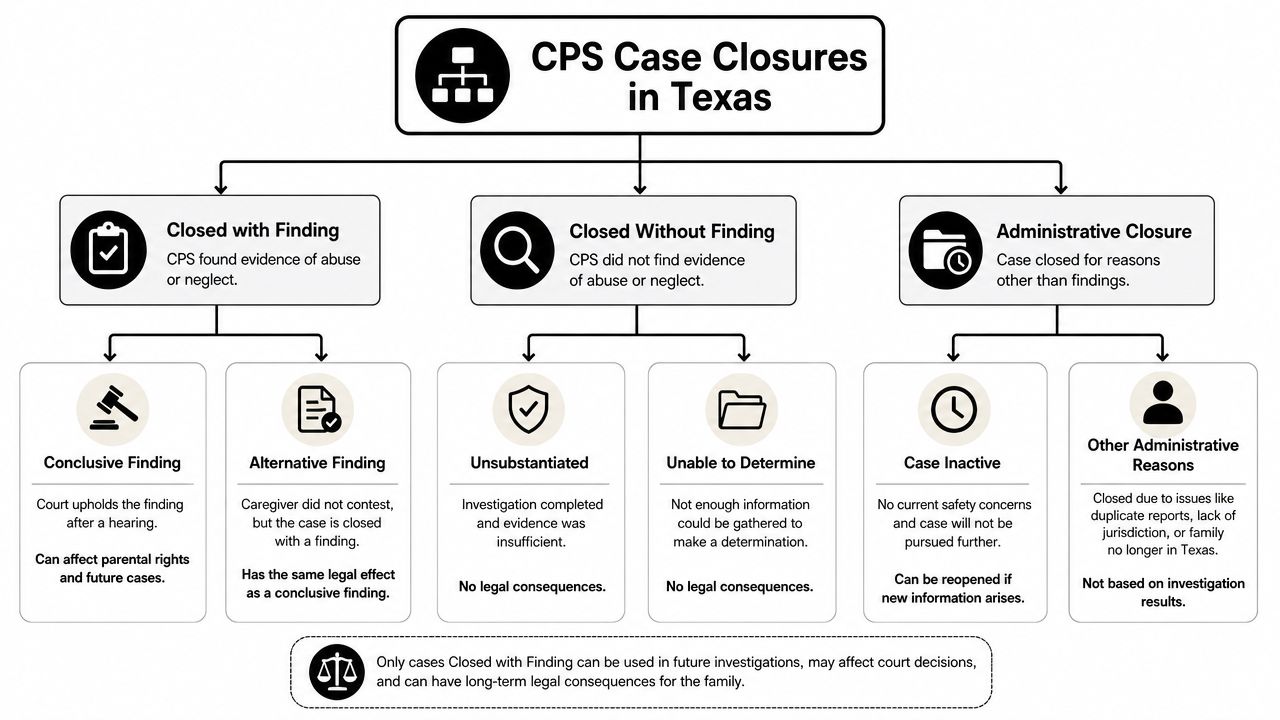
Closed with a finding
Some closures come with a formal conclusion about the allegations.
| Disposition | Plain-English meaning | Why it matters |
|---|---|---|
| Reason to Believe | CPS concluded there was a basis to believe abuse or neglect occurred | This can create problems later, even if CPS never filed a court case |
| Ruled Out | CPS did not find evidence supporting the allegation | This is generally the most favorable result |
| Unable to Determine | CPS says it could not gather enough information to decide | This isn't the same as a clean exoneration |
A Reason to Believe finding is where many parents get blindsided. They assume that because their child stayed home and no lawsuit followed, nothing serious happened. But a finding can still sit in the file and become an issue in future custody litigation, licensing matters, or later CPS contact.
A Ruled Out outcome is stronger. It means CPS did not substantiate the report. That said, even favorable closures still produce paperwork, notes, and internal records.
Closed without a merits finding
Some files close for reasons that don't answer the core accusation in a clean yes-or-no way.
Examples include administrative closures, cases where the family can't be located after reasonable efforts, or situations where the child is no longer in the home that was under review. Those closures can end agency activity without fully resolving how another person may try to characterize the history later.
Texas treats closure as a safety decision, not merely a paperwork event. If you're also trying to understand how CPS dismissal works in the court system, the distinction is important in this guide on CPS dismissal in Texas.
A parent should always ask two separate questions. Is the case closed, and what finding did CPS make before it closed?
Why the wording matters
A closure letter can affect how others read your history. A family court judge, opposing counsel, GAL, employer, or licensing board may react very differently to “ruled out” than to “reason to believe.”
That is why parents should obtain and review the actual records, not rely on memory or a brief phone conversation with a caseworker. The label attached to the closure often matters more than the fact of closure itself.
The Fate of Your File What Happens to CPS Records After Closure
Many parents think closure means deletion. In Texas, it usually doesn't.
A closed CPS case does not automatically disappear from agency systems. Texas DFPS retains CPS records for a minimum of 5 years after a case is closed, and more serious abuse or neglect allegations may be kept until the youngest child turns 18 or even indefinitely in severe cases, according to this discussion of Texas CPS record retention.
What stays in the file
The file may include much more than the final finding. It can contain:
- Intake information: What was reported, by whom, and when
- Caseworker notes: Home visits, phone calls, interviews, observations
- Collateral contacts: Statements from teachers, doctors, relatives, neighbors, or law enforcement
- Safety planning records: Agreements, recommendations, service referrals, and compliance notes
That is why parents are often surprised when a later dispute turns on a line buried in notes rather than the headline conclusion.
Who may be able to access it
These records are not a public website anyone can browse. Still, “not public” is not the same as “untouchable.”
Depending on the situation, CPS information may be reviewed by other government entities, law enforcement, or courts. In family court, lawyers may seek records if they are relevant to conservatorship, possession, or child safety issues. In some settings involving children or vulnerable people, background screening or agency review may also bring the history into focus.
Closing the case ends active supervision. It does not erase the documentation created during the investigation.
Why this catches parents off guard
Parents usually focus on the day the case ends. They are not thinking about a modification suit two years later or a volunteer application at their child's school.
But that is exactly why this stage matters. If the file contains errors, loaded language, or statements taken out of context, doing nothing now can make your future defense harder. Once another case starts, you're reacting under pressure instead of planning from a position of calm.
A Relatable Scenario The Garcia Family's Journey After Closure
The Garcias are a fictional Texas family, but their situation is familiar. Their child was briefly left with an older sibling while both parents were delayed. A neighbor made a report. CPS investigated. Weeks later, the family got a closure letter.
They felt relieved until Mr. Garcia noticed the finding said Reason to Believe for neglectful supervision.
Why the letter changed everything
At first, the family thought, “At least it's over.” Then practical questions started piling up. Mr. Garcia had planned to help coach youth sports. Mrs. Garcia was preparing for a custody modification involving a child from a prior relationship. Suddenly the wording on the letter seemed a lot more important.
The family learned that closure did not answer the question they really cared about, which was whether this record could hurt them later. That is where many Texas parents get stuck. They know the pressure is off, but they don't know what to do next.
What the Garcias did right
They stopped treating the letter like the whole file. Instead, they took a more careful approach:
- They requested records: They wanted to see the investigator's notes, not just the final page.
- They matched facts to documents: They wrote down what happened, what dates mattered, and where the file seemed incomplete or inaccurate.
- They looked ahead: Instead of asking only “Is this over?” they asked “Where could this come back?”
That shift in thinking matters. A parent who expects a future custody fight should approach a closed CPS case differently from a parent whose main concern is school volunteering or a licensing issue.
The practical lesson
The Garcias' biggest mistake would have been doing nothing because they were tired. That reaction is understandable. It is also risky.
When a CPS file has unfavorable language, the best time to understand it is before someone else uses it against you. Even if no immediate legal action is needed, reviewing the record, preserving documents, and getting legal advice can keep a closed case from becoming a surprise exhibit later.
Erasing the Past Sealing or Expunging CPS Records in Texas
Parents often ask whether they can “get it wiped.” Sometimes they can limit the future use of a record. Often they can't. The answer depends on the facts, the finding, and the legal path available.
Sealing or expunging a CPS-related record is not the same thing as receiving a closure letter. Closure ends CPS involvement. It does not itself clear the allegations from the record.
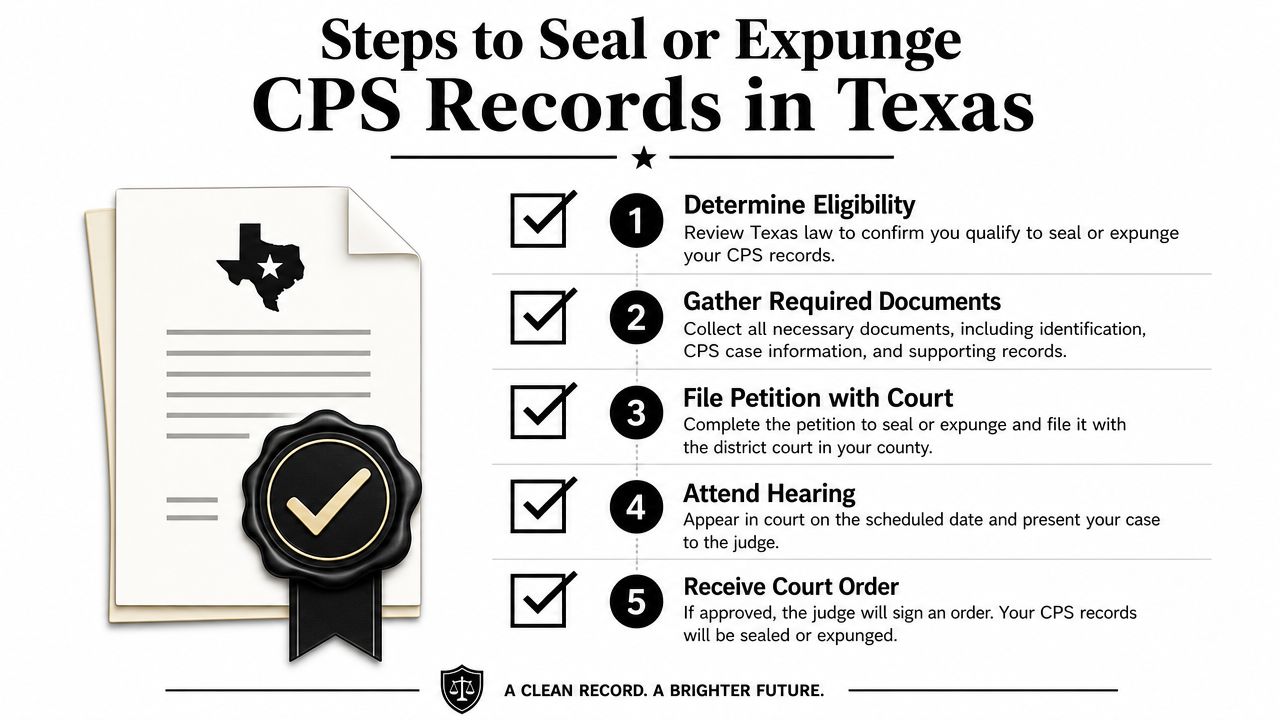
Sealing and expungement are different
In practical terms, families usually need to think in two categories:
| Option | General effect | Reality check |
|---|---|---|
| Sealing | Limits who can see or use certain records | It does not always destroy the record |
| Expungement or destruction | Aims to remove records more completely | This is usually harder and more limited |
Texas law can provide relief in narrow situations, including cases involving false reporting or other specific legal grounds. Whether those remedies fit your case depends on the actual agency finding, the procedural history, and what records exist across agencies.
What helps and what doesn't
Helpful steps include getting the full file, identifying the exact finding, collecting supporting records, and preserving any proof that the original report was false or seriously inaccurate. What doesn't help is relying on verbal assurances, social media explanations, or the belief that a closed case naturally ages out of relevance.
If you need a starting point on the record-clearing side, this page on getting a record expunged in Texas can help frame the issue.
Reality check: Most parents will not qualify for full destruction of CPS records simply because the case closed and life moved on.
Protecting documents while you build your case
When families prepare exhibits, emails, counseling records, school records, or medical material for attorney review, they also need to protect sensitive information about children. For that reason, many parents benefit from learning basic redaction insights for developers and non-developers alike. The same principles apply when you're removing private details before sharing documents more widely.
A careful lawyer will usually want to review the actual CPS records first, then decide whether the smarter move is an administrative challenge, a court filing, or preparation for future custody litigation where the old CPS history may appear.
The Long Shadow How a Closed Case Can Affect Future Legal Matters
The hardest part of a closed CPS case is that it can stay quiet for a long time and then suddenly matter. A parent may not hear about it again until a former spouse files for modification, a licensing board asks follow-up questions, or another report triggers a fresh agency review.
A U.S. study found that 64% of children whose first CPS investigation was for neglect alone were re-referred to CPS by age 18, and the same study reported that 29% later had a substantiated allegation and 16% experienced a subsequent removal, as described in this longitudinal research on later CPS contact. That doesn't mean every family will face another case. It does show that closure is not a permanent shield from future scrutiny.

Custody and divorce disputes
Family court is where old CPS history most often resurfaces. In a custody case, the other side may argue that a prior investigation shows poor judgment, unsafe supervision, substance abuse concerns, or instability in the home.
A closed file can become part of a larger narrative. Even if the allegations were overstated, a lawyer on the other side may use the record to request supervised visitation, restrictions, evaluations, or temporary orders that put you on the defensive.
Employment and licensing concerns
Some jobs and volunteer roles involve children, elderly adults, patients, or people with disabilities. In those settings, a past CPS matter can trigger follow-up review or deeper questioning.
That doesn't mean every employer will see every detail. It does mean parents should be prepared for the possibility that a prior case, especially one with an unfavorable finding, may need to be explained rather than ignored.
Criminal and investigation overlap
A closed CPS matter can also intersect with criminal issues. If a later allegation involves injury, neglect, drug exposure, family violence, or child endangerment, prior CPS history may shape how police, prosecutors, or courts view the new claim.
That is one reason parents should avoid casual statements like “the case was dropped” unless that is technically true. In many files, the cleaner statement is that CPS closed its involvement. Those are not the same thing.
Old CPS records rarely hurt people by themselves. They hurt people when a later dispute gives someone a reason to pull them back into the story.
Your Next Steps How to Obtain and Contest Your CPS Records
Once the case closes, your best move is usually not to wait and hope. It is to get informed while you still have time to think clearly.
Texas parents often assume they can always deal with this later. That is a mistake. Memories fade. Documents get lost. People move. If your record contains inaccuracies, delay usually helps the record, not you.
Start with the visual roadmap below.
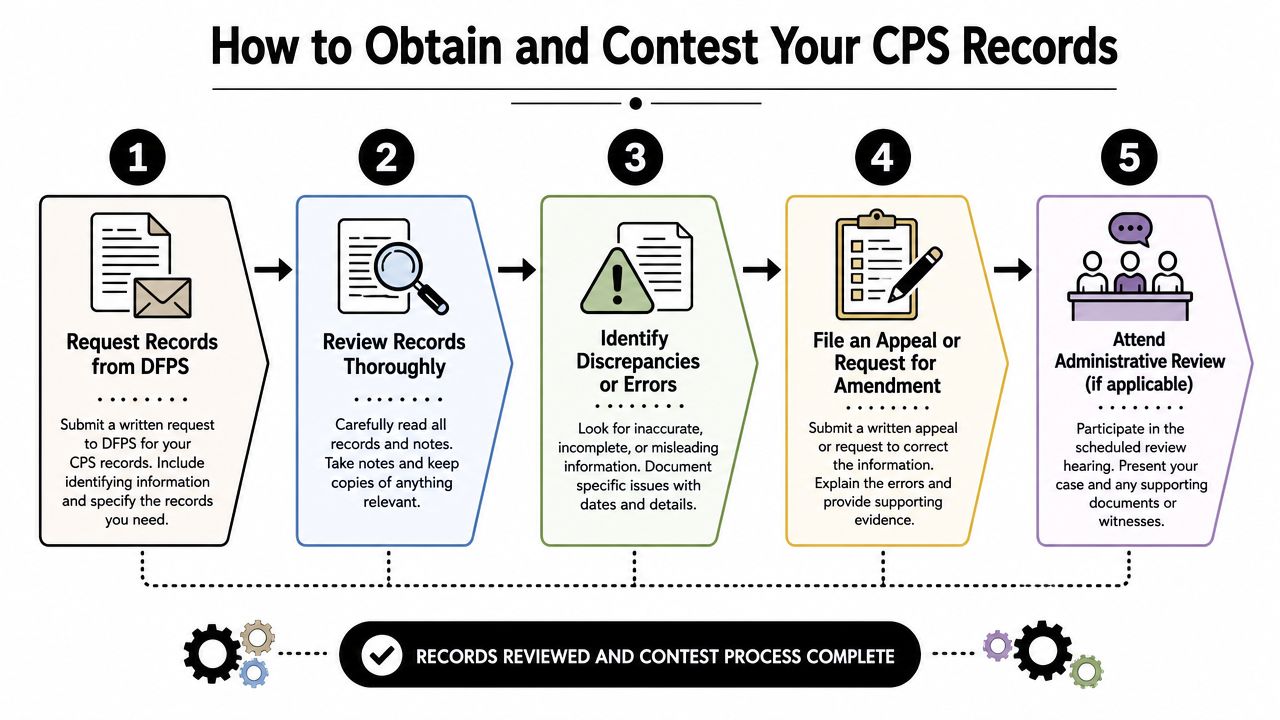
A practical sequence that works
- Request your file from DFPS. Ask for the complete record, not just the closure notice.
- Read with a pencil, not emotion. Mark dates, names, quotes, and factual claims that are wrong or incomplete.
- Separate bad facts from bad wording. Some entries are inaccurate. Others are technically accurate but framed in a damaging way.
- Find the procedural path. Depending on the finding, that may mean an administrative review, amendment request, or litigation planning.
- Get legal advice before the record is reused elsewhere.
Texas guidance commonly notes that closure doesn't erase the underlying allegations, and sealing or expunging the record, not closure by itself, is what may limit future use, as discussed in this overview of closed CPS cases and later record issues.
Here is a short explainer that can help you think through the process:
When you shouldn't handle it alone
There are certain moments when self-help stops being efficient.
- Custody litigation is pending: A closed CPS file can become evidence quickly.
- You received an unfavorable finding: Administrative challenges often depend on timing and precision.
- Your work or license may be affected: Early strategy matters.
- The records contain major factual errors: Corrections are easier to pursue before another case magnifies them.
If you need perspective on broader family support issues while sorting out legal next steps, Liberty Legal Network's family legal support is one example of a general resource families sometimes review alongside counsel-specific advice. For the Texas appeal process itself, this guide on how to appeal a CPS decision and your legal options is the more direct place to start.
A lawyer doesn't just tell you whether the case is closed. A lawyer helps you decide what that closed case can still do to your future.
If your CPS case has closed but you're still worried about custody, records, or what might surface later, talk with Law Office of Bryan Fagan PLLC. A free consultation can help you understand what the closure really means, whether your record can be challenged, and what steps make sense now to protect your family moving forward.