Skip to content
When CPS contacts you, most parents feel the same three things at once: fear, anger, and confusion. You may be standing in your kitchen with your phone in your hand, trying to remember every conversation from the last week, wondering who made the report and whether your child could be taken today. That reaction is normal. A CPS allegation hits at the most personal part of your life.
The hard truth is that this is serious. The reassuring truth is that an allegation is not a finding, and the way you respond in the first hours matters more than most parents realize. If you're trying to learn how to build a strong defense against CPS allegations, the right starting point isn't panic. It's structure.
Your World Turned Upside Down The Moment CPS Calls
A common Texas scenario looks like this. A parent gets a call from an investigator late in the afternoon. The investigator says there has been a report, wants to come by tonight, and asks a few broad questions that sound simple enough. The parent thinks, "If I just explain everything, this will go away."
Sometimes that instinct causes damage.

The first thing to remember
Most reports do not end in a confirmed finding. Nationally, roughly 92% of children reported to CPS were not determined to be victims of abuse or neglect, according to state-by-state CPS numbers summarized here. That doesn't mean CPS calls are harmless. It means many cases are decided at the stage where parents either preserve evidence and protect their rights, or accidentally help build the case against themselves.
That distinction matters in Texas because a CPS case can move from an informal conversation to court very quickly. Once a narrative hardens in the file, every later hearing becomes harder. Chapters 262, 263, and 161 of the Texas Family Code all become more dangerous when the parent starts behind.
Practical rule: Treat the first contact like the opening move in a lawsuit, not a customer service call.
Fear is normal, but loose talking is expensive
Parents often make one of three mistakes right away:
- They over-explain: They start answering questions before they know the exact allegation.
- They agree to everything on the spot: They think immediate compliance proves innocence.
- They underestimate documentation: They assume truth alone will carry the case.
In my experience, CPS investigations often turn on smaller details than parents expect. A text thread, a school attendance record, a timestamped photo, or a mismatch in dates can shape how the agency reads the whole family.
A mother in a custody dispute might be accused of leaving a child unsupervised. If she calmly gathers after-school pickup messages, location history, and messages with the other parent, the allegation may look very different. If she spends the first day arguing with the investigator and deleting old messages because she's embarrassed by unrelated private conversations, she may lose evidence that could have protected her.
What a strong defense actually looks like
A strong defense against CPS allegations isn't built by saying, "I would never do that." It's built by showing what happened, when it happened, who was present, and which records support your version.
Keep that frame in mind from the start. Your job is not to win an emotional debate. Your job is to build a clear, documented record before CPS builds one for you.
The First 48 Hours Your Immediate Response Plan
The first two days are about preventing avoidable damage. Parents often think the only goal is proving the allegation false. In reality, the immediate goal is narrower: reduce escalation risk while preserving your defense.
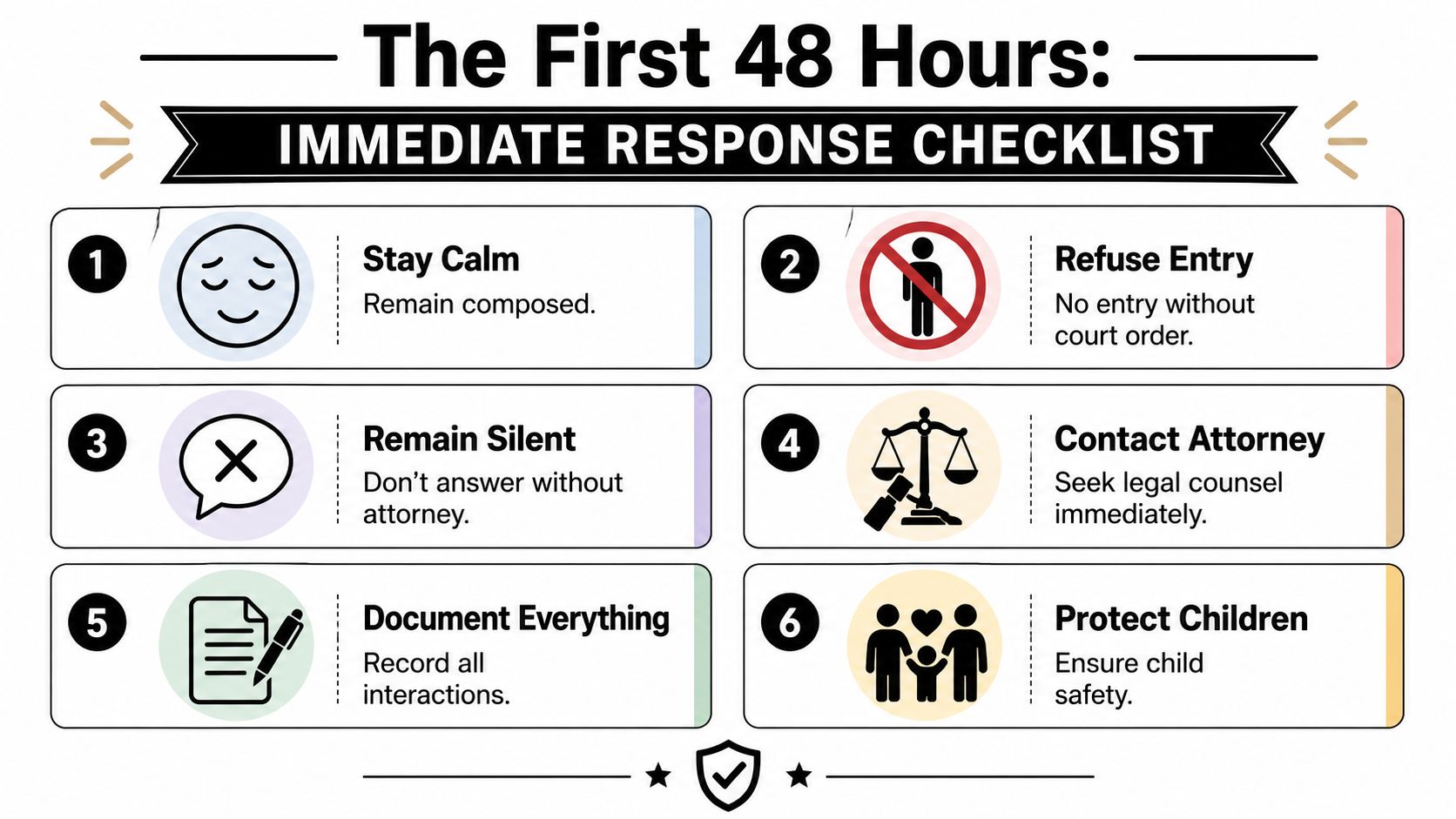
Start with this checklist.
What to do first
Get the investigator's name and contact information. Write down the full name, office, phone number, and the time of contact.
Ask what the allegation is. You may not get every detail, but you need the subject matter. Physical abuse, neglectful supervision, drug exposure, domestic violence, and medical neglect all call for different evidence.
Don't give a full statement on the spot. You can be polite without giving a running narrative. A simple response often works: you take the matter seriously, you want counsel, and you'll coordinate promptly.
Call an attorney immediately. If you need Texas-specific guidance on first contact, review how to respond when CPS shows up at your door in Texas.
After that first contact, slow the interaction down enough to think clearly.
Cooperation versus surrender
Parents hear "cooperate with CPS" and assume that means allowing unrestricted access to the home, answering every question, and signing whatever is put in front of them. That's not the same thing as smart cooperation.
A better approach looks like this:
| Situation | Better response | What to avoid |
|---|---|---|
| Investigator wants to talk immediately | Schedule through counsel or after you've gathered yourself | Long, emotional doorstep interview |
| Investigator asks broad accusatory questions | Ask for the specific concern and respond narrowly | Guessing, rambling, blaming others |
| CPS requests records | Provide relevant records in an organized way | Handing over your phone or mixed private materials |
| Home visit request | Address it deliberately with legal advice | Consent under pressure without understanding the stakes |
Texas parents should also understand the practical difference between a request and a court order. If CPS asks to enter your home or interview your child, that doesn't mean you should respond reflexively. The right answer depends on the facts, the urgency, and whether parallel criminal exposure exists.
If there is any possibility of criminal allegations, every statement to CPS should be made with that risk in mind.
What not to say in the first 48 hours
Avoid phrases like these:
- "I didn't do anything wrong, so I've got nothing to hide."
- "Come in and look around, I don't care."
- "My ex is crazy, this is all revenge."
- "I may have spanked him, but…"
Even innocent parents can make harmful admissions through careless phrasing. CPS workers document tone, word choice, and inconsistencies. Your first statement should be measured, short, and accurate.
The first 48 hours aren't about looking defiant. They're about staying controlled. That usually helps more than trying to sound persuasive.
Document Everything Building Your Evidence Locker
Once the initial panic settles, the substantive work begins. Build what I tell parents to think of as an evidence locker. One place. One timeline. One organized file for everything that may matter.

Independent guidance on CPS defense describes a staged process: lock down the allegation details, create a dated interaction log, collect corroborating records, and prepare witnesses and counsel. That same guidance stresses documenting dates, times, worker names, and the substance of every CPS contact in this overview of the CPS encounter.
What goes into the evidence locker
Your file should include:
- A contact log: Every call, voicemail, text, email, visit, and request from CPS.
- Medical records: Pediatric visits, prescriptions, discharge papers, vaccination records, therapy summaries if relevant.
- School records: Attendance, tardy history, grades, teacher messages, behavior reports.
- Photos and video: The home, sleeping arrangements, pantry, medications stored safely, visible condition of the child when relevant.
- Communication records: Texts, emails, co-parent messages, daycare messages, calendar invites.
- Witness names: Relatives, neighbors, teachers, coaches, babysitters, doctors.
- Court papers and safety plans: Keep every page in date order.
Digital evidence disappears faster than parents think
Many modern allegations rise out of family conflict, breakups, and custody fights. That's why digital proof can matter so much. If the accusation involves supervision, intoxication, late pickup, missed medical care, or domestic conflict, your phone may contain the timeline that matters most.
Preserve evidence early. Don't edit screenshots. Don't crop out timestamps. Save messages in more than one place. Export what you can. If your phone backs up to cloud storage, verify that backup is current. If there are Ring videos, school app messages, Life360 records, or pharmacy notifications, preserve them before they roll off.
For a closer look at this issue, see whether CPS can use text messages or social media against you.
Save first, sort later. Parents lose useful evidence when they start deleting "irrelevant" material too soon.
A simple example that changes a case
Take a father accused of neglectful supervision because his child was allegedly left waiting after school. He feels insulted and wants to tell CPS the report is ridiculous. That alone won't carry much weight.
Now change the record. He produces the school's dismissal log, a text from the other parent asking for a switch that day, a timestamped parking lot receipt, and phone location data showing he arrived when he said he did. The issue shifts from "who sounds believable" to "what does the record show."
That's how to build a strong defense against CPS allegations. Not with outrage. With chronology.
Navigating CPS Interviews and Investigations
By the time a formal interview is scheduled, CPS usually isn't looking for a casual explanation. The investigator is testing credibility, consistency, and risk. Parents often walk in thinking they just need to be honest and friendly. Honesty matters. Friendly matters less than disciplined.
A familiar interview scenario
A mother is told CPS wants to "clear a few things up." She attends alone because she thinks bringing a lawyer will make her look guilty. The interview starts politely. Then the questions narrow.
Who was in the home that night? Why didn't you answer the teacher sooner? Have there been arguments with the other parent? Did you ever leave the child with that relative before? By the end, she's answered far more than the allegation required, and some answers open entirely new lines of inquiry.
That happens often.
How to approach the interview
An interview is not the time to freestyle. You need to know the allegation, the likely pressure points, and which topics create criminal risk, family court risk, or both.
A useful framework is:
- Answer the question asked: Don't volunteer extra history.
- Stay concrete: If you don't know a date or time, don't guess.
- Avoid labels: Saying your ex is "abusive," "bipolar," or "vindictive" may inflame things unless you have a reason and supporting proof.
- Pause before answering: Fast answers create avoidable mistakes.
- Use records when possible: If your calendar, messages, or paperwork can answer the question better than memory, rely on them.
If you're preparing for this stage, best strategies for how to answer Texas CPS questions in an interview can help you think through the mechanics.
Child interviews and credibility fights
Many CPS allegations arise out of contested custody or domestic conflict. In those cases, the underlying dispute is often credibility, motive, and timeline. Practical guidance on false accusation defense notes that digital records such as phone records and location data can be core evidence for corroborating parenting routines or disproving timeline-based accusations in this discussion of defending against false abuse allegations.
That matters when CPS wants to interview your child. In Texas, how that interview happens can affect the whole case. Sometimes the issue isn't just what the child says. It's who framed the narrative beforehand, whether the allegation grew out of adult conflict, and whether there are records that anchor the timeline.
The parent who stays calm and organized usually presents better than the parent who keeps insisting, "This is all lies."
If your child is being interviewed, your lawyer should help evaluate the setting, the risks, and whether other evidence should be gathered first. Parents who charge into this phase emotionally often miss the bigger issue. CPS may be measuring not just the allegation, but your judgment under pressure.
Understanding the Texas CPS Legal Process and Court Hearings
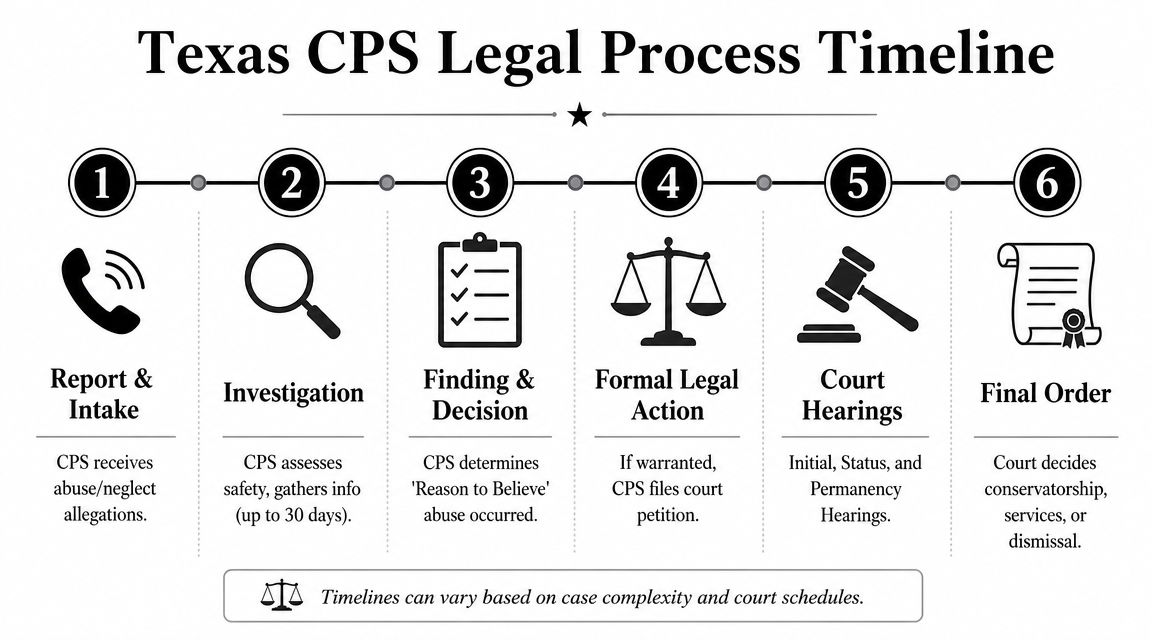
Once CPS moves into court, parents often feel like they lost control. The process becomes more formal, the deadlines matter, and what happened in the early investigation starts showing up in sworn papers and testimony.
Texas cases typically run through a sequence shaped by Chapter 262, Chapter 263, and sometimes Chapter 161 of the Texas Family Code. Chapter 262 deals with emergency protection and removal issues. Chapter 263 governs review, status, and permanency hearings. Chapter 161 addresses termination grounds and the legal framework for ending parental rights.
Why early evidence matters in Texas court
Many parents expect CPS to need overwhelming proof before the agency can make major moves. That isn't how these cases often function. Due-process advocates have pointed out that states often use only a preponderance of the evidence standard for substantiation or removal decisions, while arguing that a higher standard should apply because of the stakes. You can read that discussion in NCCPR's due-process overview.
That lower standard is one reason a disorganized defense is dangerous. If the court is deciding what is more likely than not, records and timelines become decisive. Not because they make the case glamorous, but because they make it concrete.
Key hearing stages Texas parents should recognize
Here is the simplified map:
| Texas stage | Why it matters |
|---|---|
| Emergency action under Chapter 262 | The court addresses immediate safety and whether removal or temporary orders are justified |
| Adversary hearing | The judge reviews whether the child should remain out of the home or under restrictions |
| Status hearing under Chapter 263 | The service plan and case direction become central |
| Permanency hearings | The court evaluates progress, placement, and whether reunification remains realistic |
| Final hearing | The case may be dismissed, extended, or moved toward conservatorship or termination issues under Chapter 161 |
If CPS has already filed, the right question isn't "How do I tell the judge I'm a good parent?" The better question is "What evidence do we need for this hearing, this affidavit, and this specific legal standard?"
What works in court and what doesn't
What usually helps:
- Organized exhibits
- Records tied to dates
- Witnesses who observed events
- Proof that addresses the exact allegation
- Demonstrated compliance with court orders and service obligations
What usually doesn't:
- General statements about loving your child
- Angry attacks on the caseworker
- Floods of unrelated papers
- Character letters with no connection to the allegation
- Last-minute evidence gathering
One practical option for Texas parents facing this process is working with counsel who handles CPS-related family litigation, including Law Office of Bryan Fagan PLLC, alongside any other lawyer you're consulting. The key is not the brand name. It's whether your lawyer understands how Texas CPS procedure, evidence, and deadlines intersect.
Taking Control and Protecting Your Family's Future
A CPS case can make you feel helpless. That feeling is real, but it isn't the whole story. Cases improve when parents stop reacting emotionally and start acting strategically.
The pattern is consistent. The parents who protect themselves best tend to do four things well: they slow down the first contact, they document everything, they preserve digital evidence early, and they prepare for court before court forces the issue. They don't assume innocence will speak for itself.
The trade-offs parents need to understand
There are real choices in these cases. Being cooperative can help, but over-sharing can hurt. Fixing a legitimate safety concern is wise, but agreeing with every accusation just to seem agreeable can create admissions that are hard to undo. Wanting the matter over quickly is understandable, but rushed decisions often become long-term problems.
That is especially true in high-conflict family situations. Privacy and disciplined communication matter more than many parents think. If your case involves household staff, relatives, co-parents, or people with access to private family information, careful handling of sensitive information becomes part of the defense. A useful outside resource on that issue is Superstar Nannies' guide to discretion, which helps explain why confidentiality practices can matter when family allegations start spreading beyond the home.
A CPS investigation is a legal process with human consequences. You need both a plan and restraint.
What to hold onto right now
You don't need to have the whole case solved today. You do need to avoid the mistakes that make tomorrow worse. Start with the allegation. Build the timeline. Save the records. Get advice before making decisions that affect your rights or your child's placement.
That is how to build a strong defense against CPS allegations in practice. Not by pretending the stakes are small, and not by surrendering out of fear. You protect your family by being precise, prepared, and consistent.
If CPS has contacted you, or if you believe a case may be filed soon, speak with an attorney before the situation gains momentum. The Law Office of Bryan Fagan PLLC offers a free consultation for Texas parents facing CPS investigations, hearings, and removal threats. You can get clear answers about what Chapter 262, Chapter 263, or Chapter 161 may mean in your case, what evidence to gather now, and how to respond without making things worse. You don't have to face CPS alone.