Skip to content
When a CPS investigator shows up at your door, the first feeling is often panic. You may be thinking about your child, your home, your job, and whether one conversation could change everything by the end of the day. Many parents describe those first hours as a blur.
If you're searching for answers about a foster care placement hearing texas case, you're probably trying to get your footing fast. That's the right instinct. Court deadlines move quickly in CPS cases, and what you do early matters.
Texas families have good reason to take these hearings seriously. In fiscal year 2022, children in Texas foster care spent an average of 24 months in care and experienced an average of 2.8 placement changes, according to the Texas Children’s foster care needs assessment. Those numbers don’t tell every child’s story, but they do show why preparation from the very first hearing is so important.
The good news is that a CPS case follows rules. A judge has to make decisions based on evidence, legal standards, and the child’s immediate safety. You are not powerless, even if it feels that way right now. Understanding the hearing process can help you make calm, smart decisions when the pressure is high.
That Knock on the Door Your First Step in a Texas CPS Case
A parent often meets CPS on an ordinary day. The baby is napping. Laundry is half done. Someone knocks, and within minutes the conversation turns to allegations, safety plans, interviews, and maybe even removal. Nothing about that moment feels ordinary after that.
Take a simple example. A father comes home from work and learns CPS has already visited his apartment. The investigator says there are concerns about supervision and the condition of the home. By that evening, the father is calling family members, trying to understand whether his child could be placed elsewhere, and wondering what a judge will hear first. That confusion is common.
Why the first hearing matters so much
The first court events in a CPS case shape the path that follows. They affect where your child stays, what services CPS asks you to complete, who gets to speak to the judge, and how the court views your level of cooperation.
Parents sometimes think, "I'll explain everything later." That can be a costly mistake. Early hearings often set the tone.
Practical rule: Treat every CPS hearing as important, even if someone tells you it's only temporary.
What makes this harder is the emotional pressure. You're trying to parent, work, and stay composed while dealing with a legal process that individuals rarely expect to face. If your child has already been placed outside your home, every day can feel heavy.
Fear is normal, but information helps
A foster care placement hearing isn't the end of your case. It's one point in a process. Still, it can affect the next several months of your family’s life.
That’s why parents need more than general advice. You need to know what the court is deciding, who will be in the room, what documents help, and how to show progress in a way a judge can use. Once you understand that, the process becomes less mysterious and more manageable.
Understanding the Purpose of a Placement Hearing in Texas
A few days after a removal, many parents walk into court carrying the same fear: "Is the judge deciding today whether I lose my child for good?" In most cases, the answer is no. A placement hearing is about the immediate plan for your child’s safety, care, and stability while the larger case is still being sorted out.

A placement hearing works like the first stage of a house repair after a storm. The court is not deciding every part of the rebuild. The judge is deciding where things stand right now, what is safe right now, and what temporary rules need to be in place until more facts are gathered.
That difference matters for parents. If you believe this hearing is only about proving CPS wrong in every detail, you can miss the question the judge is attempting to answer. The court usually wants a workable short-term plan. That means your best strategy is often to show stability, judgment, and a realistic path for your child’s care.
Parents who are still trying to understand the system often benefit from a plain-English explanation of how foster care and CPS placement decisions work in Texas.
What the judge is trying to accomplish
At a placement hearing, the judge is usually focused on a small set of practical decisions:
- Whether there is a current safety risk: Has CPS shown enough evidence that the child should remain out of the home, at least for now?
- Whether there is a better temporary placement: Is there a relative, family friend, or other approved caregiver who can safely care for the child?
- What temporary orders should be entered: Should the court set visitation, services, evaluations, drug testing, counseling, or contact restrictions?
Those questions may feel narrow, but they shape daily life for your family. Where your child sleeps, who supervises visits, whether a grandparent can be considered, and what the judge expects you to do next can all be affected here.
What this hearing means for you as a parent
This is your chance to help the court see more than the accusation. A judge needs specific facts that can be used to make a safe decision. Clear information carries more weight than general promises.
For example, if you want the court to consider return or a less restrictive placement, it helps to show things such as:
- proof of safe housing
- names and contact information for relatives who can help
- negative drug test results, if substance use is an issue
- enrollment in counseling, treatment, or parenting classes
- a work schedule or childcare plan
- messages, records, or other documents that correct factual mistakes
A parent who says, "I love my child and I will do anything," is being sincere. A parent who also brings a lease, a counselor letter, and the phone number of a safe grandmother gives the judge something concrete to act on.
Placement is really about your child’s daily routine
The word "placement" sounds formal, but the court is looking at ordinary life. Who gets the child ready for school? Who makes sure medication is given? Who can provide a calm home tonight, not six months from now?
That is why relative options matter so much. If your child cannot return home yet, a safe family placement may keep your child closer to familiar people, routines, school, and community. If you know of relatives or close family friends who may qualify, raise those names early and be ready with phone numbers, addresses, and any reason they would be a safe option.
A short video can also help if you're trying to put faces and procedures to the terms you're hearing from CPS and the court.
The court is looking for a safe plan, credible information, and signs that you can follow through.
Key Deadlines and Stages of Your CPS Court Case
On Monday, your child is removed. By Friday, you are being told about hearings, service plans, deadlines, and court dates that sound like another language. That is how many parents experience the first stretch of a CPS case in Texas. The pace feels fast because it is fast.
The good news is that these cases do follow a pattern. Once you know the sequence, you can stop guessing and start preparing. A helpful overview of what happens at CPS court in Texas can give you the big picture. What matters most in the moment, though, is knowing what each hearing is for, what the judge is looking at, and what you can do before that date arrives.
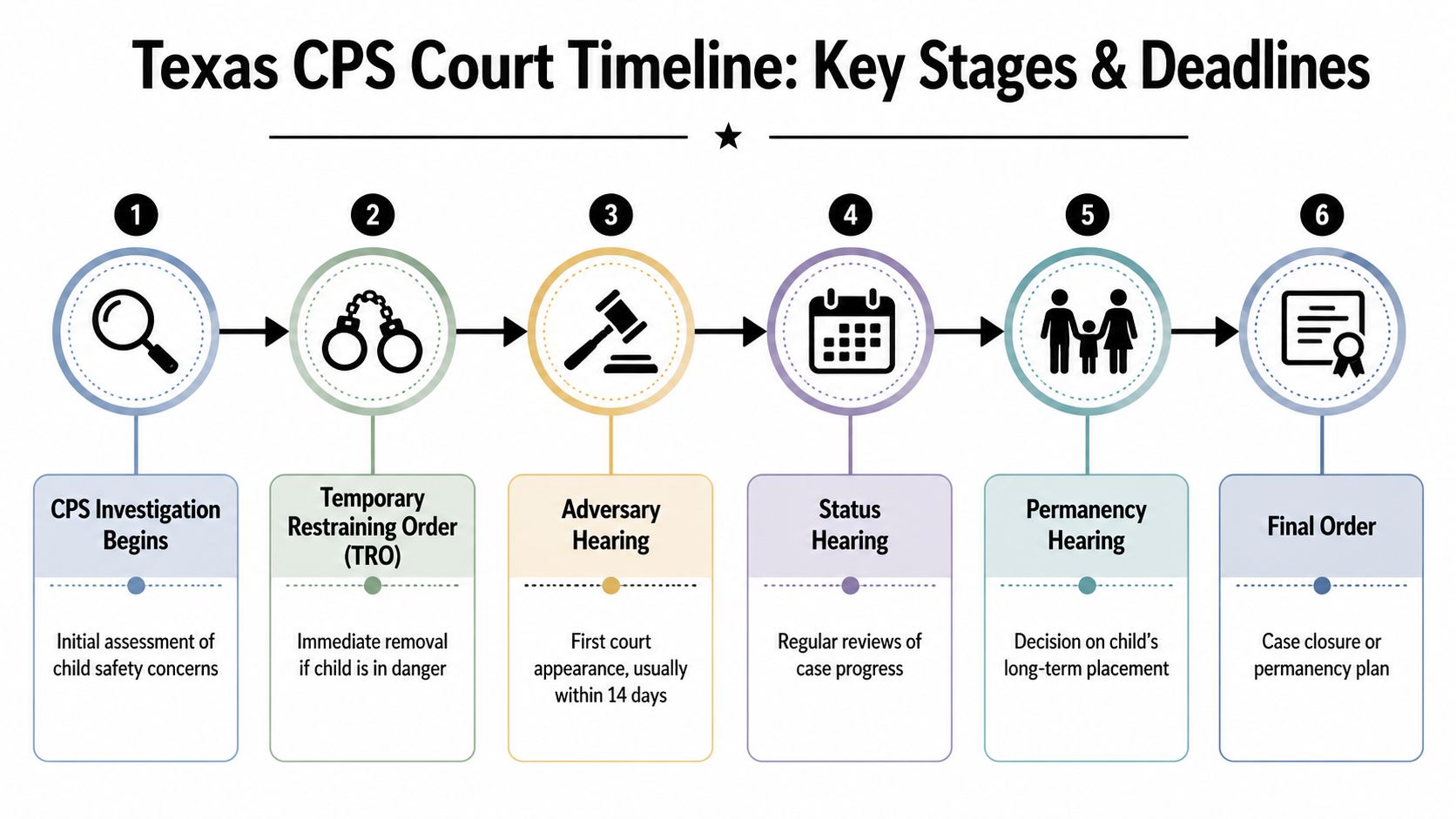
The early emergency phase
The first part of the case is about immediate safety. If CPS has already removed your child, one of the first major hearings is usually the adversary hearing, sometimes called a show cause hearing.
At that stage, the judge is not deciding the entire case. The judge is deciding whether CPS has shown enough reason for your child to stay out of the home for now while the case continues.
For a parent, that means your job is very practical. Focus on the facts closest to the removal. What exactly happened? What did CPS miss? Was there a safer option short of removal? Is there a relative who can step in right away? Have you already fixed part of the problem, such as getting stable housing, separating from an unsafe person, or starting testing or treatment?
This hearing works like the triage stage in an emergency room. The court is trying to decide what must happen first to keep the child safe. If you want the judge to see a fuller picture, your lawyer needs names, documents, contact information, and updates quickly.
The status hearing
After the emergency phase, the case usually turns to the status hearing. In many cases, this happens early enough that parents are still trying to understand the service plan while also dealing with visitation, work, transportation, and family stress.
The status hearing often centers on that service plan. The court looks at whether the plan is clear, whether you received it, whether you understand it, and whether the tasks in it fit the concerns that brought CPS into your life.
That point matters more than parents often realize.
A service plan is the court's working checklist for reunification. If the checklist does not match your case, or if parts of it are unrealistic because of distance, language, medical limits, or job hours, raise that issue early through your attorney. A bad plan can keep causing problems later if no one addresses it at the start.
Ask yourself a few simple questions before this hearing:
- Do I understand every service CPS is asking for?
- Is any part of the plan based on a factual mistake?
- Do I have proof that I already started services?
- What obstacle is making compliance harder, and can I document it?
- Is my lawyer aware of all of that?
The permanency phase
As the case continues, the court begins holding permanency hearings. These are review points where the judge checks whether the case is progressing toward a safe and lasting plan for the child.
At this stage, parents sometimes get discouraged. They hear the same words at each hearing and assume nothing is changing. In reality, at these review hearings, patterns start to matter. Judges look for follow-through. One missed class may be explainable. Months of incomplete services, missed visits, or no documentation creates a very different picture.
The court is usually reviewing questions like these:
- Are you completing the services the court ordered?
- Have the problems that led to removal improved?
- Is visitation happening and going well?
- Is CPS making reasonable efforts to move the case forward?
- Is the current placement meeting your child's needs?
- Is reunification still realistic, and if so, what still needs to happen?
Parents often help themselves most at this stage by treating each hearing like a progress report. Bring certificates, drug test results, counseling records, work schedules, housing updates, and anything else that shows steady effort. If a service is incomplete for a good reason, explain the reason with proof instead of hoping the court will infer it.
A simple way to understand the sequence
Each hearing asks a different question. If you know the question, you can prepare the right answer.
| Hearing stage | Main question |
|---|---|
| Early removal and adversary phase | Should the child stay out of the home temporarily? |
| Status hearing | Is the service plan fair, specific to this case, and being followed? |
| Permanency hearing | Is the case moving toward a safe, lasting outcome? |
Why these review dates matter
Parents sometimes see repeated hearings as delay. In practice, regular review can help when you are making real progress, because it gives the judge more chances to see change on paper and in person. A case can shift faster than you expect when a parent begins showing up consistently, completing services, testing clean, and presenting organized proof.
Analysts at Casey Family Programs examined Texas dependency hearings and found that consistent court review was associated with cases reaching permanent outcomes more quickly in some areas. The practical lesson for parents is straightforward. Do not treat the next hearing as far away. Treat it as already approaching.
In a Texas CPS case, progress only helps you if the court can see it. Keep records, give them to your lawyer early, and prepare for each hearing as if it could change the direction of your case.
The Key People at Your Placement Hearing and Their Roles
You sit down in court, hear names you do not recognize, and wonder who matters to the judge. That reaction is common. A placement hearing gets easier to handle once you know who is in the room, what each person can do, and how your actions affect what they say about you.
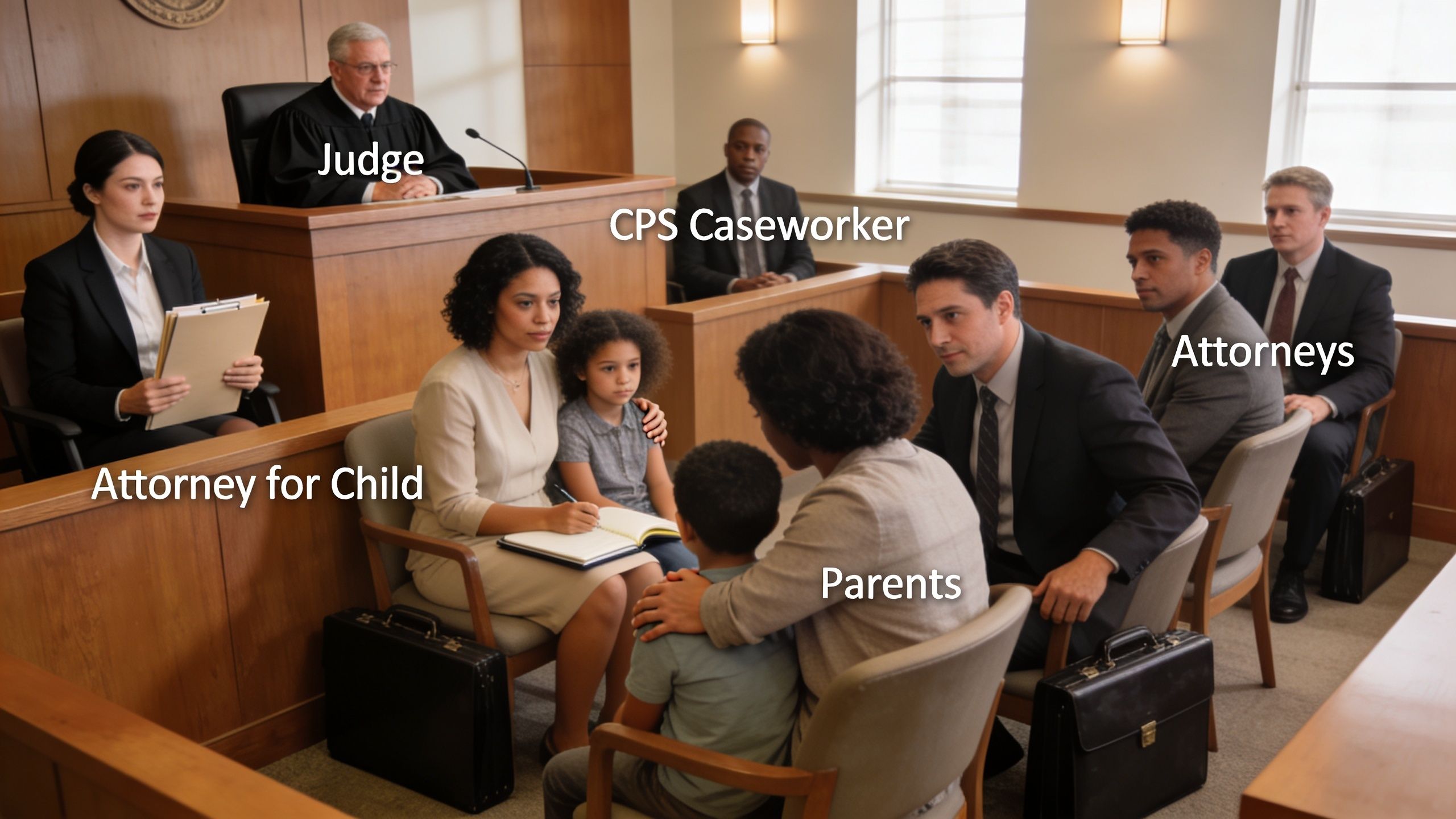
A courtroom works a lot like a case conference with one major difference. Only one person can sign orders. That person is the judge. Everyone else brings information, arguments, concerns, or recommendations for the judge to weigh.
The judge, the agency, and your lawyer
The judge decides where your child stays for now, what services will be required, what visitation will look like, and whether CPS has met its burden at that stage of the case. Judges do not conduct their own side investigation. They decide based on what is presented in court.
The DFPS attorney represents the department. That lawyer is there to argue CPS's position, offer records or testimony, and ask for orders the agency believes are needed for the child's safety.
Your attorney represents you and your rights. That includes explaining what is happening, objecting to improper evidence, questioning witnesses, and helping you present proof that supports more contact, relative placement, or reunification. If you are confused during the hearing, your lawyer is the person who should be answering your questions before and after the case is called.
Here is the practical point for parents. The judge may hear from many people, but your lawyer is the one person in the room whose job is to make sure your side is clearly presented.
The people focused on your child
Many Texas parents get tripped up by the titles. The child may have an Attorney Ad Litem, a Guardian Ad Litem, or both. Those roles are related, but they are not always the same.
An Attorney Ad Litem serves as the child's lawyer. A Guardian Ad Litem gives the court an independent view of what appears to be in the child's best interests. In some cases, a CASA volunteer also provides observations to the court after meeting with the child, caregivers, and others involved in the case.
That can feel uncomfortable at first. Parents sometimes assume every child advocate is automatically aligned with CPS. The better way to look at it is this. These people watch for consistency. If you attend visits, stay calm, complete services, communicate respectfully, and show up prepared, they may notice that progress and report it.
The caseworker and the caregivers
The DFPS caseworker is often the person you know best by the time of the hearing. The caseworker gathers records, arranges services, monitors placement, tracks your participation, and updates the court about the child's current situation. If you miss drug tests, skip visits, fail to return calls, or complete classes, the caseworker usually becomes the source of that information in court.
That is why simple habits matter. Confirm appointments. Save certificates. Keep texts and emails. Let your lawyer know quickly if the caseworker has inaccurate information.
You may also see foster parents, relative caregivers, or preadoptive caregivers in the courtroom. Texas law allows certain caregivers to attend some hearings and provide information to the court. For a worried parent, that can feel like one more set of eyes judging you. Sometimes it is. Sometimes it is also a chance for the court to hear that you have been consistent at visits, brought food or clothes, called regularly, or behaved appropriately with your child.
A simple way to read the room
If the hearing feels crowded, sort people by function:
- Judge: Makes the orders.
- DFPS caseworker: Reports facts, services, and placement details.
- DFPS attorney: Argues the department's position.
- Your attorney: Protects your rights and presents your side.
- Attorney Ad Litem or Guardian Ad Litem: Speaks for the child's legal interests, best interests, or both.
- CASA volunteer: Shares observations with the court when appointed.
- Caregivers: Provide day to day information about the child and placement.
Once you understand the roles, the hearing becomes less mysterious. This understanding is also essential for preparing with purpose. Ask yourself a parent-focused question before court: what does each of these people currently know about me, and what documents, conduct, or witnesses will help them see the progress I want the judge to understand?
Presenting Your Case and Protecting Your Parental Rights
Parents often enter court thinking they are there only to answer accusations. That’s not enough. You also need to present evidence, protect your procedural rights, and make it easier for the judge to see your progress in practical terms.

A good way to think about a foster care placement hearing texas case is this. CPS tells a story about risk. Your lawyer’s job is to test that story and, when the facts support it, present a stronger story about safety, stability, and change.
What parents can do with evidence
Consider Maria, a mother whose child was removed after allegations tied to unsafe home conditions and missed medical appointments. By the time of a later hearing, she had cleaned the home, secured more stable work hours, enrolled in parenting classes, and restarted the child’s medical follow-up through approved channels. None of that helps her in court unless it is documented and presented clearly.
That’s why paperwork matters.
Useful evidence may include:
- Housing records: A lease, utility bill, or letter from a landlord can show stability.
- Employment proof: Pay stubs or a work schedule can help show consistency.
- Service completion records: Certificates for parenting classes, counseling attendance logs, or treatment updates matter.
- Visitation records: Notes showing regular attendance and positive interaction can support increased contact.
- Support letters: A pastor, counselor, employer, or relative may help confirm your efforts if your lawyer decides those letters fit the case.
Rights that matter in real life
Parents have the right to be represented by counsel, and in many CPS cases a court may appoint counsel for an indigent parent. Parents also have the right to know what is being alleged, to respond to evidence, and to present their own witnesses and documents.
These rights are not just technicalities. They are how fairness is built into the process.
If CPS says you missed services, your records may show you attended but the provider failed to update the file. If CPS says no relative is available, your lawyer may be able to present a qualified relative who was never fully assessed. If the department claims you made no progress, a therapist, sponsor, or service provider may tell a different story.
Bring proof, not just explanations. Judges hear many promises. Documents and credible witnesses carry more weight.
How to come across in court
Parents sometimes ask whether they should "tell the judge everything." Usually, the better approach is to tell the judge what is relevant, truthful, and supported.
That means:
- Answer questions directly.
- Don’t argue with the caseworker in the hallway or in open court.
- Don’t interrupt, even if a statement feels unfair.
- Let your lawyer decide when a point should be made through testimony, objection, or cross-examination.
A calm parent with organized records often makes a stronger impression than a frustrated parent with a long story and no documents. That may not feel emotionally satisfying in the moment, but it is often more effective.
Actionable Steps to Take Before Your Court Date
When a court date is approaching, anxiety rises because parents feel there is so much they can’t control. Preparation helps because it gives you a job to do. Focus on the next correct step.
Build your hearing file
Start one folder, physical or digital, and keep every CPS-related document in it. Don’t rely on memory.
Include items such as:
- Court papers and notices so you know the date, time, and purpose of the hearing.
- Service plan documents with notes about what you’ve completed and what is still pending.
- Proof of participation like class certificates, therapy attendance, drug test results if applicable, and visitation records.
- Daily-life documents such as pay stubs, lease paperwork, school-related records, and names of relatives who may help.
- Communication logs showing emails, texts, and call notes with caseworkers and providers.
Prepare with your lawyer, not alone
Don’t show up planning to improvise. Talk with your attorney beforehand about what the judge is likely to focus on at that hearing.
Use your meeting with counsel to answer questions like these:
- What is CPS expected to argue?
- What are our strongest documents?
- Should I testify?
- Is there a relative placement option we need to push?
- What weak spots in my case should I be ready to address?
If you don’t understand something in your service plan or in the court paperwork, ask. Parents lose ground when they nod through confusion.
Practice the way you will speak
You don’t need a dramatic speech. You need clear, steady answers.
Try this approach:
- State facts first: "I completed intake, started counseling, and attended all scheduled visits."
- Acknowledge problems without spiraling: "I understand why the missed appointments concerned CPS. I’ve now arranged transportation and backup childcare."
- Stay future-focused: "My goal is reunification, and I’m following each step ordered by the court."
Handle the basics well
Courtroom basics matter because they affect credibility. They won’t decide the case alone, but they can help or hurt.
- Dress neatly: Clean, modest clothing is enough.
- Arrive early: Late arrival makes everything harder.
- Turn off your phone: A ringing phone during a hearing is a bad look.
- Address the judge respectfully: Your lawyer can help you with courtroom etiquette if you’re unsure.
A parent who is organized, respectful, and prepared gives the judge a practical reason to believe progress is possible.
Potential Rulings and the Path Forward for Your Family
At the end of a hearing, the judge may issue orders that feel disappointing, hopeful, or mixed. Often, the outcome is not a final victory or final loss. It is a set of temporary directions about what happens next.
A judge might return a child home under supervision, place the child with a relative, or continue foster care while ordering services and visits. If the child remains outside the home, the written order usually becomes a roadmap. It tells everyone what must happen before reunification becomes more likely.
What to look for in the judge’s order
Read the order with your lawyer and focus on the practical pieces:
- what services are required
- what visitation is allowed
- what findings the judge made about safety
- what the next hearing will examine
If your child has experienced stress, fear, or abrupt transitions, it may help to understand the basics of trauma-informed care. That framework can help parents and caregivers think about behavior, emotional regulation, and trust in a more constructive way during a CPS case.
If DFPS has been appointed conservator, it also helps to understand temporary managing conservatorship in Texas CPS cases, because that legal status affects placement decisions, services, and court oversight while the case continues.
Parents do best when they treat each ruling as instructions, not as a personal verdict. The path forward may be demanding, but it is usually clearer after the hearing than before it.
Answering Your Pressing Questions About Texas Placement Hearings
Is a placement hearing the same as a final trial
No. A placement hearing usually deals with temporary safety, placement, and interim orders. A final order comes later and can address long-term conservatorship, reunification, or termination issues.
Can I get my child back at the first hearing
Sometimes, but not always. It depends on the facts, the immediate safety concerns, the evidence available that day, and whether the court believes the child can safely return home or be protected through a less restrictive order.
What if I sought help for my child’s mental health and CPS became involved
These cases can be different from abuse or neglect removals. As many as 6% of children entering Texas foster care are relinquished by parents seeking mental health treatment for them, according to The Imprint’s reporting on this Texas foster care pathway. That’s one reason legal advice matters. Parents need to understand the procedural differences and how to protect their rights while still getting care for their child.
Do I really need a lawyer
If CPS is involved in court, yes. These hearings move fast, the paperwork matters, and what happens early can shape the rest of the case.
If you're facing a Texas CPS case and need clear answers about a foster care placement hearing, the Law Office of Bryan Fagan PLLC can help you understand your rights, prepare for court, and take practical steps toward reunification. You don't have to sort through this alone. Reach out for a free consultation and get guidance grounded in Texas law and real courtroom experience.