Skip to content
When a CPS investigator says your child may need to be placed outside your home, most parents don’t hear legal terminology. They hear one fear: Will my child end up with strangers? If you’re searching for non relative placement cps texas, you’re probably already in that moment, or close to it.
A common scene looks like this. A caseworker asks whether there’s a grandparent, aunt, family friend, or other adult who can step in right away. The conversation moves fast. You’re stressed, confused, and worried that one wrong answer could shape where your child sleeps tonight. Then you hear the phrase “non-relative placement,” and everything feels even less clear.
That fear is understandable. CPS cases move quickly, but parents still have rights, and placement decisions are not supposed to happen in a vacuum. Texas law and CPS policy give strong preference to family-based options before a child is placed with unrelated caregivers. If CPS is discussing a non-relative placement, that doesn’t automatically mean the outcome is final or that you have no voice in the process.
The hard part is that many parents don’t know when to speak up, what information CPS needs, or how to challenge a bad placement decision. That’s where clear guidance matters. The rules can feel cold on paper, but they affect real children, real routines, and real family bonds.
Your World Turned Upside Down by a CPS Call
You may have gone from an ordinary day to a crisis in a matter of hours. One phone call. One knock at the door. One statement that your child “can’t stay here right now.” Parents often tell me the most frightening part isn’t only the investigation itself. It’s the thought that their child may be sent to someone the family doesn’t know.
Take a relatable example. A mother in Houston is told CPS is considering removal after an incident involving alleged neglect. Her first instinct is to ask whether her sister can take the child. But she’s flustered, doesn’t have her sister’s new address, and assumes CPS will “figure it out later.” By the next court date, CPS has already been looking at other options because they didn’t have enough information to clear the relative quickly.
That kind of gap happens all the time. It doesn’t mean the parent doesn’t care. It means the system moves fast, uses unfamiliar language, and expects families to respond under pressure.
A placement conversation is never “just paperwork.” It can shape your child’s stability, school routine, medical care, and emotional safety from the very beginning of the case.
Parents also get confused because “temporary” can still last a long time in practice. If a child is placed somewhere early and no one pushes for a better option, that initial placement can gain momentum. Judges and caseworkers often look at stability, so acting early matters.
If your family is in this position, start with one grounding truth. A proposed non-relative placement is not the same as a final, unchangeable decision. You can identify safer family options, provide names and contact information, raise concerns through your lawyer, and ask the court to look closely at whether CPS followed the proper placement order.
What parents usually need first
Before talking strategy, many parents need simple language:
- Non-relative placement means CPS is considering an unrelated caregiver or licensed foster setting.
- Relative placement usually means a grandparent, aunt, uncle, adult sibling, or another family member.
- Fictive kin means someone who isn’t related by blood but has a meaningful relationship with the child, such as a godparent or long-time family friend.
Those categories matter because Texas does not treat them equally. The order matters. The timing matters. Your response matters.
Understanding the Placement Hierarchy in Texas
Texas uses a clear placement hierarchy. In plain terms, CPS is supposed to work down the list, not skip straight to strangers unless family options are unavailable or unsafe.
A helpful way to think about it is a ladder. CPS should start at the top rung and move downward only if the higher rung doesn’t work. The first question is whether a parent can safely care for the child. If not, the next questions involve other family members and people the child already knows.
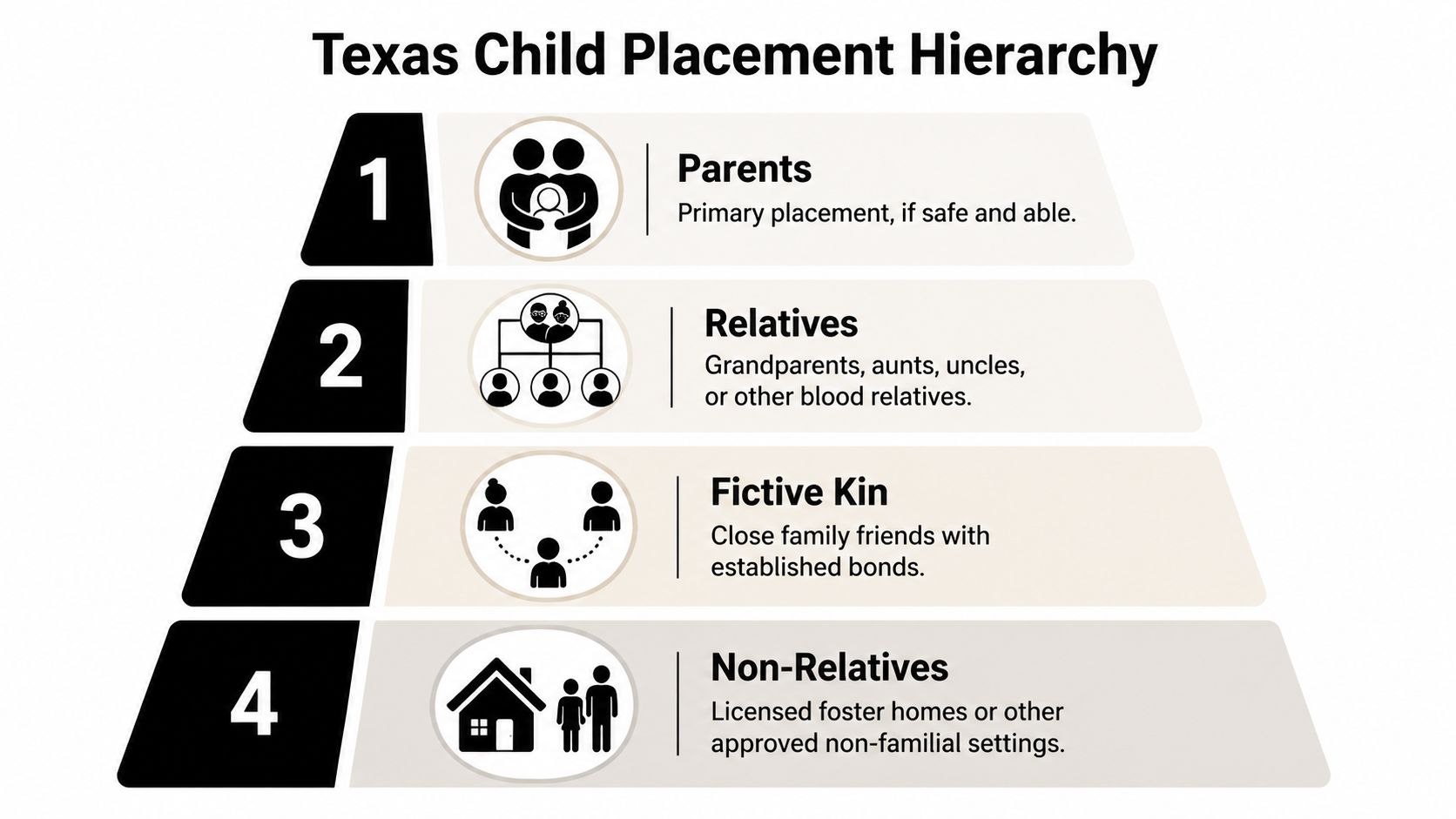
The order CPS is supposed to follow
Under DFPS policy, non-relative placement is a last-resort option, and caseworkers must first contact noncustodial parents before shifting to relatives and fictive kin, as described in the Texas CPS child placement policies and safety framework.
Here’s what that usually looks like in real life:
| Placement level | Who that includes | Why it matters |
|---|---|---|
| Parent | A non-offending or noncustodial parent | Parents have the first legal claim if they can safely care for the child |
| Relative | Grandparents, adult siblings, aunts, uncles, cousins, and others depending on the family structure | Family placements often preserve routines, culture, and bonds |
| Fictive kin | Godparents, close family friends, coaches, church members, or others with a strong connection | These placements can reduce the shock of removal because the child knows the caregiver |
| Non-relative | Foster homes, facilities, or unrelated approved homes | Used when safer, higher-priority options are not available |
Why Texas prefers family-based placements
The reason is simple. Children usually handle separation better when they remain connected to familiar people and family identity. A child who knows the caregiver may keep the same school, doctor, church, or sibling contact. That doesn’t erase the trauma of a CPS case, but it can reduce additional disruption.
Practical rule: If CPS asks whether there’s “anyone” who can help, treat that as a legal question, not a casual one. Give names, phone numbers, addresses, and the nature of the relationship right away.
Texas also requires safety screening. CPS doesn’t place children with a relative or fictive kin just because someone volunteers. The agency reviews background information, the home environment, and any prior CPS history. If there’s an open CPS investigation in the proposed caregiver’s home, family-based safety services involvement, or a prior finding that creates a barrier, that can stop the placement unless the issue is resolved through the proper process.
Where families get tripped up
Many parents hear “relative placement” and assume CPS will do the legwork. Often, CPS will investigate leads, but the agency can only move as fast as the information it receives. If your aunt is willing to take the child but never returns calls, or your child’s godfather has moved and no one provides his current address, CPS may conclude that option isn’t presently available.
That’s one reason the phrase non relative placement cps texas can be misleading. It sounds like a category. In practice, it often reflects a race against time. The family that organizes information quickly usually has a stronger chance of keeping the child with familiar people.
Navigating the CPS Case Timeline and Key Hearings
Placement decisions don’t happen only at the beginning of the case. They can be discussed, challenged, and revisited at several points. If you understand the hearing timeline, you’re in a stronger position to act before a temporary arrangement hardens into the default.
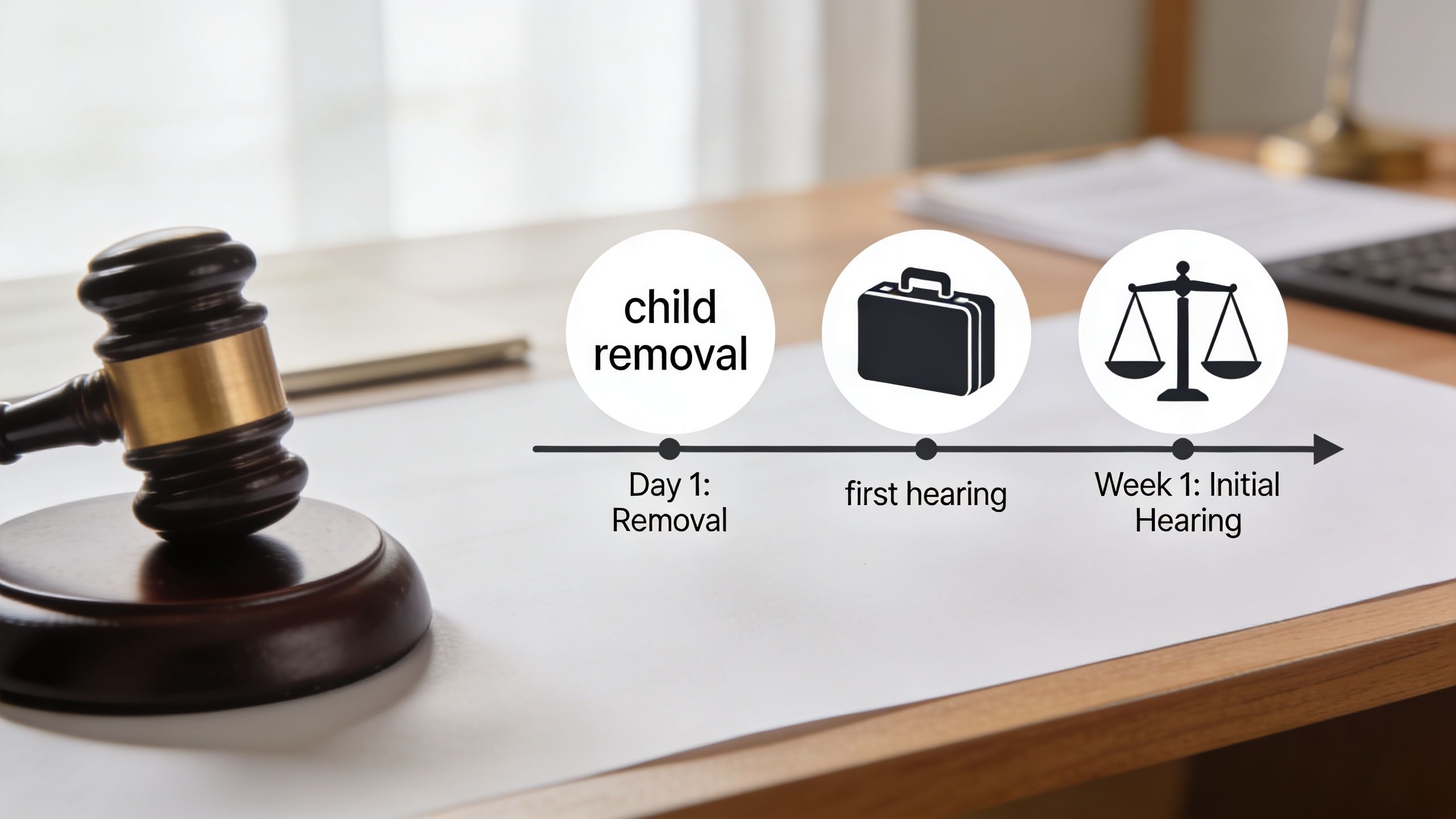
The first days after removal
After CPS removes a child, the case moves into court quickly. One of the earliest critical settings is the adversary hearing, which usually happens very soon after removal. This hearing matters because the court examines whether the emergency removal should continue and what temporary orders should be entered.
For parents, this is not a hearing to attend passively. It’s an opportunity to raise placement options, identify relatives or fictive kin, and ask the court to require CPS to explore those options. If the other parent is safe and available, that issue should be addressed early. If a grandmother or close family friend is ready to step in, the court needs to hear that too.
A practical problem comes up often here. Families may have language barriers, or proposed caregivers may struggle to understand legal instructions and court paperwork. In those situations, resources on preventing legal language access errors can help families understand why certified interpretation matters when hearings and placement decisions move fast.
What later hearings mean for placement
Texas CPS cases continue through several stages, and each stage can affect where the child lives.
Adversary hearing
The court reviews the emergency action. Parents and their lawyers can challenge the basis for removal and push for safer family options instead of a non-relative setting. If CPS says no appropriate family member has been identified, this is the time to present specific names and details, not vague promises that “someone might help.”
Status hearing
The status hearing usually focuses on the service plan and the direction of the case. Placement is still relevant here. If a relative has now completed screenings, or if a fictive kin caregiver has become available, your attorney can ask the court to revisit the current arrangement.
Permanency hearings
These hearings address the child’s progress, the parent’s progress, and the long-term path forward. If the child is struggling in the current setting, or if a family-based option has matured and become viable, permanency hearings are one of the places to bring those issues back to the judge.
The court process isn’t only about whether CPS was right to act. It’s also about whether the child’s current placement remains the best available option.
A simple timeline mindset
Parents often feel overwhelmed because they think they only get one chance. That’s not how these cases work. There are repeated moments when placement can be addressed.
A useful way to think about the process is this:
Immediate response
Gather names, phone numbers, addresses, and relationships for every possible caregiver.Early court advocacy
Raise those options at the first hearing through counsel and ask for quick assessments.Ongoing review
Keep updating CPS and the court when a family or fictive kin option becomes available or clears a barrier.Document concerns
If the child’s current placement is unstable, communicate specific problems through proper legal channels.
Why timing matters so much
If a child has already settled into a placement by the time a relative finally appears with complete information, changing placements can become harder. Judges worry about repeated moves. That means families should act with urgency but also with organization.
The strongest approach is usually coordinated. Parents provide names. Proposed caregivers contact CPS directly. The attorney raises the issue in court. Everyone works from the same facts. That’s how you turn a frightening process into a manageable one.
Your Rights and How to Proactively Advocate for Kinship Placement
Parents sometimes assume they have no practical say once CPS becomes involved. That’s not right. In a Texas CPS case, you may not control every decision, but you do have the right to advocate for a safer family-based placement and to insist that CPS follow the proper order of consideration.

One important reason not to give up is that family placement is not rare in Texas. According to the Texas DFPS relative and other designated caregiver report, 39.9% of children in Texas CPS care were placed with relatives or fictive kin as of fiscal year-to-date 2024, compared with the national rate of 34%. That tells families something important. Kinship placement is not a long-shot request. It is a common and recognized path.
For a closer look at how relatives and close family connections fit into these cases, this guide to kinship placement in Texas CPS matters can help you understand the bigger picture.
What advocacy looks like in practice
Parents help themselves most when they stop speaking in generalities and start giving CPS usable information.
Instead of saying, “My cousin can probably take her,” say: “My cousin Maria Lopez is willing to take her. She lives in Harris County, her phone number is this, she has known my child since birth, and she can speak to CPS today.”
That level of detail matters because caseworkers are screening for actual placement options, not just family possibilities.
Your first action list
Name every possible caregiver early
Include relatives, the other parent if appropriate, and fictive kin such as godparents or family friends.Give complete contact information
Provide phone numbers, addresses, and any alternate contact details. Don’t assume CPS can find people on its own.Explain the child’s bond
Say how the child knows the person, how often they’ve spent time together, and whether siblings could stay together there.Ask the caregiver to contact CPS directly
A willing caregiver who takes initiative often gets evaluated faster than one who waits for a call.Tell your lawyer immediately
If you have counsel, make sure the proposed placement information reaches the attorney in writing.
Rights tied to Chapters 262 and 263
Texas Family Code Chapters 262 and 263 shape much of the early and ongoing CPS process. In practical terms, Chapter 262 covers emergency intervention and removal issues, while Chapter 263 governs review, progress, and permanency decisions during the case.
That matters because placement isn’t separate from the case. Placement is woven into the court’s ongoing review of safety, best interest, and the child’s stability. If CPS has skipped over a viable relative or fictive kin option, that issue can be raised as part of the broader case management and court oversight process.
Here’s a helpful explainer before the next step:
A relatable scenario
A father in Dallas learns his son has been placed in a non-relative foster setting because the child’s maternal aunt was initially ruled out due to missing paperwork and confusion about who lived in her home. Instead of assuming the decision was final, he and his attorney gather the aunt’s lease, household information, and direct contact details. The aunt calls the caseworker herself, answers questions quickly, and appears prepared at the next hearing. That doesn’t guarantee a transfer, but it gives the court and CPS a real, concrete family option to evaluate.
Parents often feel powerless in CPS cases. They usually have more influence over placement than they realize, especially when they act quickly and give CPS verified information.
One more practical point
The Law Office of Bryan Fagan PLLC is one option families use in CPS matters involving relative placement issues, including situations where parents need help presenting relatives or family friends as potential caregivers and addressing background or suitability concerns in court.
How to Legally Contest a Non-Relative Placement Decision
Sometimes you do everything right and CPS still proposes a non-relative placement or denies the caregiver your family put forward. When that happens, the next step is not panic. It’s a structured challenge.

A denial can happen for several reasons. The proposed caregiver may have a prior CPS history. Someone in the household may have a criminal background issue. The home may have unresolved safety concerns. Or CPS may believe there is a prior Reason to Believe finding that blocks placement.
Start with the simplest challenge first
Before filing anything formal, make sure everyone is working from accurate facts. Families often discover that a denial was driven by incomplete information rather than a true legal barrier.
Use a practical escalation path:
Ask for the exact reason for denial
General statements like “they didn’t qualify” are not enough. You need the specific concern.Correct factual errors quickly
If CPS has the wrong address, old household information, or outdated criminal history details, fix that immediately.Request supervisory review
If the caseworker won’t reconsider, ask that the supervisor review the proposed caregiver.Raise the issue in court
If your child is already in a case under Chapter 262 or 263, your lawyer can bring the placement issue before the judge.
The Placement Review of Findings
Texas DFPS policy allows prospective caregivers to challenge some denials through a Placement Review of Findings, particularly when the barrier involves a prior Reason to Believe finding, as outlined in the DFPS placement review guidance and appeal framework.
This process matters because families often assume an old CPS finding automatically ends the discussion. In some cases, it doesn’t. The review process can give the caregiver a chance to ask DFPS to reexamine the finding and determine whether it should still block placement.
When this review becomes critical
A grandparent may have been involved in a past CPS investigation years ago. A godparent may have a household member whose history raises questions. A relative may be denied because CPS says there is an unresolved risk finding. If that underlying issue is reviewable, a formal challenge may reopen the possibility of placement.
A denial letter is not always the end of the story. Sometimes it’s the beginning of the right administrative and court response.
Public outcome data on these reviews is limited, but DFPS policy does permit them, and attorney involvement can help families move faster and present the right records. Texas Family Code §262.114 can also matter because it addresses expedited action related to evaluating relatives and other potential family placements.
What families should gather for a challenge
A strong challenge is usually document-driven. Depending on the issue, the caregiver may need:
Identity and household records
Driver’s license, lease, utility bill, and a list of everyone living in the home.Background clarification
Court records or disposition documents if CPS is relying on old or unclear criminal information.Evidence about the child relationship
School pickups, photos, text messages, medical contact records, or other proof the caregiver has been consistently involved.Safety information
Home details, sleeping arrangements, and any explanation of how the caregiver will meet the child’s needs.
Court action may still be necessary
An administrative review is one path. Court advocacy is another. If CPS is moving too slowly, or if the child remains in a poor non-relative setting while a family option sits unresolved, your attorney can ask the court to press for answers and revisit placement.
That doesn’t mean the judge picks whoever the family prefers. The court still has to consider safety and best interest. But judges can ask hard questions. Why was this caregiver denied? Was the denial based on a current barrier or an old one? Has CPS completed the required assessment steps? Those questions can change the course of a case.
Understanding Reunification Plans and Final Case Risks
Placement matters because where your child lives affects stability, stress, and the path back to you. It also matters because a shaky placement can distract everyone from the larger legal goal, which is often reunification.
Texas has faced a serious placement strain. According to ABC13’s report on the Texas CWOP crisis, Child Without Placement cases rose by over 1,100% since 2019. The same report explains that children have sometimes ended up in emergency non-relative settings such as hotels or offices, and that over 40% of teens placed in non-relative settings from a CWOP situation returned to CWOP within 90 days. For families, that underscores a painful truth. Instability in non-family settings is not just a theoretical concern.
Why instability affects your case
A child who moves from place to place may show more behavioral struggles, school problems, fear, or confusion. That can complicate family visits, counseling, and the child’s sense of security. Parents often feel blamed for everything happening in the case, even when the current placement itself is contributing to the child’s distress.
This is one reason it’s important to keep the placement issue connected to the reunification issue. If your child is in an unstable non-relative placement, your attorney may need to address both the immediate placement problem and the broader plan to return the child home safely.
Your service plan is not optional
If CPS removes your child, you will likely receive a family service plan. Think of it as a roadmap the court expects you to follow. It may require counseling, substance abuse treatment, parenting classes, psychological evaluation, stable housing, drug testing, or other tasks tied to the concerns in the case.
Parents sometimes make a dangerous mistake here. They spend all their emotional energy fighting the placement and neglect the service plan. That can backfire badly. Even if you strongly oppose the current placement, you still need to work your plan unless your attorney tells you a specific requirement is being challenged through the court.
A practical way to handle both issues
| Priority | What to do |
|---|---|
| Placement advocacy | Keep pushing for a safe relative or fictive kin option if one exists |
| Service compliance | Complete every required task as quickly and consistently as possible |
| Documentation | Save certificates, test results, attendance logs, and communication records |
| Court readiness | Be prepared to show both progress and a realistic reunification plan |
Where Chapter 161 becomes serious
Texas Family Code Chapter 161 deals with termination of parental rights. That’s the most severe outcome in a CPS case. If a parent fails to address the issues that led to removal, fails to comply with court-ordered services, or cannot show that reunification is safe, termination can become a real risk.
That doesn’t mean every CPS case ends there. Many do not. But parents need to understand the legal stakes clearly. Placement disputes matter, yet they exist inside a larger case that can permanently affect the parent-child relationship.
If your child has been removed, your legal strategy needs two tracks at the same time. Protect the child’s placement now, and build the record that supports reunification later.
A grounded example
A parent may be furious that her child was placed with unrelated caregivers instead of an aunt. That anger is understandable. But if she stops attending counseling, misses drug tests, and ignores court orders while fighting about placement, CPS will argue that she isn’t making progress toward reunification. The stronger approach is to challenge the placement and complete every service possible.
That combination gives the court something concrete to work with. It shows urgency, responsibility, and a willingness to solve the problem rather than only react to it.
Taking the Next Step to Protect Your Family
A CPS case can make parents feel like every decision is happening around them instead of with them. But regarding non relative placement cps texas, the most important point is this: you are not powerless, and the law does not start from the idea that children should be placed with strangers.
Texas uses a placement hierarchy that favors parents, relatives, and fictive kin before non-relatives. The court process gives repeated opportunities to raise placement concerns. Parents can help by identifying caregivers early, giving complete information, and making sure those caregivers respond quickly. When CPS denies a family-based option, there may be ways to challenge that decision through supervisor review, court advocacy, or a Placement Review of Findings.
At the same time, don’t lose sight of the larger case. Your service plan, your court appearances, and your day-to-day compliance matter. Placement and reunification are connected. The strongest position is one where you protect your child’s stability now while building a clear record that supports your child coming home safely.
If you’re in the middle of this process, try not to wait for the next hearing to start organizing. Write down the names of every possible caregiver. Gather addresses, phone numbers, and any records showing the child’s relationship to that person. Keep copies of everything CPS gives you. If you already know CPS is leaning toward a non-relative placement, get legal advice quickly.
What feels overwhelming today can become much more manageable once you know the rules, the timeline, and the available responses.
If your family is facing a CPS investigation or a proposed non-relative placement, Law Office of Bryan Fagan PLLC can discuss your situation in a free consultation. You don’t have to sort through Texas Family Code Chapters 262, 263, and 161 on your own while trying to protect your child. A lawyer can help you understand your rights, identify placement options, challenge harmful decisions, and build a practical path toward reunification.