Skip to content
The legal process that permanently ends the relationship between a parent and a child is known as termination of parental rights. In Texas, this is the most serious action a court can take in a family law case, as it completely and irreversibly severs all legal rights and duties between you and your child. This final step is only taken when a court finds, by clear and convincing evidence, that it is in the child's absolute best interest.
Understanding a Parent's Worst Fear

The moment a Child Protective Services (CPS) caseworker knocks on your door, your world can feel like it’s tilting off its axis. A wave of fear, confusion, and anxiety hits you all at once. It’s the nightmare every parent dreads—the idea that the state could step in and tear your family apart. This fear is very real, and at The Law Office of Bryan Fagan, we understand the incredible weight you’re carrying.
Facing the possibility of parental rights termination in Texas is terrifying. You’re suddenly thrown into a legal system that feels cold and impersonal, filled with complex rules and court dates that can make you feel utterly powerless. We want you to know that even though the stakes are incredibly high, you aren’t alone in this, and you have fundamental rights that deserve to be protected.
A Roadmap Through the Confusion
This guide is meant to be a roadmap, not a judgment. Our goal is to pull back the curtain on this challenging process, clearly explaining the laws that control it—like Chapters 262, 263, and 161 of the Texas Family Code—and giving you practical, reassuring guidance on what to expect. In this fight, knowledge is your most powerful tool.
The state cannot terminate your parental rights on a whim. The law establishes strict, high standards. To succeed, CPS must prove specific legal grounds and convince a judge that termination is truly what’s best for your child.
Termination of parental rights permanently severs the legal ties between a parent and child. It is an irreversible court order that ends all parental duties, including financial support, and all rights, including visitation and inheritance.
Let’s put this in perspective with a relatable scenario. Imagine a single mom named Maria who is battling a substance abuse problem. CPS gets involved after her child’s school files a report. Maria is terrified of losing her daughter, but she’s also ready to get help. Her journey will involve working through a court-ordered service plan, showing up for hearings, and proving to a judge that she can provide her daughter a safe, stable home. Her story, just like yours, is about fighting for that second chance.
This article will help you understand:
- The specific legal grounds CPS must prove to the court under the Texas Family Code.
- The timeline of a typical CPS case from investigation to final hearing.
- Your rights as a parent and actionable advice on how to build a strong defense.
- The concrete steps you can take to work toward reunification with your child.
The road ahead is tough, but understanding the system is the first step toward reclaiming your family’s future. The fight is worth it, and we are here to guide you. Contact The Law Office of Bryan Fagan today for a free consultation to talk about your case and learn how we can help protect what matters most.
Key Terms in a Texas Termination Case
As you navigate this process, you will hear a lot of legal jargon. It can feel like learning a new language. To help you keep things straight, here’s a quick rundown of some of the most common terms you’ll encounter.
| Term | What It Means for a Parent |
|---|---|
| Petition for Termination | The official legal document filed by CPS asking the court to permanently end your parental rights. This is the lawsuit against you. |
| Grounds for Termination | The specific legal reasons the state must prove, listed in Texas Family Code § 161.001. There are over 20 grounds, such as endangerment or neglect. |
| Best Interest of the Child | The ultimate standard the judge uses. Even if grounds are proven, the court must also find that termination is what’s best for the child’s physical and emotional well-being. |
| Adversary Hearing | A critical hearing held within 14 days of your child's removal (Texas Family Code Chapter 262). The state must prove there was an immediate danger to your child. |
| Family Service Plan | A court-ordered list of tasks (like counseling or parenting classes) designed to address the issues in your case. Completing this plan is your roadmap to reunification. |
| Ad Litem Attorney | An attorney the court appoints to represent the best interests of your child, separate from your attorney or the state's attorney. |
Getting familiar with these terms will make court hearings and conversations with your lawyer much less intimidating. It empowers you to understand exactly what is happening at each stage of your case.
The Legal Grounds for Termination in Texas
To take the drastic step of terminating your parental rights, the State of Texas can't just decide you're a "bad parent." The law sets an incredibly high bar.
CPS has to prove two very distinct things to a judge with clear and convincing evidence:
- That you committed at least one specific act listed in the Texas Family Code.
- That terminating your rights is truly in the best interest of your child.
This isn't just a legal detail—it's a critical protection for you and your family. The state has a two-part burden, and proving one without the other is not enough. The first step to building a strong defense is understanding these legal grounds, which are laid out in Texas Family Code Chapter 161.
Proving a Specific Ground for Termination
The law lists over 20 specific grounds, sometimes called “predicate acts,” that can be used to justify a parental rights termination in Texas. While that list is long and technical, most CPS cases boil down to just a handful of recurring themes.
Here are some of the most common grounds and what they mean in the real world:
- Endangerment: This is one of the most frequently used grounds. It means you knowingly placed your child in conditions or surroundings that threatened their physical or emotional well-being. Common examples include exposing a child to domestic violence, ongoing drug use in the home, or a dangerously unsafe living environment.
- Neglect: This involves failing to provide the basics. It can mean not providing necessary food, clothing, shelter, or medical care. It also includes abandoning a child without ensuring their care.
- Failure to Comply with a Court-Ordered Service Plan: If CPS creates a service plan to help you fix the problems that brought them into your life, you have to follow it. If you don't complete the plan, that failure can become a reason to terminate your rights all on its own. This is why taking that plan seriously is so important.
A Relatable Scenario: Endangerment
Let’s think about a father named David who is struggling with an alcohol addiction. He loves his son, but his drinking fuels constant, loud arguments with his partner, creating a chaotic and unstable home. One night, a fight gets so loud that a neighbor calls the police, and CPS gets involved.
In this situation, CPS would likely allege endangerment. Their argument would be that David knowingly exposed his son to an environment filled with conflict and the unpredictable behavior that comes with alcohol abuse, which put the child's emotional well-being at risk. For David, the path forward is to address his addiction and prove he can provide the safe, stable home his son deserves.
The state’s burden of proof is high for a reason. Termination is permanent. The court must be convinced not only that a specific act occurred but also that severing the parent-child bond is the only way to ensure the child’s future safety and happiness.
The process of terminating parental rights in Texas is governed by strict legal standards. According to one report, nearly half of the cases reviewed in Texas had termination of parental rights completed before the child’s first permanency hearing. This swift action is partly due to legislative changes enacted in September 2021, which redefined the criteria for neglect and streamlined the TPR process. You can explore more key facts about the TPR process in our detailed guide: https://texascpslawyer.net/understanding-cps-termination-of-parental-rights-key-facts/.
The Ultimate Test: The Best Interest of the Child
Even if CPS proves a legal ground, their job is not over. The judge must then make a separate, independent decision about whether termination is truly in your child's best interest. This is the final, and most crucial, part of the legal test.
To make this decision, the court looks at a specific list of factors, often called the "Holley Factors." These factors help the judge paint a complete picture of your child's life, needs, and future.
Factors the Court Considers:
- The emotional and physical needs of the child now and in the future.
- The emotional and physical danger to the child now and in the future.
- The parental abilities of the individuals seeking custody.
- The stability of the home or proposed placement.
- The acts or omissions of the parent which may indicate that the existing parent-child relationship is not a proper one.
- Any excuses for the parent's acts or omissions.
When looking at a child's best interest, courts often focus on the stability and quality of the parent-child bond. Because of this, a basic understanding of attachment theory can be really helpful.
This part of the legal standard gives you a powerful chance to tell your side of the story. You can show the court every positive step you’ve taken and make the case that keeping your relationship intact is what is truly best for your child.
When you’re suddenly thrown into the world of Child Protective Services (CPS), feeling lost and overwhelmed is completely normal. It’s a maze of strict deadlines, confusing hearings, and legal terms you’ve never heard before. To protect your family, you need a map—a clear guide to the journey ahead.
A typical CPS case, especially one that could lead to parental rights termination in Texas, follows a specific timeline laid out in the Texas Family Code. Getting a handle on this timeline is the first step in moving from being a passive participant to an active advocate for your family.
The Initial Investigation and Removal
It all starts with a report to CPS. An investigator is assigned to look into the situation, which usually means visiting your home, talking to you and your children, and maybe even speaking with teachers or doctors. Their one job is to figure out if your child is safe.
If that investigator believes your child is in immediate danger, they can go to a judge and ask for an order to remove your child from your home. This is probably the most terrifying moment any parent can imagine. But it's critical to understand that this is just the beginning of the legal process, not the end. Now, the burden is on the state to prove its case. You can get a much deeper look into this initial phase in our guide on the Texas CPS investigation process.
The First Critical Hearing: The Adversary Hearing
Once a child is removed, a very important clock starts ticking. Under Texas Family Code Chapter 262, the court must hold an Adversary Hearing within 14 days of the removal.
This hearing is where CPS has to stand before a judge and present evidence showing there was a real, urgent need to take your child and that it’s still too dangerous for them to come home. This is your first real shot at challenging what the state has done. Having a seasoned attorney by your side at this hearing is absolutely essential to start defending your rights from day one.
The 14-day Adversary Hearing isn't just a formality; it's a constitutional protection. It forces the state to justify the extreme act of separating a family and gives you the first formal chance to fight back.
The Roadmap to Reunification: The Family Service Plan
If the judge decides your child needs to stay in state custody for now, the next step is creating a Family Service Plan. Think of this plan as your personalized roadmap to getting your family back together. It’s a court-ordered to-do list designed to address whatever issues led to CPS getting involved in the first place.
From this point on, this plan becomes the central focus of your case. Your commitment to finishing every single task is the most powerful evidence you can show the court.
A typical Family Service Plan might include:
- Parenting Classes: To pick up new skills for managing behavior and creating a more structured home.
- Counseling or Therapy: To work through personal issues like trauma, anger, or mental health concerns.
- Substance Abuse Treatment: If addiction was a factor, this could mean outpatient programs, regular drug tests, and support groups.
- Stable Housing and Employment: To prove you can provide a safe and financially secure home.
Actionable Advice: Treat your service plan like your most important job. Keep a folder with every certificate of completion, attendance log, and positive drug test result. This documentation becomes powerful evidence your attorney can use to prove your commitment to the court.
Ongoing Hearings: Status and Permanency
After the first couple of hearings, your case settles into a rhythm of regularly scheduled court dates, all governed by Texas Family Code Chapter 263. These are known as Status Hearings and Permanency Hearings, and they’re basically check-ins with the judge.
To give you a clearer picture, here’s a quick rundown of the major deadlines you’ll encounter in a CPS court case.
Key CPS Hearing Timelines in Texas
This table provides a simplified overview of the critical hearing deadlines parents must be aware of in a CPS case.
| Hearing Type | When It Happens | What's Decided |
|---|---|---|
| Adversary Hearing | Within 14 days of removal | Whether the child's removal was justified and if they can safely return home. |
| Status Hearing | Within 60 days of removal | The first major review of the parent's progress on the service plan and the child's well-being. |
| Initial Permanency Hearing | Within 180 days of removal | A detailed review of the child's permanent living plan, like reunification, adoption, or placement with relatives. |
| Subsequent Permanency Hearings | Every 120 days after the initial one | Ongoing check-ins to monitor progress and make adjustments to the permanency plan. |
| Final Hearing | Within 12-18 months of removal | The final decision is made: reunification, termination of parental rights, or another permanent outcome. |
At each of these hearings, the court will look at your progress on your service plan and check on how your child is doing. These deadlines are firm, with the court required to make a final decision on your case within about a year. This makes every single day—and every service you complete—a critical step toward protecting your family.
Building Your Defense to Protect Your Family
When the state is trying to terminate your parental rights, it can feel like you’re standing alone against an unstoppable force. But you are not powerless. The United States Constitution and the Texas Family Code give you fundamental rights, and understanding them is the first step toward building a strong defense.
You have the absolute right to fight back. This means you have the right to be notified of every single court hearing, the right to see the evidence CPS plans to use against you, and the right to present your own evidence to tell your side of the story.
Most importantly, you have the right to an attorney. If you can’t afford one, the court is required to appoint one for you. This isn’t just a courtesy; it's a core constitutional protection to make sure you have a fair shot at defending your family.
Your Constitutional Rights in a Termination Case
Knowing your rights is absolutely essential when you're navigating a CPS case. These protections are in place to balance the power between you and the state.
- The Right to Legal Counsel: You are entitled to have a lawyer represent you at every single stage. A court-appointed attorney can be a lifeline, making sure your voice is heard and your rights are protected.
- The Right to Be Noticed: CPS can’t hold secret hearings. You must be legally notified of every court date so you have the opportunity to show up and participate.
- The Right to Present Evidence: This is your chance to show the judge the complete picture. You can submit documents, call witnesses to the stand, and testify on your own behalf.
- The Right to Confront Your Accusers: You have the right to question the witnesses CPS brings to testify against you, including caseworkers, investigators, and other professionals.
These rights are the bedrock of your defense. A skilled attorney will make sure they are honored and use them to challenge the state's case for parental rights termination in Texas.
Powerful Strategies to Defend Your Family
A strong defense isn’t passive. It's an active, organized effort to show your commitment to your child and your ability to provide a safe home. This means you have to be proactive from day one.
One of the most powerful things you can do is meticulously document your progress on the Family Service Plan. You need to treat this plan like it's your most important job.
Every completed class, every negative drug test, and every counseling session is a piece of evidence in your favor. Keep certificates, attendance logs, and notes from your providers. This documentation creates a tangible record of your hard work that your attorney can present to the judge.
Another key strategy is to gather your own team of supporters. Think about teachers, doctors, counselors, neighbors, or family members who can speak to your character and your bond with your child. Their testimony can provide a powerful counter-narrative to the one CPS might be building. You can learn more about the specific legal help available from a dedicated juvenile dependency lawyer.
The infographic below shows the critical first steps in a typical Texas CPS case, illustrating how quickly things move from removal to the first hearings and the creation of a service plan.
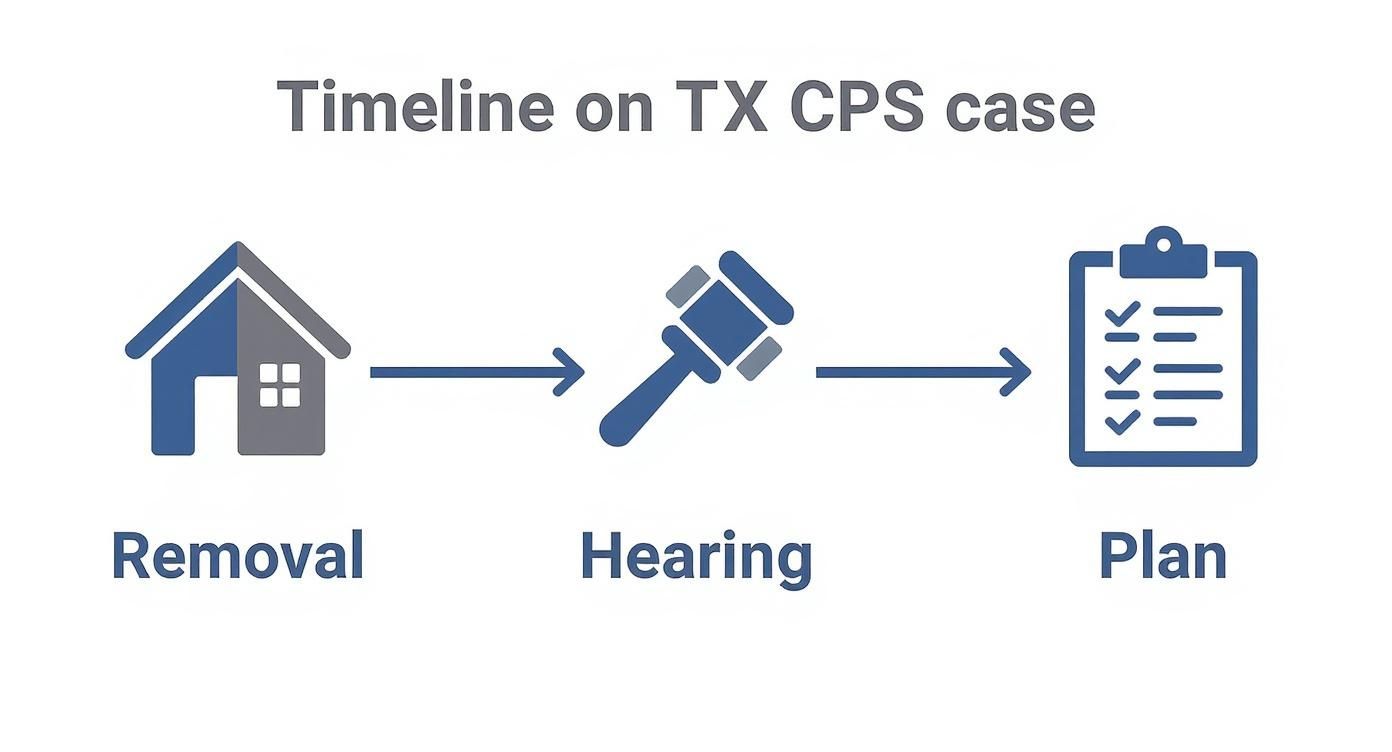
This timeline really drives home the urgency of these early stages and why engaging fully with your service plan right from the start is so critical for a successful defense.
Proving Termination Is Not in Your Child’s Best Interest
Ultimately, your defense has to center on the "best interest of the child" standard. Even if CPS manages to prove a legal ground for termination, you can still win by showing the judge that keeping your family together is what’s truly best for your child.
This is where you bring everything together—your service plan compliance, your witness testimony, and your own story. The goal is to paint a clear picture for the court: you are a loving, capable parent who provides emotional stability and security that no foster placement could ever replace. You are fighting to show that the bond you share with your child is worth preserving.
A Story of Hope: Fighting for Reunification
Consider the story of a father named Michael who lost his children after a perfect storm of job loss, depression, and a brief relapse into substance abuse. At first, things looked grim. CPS filed a petition for termination, and the odds felt completely stacked against him.
But Michael refused to give up. He immediately enrolled in a substance abuse program, found a steady job, and attended every single therapy session and parenting class on his service plan. He documented every step, giving his attorney a mountain of evidence that showed his progress. He also had his former boss and a counselor testify about his dedication and recovery.
At the final hearing, CPS argued for termination based on his past mistakes. But Michael’s attorney presented overwhelming proof of his transformation. He successfully showed that keeping his children with their loving, sober father was undeniably in their best interest. The judge agreed, and Michael’s family was reunited.
His story is a powerful reminder: no matter how tough the situation seems, the fight for your child is always, always worth it.
When it comes to the termination of parental rights in Texas, it's crucial to know that this can unfold in two very different ways: against a parent’s wishes (involuntary) or with a parent's agreement (voluntary). While both routes ultimately lead to the same irreversible outcome, the journeys to get there are worlds apart. Understanding the distinction is the first step in grasping your own situation and what’s at stake.
The overwhelming majority of CPS cases we handle involve involuntary termination. This is the scenario where the state has filed a lawsuit to sever your rights as a parent, and you find yourself in a legal battle to prevent that from happening. It’s the situation we've been breaking down throughout this guide—a courtroom fight where CPS carries the heavy burden of proving specific grounds for termination and convincing a judge it’s in your child's best interest.
What Is Voluntary Relinquishment?
On the flip side, there's voluntary termination, often called relinquishment. This is when a parent makes the conscious, willing decision to sign away their legal rights. It’s a profound and fairly uncommon choice, typically reserved for very specific, planned circumstances.
By far, the most common reason for a parent to voluntarily relinquish their rights is to make a private adoption possible.
Here’s a real-world example:
Picture a young mother who, after much soul-searching, decides she simply isn’t in a position to give her newborn the stable life the baby deserves. She might work with an adoption agency to carefully select a loving adoptive family. As a final step in that process, she’ll sign a legal document—an affidavit of relinquishment—that voluntarily ends her parental rights, clearing the path for the adoption to proceed. Her decision is intentional, made out of a desire to give her child a future she feels she cannot provide.
This Is a Final, Irreversible Decision
Whether the termination is voluntary or forced upon you, the court’s order is permanent and final. It’s a common myth that a parent can just sign away their rights to get out of paying child support. That simply isn't true.
A Texas judge will almost never sign off on a voluntary termination unless another person is ready and waiting to adopt the child at the same time. The court’s number one job is to make sure every child has the financial and emotional support of legal parents.
Even when you agree to it, the decision is irreversible. Once that judge’s signature is on the order, there’s no going back. You can't change your mind later. That’s why it is absolutely essential to speak with an attorney before you even consider signing a document that gives up your parental rights. You have to fully understand the lifelong legal and emotional weight of that choice.
If you’re facing the possibility of termination or just starting to consider your options, the stakes are far too high to go it alone. Contact The Law Office of Bryan Fagan for a free, confidential consultation. We’re here to offer the clear-headed, compassionate guidance you need to protect your family and your future.
The Fight for Your Family Is Worth It

After everything you've just read, the road ahead might still look incredibly steep. But it's so important to know that the child welfare landscape in Texas is changing, and that shift can be a real source of hope for your family. There's a growing movement toward preserving families instead of separating them, and it's being backed by actual reforms.
This isn't just empty talk; you can see it in the numbers. Recent data shows a massive evolution in how the state is handling these sensitive cases. In a truly remarkable trend, the Texas Department of Family and Protective Services (DFPS) removed 9,220 children from their homes in a recent year—a stunning 55% decrease from 2018.
Even with far fewer children being removed, Texas also saw a 53% drop in child deaths from abuse and neglect. To see more on this positive shift for yourself, you can review the data on Texas child welfare reforms.
Why This Shift Matters for Your Case
This changing perspective means that your fight to bring your family back together isn't a lost cause. In fact, it lines up perfectly with the modern goals of the very system you're navigating. The focus is slowly but surely moving toward giving families the support they need to stay together safely.
This reframes the whole story. You aren't just fighting an uphill battle against an all-powerful state; you are making an argument that is gaining more and more traction every single day. This empowers you to stand before a judge and argue, with passion and conviction, that keeping your family intact is what's truly best for your child.
Many judges are now more receptive than ever to hearing compelling cases for reunification. Your dedication to your service plan and your commitment to creating a safe home can make all the difference.
This is your opportunity to build a better future for your family, one grounded in love, stability, and a second chance. The fight for your family is absolutely worth it, and you don't have to walk this path alone.
At The Law Office of Bryan Fagan, we see the person behind the case file. We understand the fear and hope you're carrying, and we are here to help you fight for the future you and your children deserve. Contact us today for a free, confidential consultation to discuss your case.
We Get a Lot of Questions About Termination Cases
When you're staring down the possibility of losing your parental rights, your mind is probably a whirlwind of urgent, terrifying questions. The uncertainty is crushing, but getting clear, straightforward answers is the first step toward getting some control back. Here, we'll tackle some of the most pressing questions we hear from parents all across Texas.
Can I Get My Rights Back After They’ve Been Terminated?
This is one of the hardest questions to answer, because the truth is so final. A court order that terminates your parental rights is permanent. It is a complete and irreversible severing of the legal relationship between you and your child.
There are almost no situations where a termination order can be undone. The system is designed this way to create stability for the child, clearing the path for them to find a permanent new home, usually through adoption. Holding onto the idea that you can reverse it later is a dangerous myth that can stop you from fighting when you still have the power to change the outcome.
What Happens to My Child If My Rights Are Taken Away?
Once your rights are gone, the court will name a Permanent Managing Conservator for your child. This is often CPS, but it could also be a relative or another qualified adult who now has the legal authority to make all major decisions for your child.
From there, the ultimate goal is almost always adoption. Your child will be placed in a home where they can be legally adopted by new parents, giving them a new, legally recognized family. This is exactly why it is so critical to fight the state’s case with everything you have from the very beginning.
The state doesn't have to prove you're a "bad parent" in some vague, subjective sense. They must present clear and convincing evidence that you committed at least one of the specific acts listed in the Texas Family Code § 161.001 and that termination is in the child's best interest.
Does CPS Have to Prove I Am a Bad Parent?
This is a really common and important point of confusion. A termination case isn't a trial about your character or how much you love your child. The judge’s decision won't be based on a caseworker’s personal opinion of you.
Instead, the state has a very specific legal hurdle to clear. They have to prove two things: first, that you did something specific that the law defines as a ground for termination (like endangerment or neglect), and second, that severing your rights is truly what’s best for your child’s future. It’s all about meeting a strict legal standard, not passing some kind of subjective judgment.
The weight of these questions is immense, but you don't have to carry it by yourself. At The Law Office of Bryan Fagan, PLLC, we provide the compassionate guidance and aggressive legal defense you need to protect your family. If you are facing a CPS investigation or the threat of parental rights termination in Texas, contact us today for a free, confidential consultation. Let us help you fight for what matters most.