Skip to content
When a CPS investigator calls, most parents feel the same rush of fear. You start replaying every parenting decision, every argument with a co-parent, every text you wish you'd never sent. Then comes the next fear. What if someone lied? What if a witness twisted something ordinary into something dangerous?
That fear is real, and in Texas CPS cases, it can turn into a legal problem fast. A false witness statement can trigger interviews, home visits, safety plans, temporary restrictions, and court hearings before you've had time to understand what's happening. In some cases, the statement is completely fabricated. In others, it is more complicated. A real event gets stripped of context, exaggerated, or framed to make normal parenting look like abuse or neglect.
Parents often think the answer is simple. “I'll just tell CPS it's not true.” That instinct is understandable, but it usually isn't enough. CPS investigates risk. The agency is not there to sort out family drama on your timetable. If you want to know how to handle false witness statements in CPS cases, the answer is rarely louder denial. It is calm, organized, evidence-based rebuttal.
A common example looks like this. A child misses school after a fever. The other parent tells CPS that the child is “regularly left untreated” and “kept home in unsafe conditions.” The missed school day happened. The accusation about medical neglect did not. If you respond with a blanket denial, you may sound evasive. If you respond with the school absence notice, pediatrician instructions, pharmacy receipt, text messages about the child's symptoms, and the child's return to school, you give the investigator something much harder to ignore.
That's the difference between panic and strategy. It's also where experienced legal help matters. Texas Family Code Chapters 262, 263, and 161 can become relevant quickly when CPS opens a case, seeks court involvement, or begins pushing for long-term orders that affect conservatorship, possession, or even termination risks in severe cases. Early decisions matter.
Your First Response to a False Allegation
The first job is simple. Don't make the situation worse in the first day.
If you've just learned that someone made a false statement to CPS, you're probably angry, confused, and tempted to call the accuser immediately. Don't. In my experience, some of the hardest cases start with a false report and then become harder because the accused parent sends one emotional text, shows up at the accuser's home, or starts posting online.

What to do in the first 24 hours
Start with restraint.
- Stay polite with CPS: If an investigator contacts you, be respectful. Hostility helps no one.
- Say less, not more: You don't need to solve the case in one phone call.
- Stop direct conflict: Don't contact the accuser to demand a retraction.
- Preserve everything: Don't delete texts, emails, call logs, photos, voicemails, or social media messages.
- Follow current court orders: If there is an existing custody or possession order, keep following it unless the court says otherwise.
Practical rule: Your first response should protect your credibility, not satisfy your urge to defend yourself immediately.
Texas procedure gives these early hours real weight. Under Texas CPS procedures, the investigation is generally expected to be completed within 45 days, with a possible 45-day extension for good cause, according to the Texas DFPS CPS handbook. That means the evidence preserved right away can shape the investigator's first and most important impression.
What not to do with the investigator
Many parents swing between two bad options. One is refusing everything and sounding combative. The other is talking nonstop because they believe innocence will naturally come through. Neither is ideal.
A better approach is controlled cooperation. You can be courteous while protecting yourself. If you're unsure how to handle that first conversation, review guidance on what to say and not say to CPS investigators.
Here is the practical difference:
| Response style | Likely effect |
|---|---|
| Emotional denial with accusations against others | Can make you look reactive and unfocused |
| Long explanations without documents | Gives room for misunderstandings |
| Calm, limited response plus preserved evidence | Creates a record that can be verified |
Your immediate objective
Your objective isn't to “win” the first contact. It's to slow the situation down enough to build a defensible record.
Write down a timeline while events are fresh. Note the date you learned about the allegation, who contacted you, what was said, and what documents already exist. Save screenshots in more than one place. If there are witnesses who observed the underlying event, list their names and contact information now, before memories start shifting.
That kind of disciplined beginning often makes the difference between a messy credibility fight and a structured defense.
Building Your Shield of Truth with Evidence
A false statement becomes dangerous when it stays unchallenged by documents. The strongest rebuttal is usually not your denial. It's source triangulation, meaning multiple independent records pointing to the same reality.
Texas defense guidance consistently emphasizes collecting evidence from witnesses, doctors, schools, and third-party records because independent sources carry more weight than an accused parent's account alone. That practical approach is discussed in this overview of false CPS allegations and corroborating records in Texas.
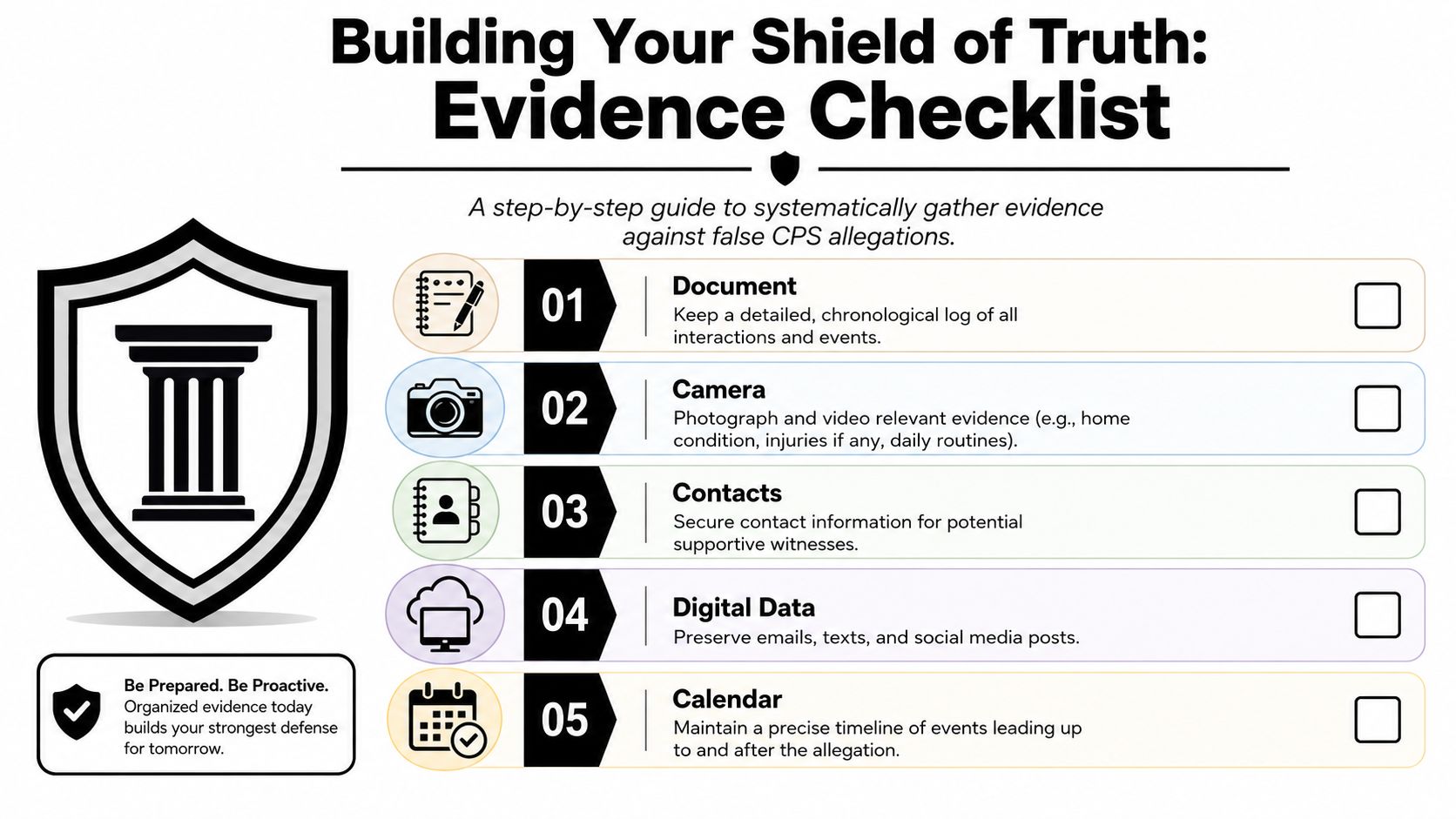
Build a rebuttal file, not a random pile of papers
Parents often gather evidence in a panic. Screenshots land in one phone folder. School notes sit in the kitchen drawer. A pediatrician visit summary stays buried in an online portal. That approach wastes good evidence.
Instead, create a simple rebuttal file organized by allegation.
- Texts and emails: Save the full thread, not just one message. Context matters.
- School records: Attendance logs, nurse visits, behavior reports, pickup records, and teacher emails often tell a cleaner story than family testimony.
- Medical records: Pediatric notes, discharge instructions, medication records, and appointment confirmations can directly challenge claims of neglect or injury.
- Photos and videos: Time-stamped media can show home conditions, the child's appearance, or ordinary routines.
- Timeline notes: Write events in order, with dates, times, and who was present.
A practical guide to creating that record is available here: how to document your case to protect yourself from CPS.
Why independent records matter more
Investigators are trained to look for corroboration. If a parent says, “My child was never left alone,” that statement helps only a little by itself. If daycare sign-out records, a neighbor's doorbell footage, and timestamped work messages all line up with your account, the case changes.
This video gives a useful overview of the documentation mindset parents need in CPS cases.
Independent records often do the talking that frightened parents cannot do clearly under pressure.
A practical example
Suppose a witness says your home was filthy and your child had no food. Your rebuttal should come from several directions at once.
- Recent photos of the kitchen and child's bedroom.
- Grocery receipts from the days around the allegation.
- A school record showing the child arrived clean and prepared.
- A pediatric record showing no hygiene or nutrition concerns.
- A neutral witness account from someone who had recent access to the home.
That is how to handle false witness statements in CPS cases effectively. You don't fight one statement with one denial. You surround it with verifiable facts.
Understanding Nuances of False Statements
Not every false statement is a pure invention. Some of the hardest CPS cases involve allegations that are partly true but strategically framed.
That's where many parents make a critical mistake. They deny everything. Then CPS uncovers the small true part, and the parent's credibility takes a hit that could have been avoided. A better strategy is to separate the accurate detail from the distortion.

One reason this matters so much is that false or unsubstantiated reports are not unusual. One policy analysis estimates that about 3.1 million children are investigated for abuse each year in the United States and that nearly four-fifths of those allegations are false, as discussed in the National Coalition for Child Protection Reform analysis of false allegations. That doesn't make your case less serious. It does mean you are not alone, and a careful defense is necessary from the start.
The problem with blanket denials
Consider a parent who grabbed a child's arm during a dangerous tantrum to stop the child from running into a parking lot. A hostile witness reports that the parent “violently yanked the child and left bruises.” The event happened. The risk-filled accusation is the framing.
If the parent says, “That never happened,” the response is vulnerable. If the parent says, “I stopped my child from running into traffic, there was no abuse, here are same-day photos, pediatric follow-up records, and messages sent immediately afterward describing the incident,” the response sounds truthful because it is precise.
How to dissect a strategically framed accusation
Use this method:
| Part of the allegation | Better response |
|---|---|
| The true detail | Acknowledge it plainly |
| The exaggerated conclusion | Challenge it with records |
| The missing context | Add time, place, and safety reasons |
| The implied pattern | Rebut with routine records over time |
The strongest defense to a half-truth is not over-denial. It is accurate context backed by documents.
A relatable scenario
A mother leaves her child with a grandparent while she works late. An accusing witness reports that she “abandons the child overnight with unstable caregivers.” The child was with a grandparent. That's the true kernel. The rest may be spin.
A disciplined response might include the grandparent's routine caregiving role, text confirmations about pickup, school attendance the next morning, the child's normal medical and educational records, and any standing custody arrangement that shows shared care is common. The issue is no longer “Did the child stay elsewhere?” The issue becomes whether the accusation accurately describes danger.
That shift matters in CPS cases. CPS may still act on partial corroboration if the broader claim sounds risky. Parents need a rebuttal that is honest enough to stay credible and strong enough to dismantle the manipulation.
Navigating the Formal CPS Investigation
Once CPS opens an investigation, the process starts to feel more official very quickly. A caseworker may want interviews with the child, the parents, and any alleged perpetrator. A home visit is common. The investigator may also request medical, school, or counseling information.
Under Texas procedure, CPS investigators are expected to interview alleged victims, parents, and perpetrators, conduct a home visit, and gather relevant documentation during the investigation process. If the agency decides court intervention is necessary, Texas Family Code Chapter 262 can come into play quickly through emergency removal or requests for temporary orders. Later case management and deadlines often fall under Chapter 263, and in the most serious cases, Chapter 161 governs termination issues.
What the investigator is doing
The investigator is not deciding whether you are a good person. The investigator is collecting facts and assessing safety.
That distinction matters because many parents answer questions as if they are trying to repair a personal misunderstanding. They start speculating about motives, venting about the other parent, or trying to persuade the caseworker emotionally. Usually, that does not help.
A better framework is this:
- Answer carefully: Give truthful, concise information.
- Provide documents deliberately: Organized records are more useful than verbal protests.
- Track every contact: Keep notes about calls, visits, and requests.
- Use counsel as a buffer: Your lawyer can help manage timing, records, and presentation.
For a broader look at what this process typically involves, see this overview of the Texas CPS investigation process.
Where counsel changes the dynamic
In contested cases, a lawyer does more than “show up in court.” Counsel helps control the flow of information so your defense is coherent instead of reactive. That can include reviewing CPS paperwork, identifying holes in the allegation, organizing rebuttal exhibits, and preparing you for interviews or hearings tied to Chapter 262 proceedings.
If you need direct representation in a CPS-related matter, Law Office of Bryan Fagan PLLC is one Texas option that advises parents on responding to CPS investigations and reviewing case materials in light of family-law consequences.
When a parent speaks alone, CPS hears one voice under stress. When a parent speaks through a prepared legal strategy, CPS receives a documented position.
What works and what doesn't
What works is disciplined cooperation. Let the investigator see that the child is safe, the home is stable, and your records are organized. What doesn't work is trying to outtalk the allegation.
If the caseworker asks for information, ask what issue they are evaluating. If they ask about a specific date, answer that date. If they want a home visit, prepare the home and be calm. If they ask about a witness statement that twists a real event, don't rush into indignation. Give the accurate sequence and the records that support it.
That approach keeps you from handing the investigation more confusion than it already has.
Wielding Legal Tools in Court Hearings
When CPS files a case or seeks court orders, the focus shifts. The question is no longer just what was reported. The question becomes what can be proven, challenged, excluded, or exposed in a courtroom.
The atmosphere is often less chaotic than parents expect. Court is structured. People testify under oath. Documents have to be introduced properly. Judges watch for consistency. That structure can help a prepared parent because false witness statements tend to weaken when details matter.
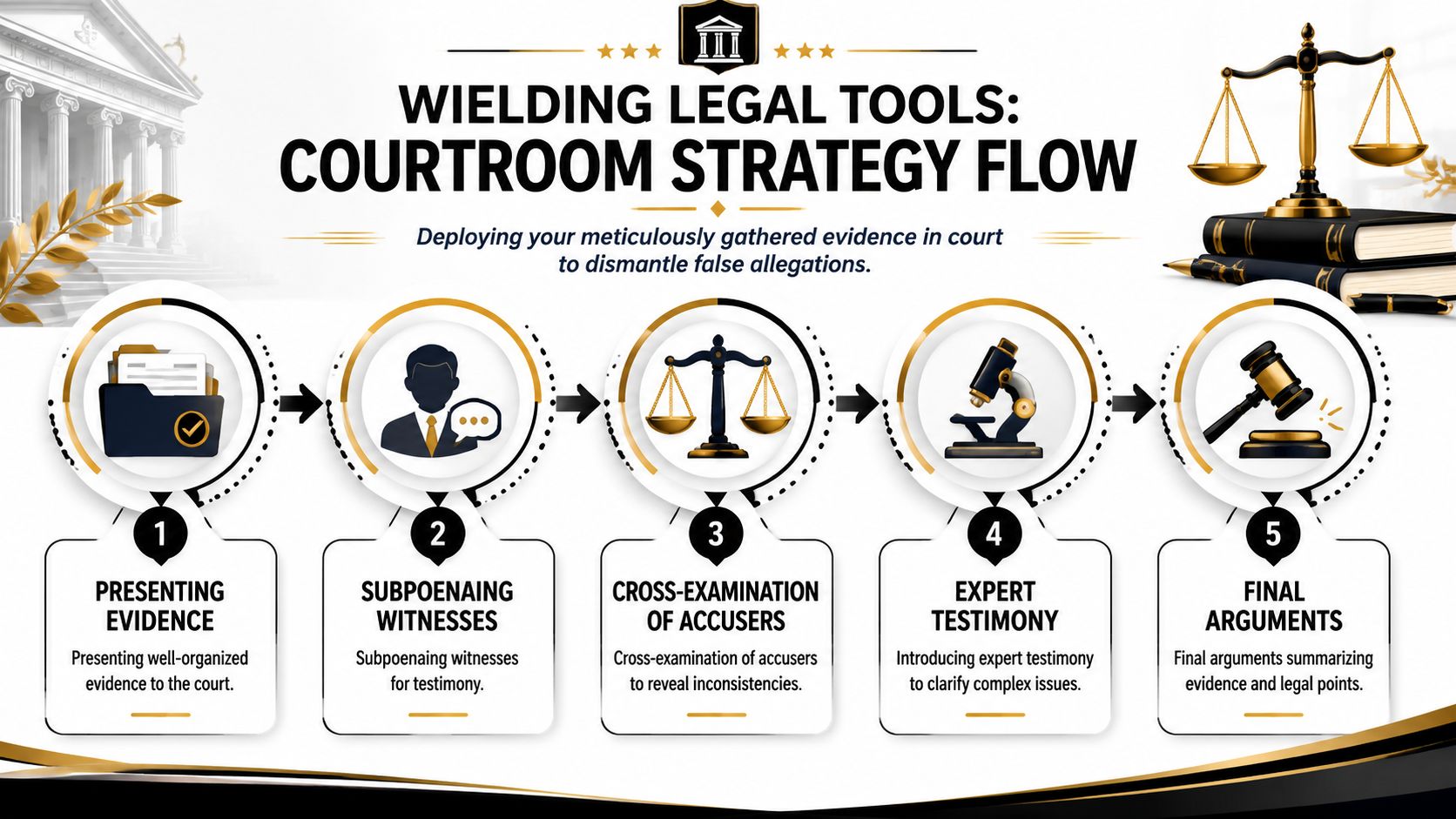
How a false statement gets dismantled
Take a familiar scenario. A witness tells CPS and later tells the court that a father “never takes the child to school” and “routinely leaves the child unsupervised.” In court, that statement sounds powerful until the records come in.
The attorney may use discovery to obtain the agency's file, interview summaries, and any prior statements made by the witness. Then comes comparison. Did the witness give the same account every time? Did text messages from that witness say something different earlier? Did school attendance logs show the father handled drop-off repeatedly? Did neighborhood camera footage place the child with a caregiver during the time the witness claimed the child was alone?
That is where prior inconsistent statements matter. A witness who said one thing by text and another thing on the stand has a credibility problem.
Useful courtroom tools
| Legal tool | Why it matters in a false-statement case |
|---|---|
| Discovery | Lets your lawyer obtain CPS records and other evidence |
| Subpoenas | Bring in school, medical, or witness records |
| Motions in limine | Ask the court to exclude improper or unfairly prejudicial material |
| Cross-examination | Tests memory, bias, motive, and inconsistency |
| Expert testimony | Can clarify injury, discipline, mental health, or investigative issues |
What cross-examination often reveals
A skilled cross-examination rarely looks dramatic. It looks controlled.
An attorney may walk the witness through exact dates, prior texts, missing details, and what the witness did not personally observe. If the witness relied on assumptions, repeated gossip, or omitted key context, that usually comes out in careful questioning. If the allegation was strategically framed, cross-examination can separate observation from interpretation.
A courtroom is one of the few places where a false story has to stay consistent under pressure.
The documents you gathered earlier become the backbone of that effort. The school record that seemed ordinary, the message thread you almost deleted, the doctor's note you downloaded because you were scared. Those are often the exhibits that restore perspective when testimony goes too far.
After the Case Seeking Justice and Future Protection
A good outcome in the CPS case is a major relief. It is not always the end of the problem.
Families often leave the process with two separate concerns. First, what does the case closure mean for future background issues, custody disputes, or agency records? Second, what can be done if someone knowingly made a false report?
What closure does and does not fix
Texas CPS findings can include outcomes such as Reason to Believe, Unable to Determine, or Ruled Out. Those labels matter because they affect how the agency categorizes the allegation, but they don't always repair the damage done to your reputation, co-parenting relationship, or child's sense of stability.
This is especially true when the original report was built from a strategically framed narrative. Even after the core allegation falls apart, the emotional residue can remain. In custody-related cases, that may require revisiting conservatorship terms, exchange procedures, communication limits, or other family-court protections.
Future protection in family court
When false statements arise in the middle of a custody dispute, one practical remedy may be to seek stronger structure in the court orders. Depending on the facts, that could include clearer communication rules, exchange protocols, or provisions that reduce opportunities for repeated manipulation.
Texas Family Code Chapters 262 and 263 often define the CPS side of the process, but the long-term family-law consequences frequently play out through modified possession, conservatorship, and compliance expectations. The right post-case strategy depends on how the allegation was used and whether the behavior is likely to continue.
A useful post-case checklist includes:
- Keep your evidence archive: Don't discard records just because the immediate crisis passed.
- Review existing orders: See whether vague language in a parenting order made the conflict easier to exploit.
- Document future incidents: If the same person makes new claims, pattern evidence may become important.
- Ask about record-related remedies: In some cases, sealing or related relief may be worth discussing with counsel.
Holding a false reporter accountable
Texas treats knowingly false child-abuse reports seriously. As summarized in this discussion of knowingly false CPS reports and Texas consequences, making a knowingly false report can be a state jail felony, and the person may also face civil liability for damages.
That does not mean every bad or mistaken report will be prosecuted. Proving that someone knowingly lied is different from proving they were wrong. But when there is clear evidence of intentional fabrication, accountability can become part of the strategy.
For many parents, that possibility matters emotionally as much as legally. They want the system to recognize that this was not a misunderstanding. It was harm. A thoughtful lawyer can help you weigh whether pursuing that issue will protect your family or only extend conflict. Sometimes the best next step is aggressive accountability. Sometimes it is securing stronger future orders and moving forward from a position of documented strength.
If you're dealing with false witness statements in a Texas CPS case, you don't need to guess your way through it. A calm, organized response can protect your rights, your credibility, and your relationship with your child. The attorneys at Law Office of Bryan Fagan PLLC help Texas parents respond to CPS investigations, challenge false allegations, and prepare for hearings with a practical, evidence-based strategy. Contact the firm for a free consultation and get clear guidance on what to do next.