Skip to content
A CPS case rarely begins at a calm moment. It starts with a phone call, a home visit, a school report, or a sudden removal that leaves you trying to answer questions while your mind is racing. Most parents I speak with aren't asking for a legal theory. They're asking a much harder question: Do I cooperate and try to resolve this, or do I fight?
That choice feels personal, but it is also highly strategic. In Texas, CPS cases move fast, the court calendar matters, and early decisions can affect reunification, placement, services, and even whether the case grows into a termination fight. The right answer isn't always the loudest one. Sometimes fighting is necessary. Sometimes settlement protects your family better. Sometimes the smartest move is a limited agreement that gives away far less than parents fear.
The Knock at the Door Your Toughest Decision
A parent opens the door expecting a package or a neighbor, and instead finds a CPS investigator standing there. The investigator says there's been a report. Maybe it's about supervision. Maybe it's about the condition of the home. Maybe it's tied to a breakup, a school absence, or something a doctor noted during a visit. In that instant, everything changes.
Most parents feel two impulses at once. One is to explain everything immediately and hope the problem goes away. The other is to slam on the brakes and resist every request because the whole thing feels unfair. Both reactions are human. Neither one, by itself, is a strategy.
What makes this harder is the emotional pressure. You may be losing sleep, replaying every conversation, and trying to guess what CPS will do next. If your thoughts are spiraling, a resource on coping with overthinking and anxiety may help you steady yourself enough to make decisions with a clearer head.
This is not a moral test
Parents often frame the choice as if settling means weakness and fighting means courage. That is the wrong lens. In a CPS case, the better question is this: Which path gives your family the strongest position under the facts, the timeline, and the judge you may face?
A mother may agree to short-term services because she knows her child needs to come home quickly and the allegations are limited. Another parent may refuse any agreement because the accusations are false and a stipulation would create a record that follows the family later. Both can be making responsible choices.
Practical rule: The best decision is the one that protects your child, your legal position, and your long-term parental rights at the same time.
Fear is normal. Delay is dangerous.
Once CPS is involved, time starts working whether you're ready or not. Caseworkers keep moving. Supervisors keep reviewing. Courts keep setting hearings. If you wait too long to gather records, identify witnesses, or get legal advice, you can lose opportunities that are hard to recover later.
The goal isn't to panic. It's to act on purpose.
Understanding the Two Paths Settlement vs Litigation
When parents ask about when to settle vs. fight a CPS case in court, they usually need translation first. In Texas, those two paths don't always look like what people expect.
What settlement usually means in a CPS case
A settlement doesn't always mean admitting every allegation. It often means reaching some kind of agreement about what happens next. That may involve a Safety Plan, a Service Plan, temporary placement with a relative, an agreed order, or a limited stipulation on a narrow issue.
Texas practice matters here. Cases often begin under Chapter 262 when removal or emergency court involvement is at issue. Then the case moves through review and permanency stages governed largely by Chapter 263. If CPS later seeks to end the legal relationship entirely, Chapter 161 becomes central because that chapter governs termination grounds and the final legal consequences.
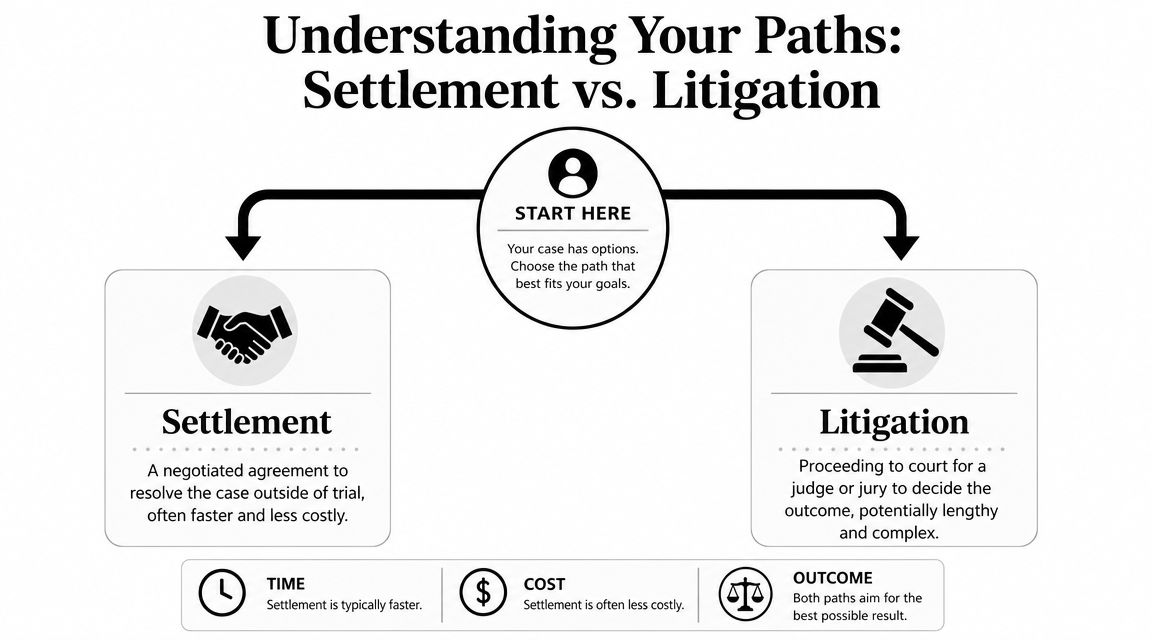
A negotiated resolution can happen early or late. In some cases, parents use CPS mediation in Texas to narrow disputes, resolve placement questions, or define service obligations before a final trial becomes necessary.
What fighting usually means
Litigation means forcing CPS to prove what it claims in a formal setting. That can happen at an adversary hearing, review hearing, permanency hearing, or trial. It may involve testimony, documentary evidence, objections, cross-examination, and legal challenges to the agency's position.
One legal reality surprises many parents. In contested CPS matters, the judge, not CPS, makes the final decision, but only on the issues and evidence presented in court, as explained in this discussion of who has more power over a CPS case. That means CPS often shapes the case before the hearing ever starts by deciding what concerns to emphasize, what paperwork to file, and what services to push.
If you want the court to protect you, you have to give the court something usable: evidence, witnesses, records, and a clear challenge to the agency's claims.
Why burden of proof matters
Parents often assume CPS has to prove everything immediately. That isn't how these cases work. The proof needed to keep a case moving forward at an early stage is different from the proof needed to win a final termination case. That's why a parent may feel like CPS is "getting away with it" early on, even though the agency would face a much steeper burden at final trial.
This distinction drives strategy. If CPS has enough to keep pressure on you but not enough to win the whole case, a careful settlement may protect more than a broad fight. If the allegations are weak across the board, litigation may be the right way to expose that weakness.
A Side-by-Side Comparison of Your Options
Parents don't need slogans here. They need a plain comparison of what each path tends to involve.
| Issue | Settlement | Litigation |
|---|---|---|
| Speed | Often moves faster if both sides can agree on services, placement, or return conditions | Usually slower because hearings, evidence disputes, and court scheduling drive the pace |
| Control | Parents may keep more influence over specific terms if they negotiate carefully | The judge decides disputed issues after hearing evidence |
| Risk | You may accept obligations or language you don't fully like | You may lose outright on a contested issue and face stricter orders |
| Evidence pressure | Less formal, but paperwork still matters | Stronger opportunity to challenge weak claims through testimony and objection |
| Family disruption | May reduce repeated court conflict if the agreement is narrow and realistic | Can increase strain on work, housing, co-parenting, and mental health |
| Long-term record concerns | Depends heavily on what exactly you agree to | A contested loss can create damaging findings, but a win may clear the way for stronger defense later |

Timeline and control
In child welfare cases, timing isn't a side issue. It is the structure of the whole dispute. After a child is removed, a temporary custody hearing must happen quickly, and many jurisdictions then hold review hearings every 4 to 10 months depending on the case, which is why early evidence gathering can materially affect outcomes, as noted in this discussion of CPS court timelines and federal child welfare volume. That same source also notes that in 2022, agencies received about 4.4 million referrals involving roughly 7.5 million children, and about 558,000 children were confirmed as victims of abuse or neglect.
In practice, settlement can give a parent some control over the pace if CPS is willing to resolve issues in exchange for services or monitored return conditions. Litigation gives less control over timing because the court's calendar, witness availability, and procedural fights can stretch the case.
Critical difference: Settlement may let you shape the road. Litigation may be necessary when the only acceptable result requires the judge to stop CPS from overreaching.
Evidence and proof
If you settle, your evidence still matters. It helps you negotiate narrower terms, shorter service expectations, and safer language in an agreed order. But if you fight, evidence becomes the center of everything.
That means gathering:
- School records that explain absences or performance concerns
- Medical records showing treatment, follow-up, or lack of injury
- Housing documents that confirm stable residence or repairs
- Text messages and emails that put the allegations in context
- Witnesses such as relatives, neighbors, teachers, or providers
Parents who have never been to court often benefit from understanding basic hearing mechanics. A plain-language guide to what happens at a pretrial hearing can help you picture why preparation matters before the judge ever hears the full case.
Cost and collateral strain
Even when CPS cases don't involve private experts or a full trial, litigation carries a price. Time off work, transportation to services, repeated court appearances, and conflict with the other parent can all become part of the cost.
Settlement can lower some of that pressure, but only if the agreement is realistic. A bad settlement is one you can't complete. A service plan that looks manageable on paper can become dangerous if your work schedule, childcare, or housing situation makes compliance nearly impossible.
Outcome range
A faster agreement may help a child come home sooner. It may also avoid turning a manageable case into a broader one.
A court fight offers something settlement often cannot: the chance to force CPS to prove its allegations in public, on the record, under the rules. But that benefit comes with the possibility that the judge accepts CPS's version and enters orders that are harder to unwind.
When Settling Makes Strategic Sense
Parents sometimes hear the word "settle" and think, "So I'm supposed to surrender." That's not what a good CPS settlement is. A good settlement is a controlled agreement designed to limit damage, define obligations, and move your family toward the next stable step.
Cases where settlement can protect more than it gives up
Settlement often makes sense when the main problem is fixable and the agency's concerns can be addressed without conceding broad wrongdoing. A missed doctor's appointment, school attendance issues during a housing crisis, unsafe people who are no longer in the home, or a temporary mental health struggle can all fit into this category.
It also makes sense when the collateral damage of fighting is too high. If you are trying to keep your job, preserve housing, avoid inflaming a divorce or custody dispute, or keep a relative placement stable, a narrow agreement may prevent the case from snowballing. As Michigan Legal Help's discussion of CPS and families explains, the parallel strain from housing, employment, family-law conflict, and mental-health instability can make a broad court battle more damaging than helpful, especially when a targeted settlement can support relative placement or monitored reunification.
Sometimes the strongest move is not "winning the argument." It is removing the conditions that let CPS keep control of your life.
What a smart settlement looks like
A useful settlement is specific. It should answer hard questions before you sign:
- What exactly are you agreeing to? Vague language creates future trouble.
- How long does it last? Open-ended obligations invite more conflict.
- What happens after compliance? There should be a path to return, closure, or reduced restrictions.
- Does it create findings you can avoid? The wording matters.
- Can you realistically complete it? If not, it is a trap, not a solution.
A parent might agree to counseling, home visits, and a sober support plan without agreeing to exaggerated allegations. Another might agree to a temporary relative placement while the home is stabilized, then push for a written return schedule tied to concrete steps rather than the caseworker's discretion.
Settlement works best when it is narrow
The biggest mistake parents make is agreeing too broadly because they want immediate peace. The better approach is to solve the actual concern and nothing more. If CPS says the problem is supervision, the agreement should focus on supervision. It should not encompass mental health, substance use, and parenting deficiencies unless there is a real basis for those issues.
When Fighting in Court Is Your Only Option
Some cases should not be settled just to make the stress stop. If the allegations are false, the agency is stretching weak facts into something far more serious, or termination is on the table without a solid evidentiary foundation, you may need to fight.

Situations that usually require a stronger court posture
A contested approach becomes much more important in cases like these:
- False allegations from a motivated reporter such as an angry ex, relative, or neighbor
- Thin evidence where CPS is relying on assumptions, hearsay, or incomplete records
- Procedural problems involving removal, notice, interviews, or unsupported safety claims
- Termination exposure under Chapter 161, where the stakes are permanent and life-changing
- Overbroad service demands that don't match the actual allegations
A parent in this position often needs to object early, preserve documents immediately, and refuse to let the agency define the case without challenge.
Speed matters more than outrage
In emergency removal situations, legal timing can compress your options fast. The ACLU of Southern California notes that in California, after an emergency removal, CPS must file a petition within two court days, and the court must hold a hearing by the end of the next day after filing, which is why rapid evidence development matters so much in these cases, even though that example comes from another state system in this explanation of child welfare investigation timelines. The lesson applies broadly: parents who wait to gather records, line up witnesses, or get counsel often lose critical ground before the first meaningful hearing.
If your case appears headed for a serious contested hearing, it also helps to understand procedural options such as a jury trial versus bench trial in Texas CPS litigation.
A short explanation may help as you think about how contested hearings unfold:
Fighting means building, not just denying
Parents sometimes think fighting means saying, "That didn't happen." In court, that is not enough. You need records, witness testimony, contradictions in CPS notes, proof of safe housing, proof of sobriety if relevant, proof of treatment if relevant, and a lawyer willing to force precision.
The parent who fights effectively is the parent who turns facts into evidence before the hearing date arrives.
If your position is strong, litigation can expose weakness in the agency's case. If your position is weak, fighting without preparation can make things worse. That is why the decision must be tactical, not emotional.
Real-Life Scenario The Garcia Family Dilemma
Ms. Garcia is a single mother in Texas. Her teenager has missed school during a rough stretch after a move, and the apartment looks cluttered during an unannounced visit. A report comes in for neglectful supervision and home conditions. CPS opens an investigation and starts pressing for services.
Ms. Garcia feels insulted. She works hard, her child is fed, and there is no abuse. Her first instinct is to reject everything and demand court. But her lawyer slows the conversation down and asks better questions.
What actually needs to be proved
The lawyer looks at the evidence first, not the emotion. Are there photographs? School attendance records? Medical concerns? Statements from the child? Has CPS overread a temporary crisis as chronic neglect?
The answer is mixed. CPS has enough to keep pressure on the family, but not a clean, simple case. The apartment disorder was real, but temporary. The school absences have an explanation. There are no injury allegations. There is no drug allegation. There is a grandmother available to help with after-school care.
The strategic middle ground
Texas guidance notes that the first hearing can happen within 14 days of removal, and the decision about appointed counsel may not be immediate, which means parents often face early settlement pressure under severe time constraints, as explained by Texas Law Help's discussion of a parent's right to a lawyer in CPS matters. In a case like Ms. Garcia's, waiting for a perfect moment can be a mistake.
So the lawyer doesn't recommend blind surrender or dramatic escalation. Instead, the strategy is a limited resolution. Ms. Garcia agrees to a short, defined set of services tied to attendance and household stability. Her attorney pushes back on broader language suggesting abuse or long-term neglect. The agreement includes clear expectations, preserves her ability to contest overstatements, and keeps the case from growing into something larger.
That result doesn't feel like a courtroom victory speech. It feels better than that. It gets the family breathing room, keeps the child at home, and prevents a weak case from turning into a stronger one through conflict and missed compliance.
Your Decision Checklist and When to Hire an Attorney
No parent should make this call by instinct alone. Before you decide whether to settle or fight, stop and work through the facts in writing.
Questions to ask immediately
- What is CPS alleging? Ask for specifics, not summaries.
- What proof does CPS claim to have? Reports, photos, statements, medical records, school records.
- What can you prove quickly? Safe housing, clean testing, counseling, childcare help, family support.
- What happens if you sign? Look at every service, every deadline, and every phrase.
- What happens if you refuse? Think through the next hearing, not just today's frustration.
- What other parts of your life could this affect? Work, lease renewals, divorce, custody, relatives, treatment.

Hire a lawyer early, not later
If CPS has contacted you, asked for a meeting, proposed a safety plan, threatened removal, filed a case, or set a hearing, the time to speak with counsel is now. Early choices shape the record that follows you.
Parents looking for a Texas CPS lawyer should ask practical questions: Who will review the allegations? Who will appear in court? How will they challenge overbroad service demands? How quickly can they start gathering records and preparing for the next hearing?
The Law Office of Bryan Fagan PLLC handles Texas CPS defense matters, including investigations, hearings, and contested court proceedings. Legal representation can't erase the stress of the process, but it can help you make decisions that protect your family instead of reacting under pressure.
If you're facing CPS involvement and you're trying to decide whether settlement or litigation gives your family the better path, speak with Law Office of Bryan Fagan PLLC for a free consultation. A careful review of the allegations, the hearing timeline, and the practical risks can make the difference between reacting in fear and moving forward with a plan.