Skip to content
Your phone rings, and the caller says they're with CPS. Or there's a knock at the door, and a caseworker is standing on your porch with a clipboard and questions. In that moment, most parents don't think clearly. They think about losing their child, saying the wrong thing, or being judged before anyone knows the full story.
That fear is real. So is the confusion.
But panic is not a plan. If you're trying to figure out how to document your case to protect yourself from CPS, the first step is simple. Start building a record grounded in facts, dates, and proof. A careful record won't solve everything by itself, but it gives your lawyer something solid to work with, and it can help you push back against assumptions, misunderstandings, and incomplete allegations.
A lot of families are touched by CPS investigations. An estimated 37% of U.S. children experience a CPS investigation before age 18, according to research indexed by PubMed Central. That same research notes that investigation rates are not evenly distributed across racial groups. This is one reason documentation matters so much. It helps preserve the facts while events are still fresh.
In Texas cases, I tell parents to think of documentation in two parts. First, preserve evidence. Second, use that evidence strategically. A stack of papers in a kitchen drawer is not strategy. A clear timeline that answers each allegation is.
That Knock at the Door Your First Response to CPS
A common scene goes like this. It's late afternoon. You're tired, the house isn't perfect, your child is in the next room, and someone knocks. A caseworker introduces herself, says a report was made, and asks if she can come in and talk. Your stomach drops.

Parents often make one of two mistakes right there. They either start talking too much because they're scared, or they freeze and say almost nothing because they're scared. Neither response gives you control.
Control starts with slowing the moment down.
What to do in the first few minutes
Write down or immediately save these basics:
- The caseworker's full name: Ask for the correct spelling.
- Agency details: Confirm the office, phone number, and email.
- Date and time of contact: Use your phone and note it right away.
- What the worker said the case involves: Keep it factual, even if the allegation sounds absurd.
- Any requests made of you: Home visit, interview, releases, records, drug testing, safety plan, or follow-up meeting.
Practical rule: Your first job is not to persuade. Your first job is to preserve the facts of the contact.
If your child was present, note that too. If another adult heard the exchange, write down their name. If the worker left a card, take a photo of it before it gets lost.
A better frame of mind
You cannot control whether CPS investigates. You can control whether the record starts with confusion or clarity.
That's why I want parents to treat the first contact as the beginning of a case file, not just a stressful interruption. A parent who calmly records names, times, requests, and responses is already doing something important. That parent is creating a paper trail that can later support counsel, rebut a distorted account, and show steady judgment under pressure.
If you need immediate guidance on the first interaction itself, read how to respond when CPS shows up at your door in Texas.
The Core Evidence What to Start Documenting Immediately
Once CPS is involved, become your family's historian. Memory fades fast. Details blur. The strongest file is built early.
Start with the evidence that captures daily reality, not just your reaction to the allegation.
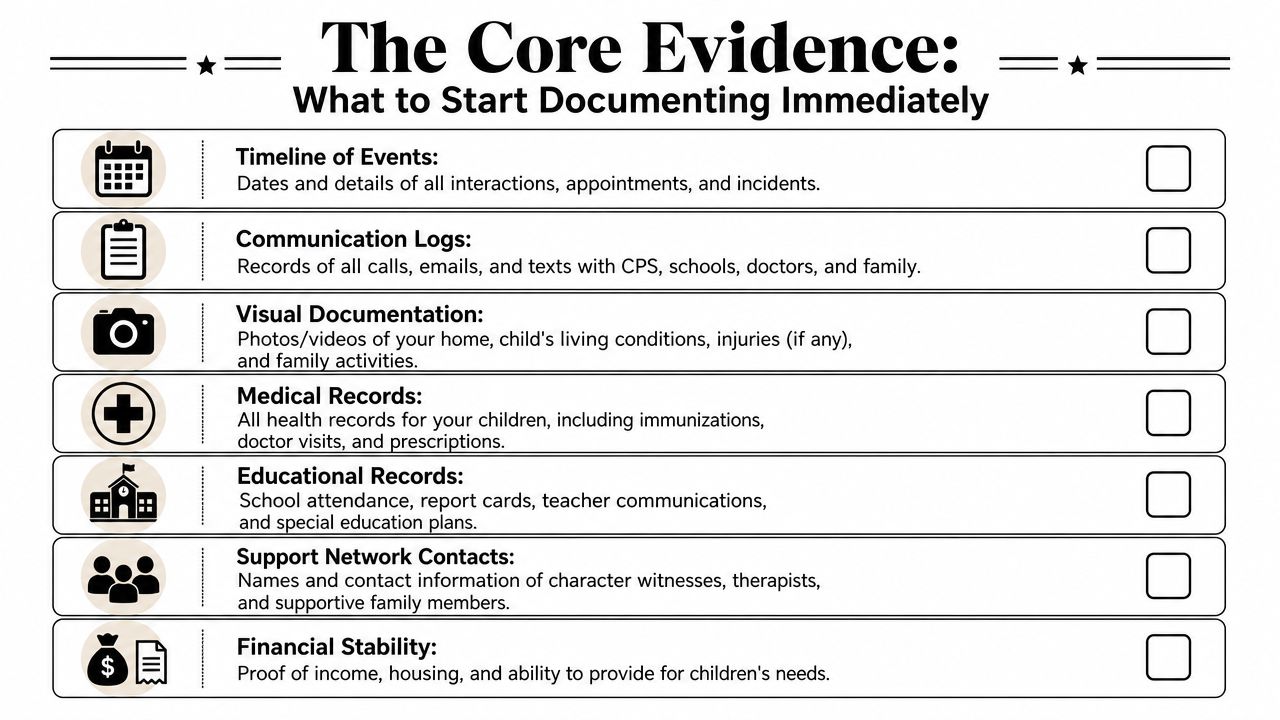
Your first evidence sweep
Gather and preserve these categories first:
- Communication records: Save every text, email, voicemail, letter, and portal message involving CPS, teachers, doctors, counselors, daycare staff, and the other parent if relevant.
- Home condition photos: Take clear, time-stamped photos of bedrooms, kitchen, bathroom, pantry, refrigerator, medication storage, and sleeping arrangements.
- Medical records: Collect immunization records, visit summaries, prescription information, discharge paperwork, and therapy records if applicable.
- School records: Save attendance, report cards, behavior notes, special education documents, and teacher communications.
- Stability records: Keep proof of employment, pay stubs, lease or mortgage records, utility bills, childcare arrangements, and transportation records.
- Child routine evidence: Preserve calendars, appointment confirmations, sign-in sheets, extracurricular schedules, and meal or medication logs if those matter in your case.
- Support contacts: List relatives, neighbors, coaches, therapists, clergy, or family friends who have direct knowledge of your parenting.
Texas guidance also supports keeping key records and preserving your own materials. Texas DFPS advises parents to preserve recordings for their own records and keep copies of what they submit, as discussed in its guide for parents during an investigation.
A short video can help you think through what evidence matters most in practice:
What parents often forget
The most useful documents are not always dramatic. They are often ordinary.
A parent accused of neglect may help their case with school attendance records, pharmacy receipts, a pediatric follow-up summary, and photos showing stocked food and appropriate bedding. Those items tell a story of routine care. Routine care is exactly what many CPS cases end up turning on.
Keep copies in the form you received them. If the school emailed a PDF, save the PDF. If the clinic gave you a portal screenshot, save the screenshot and note the date you accessed it.
If your case involves digital messages, be careful. Context matters. Screenshots can help, but they can also create problems if they're incomplete or inflammatory. This is especially true with deleted texts, edited images, and social posts. For a fuller discussion, see whether CPS can use text messages or social media against you.
Building Your Case File How to Organize Your Evidence
A messy pile of screenshots is better than nothing. It is not good enough.
When a caseworker asks for a school record, or your lawyer needs the exact date a safety concern was first raised, you should be able to find it in seconds. Organization matters because it shows reliability, and because CPS cases move faster than most parents expect.
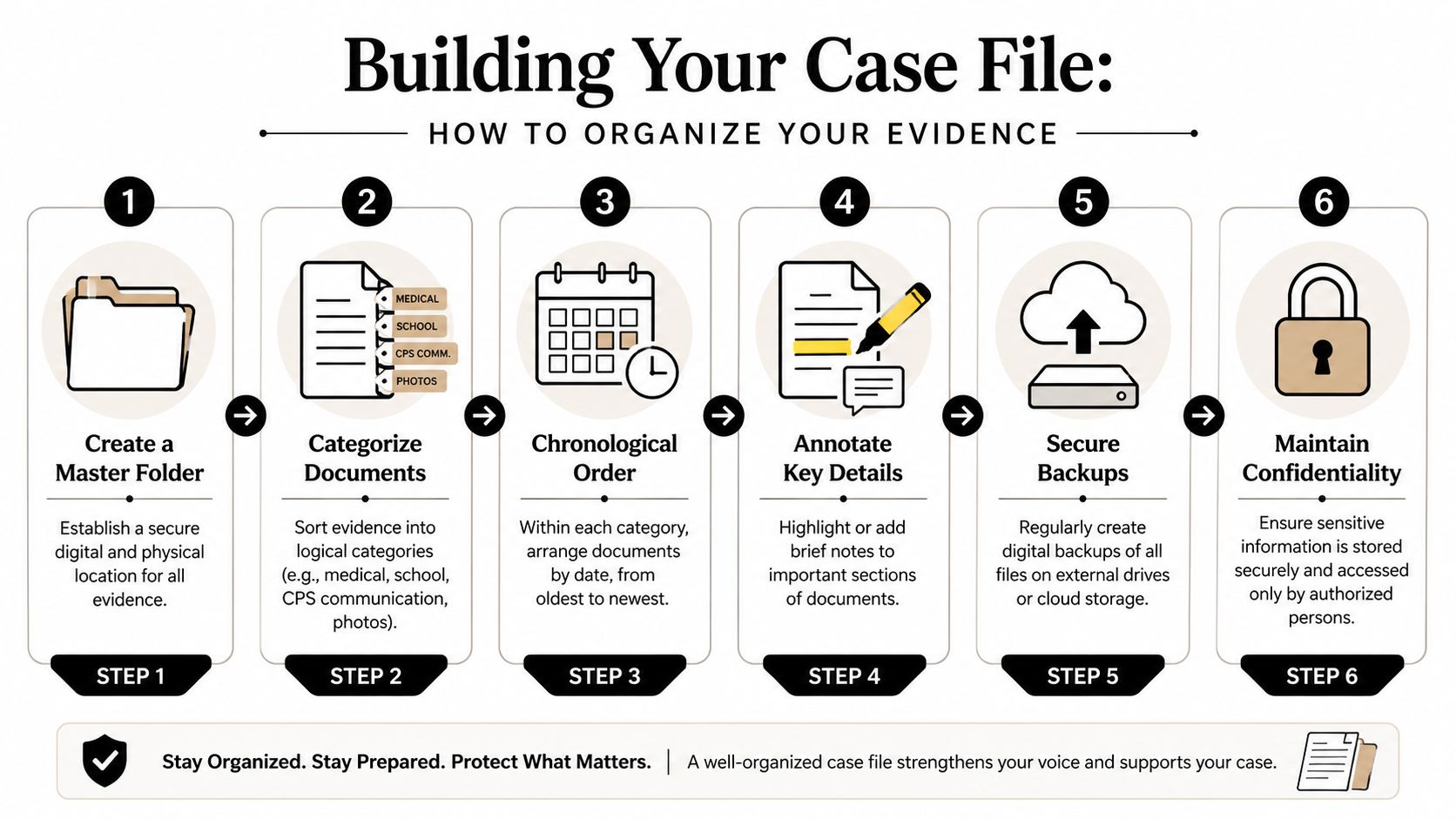
Use a two-track system
Build a physical binder and a digital archive at the same time.
Physical binder tabs
- CPS contact log
- Court papers
- Medical
- School
- Photos
- Safety plan or services
- Employment and housing
- Witnesses and support
Digital folder structure
Create matching folders in Google Drive, Dropbox, OneDrive, or another secure platform. Name files consistently, such as:
- 2026-06-07_CPS-home-visit-notes
- 2026-06-08_pediatrician-visit-summary
- 2026-06-09_school-attendance-report
Put dates first so files sort in order automatically.
What a strong log entry looks like
Here is the kind of entry I want parents to create after every contact:
Date: June 7
Time: 3:18 p.m.
Person: Jane Smith, CPS investigator
Method: In-person visit at home
Summary: Investigator stated report involved alleged lack of supervision. Requested to speak with child and asked for school and medical records. I said I wanted counsel before answering detailed questions and asked for requests in writing. Investigator left business card.
Follow-up: Sent email at 4:02 p.m. confirming request for written list of records.
That format works because it separates fact from emotion. It gives a timeline. It also makes it easy for your lawyer to compare your notes against CPS records later.
Keep your digital evidence clean
Don't rename screenshots in a misleading way. Don't crop out inconvenient context. Don't forward files from device to device until metadata gets muddy. If your case may involve disputed texts, photos, or recordings, preserving the original matters.
Parents dealing with phone evidence or altered-image claims often run into the same problems professionals see when navigating digital forensics challenges. The takeaway is practical. Save originals, keep backups, and avoid editing evidence unless your attorney tells you otherwise.
Using Documentation as a Shield and a Sword
A CPS file should do more than store paperwork. It should tell a clear, disciplined story about what happened in your home, how you responded, and why the allegation does not hold up.
That is the strategic difference many parents miss. Saving documents is only the starting point. The stronger approach is to build proof that answers the specific concern CPS is investigating while showing sound judgment, follow-through, and parental fitness. If your records do that, they protect you from distortion and also give your lawyer something useful to put in front of a caseworker, supervisor, or judge.
Texas guidance supports early, organized record-building. Parents may face requests for records during an investigation, and some cases also raise review rights under Texas Family Code §261.309 during the investigation phase. A scattered file makes it harder to respond with confidence. A focused file lets you answer the allegation instead of reacting to it.
Match the proof to the allegation
Start with the claim CPS is investigating. Then ask a simple question. What document, photo, record, or third-party source would directly confirm or rebut that claim?
If the allegation is that the home is unsafe or the child's needs are being ignored, broad denials do very little. Targeted proof changes the posture of the case.
| Allegation | Useful response |
|---|---|
| Home is dirty | Time-stamped photos of kitchen, bathrooms, sleeping areas |
| Child lacks food | Pantry and refrigerator photos, grocery receipts |
| Child misses school | Attendance records, transportation log |
| Parent ignores medical needs | Appointment summaries, prescription pickups, follow-up instructions |
That kind of file does two jobs at once. It rebuts the accusation, and it shows that you understand what responsible parenting looks like in concrete terms.
Document compliance like a decision-maker will read it
Caseworkers and courts pay attention to patterns. A parent who can show dates, confirmations, completed services, and corrected conditions usually stands in a better position than a parent who relies on memory.
If CPS asks for counseling, classes, drug testing, or home changes, keep proof of each step:
- Appointments scheduled: Save confirmations and intake forms.
- Attendance completed: Keep certificates, receipts, and sign-in records.
- Requests answered: Respond calmly, preferably in writing when appropriate.
- Safety changes made: Photograph the repaired outlet, cleaned room, lockbox, crib setup, or revised sleeping arrangement after the change.
Trade-offs matter here. You do not need to flood CPS with every paper in your house. Too much irrelevant material can distract from your strongest points. Send and preserve the records that answer the allegation, prove compliance, and show stability.
When you share records, protect them. Medical, school, counseling, and testing documents contain sensitive information, and sloppy transmission creates avoidable problems. If you need a practical primer, learn secure file sharing best practices before sending files electronically.
Used well, documentation is not just defensive. It gives your side structure, credibility, and timing. In CPS cases, that can matter early.
The 'Do Not Document' List Protecting Yourself From Misinterpretation
Parents hear “document everything” and take the instruction too strictly.
That advice can backfire. In a live CPS investigation, the wrong note, text, draft email, or social post can turn into an unnecessary problem. The better rule is this: document facts, not emotional speculation.
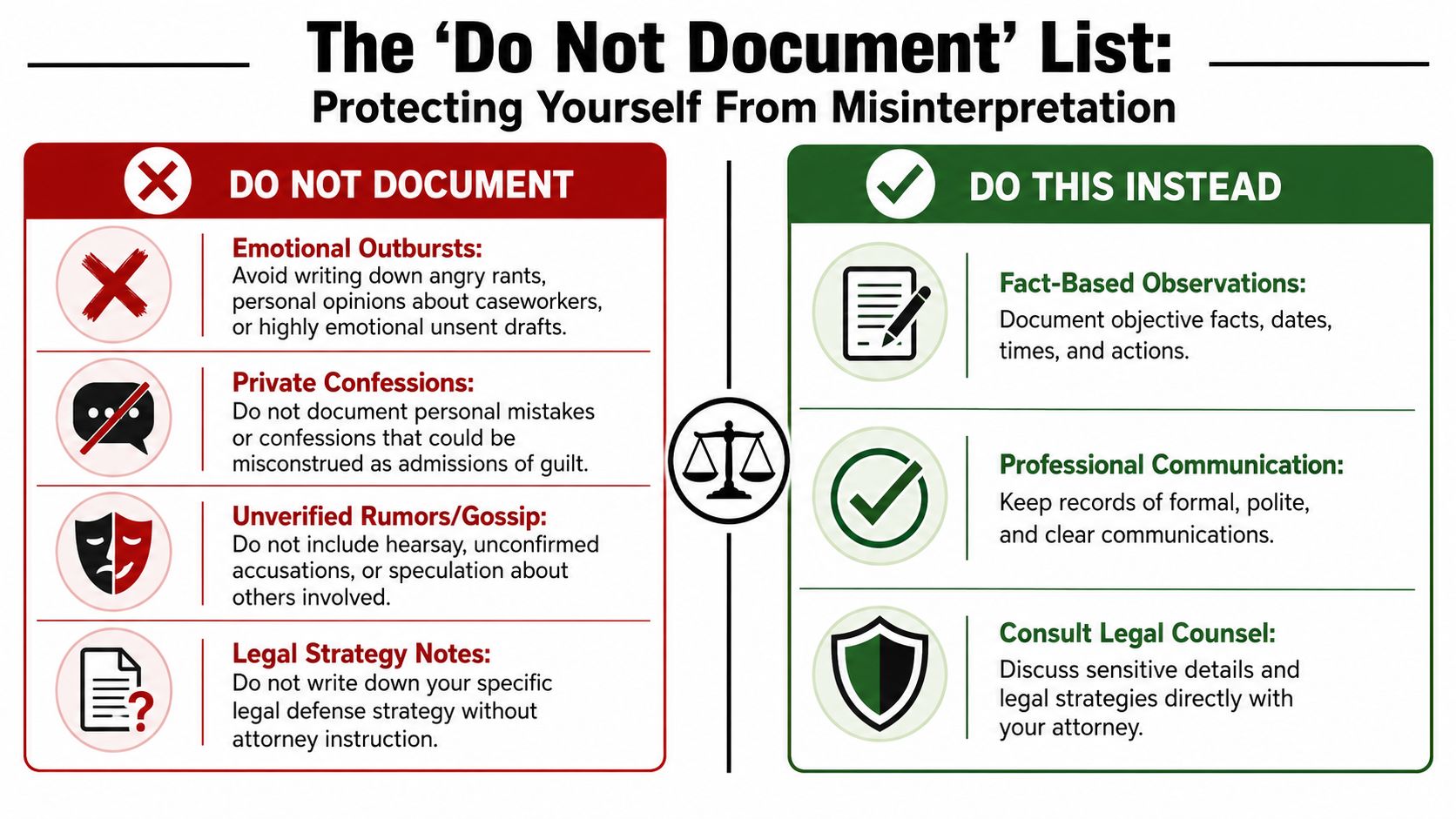
Texas DFPS materials reflect a true concern here. Existing guidance often tells parents to keep logs and gather records, but it rarely explains what not to create. Texas DFPS also advises parents not to speak with DFPS without counsel present in the alternative response guidance. That warning tells you something important. Your own words can create risk.
What not to create
Avoid these categories unless your attorney specifically tells you otherwise:
- Angry journals or rants: “I hate that caseworker,” “I lost it today,” or “sometimes I can't handle this” may be emotional release for you, but they can be framed as instability.
- Speculation presented as fact: Don't write that the other parent “must have lied” or that a teacher “is out to get me” unless you have direct proof.
- Informal admissions: A stressed text saying “I know I messed up” can be interpreted far beyond what you meant.
- Social media explanations: Public defense posts almost always create more questions than answers.
- Strategy notes in shared spaces: Don't leave your legal theories in family group chats, shared notes apps, or emails forwarded to multiple people.
What to write instead
Here is the safer substitute:
| Risky note | Better record |
|---|---|
| “The worker hates me” | “Worker arrived at 2:15 p.m. and requested school records” |
| “I'm a terrible parent” | “Child attended doctor appointment and follow-up was scheduled” |
| “My ex is crazy” | “Received text from co-parent at 8:04 p.m.; screenshot saved” |
Safer approach: If a statement is emotional, interpretive, or defensive, it probably belongs in a private conversation with your lawyer, not in your case file.
A relatable example. A parent writes in her notes, “I snapped at my son because I'm under so much pressure and I can't do this anymore.” She means she was overwhelmed. A hostile reader may try to turn that into an admission that the child is unsafe in her care. A factual note would look very different: “Child was upset after school. Homework conflict lasted 20 minutes. Child calmed down after dinner.” One version vents. The other records.
Think in terms of audience
Assume anything you create may someday be reviewed by CPS, opposing counsel, a guardian ad litem, or a judge. That doesn't mean live in fear. It means write with discipline.
If you need to process the emotional side of the case, do that in a protected conversation with counsel or a qualified therapist, based on legal advice about your situation.
Knowing When You Need a Lawyer on Your Side
Documentation is powerful. It is not a substitute for legal representation.
There are moments in a CPS case when you should stop trying to manage everything alone and get counsel involved immediately. Timing matters because CPS systems often move quickly. Some jurisdictions require CPS to open an investigation within 24 hours and complete it within 30 days, as explained by Michigan Legal Help's discussion of CPS timelines. Fast-moving deadlines are exactly why your notes and legal advice both need to happen early.
Red flags that mean call a lawyer now
Get counsel promptly if any of these happen:
- Police are mentioned or appear at the scene
- You're asked to leave your own home
- CPS asks you to sign a safety plan you don't fully understand
- A court hearing is scheduled under Chapter 262
- You're told removal is being considered
- You're asked questions that could expose you to criminal allegations
- CPS wants broad medical, school, or phone access without clear limits
Texas parents should also understand the larger legal environment. Chapter 262 deals with removal procedures and emergency court involvement. Chapter 263 governs review and permanency timelines once a case is in court. Chapter 161 addresses termination of parental rights. If your case starts moving toward court, the record you built at home must be converted into a legal defense tied to these statutes and to the facts CPS is relying on.
What a lawyer does with your documentation
A lawyer doesn't replace your case file. A lawyer turns it into advocacy.
That can include:
- identifying gaps in the timeline
- filtering what should and should not be produced
- preparing you for interviews or hearings
- challenging overbroad requests
- organizing proof of compliance
- framing your evidence around safety, stability, and parental fitness
For Texas-specific representation, review options for hiring a CPS lawyer in Texas. Early legal advice often prevents parents from making avoidable mistakes in the first days of an investigation.
Frequently Asked Questions About CPS Documentation
Should I record my conversations with the caseworker
Texas is generally known as a one-party consent state for recordings, but whether recording is wise in your specific CPS matter is a separate question. Sometimes a recording helps. Sometimes it escalates tension and changes how the interaction unfolds.
A safer default is often to create a written record right after the conversation. Send a calm follow-up email that says, in substance, “This email confirms our conversation today. You requested X, and I understood Y.” That gives you a time-stamped record without turning the meeting into a fight over the device in your hand.
Can CPS take my phone and look through everything
CPS does not automatically gain unlimited access to your phone because an investigation exists. Parents get into trouble when they hand over the whole device trying to look cooperative.
A better response is controlled and specific. If a worker asks for a particular photo, text, or appointment confirmation, provide the relevant item rather than unrestricted access to your phone. If the request seems broad or invasive, pause and speak with a lawyer before handing anything over.
What if the other parent is creating false evidence against me
Don't try to out-drama the other parent. Don't launch a text war. Don't flood CPS with accusations unless your lawyer advises it.
Focus on building your own clean record. Keep your communications measured. Save hostile messages. Preserve your parenting timeline, school records, medical follow-through, and anything else that shows consistency and stability. False claims are harder to sustain when your documentation is detailed, chronological, and supported by neutral records.
Should I keep a daily parenting log
Yes, if you keep it factual. A daily log can be very helpful when it tracks pickups, meals, school attendance, doctor visits, medications, behavior concerns, and major communications. It becomes less helpful when it turns into a diary of outrage.
The test is simple. If a judge read this line aloud in court, would it sound responsible and clear, or reactive and defensive?
If CPS has contacted you, you don't have to sort through the fear and uncertainty alone. The attorneys at Law Office of Bryan Fagan PLLC help Texas parents respond strategically, protect their rights, and avoid mistakes that can make a CPS case worse. Contact the firm for a free consultation and get clear guidance on what to document, what to hold back, and what steps to take next.