Skip to content
When a CPS investigator is standing at your door, almost every word can feel loaded. You may hear phrases like “voluntary plan,” “temporary placement,” or “sign this so we can avoid court,” and in that moment it’s hard to tell what is routine, what is urgent, and what could change your family forever.
That confusion is where many Texas parents get hurt.
The phrase voluntary relinquishment cps texas sounds simple, but it often gets used around two very different situations. One is a formal affidavit under Texas Family Code Chapter 161 that can become part of a court order terminating parental rights. The other is an informal safety arrangement outside a final termination order, often tied to a CPS investigation, a parental child safety placement, or a safety plan. Those are not the same thing. They do not carry the same legal weight. And you should never treat them as if they do.
If you’re scared, you’re not overreacting. CPS cases move fast. Parents are often asked to make major decisions before they’ve slept, calmed down, or spoken to a lawyer. The good news is that Texas law still requires procedure, judicial oversight, and proof. You have rights, even when the pressure is intense.
The Knock at the Door Understanding the Stakes of a CPS Visit
A lot of parents remember the exact moment CPS first came to the house. The knock. The badge. The sudden fear that one wrong sentence will make things worse.
Sometimes the investigator says something that sounds comforting. “We can keep this voluntary.” “If you agree to let your child stay with a relative for now, we may not need to go to court.” For a frightened parent, that can sound like the safe choice.

Why the word voluntary can be misleading
In everyday life, “voluntary” suggests freedom and control. In a CPS investigation, it may mean you’re being asked to agree under stress, without a judge present, and without much time to understand the consequences.
Texas has changed how formal removals happen. Between 2017 and 2022, Texas saw a 52% reduction in formal child removals, but families and advocates have also raised concern about growing off-the-books “voluntary” arrangements that may avoid a court case. Some estimate those arrangements could double the size of the state’s foster care system if counted, according to the Family Freedom Project’s discussion of formal removals and voluntary placements in Texas.
That matters because a lower number of formal removals doesn’t always mean less pressure on families. Sometimes it means the pressure shows up in a different form.
Parents often think, “If I cooperate, I’ll get my child back faster.” Sometimes cooperation helps. Sometimes it leads a parent to sign something they don’t fully understand.
The first question to ask
When CPS says a placement or agreement is voluntary, ask one direct question:
Is this a court order, or is this an informal agreement?
That single question helps separate two very different legal paths.
- If it is a court order, a judge is involved and the case has entered the formal legal system.
- If it is not a court order, you may be dealing with a safety plan, a temporary placement, or another agreement that does not itself terminate your parental rights.
- If CPS wants a signature immediately, slow down and ask to read every page. If possible, speak with counsel before signing.
A parent can love their child, want to cooperate, and still need to say, “I need legal advice before I sign anything.” That is not being difficult. That is protecting your rights.
What Is Voluntary Relinquishment in a Texas CPS Case
In Texas, voluntary relinquishment has a specific legal meaning. It usually refers to signing an Affidavit of Relinquishment of Parental Rights under Texas Family Code Section 161.103. That is a formal legal document used in a termination case. It is not the same as agreeing to a temporary safety plan.
Parents often hear these terms during the same stressful period, which is why they get mixed together.
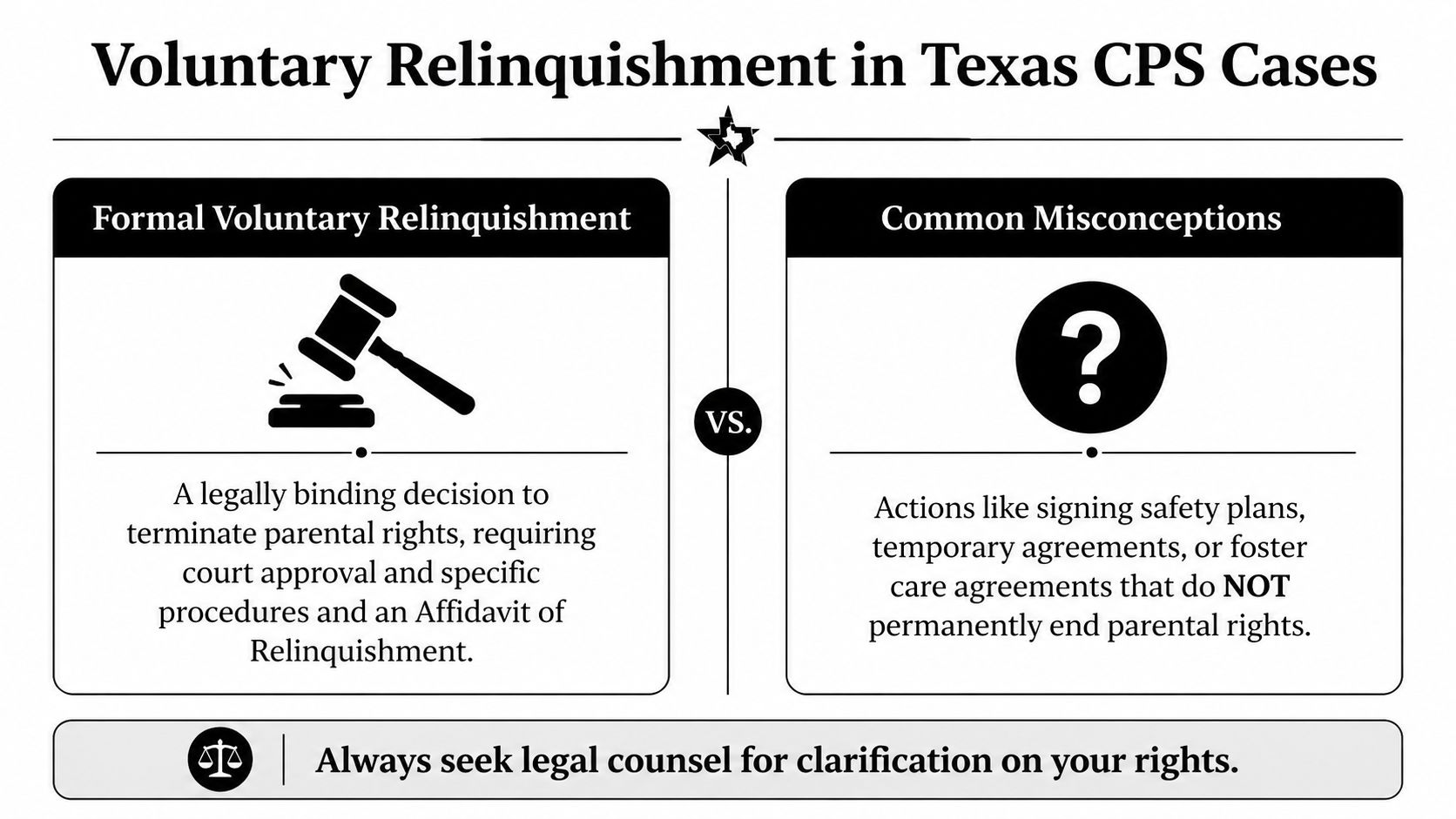
Formal relinquishment versus informal safety planning
The cleanest way to understand this is to compare them side by side.
| Situation | What it usually means | Does it permanently end parental rights |
|---|---|---|
| Affidavit of Relinquishment | A formal legal document used in a court termination case | No, not by itself. A judge must sign a court order |
| Safety plan or parental child safety placement | A temporary agreement about where the child stays or who supervises | No |
A formal affidavit belongs in the world of Chapter 161, where courts handle termination of parental rights. By contrast, safety planning often arises during investigations and removals under Chapter 262, and ongoing case review and reunification issues often fall under Chapter 263.
What the affidavit does and does not do
A signed affidavit is serious, but it is not the final step by itself. In Texas, a signed affidavit of voluntary relinquishment is not enough to terminate parental rights. A judge must sign a court order to make termination permanent and binding. Texas law also requires the child to be at least 48 hours old before such an affidavit can be signed, as explained by Texas Law Help’s guide to terminating parental rights in Texas.
That point surprises many parents. They assume the moment they sign, everything is over. Legally, that is not how it works.
Practical rule: If no judge has signed an order terminating your rights, don’t assume your rights are already permanently gone.
Where parents get confused
Here is a common example. A mother is told her child can stay with an aunt while CPS investigates. She signs paperwork because she thinks it’s only a temporary arrangement. Later, she starts hearing the phrase “relinquishment” and panics, believing she already signed away her rights.
Those may be very different documents.
A temporary placement form may affect where the child lives for the moment. A formal affidavit under Chapter 161 is aimed at termination. One is about immediate safety and control. The other is about permanently changing the legal relationship between parent and child.
If you’re reading paperwork and you see language about relinquishing parental rights, termination, or an affidavit under Section 161.103, stop and get legal advice before signing.
Plain language takeaway
If CPS asks you to sign something, don’t rely on the word “voluntary.” Ask what chapter of the Texas Family Code applies, whether a judge is already involved, and whether the document is meant to affect custody temporarily or parental rights permanently.
Those are not technical questions. They are survival questions in a CPS case.
The Legal Process for Signing Away Parental Rights
A formal relinquishment case does not happen on a porch, over the phone, or through a casual agreement with a caseworker. It moves through a legal process with specific requirements.

Step one starts after court involvement
In a CPS setting, DFPS policy does not allow an affidavit of relinquishment to be used to start conservatorship. The affidavit can only come into play after a judge has already found grounds for removal, such as abuse, neglect, or endangerment. That is one reason parents should understand the larger process surrounding termination of parental rights in Texas CPS cases.
This is a key distinction. A caseworker cannot lawfully use a relinquishment affidavit as a shortcut to avoid judicial findings at the front end of the case.
Step two involves a very specific affidavit
Texas requires formalities. The affidavit must be properly executed. Based on DFPS policy and the governing law, parents should expect strict requirements such as:
- Timing matters: the affidavit must be signed only after the child is at least 48 hours old.
- Witnesses matter: the document must be witnessed by two credible people.
- Notarization matters: it must be notarized and verified.
- Language matters: it must contain statutory language explaining the permanent consequences.
- Medical history matters: the biological parent must provide a medical history report.
If these formalities are not handled correctly, the affidavit can be challenged.
Step three is filing and court review
After the affidavit is signed, it does not end there. The document is filed with the court, and a judge reviews the case.
The court is not just checking whether your signature appears on the page. The judge must evaluate whether legal grounds exist and whether termination is in the child’s best interest.
That second part matters a lot. A parent’s agreement does not replace the court’s duty to protect the child.
To make the process easier to follow, watch this overview before any hearing or document signing:
Step four is the final hearing
At the hearing, the judge may ask questions about whether the decision was voluntary and informed. The court can also examine the child’s situation, placement, and long-term plan.
A simple way to think about it is this:
- The affidavit creates a legal ground the court can consider.
- The judge still must decide whether termination serves the child’s best interest.
- Only a signed court order makes the termination permanent.
If anyone tells you signing the paper is “just a formality,” be careful. In Texas CPS litigation, every formality matters.
A better way to approach the moment
If you are ever presented with an affidavit, don’t answer on the spot. Ask for a copy. Read every word. Write down names, dates, and what was said to you. If possible, have an attorney review the affidavit before you sign. That pause can protect you from a permanent decision made during a temporary crisis.
Understanding the Permanent Consequences of Relinquishment
Parents sometimes agree to things in a CPS case because they hope the arrangement is temporary. A final termination order based on relinquishment is not temporary.
Once the court signs that final order, the legal relationship between parent and child is severed. You no longer have the right to make decisions for the child, seek custody, or insist on visitation through the rights you once had as a parent.
Why the law treats this so seriously
Under DFPS policy, an Affidavit of Relinquishment of Parental Rights under Texas Family Code Section 161.103 is irrevocable once properly executed and serves as a statutory ground for termination. DFPS also prohibits using it to start a case, and a court must still find that termination is in the child’s best interest, as described in the DFPS CPS handbook section addressing relinquishment practice.
That combination tells you how Texas views the issue. The affidavit is powerful, but not self-executing. The court order is final, but only after judicial review.
A relinquishment affidavit is not a timeout. It is a document aimed at ending the legal parent-child relationship if the court approves termination.
What parents usually lose
After a final order terminating rights, the parent generally loses legal authority over matters such as:
- Custody and possession: the right to have the child live with you or visit under parental rights.
- Decision-making: the right to make educational, medical, and other major choices.
- Legal status: the right to act as the child’s parent in court or with agencies.
- Family law standing: the practical ability to return later and ask the court to treat you as a legal parent.
For some families, that truth raises another question. Can rights ever come back? In limited situations, parents may want to learn more about the narrow subject of reinstatement of parental rights in Texas, but parents should not count on that as a safety net before signing.
The emotional reality behind the paperwork
A lot of parents do not sign because they do not care. They sign because they feel cornered. They think they are helping their child by reducing conflict, speeding up placement, or showing cooperation.
That emotional pressure is exactly why courts require more than a signature. The law recognizes that fear, shame, exhaustion, and confusion can affect decision-making.
“I just want my child safe” is a loving instinct. It is not the same as saying, “I am ready to permanently end my legal rights.”
If you are considering relinquishment, treat it like the most serious legal decision of the case. Because it is.
A Parent's Story Navigating Pressure from CPS
Maria is a fictional parent, but her situation is familiar to many families. CPS came to her apartment after a report about unsafe conditions. She had been working long shifts, her electricity had recently been shut off for a short time, and a relative had called in concerns after an argument.
The investigator spoke quickly. Maria heard words like “temporary placement,” “cooperate,” and “voluntary.” Her son could stay with Maria’s sister for now, the investigator said, and things might go more smoothly if Maria signed the paperwork.

Where the fear took over
At her kitchen table, Maria looked at the forms and felt her chest tighten. She didn’t want to fight. She didn’t want to seem uncooperative. Most of all, she didn’t want CPS to think she was choosing herself over her child.
That’s when many parents make a dangerous assumption. They think signing first and asking questions later will prove they are good parents.
The pause that changed the case
Maria called a lawyer before signing. Not because she wanted a courtroom battle, but because she wanted to know what she was being asked to do.
The lawyer explained the difference between a temporary safety arrangement and a formal relinquishment document. They reviewed each page line by line. One set of papers addressed temporary placement with a relative. Another document carried language tied to parental rights that required much more caution.
Maria then asked better questions:
- Is this a court order or just an agreement with CPS
- Who has legal custody right now
- Am I agreeing to temporary placement, or am I being asked to give up rights
- What hearing is next, and what happens if I do not sign today
Those questions changed the tone of the conversation. The pressure eased once everyone understood Maria was not refusing to cooperate. She was refusing to sign blindly.
Parents do not protect their children by guessing what legal paperwork means.
What her story shows
Maria still had a hard road. She had to address housing issues, attend meetings, and follow through with services. But she did it with clarity instead of panic.
That is often the turning point in a CPS case. Not a dramatic speech in court. Not a perfect parent. Just a parent who slows the moment down enough to understand what is temporary, what is permanent, and what rights still matter.
Exploring Your Options Beyond Voluntary Relinquishment
When CPS is involved, parents often feel boxed into one of two choices. Sign what CPS wants, or lose everything in court. In many cases, that is not the full picture.
Texas family law gives parents and courts other ways to address safety concerns while preserving the goal of reunification. In CPS cases, the law generally expects reasonable efforts to avoid removal and treats reunification as the primary goal when a child is placed in state custody. That principle appears throughout the practical work of Chapters 262 and 263.
Options that may be available in your case
Some alternatives depend on the facts, the stage of the case, and the judge involved. Common paths include:
- Family-Based Safety Services: CPS may offer services aimed at addressing risk while trying to keep the family together.
- A court-ordered service plan: In an open case, a parent may complete services tied to housing, counseling, substance use treatment, parenting education, or other concerns.
- Relative or kinship placement: A child may stay with a grandparent, aunt, uncle, or another trusted adult instead of moving into stranger foster care.
- Temporary orders with conditions: The court may create a structure for visitation, supervision, or return steps rather than ending rights.
- Contesting allegations: If you disagree with CPS’s claims, you can present evidence, challenge removals, and ask the court to scrutinize the state’s case.
A practical way to evaluate your options
Instead of asking, “How do I make this end today,” ask these three questions:
- What is CPS saying the immediate safety problem is
- What can I do quickly to reduce that concern
- What option protects my child without permanently ending my rights
That shift matters. A parent who is behind on rent, dealing with untreated depression, or living with the wrong roommate may have serious issues to fix. But those facts do not automatically mean relinquishment is the right answer.
Steps you can take right now
If you are under investigation or already in a case, do these things as soon as possible:
- Get every document in writing: keep copies of safety plans, notices, petitions, and court dates.
- Build a relative list: identify safe adults who may help with placement, transportation, or supervision.
- Start services early: if counseling, treatment, or classes are relevant, begin as soon as you can and keep proof.
- Keep a case notebook: write down who said what, when visits occurred, and what tasks you completed.
- Stay respectful but clear: cooperation does not require silence. You can ask questions and still work with CPS.
Some of the strongest reunification cases begin with a parent saying, “I need help, and I’m willing to do the work,” while also protecting their legal rights.
One option for legal help
Parents often speak with private counsel, court-appointed counsel when available, or legal aid depending on the case. Some families also consult firms that handle CPS and related family law issues, including the Law Office of Bryan Fagan PLLC, to review documents, prepare for hearings, and explain how Texas Family Code Chapters 161, 262, and 263 interact in a CPS matter.
Relinquishment is one option in Texas. It should never feel like the only option unless a lawyer has helped you test every realistic alternative.
Why You Need a Lawyer Before Signing Any CPS Document
CPS has a job to do, but CPS does not represent you. The caseworker represents the agency’s position. The agency’s lawyer represents the State of Texas. Neither one is your personal legal advisor.
That imbalance is where many mistakes happen.
Red flag moments when counsel matters most
There are certain points in a case where getting legal advice should move to the top of your list.
- You are asked to sign anything: safety plan, temporary placement paperwork, medical releases, service plan, or an affidavit.
- You are told court can be avoided if you cooperate immediately: that may or may not be true, and you need independent advice.
- You are accused of abuse, neglect, drug use, or endangerment: those allegations can affect both your family case and, in some situations, criminal exposure.
- A hearing is coming up: early hearings can shape custody, placement, visitation, and the direction of the entire case.
If you are trying to decide whether to hire counsel, start by learning what a Texas CPS lawyer does in an active case.
What a lawyer can actually do for you
A good lawyer doesn’t just “fight CPS.” In many cases, the lawyer’s most important work happens outside dramatic courtroom moments.
They can:
- review the wording of any proposed document
- explain whether a paper is temporary or permanent
- tell you what the court can order and what CPS is merely requesting
- help you prepare evidence, witnesses, and a realistic reunification strategy
- identify when your CPS case may overlap with criminal allegations, protective orders, or another family law dispute
The most dangerous sentence in a CPS case is often, “I thought I had to sign.”
Delay can cost you options
Parents sometimes wait because they hope they can fix things informally. Sometimes they can. But if the paperwork involves relinquishment, conservatorship, or admissions that may be used in court, delay can close doors fast.
You do not need to be aggressive to protect yourself. You need to be informed. A lawyer helps you stay informed when the pressure is highest.
Common Questions About Voluntary Relinquishment in Texas
Can CPS make me voluntarily relinquish my rights
CPS cannot solely end your parental rights by asking you to sign a document. A final termination still requires a court order. Pressure can happen in real life, and some parents feel they have no choice, but the legal system still requires judicial action before rights are permanently terminated.
Is a safety plan the same as signing away my rights
No. A safety plan or temporary placement agreement is not the same as a final termination of parental rights. That said, you still should not sign a safety-related document without understanding what it changes about possession, placement, contact, and your next court date or case step.
Can I revoke an affidavit after I sign it
This depends on the wording, timing, and whether it has been filed and acted on in court. Parents should assume the issue is urgent and get legal advice immediately after signing if they have second thoughts. In practice, waiting is dangerous. Once the case moves forward, the stakes rise fast.
Do I still have to go to court if I signed something
Often, yes. Signing paperwork does not necessarily remove the court from the process. In a formal relinquishment matter, the court still has to decide whether termination should be granted and whether it is in the child’s best interest.
Will signing away my rights erase child support
Parents ask this all the time. The answer is not automatic. Child support issues can be complicated and fact-specific. A termination order can affect future obligations, but parents should never assume a signature wipes out every financial issue connected to the case. Get case-specific advice before relying on anyone’s verbal summary.
What if the other parent does not agree
The other parent’s rights and position still matter. One parent’s affidavit does not erase the legal role of the other parent. Depending on the facts, the court may need to address that parent’s rights separately.
What if I only want my child placed with a relative for now
That is a different question from relinquishment. You may be talking about a temporary relative placement, kinship care, or another short-term arrangement while CPS investigates or while a case is pending. Be precise with your language. Tell everyone involved that you are discussing placement only, not permanent termination.
Should I sign if CPS says it will look better to the judge
Not until you understand the exact document. Judges do consider whether parents cooperate, but blind cooperation is not the goal. Informed decision-making is.
What should I bring to a lawyer if CPS is pressuring me
Bring everything. That includes:
- All paperwork: every page CPS handed you, even if it looks routine.
- Names and contact information: caseworkers, supervisors, relative caregivers, and witnesses.
- Your timeline: write down the dates of visits, calls, allegations, and meetings.
- Proof of stability: lease papers, pay stubs, counseling records, treatment enrollment, school records, or anything else tied to the allegations.
What is the safest mindset to have
Treat every CPS document like it matters. Because it does. Ask questions in plain English. Do not sign to end an uncomfortable conversation. Sign only when you understand whether the paper is about temporary safety, ongoing conservatorship, or permanent termination of rights.
If CPS has asked you to sign paperwork, suggested a “voluntary” arrangement, or raised the possibility of relinquishing parental rights, get legal guidance before you make a permanent decision under pressure. The Law Office of Bryan Fagan PLLC helps Texas families understand CPS investigations, court hearings, and the difference between temporary safety plans and formal termination documents. Contact the firm for a free consultation so you can protect your rights, understand your options, and make decisions with clarity instead of fear.