Skip to content
Your child was just taken. The house feels wrong, your phone will not stop buzzing, and every call from CPS makes you wonder whether one bad answer will be used against you later. That fear is real. So is the next step. You need to get control of yourself, then get control of the record.
In a return of child after cps removal Texas case, good intentions do not bring a child home. Proof does. Deadlines do. Clean drug tests, completed services, organized records, and calm behavior in front of the court do. Parents lose time when they argue with investigators, rely on verbal promises, or assume the judge will somehow see the full story without documents. That never works.
Reunification happens, but it goes to parents who treat the case like a legal fight and a documentation project from day one. Start thinking like the person who has to prove progress every week. Save every text. Write down every conversation. Keep a binder or a phone folder with dates, names, service referrals, class certificates, test results, medication records, pay stubs, lease documents, and screenshots confirming what you completed and when.
Here is the pattern I see all the time. A parent spends the first few weeks trying to convince CPS there has been a misunderstanding. Meanwhile, no one requests copies of the key paperwork, no one confirms hearing dates in writing, and no one keeps proof of the counseling or classes already started. By the first serious court setting, that parent is telling the truth but cannot prove enough of it. That is the problem you need to fix early.
Your mindset matters here. Panic creates gaps in the record. Discipline creates evidence.
You also need enough emotional stability to follow instructions, show up on time, and avoid making angry decisions that hurt your case. If you are so overwhelmed that you cannot think straight, even a general resource like this Penticton therapy guide can help you identify the kind of counseling support that may help you regulate, stay functional, and document your recovery consistently. You do not need to look perfect. You need to get steady and stay steady.
The Unimaginable Knock at the Door
The first hours after removal feel unreal because your brain is trying to process two emergencies at once. One is legal. The other is emotional. If you ignore either one, the case gets harder.
CPS cases move fast under Texas Family Code Chapter 262 because the state claims there was an immediate need to act. That means you cannot spend a week waiting for the shock to wear off. You need records, names, dates, hearing information, and a lawyer who understands removal litigation.
Practical rule: Your feelings matter, but your paperwork wins hearings.
Parents often make the same early mistake. They focus on persuading the investigator that they are a good parent, when they should also be gathering every document that will matter in court. Good parents still lose temporary hearings when they show up unprepared.
What your mindset needs to become
Right now, stop asking only, "Why did this happen?" Start asking these better questions:
- What exactly is CPS alleging
- What document supports the removal
- Where is my child placed right now
- When is my next hearing
- What does the court expect me to do before then
- What proof can I start collecting today
That shift matters. A scared parent waits to be told what happens next. A prepared parent writes everything down, confirms every deadline, and creates a record that can be handed to an attorney and a judge.
A hard truth that helps
Being angry at CPS may be justified. Showing uncontrolled anger to CPS rarely helps. Every text, voicemail, in-person exchange, and supervised visit can become part of the story they tell about you.
That doesn't mean you become passive. It means you become strategic. You can challenge bad decisions, false allegations, and sloppy investigations. But you do it with evidence, not explosions.
The First 48 Hours Your Immediate Action Plan
This is the most critical window in your case. What you do now sets the tone for everything that follows.

Texas has changed how often children enter custody. Since 2018, children entering government custody in Texas dropped from 20,685 to 9,965, a decline of about 52%, and that shift has been tied to policy changes that narrowed the definition of neglect and increased alternatives to removal, as reported in The Imprint's analysis of Texas foster care removal policy. That matters because your attorney may be able to argue that removal was unnecessary if safer alternatives existed.
Do these things immediately
Get the basic case information in writing
Ask for the caseworker's full name, supervisor's name, office location, phone numbers, and your child's placement information if they will provide it.Request the removal paperwork
You need the petition, court orders, and especially the affidavit describing why CPS says removal was necessary. If you don't know what that document is or why it matters, read this guide on the affidavit of removal in Texas CPS cases.Write a timeline while your memory is fresh
Put down dates, times, witnesses, screenshots, medical events, arguments, text messages, and anything else tied to the allegations. Your memory will get worse under stress, not better.Identify safe relatives fast
Give CPS names of relatives or close family friends who could be considered for placement. If your child can't come home immediately, placement with family is often better than a stranger placement.Call a lawyer before the hearing sneaks up on you
The emergency hearing schedule moves quickly. Waiting until the night before court is a serious mistake.
Do not do these things
- Don't delete texts or social media posts because you think they look bad. Deleting evidence can hurt you more than the content itself.
- Don't skip drug tests even if you think the request is unfair.
- Don't coach your child or other witnesses on what to say.
- Don't argue with caseworkers by text at midnight. Assume a judge could eventually read it.
- Don't rely on verbal promises from anyone. Confirm by email or text when possible.
Your first hearing is not a formality
The adversary hearing under Texas Family Code § 262.201 is where the court examines whether CPS should keep temporary custody. Parents who walk into that hearing without records, witnesses, or a coherent response often lose ground they could have kept.
A lot of parents tell me, "I thought the judge would just know I love my child." Judges don't decide these cases on vibes. They decide them on legal standards, safety concerns, and evidence.
Here's a quick explainer to help you understand the urgency before that hearing:
Your emergency checklist
| Action Item | Why It's Critical | Timeline |
|---|---|---|
| Request court papers | You need to know the exact allegations and orders | Immediately |
| Build your timeline | Facts fade fast under stress | Same day |
| Save all communications | Messages may support your defense | Immediately and ongoing |
| Identify relatives | Placement options matter early | Within the first day |
| Get legal advice | Early strategy affects the whole case | As soon as possible |
If CPS says one thing on the phone and another thing in court, your written notes may be the difference between confusion and credibility.
Decoding Your Family Plan of Service
Once the initial emergency passes, your case becomes a test of follow-through. During this stage, Texas Family Code Chapter 263 starts shaping your daily life. If the court orders services, your Family Plan of Service, often shortened to FPOS, becomes the roadmap the court expects you to follow.
Many parents treat the service plan like a suggestion. That is a terrible approach. Treat it like a contract tied to your child's return.
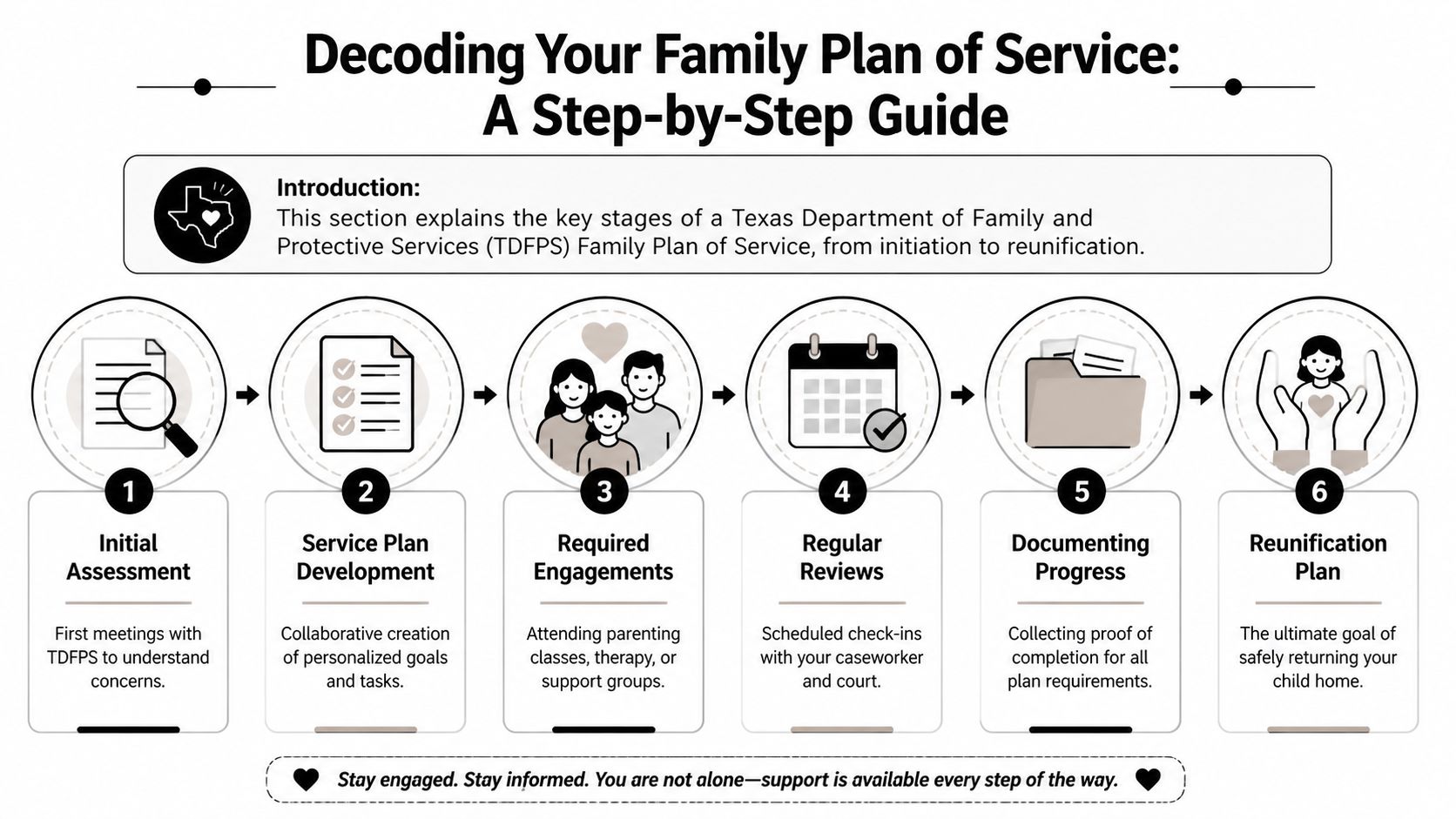
Texas DFPS uses a structured tool when evaluating whether children can safely return home. The agency's Reunification Assessment Resource Guide states that the assessment examines risk, safety, and visitation quality, and the result helps drive recommendations about whether the child should return home, remain out of home, or move toward another permanency goal. Your compliance with the FPOS feeds directly into that process.
What the service plan usually means in real life
A parent might receive tasks like drug testing, substance use treatment, counseling, parenting classes, stable housing, regular employment verification, and supervised visitation. None of that is random. CPS is trying to create a paper trail showing either improvement or noncompliance.
If your case involves mental health concerns, don't be embarrassed by that. Be proactive. If CPS asks for an evaluation and you need a plain-English explanation of what that can involve, this overview from Refresh Psychiatry for psychiatric evaluations is useful for understanding the process before you walk in.
Read every line before you sign
A service plan should be specific enough that you know what is required. If a line says "complete counseling," find out:
- Who approves the provider
- How many sessions are expected
- Whether missed sessions must be made up
- What proof of attendance is required
- Whether progress reports must be submitted
If you don't understand a term, ask in writing. If a service is impossible because of work hours, transportation, cost, or distance, raise that immediately and ask for a practical alternative. Silence gets framed as refusal.
For a closer look at how these plans work, review this page on the Texas CPS family service plan.
The people in your case are not all on the same wavelength
Your caseworker, the child's attorney ad litem, the judge, and your lawyer may all view the same facts differently. That's normal. Your job is not to make everyone like you. Your job is to make your progress undeniable.
A simple example. A father gets ordered to take parenting classes and individual counseling. He finishes both, but he never sends the certificates to anyone because he assumes the providers will do it. Court arrives. The caseworker says records were incomplete. The father insists he did everything. The judge sees confusion, not proof. That problem was avoidable.
How to approach the FPOS without drowning in it
Break the plan into four buckets:
| Bucket | What goes in it | What you should do |
|---|---|---|
| Court dates | Hearings, reviews, deadlines | Put them in your phone and on paper |
| Services | Classes, therapy, treatment, testing | Schedule them immediately |
| Proof | Certificates, sign-in sheets, receipts | Save copies the same day |
| Communication | Emails, texts, calls with CPS and providers | Keep a dated log |
Your service plan is not there to test whether you mean well. It's there to test whether you can do hard things consistently.
Watch the reassessment cycle
DFPS policy also requires continued reassessment after children return home in reunification cases. The same DFPS guide explains that caseworkers complete a Risk Reassessment at least every 90 days after all children with a reunification goal have returned home, or sooner in some court-review situations. That means reunification is not the finish line. It is the beginning of a new period where consistency still matters.
If the court and CPS are watching your safety, risk, and visitation history, then every appointment, every home condition issue, and every communication matters. That's why your documentation system has to start now, not later.
Building Your Case with Undeniable Evidence
A lot of parents lose reunification for a simple reason. They did some of the work, but they could not prove it cleanly when the judge asked.

You need to treat your case like it will be challenged at every hearing, because it will. Good intentions do not reunify families. Records do. Start building proof now, not after someone says your file is incomplete.
I tell parents to keep a reunification binder even if they also use a phone folder or cloud drive. Your goal is simple. If your lawyer, caseworker, CASA, or judge asks for proof, you can put your hand on it in seconds.
What goes in the binder
Use tabs or folders. Keep each category current.
Court documents
Petitions, orders, notices, service plans, and hearing settings.Drug testing records
Test notices, attendance confirmations, results, and any chain-of-custody paperwork you receive.Treatment and counseling
Intake paperwork, attendance logs, progress notes if available, discharge summaries, provider letters, and certificates.Housing and employment
Lease, utility bills, photos of the home, pay stubs, work schedule, and employer letters.Parenting proof
Class completion records, homework, coaching notes, and provider feedback.Visitation log
Date, location, supervisor, what went well, what your child needed, and any concern that came up.
Do not dump papers into a pile and promise yourself you will organize them later. Later is how parents walk into court with half a story.
Build evidence the court can trust
The strongest parents in CPS cases are not always the most emotional or the most persuasive. They are the most consistent. They can show a pattern of sobriety, attendance, stable housing, reliable communication, and calm visits over time.
That pattern matters.
If you miss a drug test because of work, document the shift, the call you made, and your attempt to reschedule. If a provider cancels your counseling session, save the text or email. If you finish a class, get the certificate the same day and send a copy to your lawyer. Judges see excuses every week. What stands out is a parent who shows the problem and the proof in the same file.
Your mindset should be simple. Never assume CPS already has the record. Never assume a provider sent it. Never assume the judge will fill in gaps in your favor.
Supervised visits create evidence every time
Visits are not just family time. They are part of your case file.
Parents often walk into supervised visits focused only on emotion. I understand why. But you need a plan. The supervisor is watching whether you stay regulated, whether you follow directions, whether you respond to your child’s cues, and whether you put your child’s needs ahead of your anger about the case.
Use a repeatable routine.
Before the visit
- Get yourself steady so you do not arrive scattered, late, or irritated.
- Bring child-focused items if the rules allow it, such as books, drawings, or age-appropriate activities.
- Read the visit rules again so you do not create a preventable problem.
- Write down one or two goals for the visit, such as helping with homework, practicing patience, or staying calm during transitions.
During the visit
- Stay focused on your child rather than the case.
- Do not coach your child about what to say to CPS, CASA, or the judge.
- Follow redirection immediately if the supervisor gives it.
- Keep your tone controlled even if you feel upset.
After the visit
- Write your notes within an hour while details are fresh.
- Record concrete facts such as how your child greeted you, what activities you did, how you handled stress, and how the visit ended.
- Note problems without spinning them. Accuracy helps you more than drama.
- Send important updates to your lawyer if the visit showed progress or raised a concern.
The parent who arrives prepared, stays calm, and documents the visit usually builds a stronger case than the parent who keeps arguing that the system is unfair.
Your communication file can save you
Save every email, text, appointment reminder, and provider message. For phone calls, keep a call log with the date, time, who you spoke with, and what was said.
This is not busywork. It protects you when someone claims you failed to respond, missed an instruction, or ignored a referral. A short, dated note can shut down a false accusation fast.
Your records also make your legal team more effective, whether you work with a dedicated CPS defense firm or a court-appointed attorney. If you are getting ready for the hearing where removal and return issues are fought early, learn what to expect at a Texas CPS adversary hearing.
Keep one standard for everything in this case. If it is not documented, it may not count.
Understanding the Courtroom Battle for Your Family
You walk into court hoping someone will finally hear your side. Instead, the judge has a stack of reports, CPS has a position, and every missed appointment, drug test, and text message can become part of the story told about you. Court is not the place to start getting organized. Court is where your preparation gets tested.
Texas CPS cases follow a legal track. Under Texas Family Code Chapter 262, the court reviews whether removal was justified and whether CPS should keep temporary custody. Under Chapter 263, the judge tracks your progress, your child's placement, and whether reunification is still realistic. Under Chapter 161, the state can ask to terminate your parental rights. Those chapters are not abstract law. They define what the judge is allowed to do to your family.
The hearing that shapes the judge's first impression
The adversary hearing often sets the tone for everything that follows. If you need a clearer breakdown of that stage, read this explanation of a Texas CPS adversary hearing and what parents should expect.
First impressions matter in CPS court. Judges look for stability, honesty, and action. If you show up confused, defensive, or unsupported, CPS will use that. If you show up with clean testing, names of safe relatives, proof of treatment, housing information, and a calm plan for your child, you give the court a reason to question CPS's version of events.
Your mindset matters here. Stop treating the hearing like a chance to vent. Treat it like a record-building event. Every hearing creates a paper trail that either supports return or supports continued removal.
Review hearings are where reunification is won or lost
Parents often make a serious mistake after the first court date. They assume starting services is enough. It is not. Judges want proof that the safety problem has been addressed, not delayed.
At status and permanency hearings, the court is measuring patterns. Are you testing consistently. Are you attending counseling and finishing it. Are you still involved with the person CPS says puts your child at risk. Has your home become safe and stable. Are visits going well over time. Can your lawyer hand the judge organized proof, or only excuses.
That is why documentation matters so much at this stage. Bring certificates, discharge papers, lease records, pay stubs, screenshots of completed classes, attendance logs, medication records, and written updates from providers. Put dates on everything. If a service was hard to schedule, document your attempts. If CPS gave conflicting instructions, document that too. A parent with a clean timeline and organized records usually has more credibility than a parent who insists they are trying but cannot prove it.
Courts are careful about sending children home before the home is safe. Judges know weak reunifications can collapse. If your progress looks rushed, inconsistent, or incomplete, expect resistance.
The court follows deadlines, not your good intentions
Texas CPS cases move fast. The court does not leave children in temporary care while parents slowly decide whether to comply. If you lose months early, you may run out of time later.
Use this chart as a case strategy guide:
| Hearing stage | What the court is deciding | What you should be doing |
|---|---|---|
| Adversary hearing | Whether CPS keeps temporary custody | Challenge weak allegations, present safe placement options, show immediate stability |
| Status hearing | Whether the service plan is clear and whether you are engaging | Fix vague requirements, get referrals in writing, start building your proof file |
| Permanency hearings | Whether return is becoming realistic or less likely | Show completed services, changed behavior, safe housing, steady visits, and reliable sobriety |
| Final trial or final order | Whether your child returns, stays in care, or faces a more permanent outcome | Present a clean, organized record that shows the danger has been removed |
The judge is not grading effort. The judge is deciding safety.
Chapter 161 is where delay becomes danger
If CPS starts building a case under Chapter 161, you are in serious trouble. Termination of parental rights can permanently end your legal relationship with your child.
Parents need to understand how this happens. It is rarely one dramatic moment. It is a collection of problems that keep showing up in the record. Missed hearings. Incomplete treatment. positive drug tests. Unstable housing. Unsafe relationships. Angry outbursts in court or during visits. Long periods where nothing is finished and nobody can tell what progress, if any, has been made.
Do not wait for a final warning from the judge. Act like every hearing matters because it does. Get your records in order. Follow through on services. Fix the underlying problem that brought CPS into your life. Give your lawyer documents, not promises.
That is how parents put themselves in a position to get their children back.
Common Obstacles and Why You Need an Attorney
Some CPS cases are straightforward. Many are not. The hardest cases usually involve one of these problems: a caseworker who has already made up their mind, allegations that keep changing, a parent who is trying but disorganized, or a substance use or mental health issue that turns progress into a stop-and-start pattern.
If your case involves substance abuse or mental health allegations, the risk profile changes. In Texas, children reunified after removal for parental substance abuse or mental health issues had a 57% higher risk of reentering foster care, and for children in care beyond 18 months, the reentry hazard was 52% to 68% higher for those cases, according to the Texas reentry risk research published by the National Library of Medicine. That does not mean your case is hopeless. It means casual effort is not enough.
The obstacles I see most often
False confidence early on
A parent assumes the allegations are weak, so they delay getting legal help.Service plan confusion
They complete part of a requirement but don't verify whether CPS accepts the provider or proof.Relapse or setback
Instead of addressing it with a concrete recovery response, they hide it, miss visits, or disappear.Toxic communication
Angry texts, social media posts, or confrontations damage credibility.Unsafe relationships
A parent keeps contact with the person CPS identified as a danger, then acts surprised when the court refuses return.
Why legal representation is not optional
You need someone who can do more than comfort you. You need someone who can attack weak evidence, force clarity in court orders, object when CPS overreaches, prepare you for testimony, and keep the case focused on legally relevant facts.
A lawyer also helps you separate real problems from noise. Some allegations can be disproved. Some concerns must be fixed, not debated. A good attorney tells you which is which.
Parents sometimes ask whether they can handle the case alone if they just cooperate. That is the wrong question. The right question is whether you can afford to misunderstand a Chapter 262 emergency hearing, a Chapter 263 permanency deadline, or a Chapter 161 termination threat. You can't.
Frequently Asked Questions About CPS Reunification
Can I get my child back if I disagree with the allegations
Yes, but disagreement alone won't move the judge. You need evidence, witnesses, records, and a legal strategy. Courts decide based on what can be proven.
Do I have to sign the Family Plan of Service
You should never sign anything you do not understand. If you disagree with parts of the plan, raise those concerns quickly and through counsel if possible. Refusing to engage without a legal strategy can hurt you.
If my child comes home, is the case over
Not necessarily. DFPS uses ongoing reassessment after reunification in many cases, and the court may continue monitoring compliance and safety conditions for a period of time.
Can parental rights really be terminated
Yes. Under Texas Family Code Chapter 161, parental rights can be terminated. That is why delays, missed hearings, and half-completed services are so dangerous.
I had a setback. Should I hide it
No. A setback handled responsibly is often less damaging than a setback hidden badly. Talk to your lawyer and build a response plan immediately.
What should I do today
Use this quick reference.
| Action Item | Why It's Critical | Timeline |
|---|---|---|
| Gather every court paper | You need the exact allegations and orders | Today |
| Start a reunification binder | Proof wins more than promises | Today |
| Confirm every service requirement in writing | Misunderstandings cause delay | Today and this week |
| Prepare for visitation like court evidence | Visits affect how CPS views parenting | Before every visit |
| Speak with a CPS attorney | Strategy early is better than damage control later | Immediately |
If you are serious about the return of child after cps removal texas process, stop waiting for the system to be fair on its own. Build your record. Protect your rights. Show the court change in a form the court can verify.
If CPS has removed your child, you do not need more confusion. You need a plan. The attorneys at Law Office of Bryan Fagan PLLC help Texas parents respond to CPS investigations, prepare for hearings, challenge removals, and pursue reunification with discipline and urgency. If you're scared, overwhelmed, or unsure what to do next, reach out for a free consultation and get clear direction on the next move for your family.