Skip to content
A CPS investigator at your door can make the room feel smaller in seconds. Most parents I speak with are dealing with the same mix of fear and confusion. They want to know one thing immediately. What evidence does CPS need to remove a child in Texas?
The answer is more precise than families are typically told. CPS does not get to remove a child just because someone made a report, because a home looks imperfect, or because a caseworker disapproves of your lifestyle. In Texas, removal decisions are tied to legal standards, specific evidence, and very short court deadlines. If you understand those stages, you can make better decisions fast and avoid mistakes that hurt your case.
The Knock on the Door Understanding a CPS Removal
A common scenario starts like this. A teacher notices repeated absences, a child makes a troubling comment, or a neighbor calls in a concern. Then a caseworker shows up and says they need to talk. For many parents, that moment feels like the state has already decided the outcome.
It hasn't.
Texas law gives CPS serious authority, but it also puts that authority inside a court process. A removal is not supposed to be an informal judgment call. Texas DFPS defines a removal as the point when CPS concludes the child cannot safely stay at home and the agency must seek custody to protect the child, as shown in Texas DFPS removals data. That same data shows Texas removed 20,685 children in 2018 and 9,220 in 2024, a 55% decline over six years, which matters because it reflects that removals are treated as serious safety actions, not routine case management.

What parents usually get wrong in the first hour
The biggest mistake is assuming that talking more will clear everything up. Sometimes it helps. Often, it gives CPS extra statements to frame against you before you've seen the allegations clearly.
Another mistake is assuming CPS always needs a criminal case first. It doesn't. CPS can seek custody when it believes a child cannot safely remain in the home, even without a criminal conviction.
Practical rule: The first conversation with CPS can shape the first hearing. Stay calm, be polite, and don't guess, speculate, or argue facts you haven't had time to document.
A more useful way to think about removal
Think of removal as a legal claim CPS must support quickly. The agency still has to connect its concerns to danger, urgency, and the lack of safer alternatives. If you're dealing with a sudden removal question, this guide on whether CPS can take your child without a court order in Texas helps explain that first distinction.
Parents do better when they stop asking, "Why is CPS being unfair?" and start asking, "What facts are they relying on, and what facts can I prove?" That shift gives you something solid to work with.
Defining Immediate Danger The Legal Threshold for Removal
The phrase that matters most early in the case is immediate danger. In an emergency removal, CPS is not required to prove the entire case at trial level. The initial standard is lower.
Under Texas law, the standard for an initial emergency removal is probable cause, described as whether a person of "ordinary prudence and caution" could reasonably believe there was danger to the child, as explained in this discussion of Texas Family Code § 262.201(g). That is a lower threshold than what many parents expect.
What that means in plain English
CPS doesn't have to prove every allegation conclusively at the moment of removal. It has to show enough facts that a reasonable person could believe the child's physical health or safety was at risk and that removal was necessary right then.
That low threshold is why the details matter. A parent's denial by itself usually won't beat photographs, records, witness observations, or evidence of impairment. On the other hand, a vague suspicion without a specific safety risk should not be enough to keep a child out of the home.
What often counts, and what often doesn't
Some conditions can support a danger finding if they create an actual safety threat:
- Accessible drugs or paraphernalia: If a child can reach them, CPS may frame that as immediate physical danger.
- Serious home hazards: Exposed wiring, blocked exits, unsafe sleeping conditions, or severe sanitation problems can become central evidence.
- Impairment by a caregiver: If the concern is that a parent cannot safely supervise the child at that moment, CPS will focus on function, not excuses.
By contrast, some facts are often misunderstood:
- Poverty is not neglect by itself.
- A cluttered home is not automatically a removal case.
- Unpopular parenting choices are not enough unless they create a concrete safety risk.
If the issue in your home involves severe accumulation, contamination, or blocked access, a practical resource like the 360 Hazardous hoarding cleanup guide can help you understand what conditions move from "messy" to dangerous.
Parents often lose ground when they defend every criticism instead of separating appearance from legal danger. Courts care about safety, not perfection.
The Evidence CPS Gathers to Justify a Removal
Most parents expect CPS to need a dramatic piece of proof. Many cases don't work that way. They are built from records, observations, and inferences stitched together into a safety narrative.
Texas-focused legal commentary notes that many removal cases rely on indirect, documentary evidence, including school attendance records, medical histories, prior CPS reports, and teacher observations, as discussed in this overview of CPS case evidence. That matters because the defense often turns on the quality of the paper trail, not just whether one accusation is true.

The main categories of evidence
Here is what CPS commonly tries to assemble.
Physical proof
- Photos of injuries
- Photos or video of home conditions
- Objects found in reach of a child, such as drugs, weapons, or hazardous items
Official records
- Police reports
- Hospital and clinic records
- Drug test results
- Prior CPS history
Third-party observations
- Teacher statements
- School disciplinary notes
- Counselor or medical provider concerns
- Relative or neighbor accounts
Parent statements and conduct
- Admissions made during interviews
- Contradictory explanations
- Refusal to address an obvious safety issue
- Visible impairment during contact with CPS
A relatable example
Take a case where a school reports repeated absences and a child arrives tired, unwashed, and hungry. CPS then pulls attendance records, speaks with a teacher, reviews medical history showing missed follow-up care, and visits the home. During the visit, the caseworker notes unsafe sleeping arrangements and finds medication where a young child can reach it.
No single fact may tell the whole story. Together, those documents and observations can become the basis for removal.
That is why parents should review allegations with precision. Did the school records show what CPS claims? Is a medical note being taken out of context? Was a condition temporary and already fixed? If you need a broader look at child removal criteria and procedures in Texas CPS investigations, that can help you map how these pieces fit together.
The strongest rebuttal is usually organized evidence, not outrage. Judges listen more carefully when a parent can show records, dates, repairs, treatment, and safe placement options.
Emergency Removals vs Court-Ordered Removals
These two paths sound similar, but they create very different timelines and immediate choices for parents.
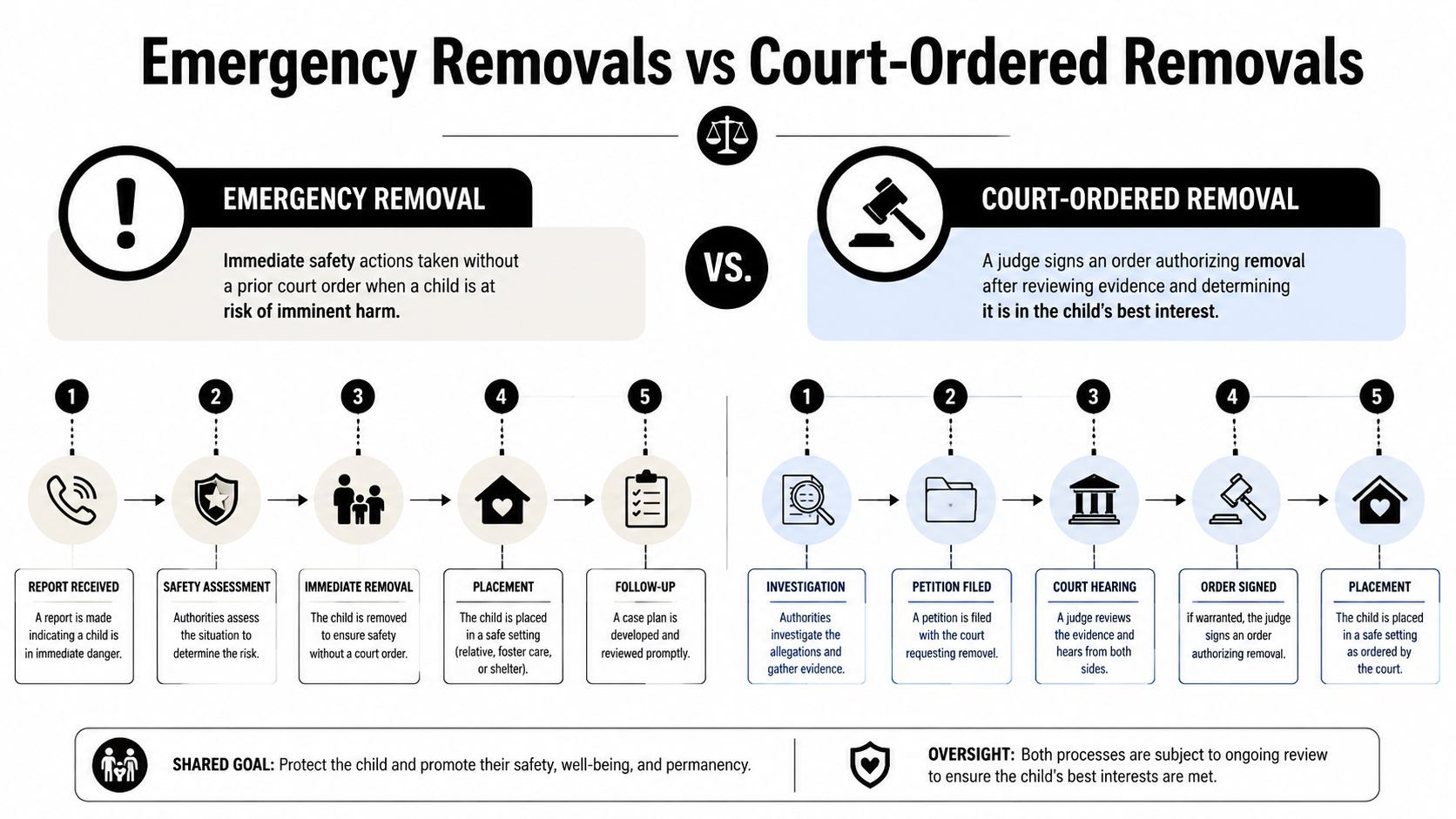
Side-by-side comparison
| Removal type | What happens first | Parent's immediate issue |
|---|---|---|
| Emergency removal | CPS removes first, then goes to court quickly | You need to prepare for a fast hearing and identify safer alternatives immediately |
| Court-ordered removal | CPS asks a judge before removal | You may have notice and a chance to respond before the child is taken |
An emergency removal is the version that causes the most panic. It can happen without a prior court order if CPS claims the child faces immediate danger. But even then, CPS must show more than danger alone. Texas Family Code § 262.201(g) requires the agency to demonstrate danger and that reasonable efforts to prevent removal were made and failed, as explained by Texas Law Help's removal process guide.
Why the less restrictive alternative matters
This point gets overlooked. CPS is supposed to show there was no viable safer option available in that moment. That could include another parent, a relative, a family friend approved for temporary care, or a protective arrangement short of removal.
If you're dealing with a sudden take into custody, this resource on Texas emergency CPS removals can help you understand what the agency should have been prepared to show.
What works for parents in each path
In an emergency removal, speed matters more than speeches. Focus on:
- Names and numbers: Identify relatives who can pass a background check and take placement.
- Documents: Gather prescriptions, school records, lease information, repair receipts, and any proof the danger claim is overstated.
- Timeline: Write down exactly what happened before and during the removal.
In a court-ordered removal situation, the strategy is a little different. You may have time to present safer alternatives before the judge signs off. That's when photos of corrected conditions, treatment enrollment, and third-party support can matter early.
Navigating the First Court Hearings After Removal
The first days after removal are a blur for most families. They move fast, and Texas law does not give parents much time to get organized. A child taken without a prior court order will usually trigger a very quick initial hearing, often by the next business day, and the adversary hearing generally occurs within 14 days. The pressure on both sides is immediate.

What the judge is deciding early on
The early hearings are not a full trial on everything that has ever gone wrong in your life. The judge is deciding whether CPS should keep temporary custody while the case continues.
By the adversary hearing, the focus shifts. Texas practitioner guidance explains that CPS must prove a continuing, immediate danger exists, and the strongest defense is often to attack causation and immediacy by showing the concern is historical, not current, or that a less drastic option such as relative placement can protect the child, as described in this explanation of the 14-day hearing battleground.
The first 14 days in practical terms
Here is a simple timeline many parents can follow.
Day one or next business day
Confirm where your child is, get the court information, and ask what allegations led to removal.The first several days
Find counsel, identify family placement options, and start gathering records that address the exact safety concerns.Before the adversary hearing
Organize your timeline, line up witnesses, and fix any condition that can be fixed immediately.
A short explanation of how these hearings fit together can help if you're trying to orient yourself quickly:
What to bring your lawyer or prepare yourself
Parents are often surprised by what helps and what doesn't.
Useful items include:
- Current records: medical updates, prescriptions, discharge papers, school attendance corrections
- Proof of changed conditions: repair invoices, photographs, landlord communication, treatment enrollment
- Relative information: full names, addresses, phone numbers, relationship to the child
- Communication logs: texts, emails, and notes that place events in context
Less useful approaches include:
- Long explanations that don't answer the safety allegation
- Angry messages to the investigator
- Bringing supportive friends who don't know firsthand facts
- Promising future improvement without any proof of present action
Bring proof of today's safety, not just promises about tomorrow.
A realistic hearing example
Suppose CPS says the child was removed because the home was unsafe and the parent failed to supervise. At the hearing, the parent may improve the case by showing the hazardous condition has already been corrected, the issue was temporary, the child can stay with a sober grandparent, and the records CPS relies on describe older events rather than a current threat.
That kind of response is focused. It meets the court where the legal issue is.
Protecting Your Parental Rights and Building Your Defense
The hours after a removal shape the rest of the case. Parents often feel pressure to explain everything at once, sign whatever is put in front of them, and trust that cooperation alone will bring the child home faster. In practice, the better approach is narrower and more disciplined. At each stage, CPS has to prove a specific level of risk. Your job is to answer the allegation tied to that stage with proof, not panic.
Your parental rights still matter, even in a crisis. You can ask what CPS is alleging, what evidence supports it, whether there is a court order, and when the next hearing is set. You can seek legal counsel before making major statements or signing broad releases. Those choices matter because a CPS case can overlap with custody disputes, protective orders, or criminal investigations.
Good defense work starts with separating urgent decisions from emotional reactions.
Protect your rights without making the case worse
Parents sometimes damage their position by treating every CPS request as harmless paperwork. It is not. Safety plans, releases, drug testing requests, recorded interviews, and written statements can affect what the judge hears at the emergency stage and again at the 14 day hearing.
That does not mean refusing every request. It means asking a practical question each time. What is CPS asking for, what can they do with it, and does it help show present safety or create a new problem?
A careful response often works better than a fast one. If an investigator asks about a bruise, missed school, drug use, or violence in the home, answer truthfully, but do not guess, exaggerate, or fill silence with details you cannot support. If there is a parallel criminal issue, get legal advice before giving a full statement.
Build your defense around the exact allegation
Judges do not return children because a parent says, "I love my child" or "this is unfair." Judges want evidence tied to the claimed danger.
If CPS says drug use created a current safety threat, the useful defense may include clean testing, treatment enrollment, proof of sobriety support, and a safe supervisor for contact with the child. If CPS says the home was unsafe, the focus shifts to corrected conditions, updated photographs, repair records, and testimony from someone with firsthand knowledge. If the issue is neglectful supervision, the court will want to know who is caring for the child now, what changed, and why the problem will not happen again.
At this stage, parents regain some control. Match your proof to the accusation.
Organize evidence the way a judge can use it
Make one case file and keep it current. Digital is fine. Paper is fine. Disorganized proof helps far less than parents expect.
Use a structure that tracks how the case will be argued:
- Allegation file: one page for each CPS claim, with the date and your response
- Timeline: a dated sequence of events, including police calls, medical visits, school contacts, CPS visits, and who was present
- Documents: medical records, school records, leases, repair receipts, testing results, counseling enrollment, and photos
- Witness list: relatives, neighbors, teachers, doctors, counselors, or babysitters with firsthand information
- Placement options: full contact information for relatives or family friends who can pass a background check and protect the child if return home is not yet approved
A strong defense file does two things at once. It challenges weak or outdated CPS evidence, and it gives the court a safer alternative than continued separation.
Understand the trade-offs in cooperation
Parents ask whether they should cooperate with CPS. The honest answer is that it depends on what CPS is asking for and what stage the case is in.
Some cooperation can help. Drug testing can matter if sobriety is the central issue and you are clean. Home access can matter if conditions have been fixed and you want that documented. Relative names should usually be provided early because placement delays can hurt the child and the parent.
Some cooperation carries risk. Broad medical releases, informal text explanations, and long unsworn narratives often create confusion instead of clearing it up. A parent who talks too much can hand CPS a statement that gets repeated in court without the missing context.
Measured cooperation is usually the better course. Give useful proof. Avoid careless admissions.
Use counsel to keep the case focused
A lawyer's job in a CPS case is not just to argue. It is to narrow the issues, test the evidence standard at each hearing, object when CPS relies on weak foundations, and present a plan the judge can act on.
Law Office of Bryan Fagan PLLC handles Texas CPS matters and related custody and court issues. If you are already in a case, counsel can help identify what CPS still must prove, what evidence matters now, and which facts are distracting you from the actual legal question.
The strongest defense answers the current safety allegation with present-day proof, credible witnesses, and a realistic plan for the child's care.
Taking the First Step to Protect Your Family
When parents ask what evidence CPS needs to remove a child in Texas, the honest answer is that it depends on the stage of the case. The initial removal standard is lower than many people expect. The later hearings demand more focused proof about current danger and whether safer alternatives exist.
That distinction matters. It tells you where to fight. If the removal was based on assumptions, missing context, or stale facts, your job is to show the court what is true now. If there was a real concern, your job is to show it has been addressed in a way that protects the child without unnecessary separation.
You do not need to solve everything in one day. You do need to move quickly, stay organized, and avoid making the record worse. In CPS cases, control often comes back in small steps. Getting the allegations, building your timeline, finding placement options, and preparing for the first hearings are those steps.
If CPS has contacted you, removed your child, or scheduled a hearing, don't wait for the next court date to get answers. The Law Office of Bryan Fagan PLLC offers a free consultation for Texas families facing CPS investigations and removals. You can speak confidentially about what happened, what CPS is claiming, and what evidence you need to start gathering right now.