Skip to content
When CPS removes your child, the room goes quiet in a way you never forget. You may have just spoken to an investigator, a police officer, a teacher, or a relative. Now you're staring at paperwork, trying to understand where your child is sleeping tonight and whether you're about to lose them for good.
That fear is real. So is the confusion. But panic is not a strategy.
Texas CPS cases move fast, and that cuts both ways. A fast system can overwhelm a parent who freezes. It can also help a parent who gets organized immediately, gets legal advice early, preserves evidence, and avoids saying the wrong thing in a parallel criminal investigation. That last part matters more than most parents realize. In many removal cases, what you say to CPS can affect a criminal case, and what you refuse to say in a criminal case can affect the family court's view of you.
How to Fight a CPS Removal Case in Texas (Step-by-Step) starts with understanding that you are already in litigation mode. This is no longer a casual conversation with an agency. It is a legal case with deadlines, evidence rules, and long-term consequences under Texas family law.
Your World Turned Upside Down – First Steps After CPS Removes Your Child
A common scene looks like this. A parent gets a call that the child has been taken, or comes home and learns the child was placed with a relative or foster home. The parent starts calling the caseworker over and over, trying to explain what really happened. Friends tell the parent to “just cooperate,” “tell them everything,” or “wait for CPS to sort it out.”
That approach often makes things worse.

Texas removal cases start on a short statutory clock. Under Texas Family Code Chapter 262, if DFPS removes a child without a prior court order, a judge must hold an adversary hearing within 14 days of removal, and DFPS guidance states the caseworker must make reasonable efforts to avoid removal when possible and seek emergency court authority unless exigent circumstances exist, as described in the Texas DFPS CPS handbook. Parents also need to understand that when CPS removes a child without a court order, the agency must move quickly in court, which is why an emergency removal in Texas CPS cases should be treated as an immediate legal emergency.
What to do in the first hours
Your first job is to stabilize the case, not win every argument by phone.
- Get every paper together: Removal notice, safety plan, investigator card, drug test request, court papers, texts, and emails.
- Write a timeline while your memory is fresh: Who came to the home, what they said, who was present, and what was taken or photographed.
- Identify safe witnesses: Grandparents, teachers, daycare staff, neighbors, doctors, counselors, church members, or coaches who've seen you parent.
- Stop reactive texting: Angry messages, threats, and long explanations can become evidence.
Practical rule: Don't try to talk your way out of a removal case before you know the allegations, the court date, and whether criminal exposure exists.
What usually works and what usually does not
What works is calm, fast organization. What doesn't work is emotional overexplaining, social media venting, or assuming the caseworker will “understand” if you just keep talking.
If there's a bruise allegation, a drug allegation, a domestic violence allegation, or a claim that law enforcement was involved, treat the case as both a family law problem and a possible criminal defense problem. Parents hurt their own cases when they think those are separate lanes. They aren't.
Understanding the Critical 14-Day Adversary Hearing
The Adversary Hearing is the first hearing that can change the direction of the case. In Texas CPS removal cases, it must occur within 14 days of emergency removal without a prior court order, and it is the critical first procedural checkpoint where DFPS must show sufficient evidence to justify what it did, as explained in this discussion of the Texas CPS adversary hearing and the related analysis at Texas CPS Lawyer.
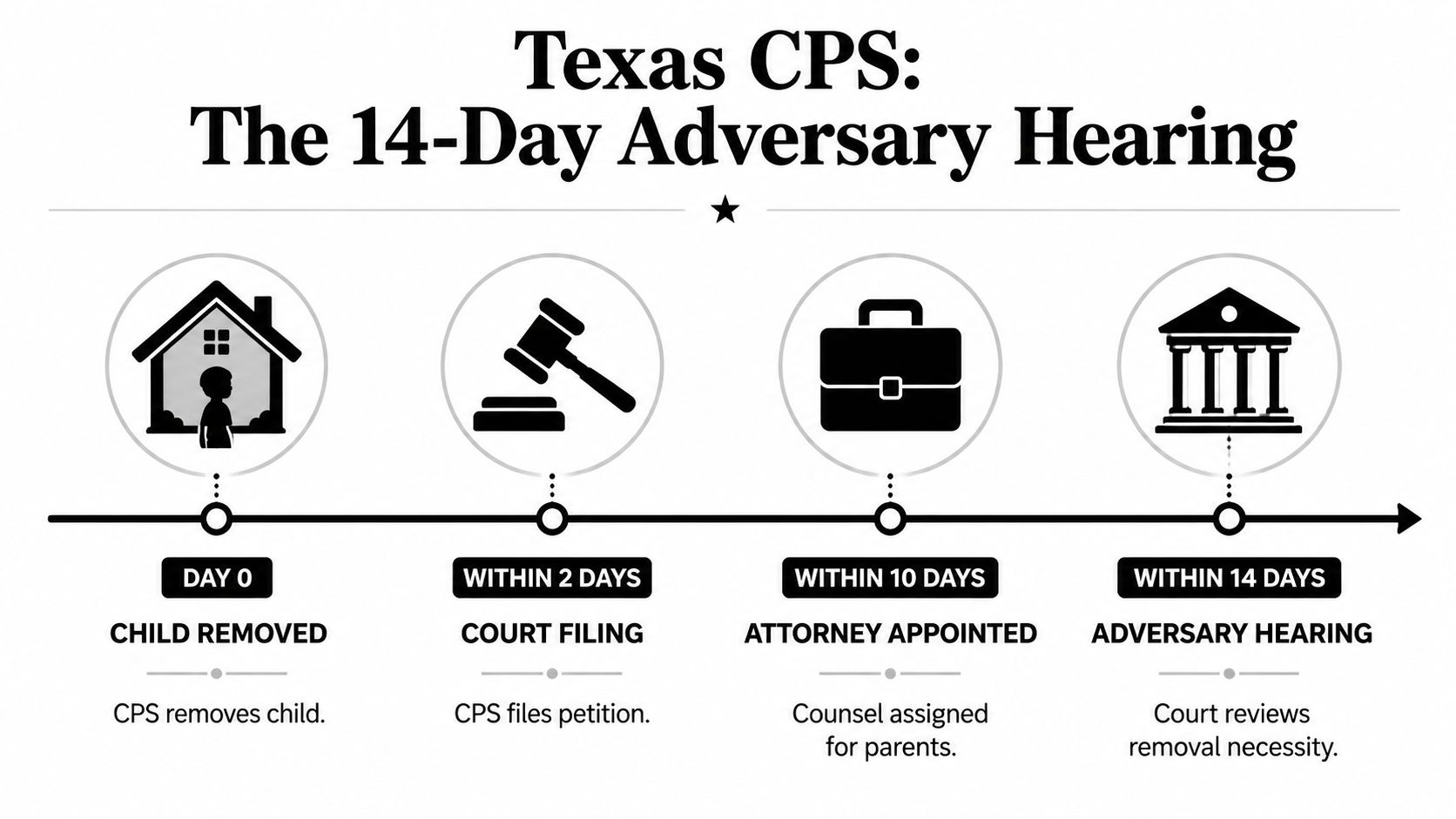
This hearing matters because it is often the best chance to challenge removal before temporary arrangements start to harden. If a parent shows up unprepared, with no documents, no witnesses, and no clear theory of the case, the court may leave the child out of the home while the case continues.
What the judge is looking at
At this stage, the court is not deciding every final issue. The court is deciding whether CPS had enough basis to remove and keep the child out of the home for now.
The agency generally relies on its removal affidavit and testimony. The affidavit should contain specific facts and identify the agency's reasonable efforts to prevent removal. That means parents need to read the affidavit closely, not just react to the label attached to them.
A good hearing presentation usually focuses on concrete contradictions:
- Timeline errors: The report says one adult was present, but records or witnesses show otherwise.
- Condition of the home: Photos, videos, lease records, utility bills, and testimony may undercut claims of instability.
- Medical context: A child's diagnosis, prescription, or prior condition may explain facts CPS presented in a more suspicious light.
- Alternative safety measures: Relatives, temporary protective steps, or other less restrictive options may show removal wasn't necessary.
How to prepare for the hearing
Parents often think the hearing is mostly about speaking from the heart. That matters, but court usually responds better to organized proof than to raw emotion.
Bring the kind of evidence a judge can absorb quickly:
| Evidence type | Why it matters |
|---|---|
| School records | Can show attendance, routine, and parental involvement |
| Medical records | Can clarify injuries, medications, or treatment history |
| Character statements | Can support your day-to-day parenting and stability |
| Photos and videos | Can rebut conditions claims about the home |
| Witnesses with direct knowledge | Can challenge hearsay with firsthand facts |
The hearing is not the place to “wing it.” It is the place to rebut the affidavit with documents, witnesses, and a credible safety plan.
The biggest mistakes
Three mistakes show up repeatedly.
First, parents miss the urgency and spend days trying to negotiate informally. Second, they assume being innocent is enough. Third, they treat family court and criminal exposure as unrelated.
If there's any chance of a criminal allegation, your testimony has to be planned with care. A rushed explanation may sound helpful in family court and still create serious damage elsewhere.
How to Preserve Evidence and Protect Your Rights Immediately
The case starts building the minute CPS shows up. So should your file.

Parents usually know they need “evidence,” but they often collect the wrong things or collect good evidence too late. Start with the ordinary records that show daily life was functioning: school attendance, pediatric records, pharmacy receipts, rent receipts, utility confirmations, work schedules, counseling attendance, and messages that provide context for the allegation.
Build an evidence file before memories shift
Create one folder, digital and paper, and sort it by category.
- Home condition proof: Photos, videos, lease, utility records, repair receipts
- Child care proof: School communications, daycare logs, attendance notes, teacher emails
- Medical proof: Discharge instructions, appointment summaries, prescriptions, immunization records
- Communication proof: Texts with the reporting party, family members, the other parent, or the caseworker
- Witness list: Names, phone numbers, and a short note about what each person personally knows
Don't edit messages, crop screenshots in misleading ways, or coach witnesses. Good evidence is clean and believable.
The criminal case problem most parents miss
Some CPS removals sit next to a possible criminal case. Allegations involving injuries, drugs, domestic violence, or child endangerment can move in that direction quickly.
One of the hardest parts of these cases is this: invoking Fifth Amendment rights in criminal court can be used against a parent in family court CPS proceedings, which applies a lower preponderance of the evidence standard, creating a real strategic dilemma for parents trying to protect themselves in both systems, as discussed at Dodson Law Offices.
That doesn't mean you should talk freely to everyone. It means your response has to be coordinated.
If a police detective, forensic interviewer, or CPS investigator is asking about the same event, assume the information may travel across cases.
In some matters, psychological or parenting-capacity evidence also becomes important. When an evaluation may help answer a specific concern, parents and counsel sometimes consider independent resources such as PPA clinical evaluations to frame mental health, parenting function, or trauma issues in a more careful way than a rushed agency assumption.
What not to do
Parents under stress make predictable mistakes. Avoid these:
- Don't consent blindly: Read requests for releases, testing, and interviews carefully.
- Don't delete anything: Deleted texts and posts can create a bad inference.
- Don't post online: Even “vague” posts about CPS, your ex, or the case can come back.
- Don't give recorded statements casually: If the facts could support criminal allegations, you need legal advice first.
Later in the case, evidence disputes may matter a great deal. In some situations, a parent's lawyer may examine whether statements, searches, or seized material can be challenged through tools such as a motion to suppress evidence in Texas.
A short discussion of these pressure points can help frame your next steps:
Working with the TDFPS Caseworker and Service Plan
You don't need to like the caseworker. You do need to deal with the caseworker strategically.
Texas CPS investigations generally aim to conclude in about 45 days, according to the DFPS parent guide to investigations. That short window means your early conduct gets judged fast. The way you communicate, how quickly you produce records, and whether you begin addressing concerns can affect how the agency frames you to the court.
Be cooperative without becoming careless
Some parents become hostile and refuse everything. Others become so eager to look cooperative that they agree to every accusation, every demand, and every framing choice CPS makes. Neither approach is smart.
A better approach is controlled cooperation.
- Answer logistics promptly: Confirm visits, drug test notices, and document requests.
- Keep communication in writing when possible: Emails and text confirmations reduce later disputes.
- Stay factual: “I completed the class and attached the certificate” is better than a long emotional explanation.
- Correct errors politely: If the caseworker gets a fact wrong, document the correction and attach proof.
Treat the Family Service Plan as a legal document
Under Chapter 263 practice, the service plan becomes one of the main ways the court measures progress. Parents sometimes treat it like homework assigned by CPS. It's more than that. It often becomes the road map the judge uses to decide whether return is safe, whether visits can expand, and whether the case moves toward reunification or something worse.
A service plan should connect to actual safety concerns. If it doesn't, challenge it through counsel rather than refusing.
Consider a common scenario. A mother is accused of neglectful supervision because the child was left with an unsafe boyfriend. She is then handed a service plan with broad requirements, including classes unrelated to the accusation and vague tasks that are impossible to measure. The strategic response is not, “I'm not doing any of this.” The better response is to complete what is reasonable, document it, and push to narrow or clarify the parts that aren't tied to the case.
Keep a caseworker log
A simple log can protect you later.
| What to log | Why it helps |
|---|---|
| Date and time of each contact | Establishes response history |
| What was requested | Prevents “you were told” disputes |
| What you provided | Shows compliance |
| Next deadline | Keeps you from missing tasks |
Use one notebook or one digital document only. Scattered notes across phones and scraps of paper create avoidable mistakes.
If criminal allegations are in the background, this is also the point where coordinated counsel matters. Some parents work with one lawyer for the CPS side and another for the criminal side. Some use a firm that handles both types of issues under one roof. What matters is that somebody is watching for conflicts between what helps in family court and what creates risk elsewhere.
Common Defenses and Strategies for Family Reunification
A removal case is not fought with one argument. It's built with a combination of defense themes, consistent proof, and visible progress.

Some defenses attack the original removal. Others focus on why the child can safely come home now. Those are different jobs, and strong cases usually do both.
Defenses that often matter
A few themes show up again and again in viable CPS defenses:
- False or exaggerated reporting: The reporting party may be an angry ex, relative, or household member with a motive.
- Weak factual support: CPS may rely heavily on hearsay, assumption, or incomplete context.
- Procedural problems: The agency may have overstated danger or ignored less restrictive alternatives.
- Changed conditions: Even if there was a problem at removal, the home, supervision plan, sobriety support, or household membership may now look very different.
Reunification is built, not announced
A parent cannot tell the court, “My child should come home,” and expect an immediate result. The court wants a safe return plan it can trust.
That usually means showing several things at once:
- The original safety concern is disputed or reduced by evidence
- The parent has complied with key services or has a good reason to challenge parts of the plan
- The home is currently stable
- Visits have gone well
- Support systems exist if stress returns
A relatable example is a father accused of unsafe parenting after a chaotic domestic dispute in a shared home. He later moves to a separate residence, documents stable work, completes counseling, brings in family members who can help with transportation and child care, and consistently attends visitation without incident. That package tells a stronger story than argument alone.
If substance use is part of the case
Substance allegations are common, and they require candor plus structure. Denial without proof usually fails. Empty promises also fail.
Parents in recovery often need to show the court a realistic support plan, not just a statement that they've “learned their lesson.” For some families, outside treatment education can help them understand how courts view co-occurring mental health and addiction issues. A plain-language guide to integrated care for addiction can be useful when treatment history, relapse risk, or dual-diagnosis concerns are part of the record.
Courts usually respond better to documented routines, verified treatment participation, and stable housing than to broad claims about personal growth.
The road back home
In many cases, progress leads first to expanded visitation, then a trial return or monitored return, then dismissal if stability holds. The key is consistency. A single completed class rarely changes a judge's mind. A pattern of reliability can.
That's why parents should think in terms of building a record. Every clean drug test, every completed class, every timely visit, every corrected household problem, every supportive witness, and every calm interaction with the caseworker adds to that record.
Your Top Questions About Fighting CPS in Texas
When parents are in crisis, the same urgent questions come up again and again. The answers below are short on purpose. The right answer in your case still depends on the allegations, the court orders, and whether criminal exposure is part of the picture.
FAQ Quick Answers to Urgent Questions
| Question | Answer |
|---|---|
| What is an attorney ad litem? | In a CPS case, the court may appoint an attorney ad litem to represent the child's interests in the litigation. That lawyer is not your lawyer. |
| Can I get a court-appointed lawyer? | Possibly. Texas Law Help notes that appointment of counsel for a parent depends on indigency, a CPS lawsuit seeking temporary managing conservatorship or termination, and formal opposition to the petition. |
| What happens if I miss court? | Missing court can seriously damage your case. The judge may proceed without hearing your side, and early missed appearances can be hard to recover from. |
| Should I testify if there may be criminal charges? | Maybe, maybe not. This is one of the most dangerous decisions in the case because protecting yourself in criminal court can hurt you in family court. Get coordinated legal advice before making that call. |
| Can I talk directly to the caseworker to fix this? | You can communicate, but don't rely on informal phone conversations to solve a removal case. Court deadlines and evidence matter more than promises. |
| What if the allegations are false? | False allegations can still lead to removal if CPS presents them effectively and the parent is unprepared. You fight false claims with documents, witnesses, and consistent follow-through. |
| Can a CPS case affect my divorce or custody case? | Yes. Allegations and temporary orders in one case can influence the court's view in the other. Family law matters rarely stay in neat separate boxes. |
Final practical answers parents need to hear
If your child has been removed, don't measure progress by whether the caseworker sounds friendly on the phone. Measure progress by what is filed, what is ordered, what is completed, and what can be proven.
If you think criminal charges might be coming, don't treat CPS interviews as harmless conversations. If you already have a criminal case, don't assume your silence in one courtroom will carry no consequences in another.
And if you've already made mistakes, that doesn't mean the case is over. Many parents begin badly because they're scared. The important move is to stop digging, get organized, and make every next step count.
If CPS has removed your child, or you believe criminal allegations may grow out of the same facts, speak with Law Office of Bryan Fagan PLLC for a free consultation. Our team helps Texas parents address the family court emergency and the criminal defense risk together, so you can make informed decisions from the start instead of reacting after the damage is done.