Skip to content
A CPS case can make your phone feel dangerous. A text you sent in frustration, a photo someone tagged you in, or a comment in a private group can suddenly seem like it might decide whether you keep your child at home, whether you get monitored visits, or whether the court questions your judgment.
For Texas parents, the fear behind the question Can CPS Use Text Messages or Social Media Against You? is real. The short answer is yes, they can. But the better answer is that how CPS gets digital evidence, how it gets admitted, and how much weight the court gives it all matter. In a Texas case under the Family Code, especially when removal, service plans, permanency, or even termination are on the table under Chapters 262, 263, and 161, digital evidence can matter a great deal. It still has to fit into legal rules.
That distinction matters because panic leads parents to make mistakes. They hand over a phone without understanding the consequences. They delete messages. They post about the case online. They argue with a co-parent in writing. Those choices usually make a hard case harder.
A better approach is to understand the system, protect your rights, and make careful decisions from this point forward.
That Heart-Stopping Moment Your Private Words Feel Public
You send a late-night text to your sister after a brutal day. You say you're exhausted, your child won't listen, and you feel like you're at the end of your rope. An hour later, you remember the open CPS investigation and your stomach drops.
That reaction is common. Parents in Texas often assume there is a clear line between private conversation and legal evidence. In a CPS case, that line is thin. Text messages and social media posts can become preserved evidence, and metadata like timestamps and sender or recipient information can help reconstruct timelines and test credibility, as noted in this discussion of digital evidence and preserved communications.
Why this feels so personal
A CPS investigation already puts your parenting under a microscope. If the Department is looking at supervision, substance use, domestic conflict, medical neglect, abandonment, or unsafe associates, your digital communications may be used to support or challenge your version of events.
In practice, that means a message isn't just a message anymore. It can become part of a narrative.
Practical rule: If a CPS case is open, treat every text, direct message, post, and photo caption as something a judge might eventually read.
What parents usually get wrong
Parents often believe one of three things:
- It was private. They think a direct message or small group post stays confined to that audience.
- It was deleted. They assume removing the message removes the risk.
- It was only a joke. They believe sarcasm, exaggeration, or venting will be obvious to everyone later.
Texas courts and CPS cases don't work that way. A message can be copied, screenshot, forwarded, exported, or produced later by someone else. And once a message is separated from tone, context, and the rest of the conversation, it can look very different from what you meant.
That doesn't mean digital evidence automatically proves CPS is right. It does mean you should take it seriously from the first day of the case.
How CPS Legally Obtains Your Digital Communications
CPS doesn't get to bypass the law and rummage through your phone just because an investigation started. That's important. Parents often swing between two bad assumptions. One is "they can see everything anyway." The other is "they can't get anything unless I give it to them." Neither is accurate.
The better mental model is this: CPS usually gets digital evidence through people, process, or court authority.
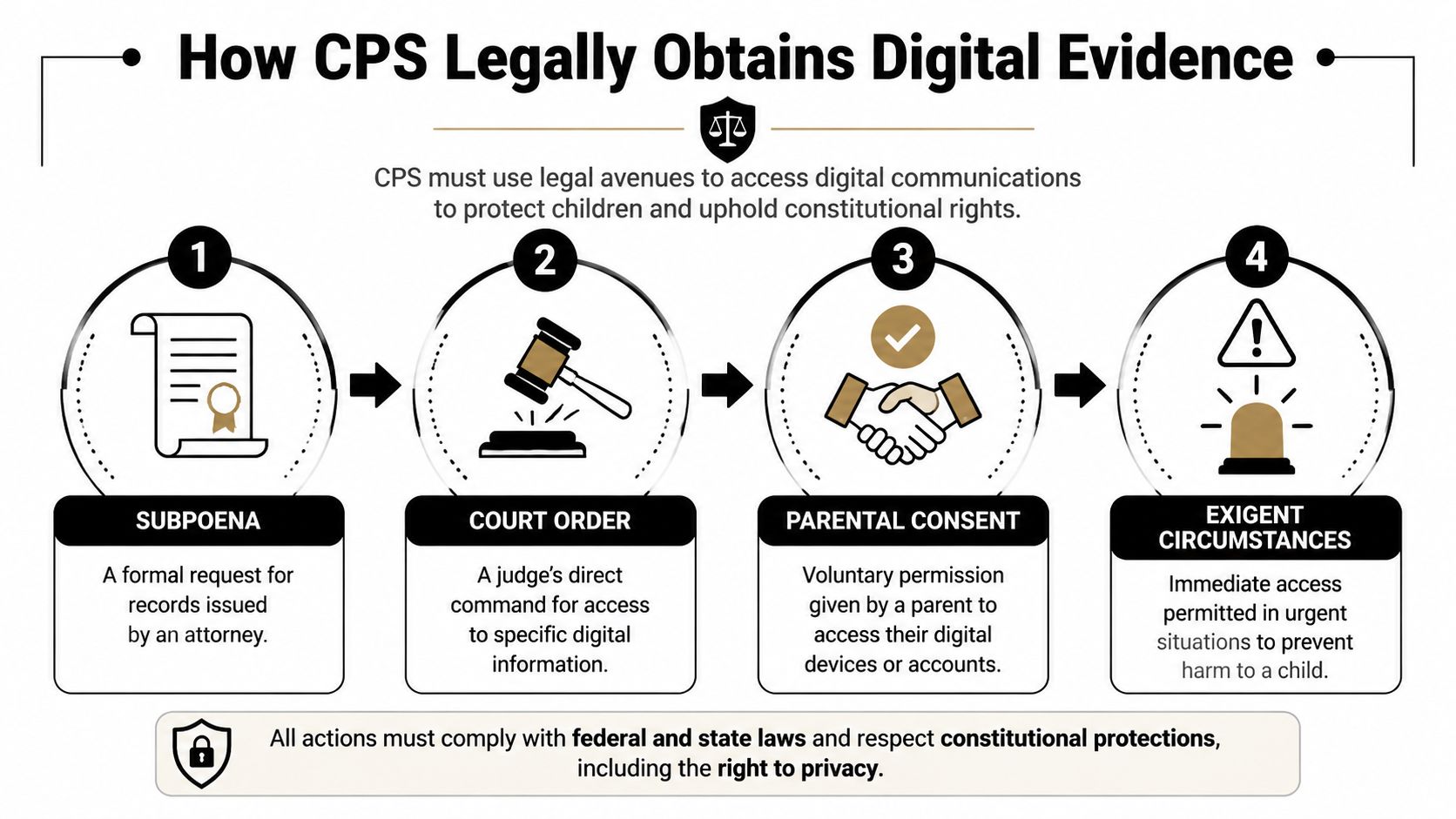
Consent is the fastest path
Sometimes a caseworker asks, "Can I see your phone?" or "Would you mind opening that message thread?" Parents often feel pressure to cooperate because they don't want to look defensive.
Be careful. Consent is powerful because it can remove a fight over access before one begins. If you're under investigation in a Texas CPS case, you should understand exactly what is being requested and why. Saying yes to "just one message" can quickly become broader review.
This is one reason illegal search and seizure issues still matter around digital evidence. If you want a clearer sense of those limits, read this overview of illegal search and seizure issues.
Third parties often create the evidence trail
A co-parent, ex, relative, teacher, neighbor, or anonymous reporter may hand CPS screenshots. A friend in a private Facebook group may forward a post. The recipient of your text may decide to share it.
That often surprises parents more than anything else. CPS may not have direct account access at the start, but a third party may voluntarily provide the content. Once that happens, the Department may use it as a lead, as impeachment material, or as part of a broader claim about risk to the child.
Subpoenas and court process matter
A major legal backdrop for phone evidence is the Supreme Court's decision in Riley v. California (2014), which recognized that phones contain vast amounts of personal data and that police generally need a warrant to search a cellphone seized during arrest. That privacy logic is part of why investigators often seek digital records through legal tools instead of assuming automatic access, as explained in this discussion of Riley and digital records.
In a Texas CPS case, that often means lawyers and parties use formal requests, subpoenas, and court orders to seek records. The exact mechanism depends on who has the material and what kind of proceeding is pending.
Search warrants and urgent situations
If law enforcement is involved alongside CPS, a search warrant may enter the picture. That's different from an ordinary request by a caseworker. It usually involves a higher level of judicial authorization.
There are also emergency child-safety situations where agencies may act quickly to protect a child. In Texas, emergency removal issues under Chapter 262 can move fast. But "urgent" does not erase legal boundaries. It changes the pace, not the need for lawful authority.
A simple way to think about it is this:
| Method | Who usually provides access | Parent control |
|---|---|---|
| Consent | The parent | High, until consent is given |
| Screenshot from another person | Third party | Low |
| Subpoena or court order | Provider or record holder | Limited, but challenge may be possible |
| Search warrant | Law enforcement with judicial approval | Very low at the access stage |
What Makes a Text Message Admissible in a Texas CPS Court
A screenshot isn't magic. A printed message thread isn't automatically true just because someone brought it to court. In Texas CPS litigation, the primary question is whether the evidence can be admitted and what the judge decides it means.
That matters in hearings tied to removal, status, permanency, final orders, and termination. Under the Texas Family Code, especially Chapters 262, 263, and 161, courts focus on child safety, parental conduct, compliance with services, and future risk. Digital evidence often gets offered to support those themes, but it still has to clear legal hurdles.

Authentication comes first
The first fight is often simple. What is this, and who created it?
A lawyer may ask:
- Was this screenshot altered
- Who took the screenshot
- How do we know this account belonged to the parent
- Is there a full message thread, or just one cropped image
- Does the metadata line up with the claim being made
That is why defense strategy often focuses on authentication, missing context, and whether a screenshot alone is enough to prove authorship or intent, as discussed in this family law analysis of digital evidence reliability.
Relevance decides whether it matters
Not every embarrassing post is legally important. The court is supposed to care about facts tied to the child, the home, the parent's judgment, safety planning, substance use, violence, or credibility.
A party photo from last year may mean very little unless CPS ties it to a claim that the child was left unsupervised, exposed to unsafe people, or placed at risk. Relevance is where the legal argument shifts from "this exists" to "this helps prove something the court needs to decide."
Hearsay is not the end of the issue
Parents sometimes hear "hearsay" and assume the evidence must be excluded. Usually, it isn't that simple. Some statements may come in as statements by a party-opponent. Other parts of a communication may still be challenged.
A strong CPS defense often isn't about pretending the message doesn't exist. It's about forcing the other side to prove who wrote it, when it was sent, what was missing, and why it actually matters.
If you are facing digital evidence in a CPS case, challenges to admissibility and context can be critical, making guidance on how to challenge CPS evidence in a Texas case especially useful.
A Parent's Digital Minefield Real-Life Scenarios
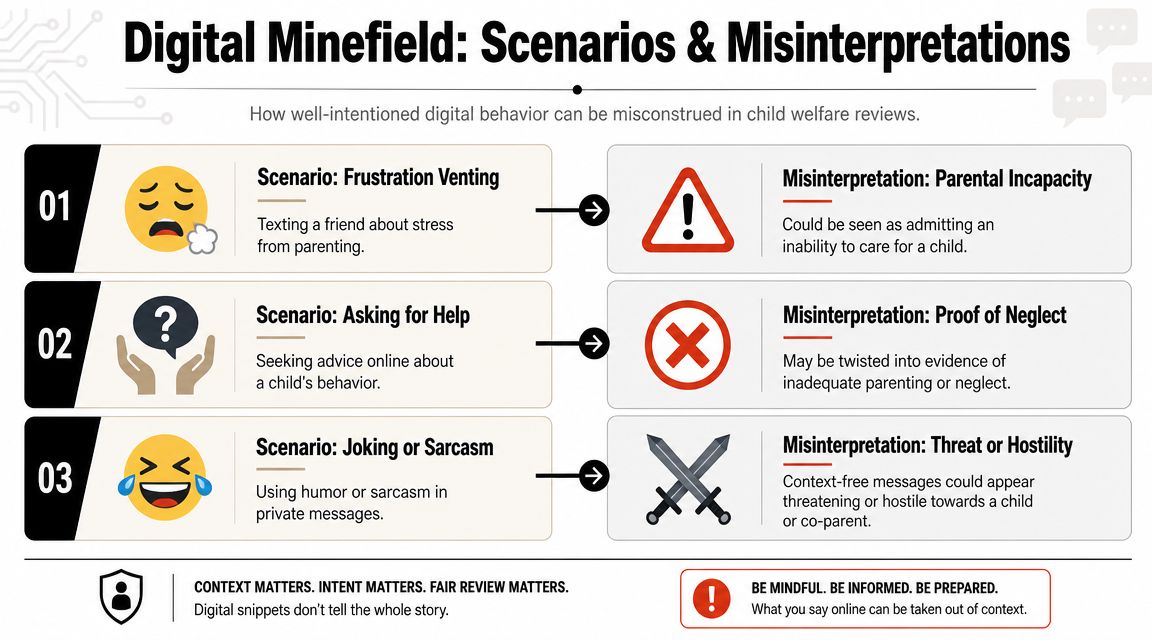
Most parents don't get into trouble online because they planned to create evidence. They get into trouble because they were tired, angry, lonely, or trying to find support.
That is why context matters so much in CPS cases. Social platforms and messaging apps create a lasting digital footprint, and stored information such as timestamps, message threads, photos, and tags can later be used to establish patterns of supervision, contact, or alleged safety concerns, as the American Academy of Child and Adolescent Psychiatry explains in its guidance on social media, privacy, and family safety.
The venting text
A mother texts her cousin after a child refuses to sleep for the third night in a row. She writes, "I'm losing my mind. I can't do this anymore."
In real life, that may be ordinary frustration. In a CPS file, stripped of tone and timing, it may be framed as proof she cannot cope with parenting responsibilities. If there are already allegations about emotional instability, untreated mental health issues, or poor supervision, that text may be used to support them.
The weekend photo
A father is under investigation after a report about unsafe conditions in the home. On Saturday, he appears in a tagged photo holding a drink at a backyard gathering. The children are not in the picture.
Standing alone, that image may not prove much. But if the case already involves alcohol allegations, missed visits, or conflicting statements about where he was, the post can become a credibility problem. A co-parent may use it to argue that his priorities are misplaced or that he was not where he claimed to be.
The private group post
A parent joins a "private" online support group for difficult child behavior. She posts that her son is acting out, she feels overwhelmed, and she doesn't know what to do next.
That may be a healthy search for support. But one member can screenshot the post. Once it leaves the group, it may be used to argue the parent lacks control, uses poor judgment, or cannot manage the child's needs without intervention.
What courts often miss at first glance: a digital statement may show stress, sarcasm, or fear. It does not automatically show neglect, danger, or inability to parent safely.
These situations are common because they're human. The danger is not only what you say. It's what someone else later says your words meant.
Practical Do's and Don'ts for Your Digital Life During a CPS Case
A good digital plan during a CPS case serves two jobs at once. It limits new damage, and it preserves the messages, photos, and timelines that may help you. Texas parents often get into trouble because they focus only on privacy. The better question is evidence. What can another person see, save, forward, or later hand to CPS or the court?

What to do starting today
- Tighten privacy settings. That does not block a subpoena or stop a friend, relative, or co-parent from sharing what they can already see. It does reduce casual exposure.
- Write every text as if a judge could read it later. That is the safest mental model in a Texas CPS case.
- Keep messages short, factual, and child-focused. Use dates, times, pickups, medications, school issues, and safety facts. Skip sarcasm, insults, and emotional side arguments.
- Preserve helpful communications. Save screenshots, export message threads, and keep records in one folder for your lawyer. Context matters. A full thread is often more useful than one isolated screenshot.
- Ask before giving CPS direct access to your phone, apps, passwords, or cloud accounts. A request is not the same as a court order. The answer may depend on the scope of the request and what authority CPS is relying on.
Parents who want a broader consumer-level resource outside the legal setting may also find this guide to securing your online presence useful as a practical checklist for reducing avoidable exposure.
What not to do
- Do not delete texts, posts, or direct messages after a case starts or after you reasonably expect litigation. That can create a spoliation problem and make a bad fact look worse.
- Do not post about CPS, your caseworker, the judge, the other parent, or the case. Even a post that feels harmless can become an exhibit about judgment, credibility, or cooperation.
- Do not vent about your child in writing. A frustrated late-night message can be recast as hostility, instability, or inability to meet the child's needs.
- Do not fight by text. Written arguments usually produce selective screenshots, and selective screenshots are common in CPS litigation.
- Do not assume “friends only,” disappearing messages, or private groups protect you. Those settings limit access. They do not stop screenshots, forwarding, or voluntary disclosure.
One practical rule helps parents make better decisions. Separate what CPS can legally compel from what CPS may otherwise receive. CPS may seek records through legal process in some situations. CPS may also get screenshots, forwarded texts, or downloaded posts from a co-parent, ex, relative, teacher, or anyone else who already has access. Both routes can create evidence problems, but they raise different legal objections.
When legal help fits into the digital plan
Sometimes the issue is not just what a message says. The issue is how it was obtained, whether it is complete, and whether it can be authenticated under the Texas Rules of Evidence. If digital evidence was gathered improperly, a motion to suppress evidence in Texas may be part of the response.
The Law Office of Bryan Fagan PLLC handles CPS and related family law matters. In the right case, a lawyer can help you preserve favorable evidence, object to misleading screenshots, and decide whether CPS is asking for something it can require.
The Myth of the Deleted Message and Private Groups
Deleting a message feels productive. It rarely solves the legal problem.
Once a communication is sent, control changes hands. The recipient may still have it. A screenshot may already exist. A backup may preserve it. A cloud sync may retain a copy. Even if you remove something from your side, that doesn't mean it has disappeared from every place it touched.
Why deletion is usually the wrong move
In CPS cases, deletion creates two risks at once. First, the content may still surface anyway. Second, the act of deleting can make you look like you were trying to hide something after the investigation began.
That is especially dangerous if the deleted material would have shown context instead of harm. Parents sometimes erase whole threads because one line looks bad, only to lose the surrounding conversation that would have helped explain tone, timing, or who started the conflict.
Private groups aren't private in the way parents hope
A private Facebook group, a closed chat, or a limited audience story can feel safe because access is restricted. Legally and practically, that confidence is misplaced. Any member can screenshot content and share it outside the group.
The same is true for direct messages. Privacy settings control who is invited in. They do not control what invited people do with what they see.
If you're discussing your CPS case, your parenting, your mental health, substance use, or your child's behavior in any digital forum, assume another copy can exist somewhere else by the end of the day.
If you need a plain-English reminder of how recoverable digital information can be, even outside litigation, resources about how technicians recover lost data help illustrate the basic point. Deleting something and making it unreachable are not the same thing.
The safest course during a CPS case is simple. Preserve what exists. Stop creating careless material. Move sensitive discussions to your lawyer's office, not your phone.
You Are Not Alone Navigating a CPS Investigation
When parents ask, Can CPS Use Text Messages or Social Media Against You?, they are usually asking something deeper. They want to know whether one bad message, one misunderstood post, or one ugly screenshot can wreck their case.
Sometimes digital evidence does serious damage. In Texas CPS litigation, especially when the court is making decisions under Chapters 262, 263, and 161 of the Family Code, words on a screen can affect removal, services, visitation, reunification, and termination arguments. But that does not mean every screenshot wins the case for CPS.
It means the case needs context. It means the evidence needs to be tested. It means someone needs to ask whether the message is authentic, complete, relevant, and fairly interpreted. It also means you need a plan from this point forward, because judges pay attention to what parents do after the investigation begins.
If you're in this situation, focus on the next right steps:
- Preserve existing messages and posts
- Stop posting about the case
- Communicate in short, factual language
- Get legal advice before giving consent to broad digital access
- Take every hearing and service requirement seriously
You do not have to sort out admissibility, subpoenas, screenshots, and Family Code deadlines by yourself. A good attorney does more than show up in court. Your lawyer helps frame your messages in context, challenge weak digital evidence, push back on overreach, and keep one bad exhibit from becoming the whole story of your family.
The stress of a CPS case can make parents feel isolated and judged. You are not the first parent to be scared by what might be on a phone. You are not the first parent whose words came out badly in a hard moment. And you are not without options.
If CPS is involved and you're worried that texts, screenshots, or social media posts may be used against you, talk with Law Office of Bryan Fagan PLLC for a free consultation. A confidential case review can help you understand your rights, your risks, and the steps you can take now to protect your family and present your side of the story clearly in court.