Skip to content
A CPS investigator shows up at your door, asks urgent questions, looks around your home, and leaves you with paperwork that feels impossible to read straight. You're scared, angry, and trying not to say the wrong thing. Most parents in that moment feel outnumbered before the case has even started.
You are not powerless.
In Texas, CPS still has to support its position with evidence, and weak evidence can be challenged. The key is speed, organization, and knowing where the pressure points are. If you're trying to figure out How to Challenge CPS Evidence in a Texas Case, start thinking in a timeline. What you do on day one is different from what matters at the first hearing, and different again from what matters in an administrative review or final court fight.
A common situation looks like this. A parent agrees to talk freely because they think cooperation alone will fix everything. Weeks later, the CPS report reflects only the worst interpretation of those conversations, leaves out context, and treats assumptions like established fact. By then, the parent is trying to undo a written record that should have been challenged immediately.
That's why your response has to be both calm and strategic. You need to preserve your own proof, force disclosure of the agency's file, identify weak spots in the investigation, and present a stronger, better documented story than the one CPS is trying to tell.
The Knock on the Door Your World Turned Upside Down
The hardest part of a CPS case is often the beginning. You're standing in your own doorway, but suddenly it feels like you're on trial. The investigator may sound polite, but every answer, every hesitation, and every room in your house can become part of a report that follows your family for a long time.
That first contact creates pressure. Parents often feel they must explain everything immediately, sign whatever is handed to them, and trust that the truth will sort itself out later. In practice, later can be too late. Once a narrative gets written into a CPS file, your lawyer may spend months correcting a version of events that never should have gone unchallenged.
A better approach starts with this simple rule: take the case seriously from the first minute. That doesn't mean being hostile. It means being careful, respectful, and deliberate.
Practical rule: The first story in the file often becomes the baseline everyone else reacts to. If it's incomplete or slanted, challenge it early.
If CPS has already contacted you, slow the situation down. Ask for the investigator's name, contact information, and the basic nature of the allegation. Keep every paper they leave. Write down what was said as soon as the conversation ends. If you need immediate guidance on first-contact decisions, this resource on how to respond when CPS shows up at your door in Texas is a good starting point.
You still have rights. You still have options. And in many cases, the difference between a weak defense and a strong one is whether the parent started preserving facts before CPS turned assumptions into evidence.
The First 48 Hours Preserving Your Rights and Evidence
The first two days after CPS contact are not for guessing. They're for building a record of your own.

If a child has been removed, the timeline gets serious fast. According to Texas Home School Coalition's discussion of CPS hearing and investigation timing, CPS must provide evidence at a hearing within 14 days after removal, and investigators often must complete the investigation within 30 to 45 days, which can lead to a “Reason to Believe” finding and a tight review deadline. That's why evidence preservation can't wait.
Start your own case file
Don't rely on memory. Open a notebook, a notes app, or a clearly labeled folder and begin logging events in order.
Include:
- Names and roles of every CPS worker, police officer, doctor, teacher, or relative involved
- Dates and times of visits, calls, texts, and interviews
- Exact statements that matter, especially threats, promises, or instructions
- Documents received such as notices, safety plans, business cards, and reports
- Your own observations about your child's condition, your home, and witness presence
This timeline helps in two ways. First, it preserves details while they're still fresh. Second, it lets your attorney compare your account against later CPS summaries for omissions and inconsistencies.
Preserve the evidence CPS may ignore
CPS files often leave out facts that help parents. That's why you need your own proof.
Focus on objective material:
- Photos and video of the home. Take clear, date-preserving images of food, sleeping arrangements, medication storage, utilities, and general conditions.
- Medical information. Save discharge papers, prescriptions, appointment summaries, therapy attendance, and vaccination or treatment records where relevant.
- School records. Attendance reports, report cards, teacher emails, and behavior notes can all matter.
- Communications. Screenshot texts, save voicemails, and export emails rather than assuming they'll stay on your phone.
- Witness information. Write down names and contact details for neighbors, relatives, childcare providers, counselors, or coaches who have direct knowledge.
If a fact matters, preserve the original form if you can. A screenshot helps, but the full text thread, metadata, or original email chain is often stronger.
Be careful with entry, interviews, and signatures
Many parents ask whether they have to let CPS in immediately. The legal answer depends on the circumstances, and the strategic answer depends on the facts. Before making that call, review this guide on whether you can refuse CPS entry in Texas.
Also be cautious about “voluntary” paperwork. A safety plan may be presented as temporary, cooperative, or informal. But what you sign can shape later arguments about danger, admission, and your parenting decisions. If you don't understand a document, pause and get legal advice before signing.
What works and what usually doesn't
Here is the trade-off parents need to understand.
| Response | Likely result |
|---|---|
| Organized documentation | Gives your attorney material to test CPS claims |
| Calm, limited communication | Reduces harmful statements and confusion |
| Immediate evidence preservation | Helps before deadlines close |
| Long emotional explanations | Often create statements that can be quoted out of context |
| General denials without proof | Rarely move the case |
| Assuming CPS will gather favorable evidence | Often leaves major gaps uncorrected |
The first 48 hours don't determine everything, but they often determine whether you'll be reacting to CPS's version or presenting one of your own.
Using Discovery to Uncover the CPS Case File
You can't challenge evidence you haven't seen. In a Texas CPS case, one of the most important turns happens when you stop arguing with accusations in the abstract and start reading the actual file.
Discovery is where parents often realize the case is not built on one clean piece of proof. It may rest on summaries, selective quotations, hearsay-heavy notes, and missing context. Texas DFPS guidance on evidence recognizes that objections should target specific objectionable documents rather than broad complaints about the entire file, as discussed in the DFPS attorneys' evidence guide.
What to request
A complete file review should go wider than the final report. Ask your attorney about obtaining:
- Investigator narratives and handwritten notes
- Audio or video recordings of interviews
- Photographs taken by CPS
- Medical or drug test records CPS relied on
- Emails or internal communications, when obtainable
- Safety plans and service plans
- Affidavits used to support removal
- Referral information and intake summaries
Some of those items may be incomplete, redacted, or delayed. That alone can matter. If CPS relied on a fact but cannot produce the underlying support, your lawyer may be able to challenge the weight of that claim.
How to read the file like a case builder
Don't read the file looking only for obvious lies. Read it looking for weakness.
Red flags include:
- Leading questions in child interviews that suggest the answer before the child gives it
- Conclusions without sourcing, such as a statement that a parent was “agitated” without describing conduct
- Facts that change over time across notes, affidavits, and testimony
- Missing follow-up, such as a failure to contact a doctor, school, or favorable witness
- Summaries that overstate certainty, especially when the original statement was tentative
- Document gaps, where a major allegation appears without records that should exist
A weak CPS document is not useless to the agency. It can still influence a judge if nobody pinpoints why it is unreliable.
Comparison work matters significantly at this stage. If your case includes multiple drafts, affidavits, notes, and reports, tools that help discover essential features of legal comparison can make it easier to identify changed language, omitted facts, and inconsistencies across versions.
A relatable example
Suppose the report says your child “disclosed ongoing neglect.” That sounds powerful until you review the interview notes and recording. Maybe the child never used that language. Maybe the investigator asked the same question several times in different ways. Maybe the child's full answer included that meals were skipped only when the child was upset and refusing food, but the report left that out.
That isn't a technicality. It goes directly to reliability.
Target the quality, not just the existence
Parents often say, “But they have no evidence.” Sometimes CPS has something in the file. The better question is whether that material is trustworthy, complete, and properly supported.
That distinction matters. A file can look thick and still be fragile.
If your lawyer shows that a key report is cumulative, poorly authenticated, unsupported by first-hand knowledge, or contradicted by stronger records, the case starts to shift. The goal isn't just to say CPS is wrong. The goal is to show why their proof should carry less weight than yours.
Building Your Counter-Narrative with Strong Evidence
A parent can do everything right for years and still freeze when reading a CPS report that makes ordinary family stress sound like danger. I have seen that moment many times. The way out is to start building your own record, organized by allegation and by date, so the court sees more than the agency's version of events.
Once you know what CPS is relying on, your job is to present a documented timeline that answers each claim with proof. In administrative CPS findings, the standard is lower than in criminal court, so parents often get better results by showing why the investigation was incomplete, one-sided, or contradicted by reliable records, as described in this Texas discussion of CPS administrative findings and appeals.
Start with the allegation. Then match it to records, witnesses, and dates.
Build your proof around each claim
If CPS alleges drug use, collect lawful test results, treatment records if they help, prescription records, and any written recommendation from a provider that explains the result in context. If the allegation is educational neglect, pull attendance records, emails with school staff, notices about illness, transportation issues, or special education needs. If CPS claims unsafe housing, gather current photographs, repair invoices, lease documents, inspection records, and statements from people who have recently been in the home.
Specificity matters. A judge is more likely to trust a dated record tied to a particular event than a broad statement that you are a good parent.
Your Evidence Gathering Checklist
| Evidence Category | Examples | Why It's Important |
|---|---|---|
| Home condition | Photos, videos, repair invoices, lease documents | Counters claims of unsafe or unsanitary living conditions |
| Child wellbeing | Medical records, counseling attendance, prescription records | Shows care, treatment, and follow-through |
| Education | Attendance records, report cards, teacher emails | Responds to neglect allegations tied to school |
| Parent conduct | Text messages, call logs, calendars, work schedules | Adds context to disputed events and availability |
| Third-party support | Statements from relatives, coaches, childcare providers, counselors | Supplies firsthand observations CPS may have missed |
| Substance-related claims | Independent test results, treatment participation records | Challenges assumptions and supports compliance |
| Relationship evidence | Parenting journals, photos, visitation logs, therapist observations | Helps show ongoing bond and day-to-day care |
Use third-party records first
Independent records usually carry more weight than character letters from friends and relatives. Medical charts, school attendance logs, pharmacy records, daycare sign-in sheets, employer schedules, and timestamped messages often do more work because they were created for reasons unrelated to your case.
Affidavits still matter. They are strongest when they explain or authenticate another record, or when the witness has direct personal knowledge CPS ignored.
The strongest counter-narrative ties one disputed CPS statement to one stronger piece of proof.
That timeline approach matters from the first investigation through the final hearing. If an investigator says you missed medical care, show the appointment date, the provider note, the follow-up instructions, and the refill record. If CPS claims you left a child unsupervised, show the pickup text, the after-school sign-out sheet, your work schedule, and the caregiver's statement. Each item should answer who, what, when, and how the agency got it wrong.
Preserve recordings and get them reviewed accurately
Interview recordings, voicemails, body cam audio, and supervised visitation recordings can become important fast. Save the original file. Save screenshots that show the date and sender. Keep a copy in a secure folder your lawyer can access. If a key issue turns on what was said during an interview, families sometimes use secure audio to text tools to help counsel review long recordings closely and compare them to CPS summaries.
In some cases, your lawyer may also look at whether a statement, search, or seizure can be challenged procedurally. If that issue is in play, this overview of a motion to suppress evidence in a Texas CPS case explains how exclusion arguments can fit into the broader defense strategy.
Experts can help, but only when the issue justifies the cost
Not every case needs an expert. Parents in crisis should hear that plainly, because expert work can be expensive and sometimes unnecessary.
The right expert can still make a difference when the case turns on a technical issue. A physician may review whether an injury was misread. A licensed counselor may evaluate parent-child interaction. A substance use professional may explain testing limits, false positives, treatment compliance, or why a result does not prove impairment during parenting time. A private investigator may locate a witness CPS never interviewed.
Good strategy means spending money where it changes the result.
A pattern that often changes the case
A parent is accused of failing to provide proper supervision. CPS has a neighbor complaint and an investigator summary. The parent responds with work schedules, after-school program records, text messages confirming pickup, school attendance documents, and a statement from the actual caregiver. That record does more than deny the allegation. It gives the judge a cleaner, dated, fact-based story that can be tested against the agency file.
That is how a counter-narrative works in practice. It does not depend on outrage. It depends on proof, organization, and timing.
Attacking Weak CPS Evidence in Court and Administrative Reviews
If you are walking into a hearing with a CPS report that makes you sound careless, dangerous, or dishonest, it can feel like the case is already decided. It is not. Weak evidence can be challenged, and timing matters. The record you built from the first contact with CPS often decides how much room your lawyer has to push back in court and in any later review.
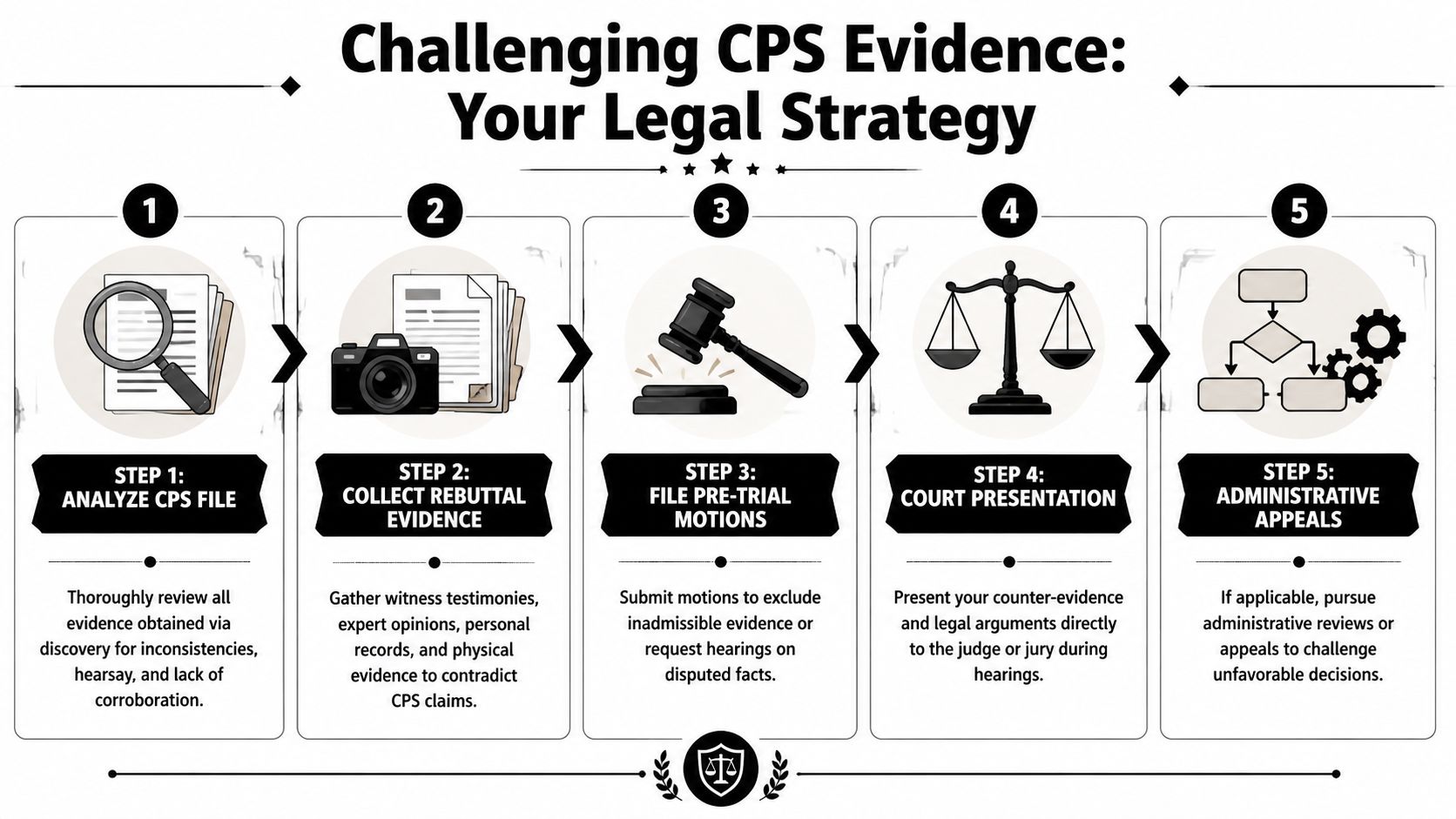
After an emergency removal, the first major court setting usually arrives fast. Under Texas DFPS policy describing the adversary hearing standard under Texas Family Code § 262.201, DFPS must present evidence that would satisfy a person of ordinary prudence and caution that the child remaining in the home would be contrary to the child's welfare. That standard still gives your side room to attack reliability, expose missing facts, and force the agency to defend how it built the case.
In court, the attack has to be precise
Judges hear broad denials every day. What gets attention is a specific defect tied to a document, a witness, a test result, or a gap in the investigation.
Your attorney may object to:
- Hearsay statements with no reliable first-hand source
- Records that were never authenticated by someone who can identify and explain them
- Testing evidence with chain-of-custody problems
- Incomplete investigations where CPS skipped obvious witnesses or records
- Evidence gathered in a legally improper way
If the problem is how evidence was obtained, your lawyer may file targeted motions instead of waiting to argue about weight at the hearing. This Texas guide to motions to suppress evidence in CPS cases explains how exclusion arguments can change the case before the judge ever decides credibility.
Cross-examination often exposes what the report hides
A written affidavit can sound polished because it is one-sided and compressed. Live testimony is different. The caseworker has to answer direct questions about what they saw, what they assumed, what they failed to check, and why they left out facts that helped the parent.
That is often where pressure builds.
A good cross-examination may show that the investigator relied on a second-hand accusation, never interviewed the daycare provider, summarized a medical issue without speaking to the treating doctor, or treated a missed callback as proof of noncooperation. Those points do not erase every allegation, but they can cut down the weight the court gives the agency's story. In close cases, that matters.
Administrative reviews require a different record
Some parents also need to challenge CPS findings outside the courtroom, especially when they are trying to correct or remove damaging records. Administrative reviews usually reward organization more than emotion. The strongest presentations line up the allegation, the agency claim, the missing support, and the records that contradict it.
Deadlines matter here. So does format. A scattered response full of understandable frustration usually carries less force than a dated packet with school records, medical records, witness statements, test explanations, and a short timeline that points out exactly where CPS got it wrong.
Technical cases may also require a specialist who can explain why an injury was misread, why a test result proves less than CPS claims, or why a mental health concern was overstated. If you are sorting out what kind of professional fits your case, this guide on expert witness types for attorneys can help frame the options.
Parents need to hear this clearly. You do have rights. You do have ways to challenge bad evidence. The strongest strategy usually starts early, stays organized, and forces CPS to prove its claims with reliable facts instead of assumptions. If your case is already headed to a hearing or review, get legal help quickly so the challenge is built around the timeline that controls the result.
Your Questions Answered About Challenging CPS
If a CPS investigator has already been in your home, talked to your child, or filed papers based on an incomplete story, you may feel like the case is already decided. It is not. In Texas, parents often have more room to challenge weak evidence than they realize, but the timing matters, and so does the way the challenge is built.
These are the questions parents ask when they are trying to protect both their children and their record.
Can I challenge CPS evidence even if I already cooperated
Yes.
Letting CPS into the home, answering questions, signing releases, or trying to be polite does not mean you gave up the right to fight inaccurate evidence later. Many parents cooperate early because they are scared and want to show they have nothing to hide. I understand that instinct. It is common, and it does not end your case.
The crucial question is what happened after that cooperation. Did the investigator quote you accurately. Did the file leave out context. Did CPS rely on a summary that oversimplified what a doctor, teacher, or relative said. Those are all points that can be challenged.
From a strategy standpoint, early cooperation changes the work. It means your lawyer may need to compare your recollection, texts, medical records, and witnesses against the agency write-up line by line.
What if CPS has only partial or second-hand information
That happens often, and it can be a serious weakness in the CPS case.
Some files are built on layers of repetition. A neighbor tells a teacher, the teacher tells CPS, the investigator writes a summary, and by the time the allegation reaches court, it can sound firmer than it really is. The closer you get to the original source, the more holes sometimes appear.
Ask practical questions. Who saw the event. Who is repeating someone else's statement. Did the wording change from one report to the next. Is there a record that directly contradicts the claim.
Second-hand information is not always useless, but it should not go untested. If CPS built its timeline on assumptions instead of firsthand proof, that can become a strong point of attack.
Can I fix a false CPS finding after the investigation ends
Often, yes. But you may have a short window to act.
A lot of parents relax when home visits stop or calls slow down. Then they learn that an adverse finding still exists in agency records. That finding can affect future custody disputes, job opportunities in certain fields, professional licensing, or the way later reports are viewed.
The timeline matters here. Once the investigation closes, the focus usually shifts from arguing with the investigator to meeting the right review deadline, assembling the right documents, and challenging the written finding directly. If you wait too long, a bad finding can stay in place even when the underlying evidence was weak.
That is one reason I tell parents to treat the end of an investigation as another deadline, not a victory lap.
What should I avoid doing if I think CPS got it wrong
Avoid actions that help CPS clean up a weak case.
Common mistakes include:
- Waiting to gather records. School, medical, counseling, and phone records can take time to get.
- Sending long emotional messages. Those messages often become part of the file and can distract from the facts.
- Talking loosely with third parties. Relatives, ex-partners, and family friends sometimes become witnesses.
- Assuming the truth will sort itself out. Courts decide cases based on admissible evidence and deadlines, not intuition.
- Trying to explain every detail from memory. A rushed explanation can create inconsistencies that a written timeline would have avoided.
A better approach is disciplined and boring. Save records. Write down dates. Identify witnesses. Keep communications short and accurate. That approach is far more persuasive than anger.
Do judges always believe CPS
No.
Judges know CPS investigations vary in quality. Some are careful and well documented. Some are rushed, incomplete, or too dependent on one-sided interviews. The court's job is not to rubber-stamp the agency's position.
Still, judges work with the record presented to them. If CPS has a clean timeline and you have only a general denial, the agency may look more credible even when the facts are weaker than they appear. That is why a successful challenge usually ties each disputed claim to something concrete: a missing witness, a contradiction in the file, a medical explanation, a school record, a timestamp, or a procedural failure.
Is it worth hiring a lawyer early
In serious CPS matters, usually yes.
Early legal help can change what gets preserved in the first days, what is requested from CPS, how interviews are handled, what objections are made, and whether a bad finding is challenged before it hardens into the official version of events. That is the strategic timeline parents need to understand. The first knock on the door matters. The first 48 hours matter. The period after the investigation closes matters too.
There are trade-offs. Hiring counsel early costs money at a time when many families are already under pressure. But waiting can cost access to records, missed deadlines, avoidable statements, and lost opportunities to challenge the case while the facts are still fresh.
You do not have to figure this out alone. If CPS is relying on weak interviews, incomplete records, or conclusions that do not match the facts, the attorneys at Law Office of Bryan Fagan PLLC can review the case, explain your options, and help you respond on the timeline that controls the outcome. Contact the firm for a free consultation if you need clear next steps now.