Skip to content
When you fail a CPS drug test in Texas, panic usually hits before clarity does. Your phone rings. A caseworker says the result came back positive. Your mind jumps straight to the worst outcome. Are they taking my kids today? Do I need to explain everything? Should I refuse to talk? Could I be arrested too?
Those fears are common, and they aren't irrational. A positive test can affect where your children stay, what CPS asks of you, what a judge does next, and whether a criminal investigation starts moving alongside the CPS case. What matters now is not guessing. It's responding carefully and fast.
A failed test is serious, but it is not an automatic end to your parental rights. In many cases, the outcome depends less on the test result itself and more on what the parent does in the hours, days, and weeks after it. Calm decisions, documented treatment, and a legal strategy that accounts for both family court and possible criminal exposure can change the direction of the case.
The Moment Your World Stops The Shock of a Positive Test
For many parents, the moment doesn't feel legal at first. It feels personal. You hear that the test is positive, and everything else fades out. You may be standing in a parking lot after work, sitting in your kitchen, or trying to act normal while your child is in the next room.
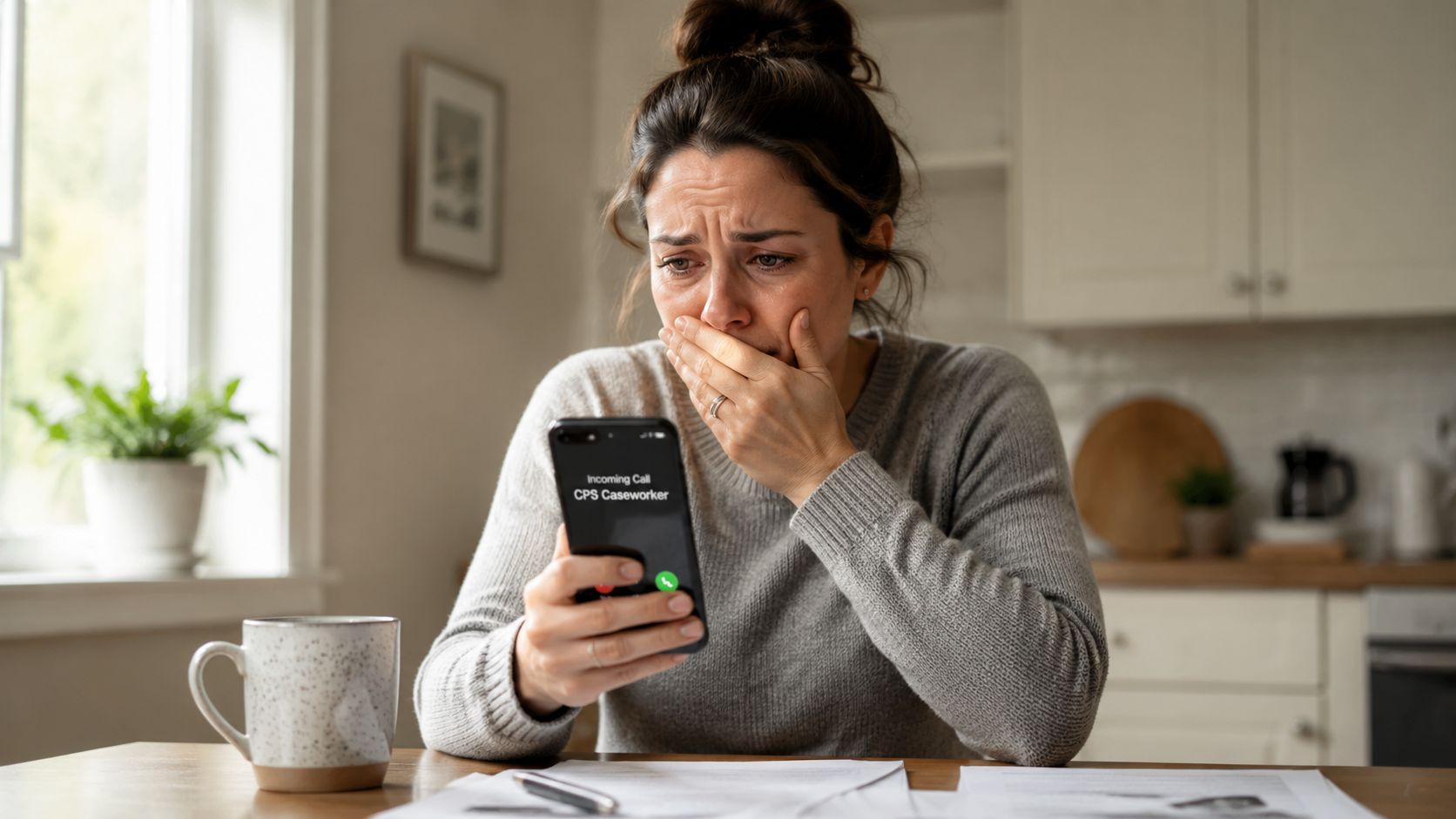
A very typical scenario looks like this. A parent agrees to test because the caseworker says it will help “clear things up.” Then the result comes back positive for something the parent says was from old use, a prescription issue, or a single mistake. The parent's first instinct is often to explain everything at once. That usually makes things worse, not better.
What parents usually feel first
Most scared parents cycle through the same thoughts:
- Fear about removal: You want to know if your children are about to be taken.
- Shame and defensiveness: You feel judged before you've had a chance to speak.
- Confusion about your rights: You don't know what you must do versus what CPS is asking you to do.
- Terror about criminal charges: You realize this may no longer be only a CPS problem.
A positive CPS test creates pressure. Pressure causes bad decisions. Slow down before you start talking.
What actually helps in the first hours
The first useful step is to stop trying to fix the case with one emotional conversation. CPS usually isn't deciding your future based on how upset you sound on the phone. They are looking at safety, evidence, cooperation, and whether there is a plan for the children.
If treatment or retesting becomes part of your response, use providers that understand formal testing and documentation. Parents sometimes start by reviewing Paramount Recovery's substance testing options so they can better understand how different tests are used and what records matter.
Two things can be true at once. You may love your children, and you may also be in a legal situation that can spiral quickly if handled casually. That's why fear has to turn into a plan.
Immediate CPS Actions After a Failed Drug Test
Once CPS has a positive result, the case usually speeds up. The caseworker may want to see the children, inspect the home, talk to relatives, or ask who can supervise the kids if CPS decides the current arrangement isn't safe.
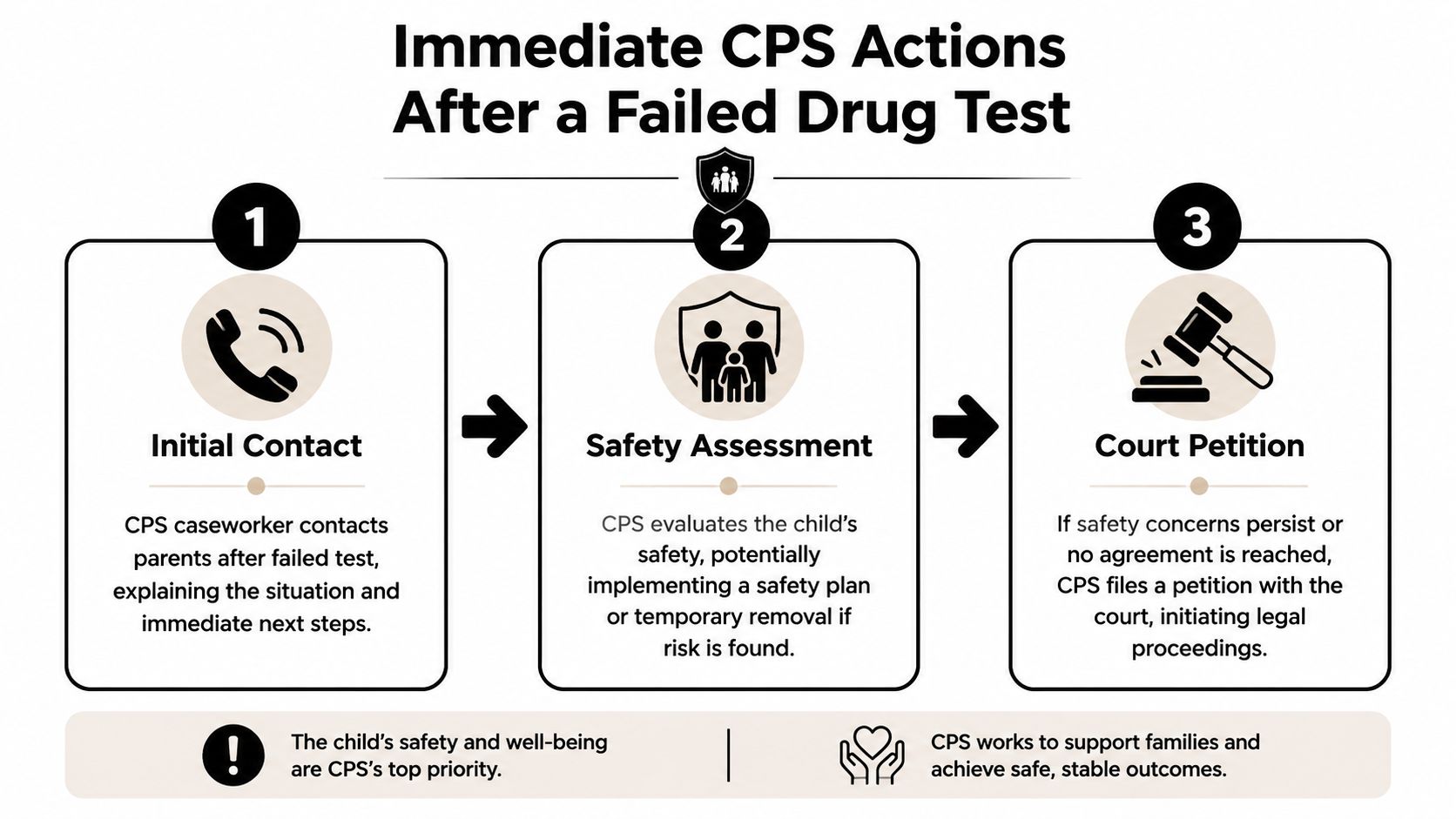
If you need a primer on how testing issues fit into a broader investigation, this guide on CPS drug testing in Texas is a useful starting point.
What CPS may do right away
In the short term, expect some combination of these moves:
- Increased contact: The caseworker may call, text, or arrive unannounced.
- Child checks: CPS may insist on seeing the children quickly and assessing their condition.
- Family interviews: The agency may speak with the other parent, grandparents, or anyone living in the home.
- Safety planning: CPS may ask for a temporary arrangement where another adult supervises contact or where the children stay with a relative.
- Service demands before court: Even before a judge enters orders, CPS may push you toward an assessment, counseling, or treatment.
A parent often asks whether a safety plan is “voluntary.” On paper, many are. In practice, parents feel enormous pressure to agree because the alternative may be a removal request. That doesn't mean you should refuse automatically. It means you should understand exactly what you are signing, how long it lasts, and whether violating it will be used against you later.
Removal without a court order
Texas law does allow emergency action in the most serious situations. Under Texas Family Code § 262.102, if CPS has evidence of an immediate danger to a child, they can take possession of the child without a court order, but must file a suit and have a hearing within 14 days.
That is why the hours after a failed test matter so much. CPS is not just evaluating whether you used a substance. The agency is evaluating whether your child is in immediate danger right now.
Here's a helpful overview of the process many parents face next:
What works and what doesn't
A smarter response usually looks like this:
| Response | Usually helps | Usually hurts |
|---|---|---|
| Communication | Brief, polite, documented | Long emotional explanations |
| Testing issue | Ask for records and clarification | Arguing with the collector or caseworker |
| Child safety | Present a sober, safe adult option | Pretending CPS has no authority |
| Treatment | Start a real evaluation quickly | Waiting to see if things “blow over” |
If you need to begin documenting substance use concerns in a structured way, a formal drug and alcohol evaluation can be an important piece of your file, especially when the result needs context beyond the raw test.
Practical rule: Do not lie, do not volunteer extra facts, and do not sign anything you don't understand.
Navigating the Texas Court System and Temporary Orders
A failed drug test often becomes the engine that moves a CPS investigation into court. Once that happens, the case stops being an informal conversation with a caseworker and becomes a lawsuit that can control possession of your children, your visitation, and your daily choices.
How the case reaches a judge
Sometimes CPS asks the court for immediate orders based on the test result and surrounding facts. Sometimes the agency first pushes for an agreement outside court and goes formal only if the parent resists or the facts look dangerous. Either way, the positive test is usually framed as evidence of endangerment, impaired supervision, or an unsafe home environment.
You may hear terms like TRO, adversary hearing, or temporary orders. Those terms matter because they define who has custody while the case is pending and what you must do to move toward reunification.
The early hearings that matter most
A useful way to think about the first phase is this:
- Temporary restraining order: This is an emergency order that can set short-term limits quickly.
- Adversary or show cause hearing: This is the first major hearing after an emergency removal or emergency court action.
- Temporary orders hearing: The court decides where the child stays, what access parents get, and what rules apply while the case continues.
At these hearings, the judge is not deciding the final outcome forever. The judge is deciding where the child should be while the case is still being investigated and litigated. That temporary decision can shape everything that follows.
What the judge is looking for
Judges usually focus on practical safety questions:
| Court concern | What the judge may ask indirectly |
|---|---|
| Current sobriety | Is the parent using now or recently? |
| Child supervision | Who watches the child day to day? |
| Home stability | Is there another safe adult in the home? |
| Parent credibility | Does the parent minimize, deny, or take steps to fix the issue? |
| Follow-through | Has the parent started services or ignored the problem? |
The legal standard in these early hearings is lower than what many parents expect. CPS does not need to prove the entire case the way a prosecutor would try to prove a criminal charge at trial. That's one reason parents hurt themselves by treating the first hearing casually.
A common example is a father who says, “I only used on weekends, never around my daughter.” He thinks that statement helps. In family court, CPS may answer that any admitted use raises judgment and supervision concerns, especially if the child is young or there was no sober backup caregiver. The statement can then live in the court record long after it leaves his mouth.
The temporary hearing is not a dress rehearsal. It often sets the living arrangement, the visitation structure, and the tone of the entire case.
What temporary orders can include
Temporary orders may address:
- Where the child lives
- Whether visits are supervised
- Who can supervise
- Whether drug testing continues
- Whether treatment, counseling, or classes start immediately
- Who can access school or medical information
If you walk into that stage without a plan, CPS supplies one for you. If you walk in with verified treatment steps, possible relative placements, and a parent who understands the difference between explanation and self-incrimination, the case looks very different.
Creating and Completing Your Court-Ordered Service Plan
Once the court gets involved, many parents are handed a service plan and read it like a punishment sheet. That's understandable, but it's the wrong mindset. In most cases, this plan is your roadmap back to unsupervised contact, expanded visitation, and eventually reunification.
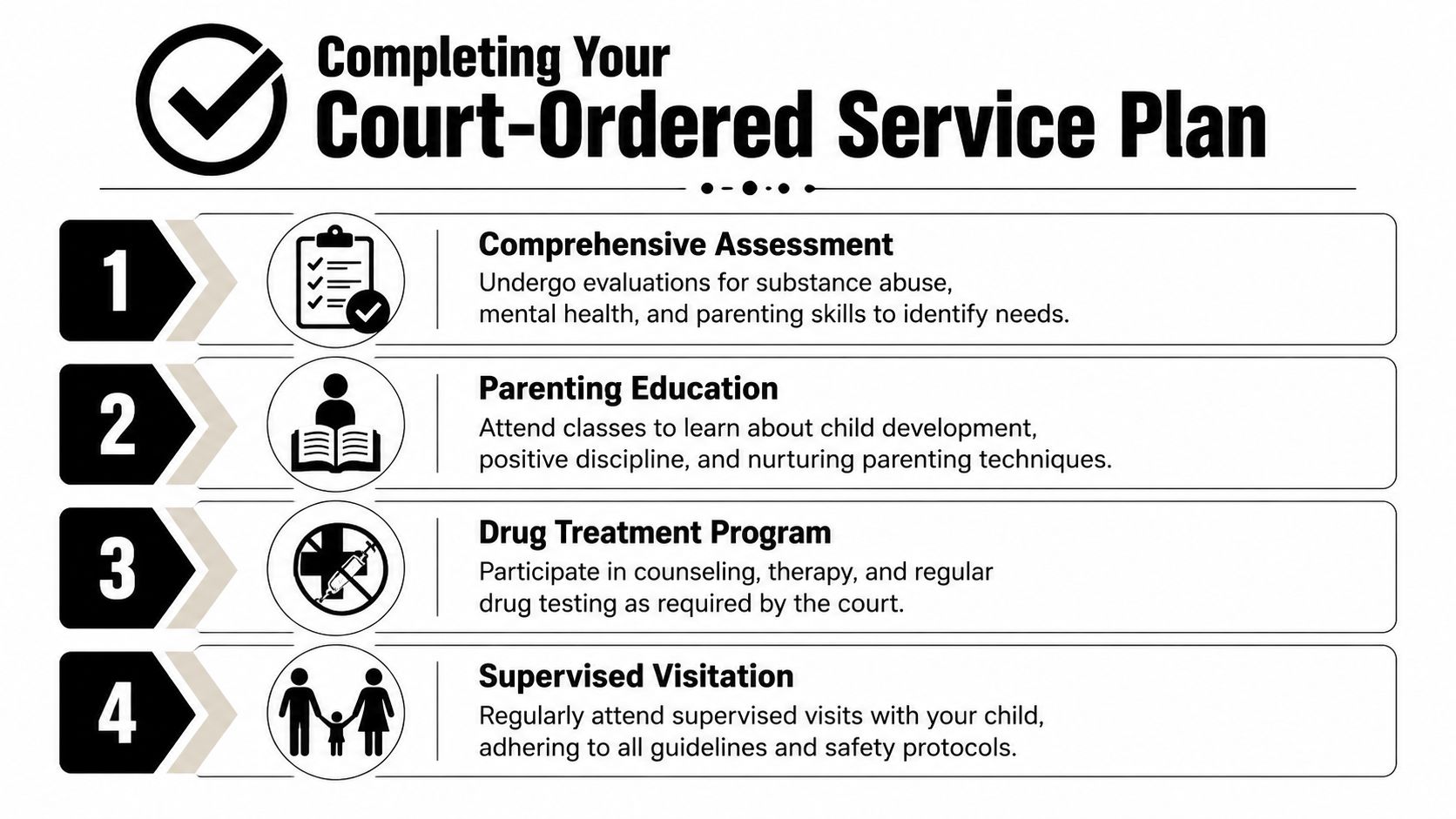
If you're trying to understand how finishing required services can affect the case outcome, this article on dismissal after service plan completion in Texas CPS cases gives useful context.
What a service plan often includes
After a failed drug test, common requirements include:
- Substance abuse assessment: A provider evaluates the severity of the issue and recommends care.
- Counseling: This may focus on relapse prevention, decision-making, trauma, or mental health.
- Random testing: Courts and CPS often want ongoing proof of sobriety, not just promises.
- Parenting classes: These are meant to address judgment, supervision, and age-appropriate care.
- Visitation rules: You may begin with supervised visits and need consistent compliance to expand access.
How parents succeed with service plans
The parents who do best usually stop arguing with the existence of the plan and start building a record of completion. They keep calendars, certificates, sign-in sheets, discharge papers, prescriptions, and every negative test result. They don't rely on memory.
Consider a mother who tests positive early in the case and feels convinced the judge has already written her off. She starts attending every class, confirms each appointment in writing, shows up early for visits, and enters treatment that addresses the actual issue instead of the cheapest option available. A few months later, the paper trail tells a stronger story than her fear did.
If the assessment recommends treatment, the quality of the program matters. Parents often benefit from learning about effective substance use treatment options so they understand what meaningful participation looks like and how group therapy can fit into recovery.
How to keep CPS from saying you “didn't comply”
Use a simple working system:
Create one file for everything
Keep every record in one folder, physical or digital. Missed paperwork creates avoidable disputes.Confirm appointments in writing
Emails and text confirmations are better than verbal claims later.Track every completed task
Dates matter. Names matter. Provider contact information matters.Tell your lawyer before a setback becomes a violation
Relapse, missed testing, transportation problems, and prescription issues need immediate legal guidance.
Compliance isn't just doing the service. It's being able to prove you did it.
A service plan can feel exhausting. Still, in many cases, it is the clearest path back to your children if you treat it like evidence, not paperwork.
When a Failed Test Can Threaten Your Parental Rights
This is the part parents are often too scared to ask out loud. Can one failed drug test terminate my parental rights?
Usually, one failed test by itself is not enough. The greater danger comes when the positive result becomes part of a larger pattern that CPS describes as endangerment under Chapter 161 of the Texas Family Code. The agency will try to connect drug use to unsafe supervision, unstable housing, repeated failed services, continued positive tests, domestic conflict, or exposing a child to dangerous people or conditions.
What makes the risk more serious
Termination cases typically become stronger for CPS when the positive test is paired with facts like these:
- Repeated failed tests or missed tests
- Refusal to engage in treatment
- Visits that remain chaotic, missed, or unsafe
- A child with special medical or developmental needs whose care requires consistent sobriety
- Statements by the parent that minimize obvious risk
- A home environment tied to ongoing criminal activity or violent conduct
A single bad result can often be managed. A pattern of denial plus noncompliance is much harder to defend.
The legal idea behind endangerment
In plain language, CPS has to do more than say, “This parent used drugs.” The agency tries to show that the parent's conduct endangered the child's physical or emotional well-being and that termination would be in the child's best interest. That is a much bigger claim than simple use.
Here is where many parents make a costly mistake. They focus only on whether they love their child. Love matters, but in a termination case, the court also looks at behavior, stability, judgment, follow-through, and whether the child can safely rely on the parent moving forward.
A realistic way to think about the risk
| Situation | Termination risk tends to be lower | Termination risk tends to be higher |
|---|---|---|
| Test history | Isolated result with corrective action | Ongoing positive or missed tests |
| Services | Parent engages quickly | Parent ignores or abandons plan |
| Child safety | Safe relatives and structure exist | Unsafe home remains unchanged |
| Court view | Parent accepts responsibility | Parent blames everyone and fixes nothing |
This section matters because false comfort is dangerous. So is despair. The better view is balanced. A failed test can become part of a termination case, but many parents reduce that risk substantially when they stop treating the case as temporary embarrassment and start treating it as a record that is being built every day.
Your Legal Defense Against a Positive Drug Test Result
The phone rings. CPS says the test came back positive, and your first instinct is to explain everything. That is often the moment parents make the case harder on themselves.
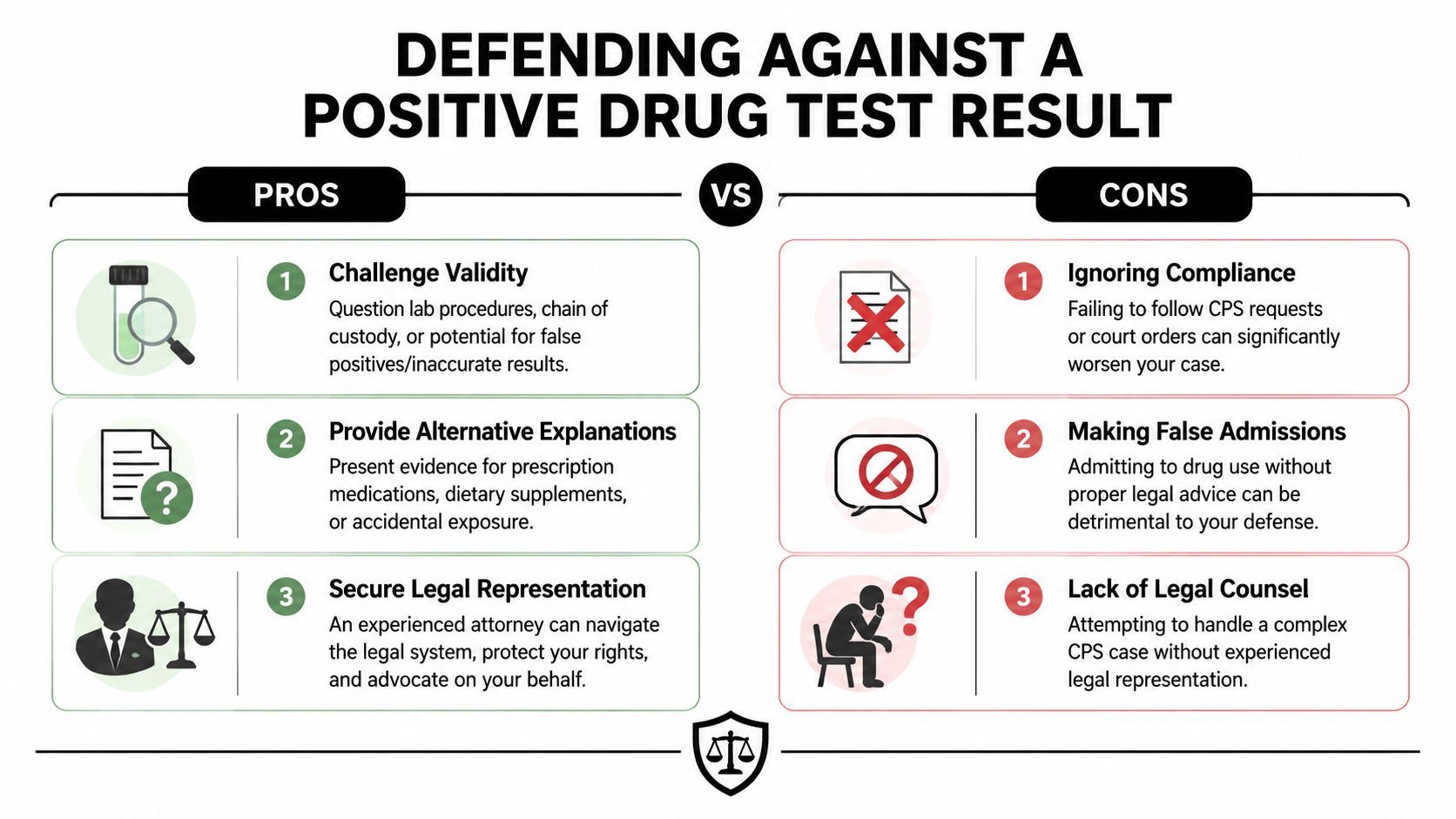
A real defense starts by treating this as two cases that may be developing at the same time. One track is the CPS case about child safety, placement, and your rights as a parent. The second track is possible criminal exposure based on the same facts. If you defend only the CPS side and ignore the criminal risk, you can do serious damage with your own words.
For a closer look at how these cases are defended, review this page on a Texas CPS case for drug use defense.
Track one is the CPS case
In family court, the test result matters. The result is still only one piece of the record. Judges also look at what the result shows, whether the child was placed at risk, what safety measures existed, and what you did after the test.
A CPS defense often focuses on points like these:
- Testing problems: Chain of custody errors, unclear lab procedures, or weak confirmation testing can reduce the weight of the result.
- Prescription or medical explanations: Some lawful medications and treatment issues affect how a screen should be read.
- Timing and context: A positive result does not automatically prove the child was unsupervised, exposed to drugs, or harmed.
- Protective adults in the home: A sober co-parent, grandparent, or other caregiver can matter if that person was providing safe care.
- Your response after the test: Honest treatment records, counseling, negative follow-up tests, and documented stability can help limit the damage.
The legal question in CPS is broader than drug use by itself. The agency still has to connect the facts to danger to the child.
Track two is possible criminal exposure
This is the part many parents do not see coming. The same investigation can raise issues about possession, paraphernalia, child endangerment allegations, probation problems, or statements made to caseworkers, police, doctors, or court-appointed professionals.
That creates a real conflict. In the CPS case, accepting some responsibility may help show the judge that you are taking the matter seriously. In a criminal case, broad admissions can be used against you. I have seen parents try to sound cooperative and end up giving the government a cleaner case than it had before.
Every major decision should be screened through both risks. That includes drug testing, written statements, substance abuse assessments, home visits, and conversations about who was present, what was used, and where it was kept.
Mistakes that weaken your defense
Some reactions make a bad situation worse fast:
Talking too freely with CPS
Parents often volunteer details that were never asked for and never needed.Assuming the case is already lost
That attitude leads people to skip hearings, ignore deadlines, or stop documenting progress.Hiding new use or a relapse
Courts can work with relapse more easily than dishonesty.Treating the CPS case and criminal risk as separate worlds
They overlap. What you say in one setting can affect the other.
What a coordinated legal response looks like
A lawyer handling this kind of case should be doing more than arguing about one drug test. The job includes protecting you from avoidable admissions, reviewing the testing process, preparing for hearings, organizing treatment and counseling records, managing service-plan compliance, and watching for signs that police or prosecutors may get involved.
That overlap matters. The Law Office of Bryan Fagan PLLC handles criminal and CPS-related matters that intersect, which matters when one positive test can affect both custody and personal freedom.
The strongest defense is usually disciplined and documented. Say less. Miss nothing. Get help early.
Your Next Step Taking Control with an Experienced Attorney
Understanding what happens if you fail a CPS drug test in Texas, you're probably not looking for theory. You want to know whether your family can survive this. In many cases, the answer is yes, but only if you move quickly and stop treating this like a misunderstanding that will fix itself.
A positive test can trigger immediate CPS action, difficult court orders, a demanding service plan, and long-term risk to your parental rights if the case keeps getting worse. It can also open a second front if police or prosecutors become interested in the same facts. That is why this kind of case needs a response that is calm, documented, and legally coordinated.
The right attorney can step in early, communicate with CPS, help you avoid damaging admissions, challenge weak testing issues, prepare for temporary orders, and turn your service plan into evidence of progress instead of a list of failures. Just as important, your lawyer can help protect you from saying something in the CPS case that creates criminal problems later.
You do not need to solve everything today. You do need to take the next smart step today.
If you're facing a failed CPS drug test, contact Law Office of Bryan Fagan PLLC for a free consultation. You can talk through what CPS has told you, whether your child is at risk of removal, how court orders may affect your custody rights, and whether there is any separate criminal exposure you need to address now. When your family is on the line, getting clear legal advice early can make all the difference.