Skip to content
Your child is screaming. A younger sibling is crying. A lamp just hit the floor. You're standing in the kitchen with your phone in your hand, asking a question no parent wants to ask: Can you call the police if your child is misbehaving?
In Texas, that question usually comes up at the worst possible moment. Not when things are calm. Not when you've had sleep, support, or space to think. It comes up when you feel trapped, scared, and out of options.
For some parents, the situation looks like a teenager shoving a parent during an argument and punching a hole in a bedroom door. For others, it's a child threatening a sibling, grabbing a knife from the drawer, or running out of the house in the middle of the night. And sometimes the behavior is serious, but not immediately violent: defiance, repeated runaway episodes, school refusal, threats, verbal abuse, or destruction that leaves the home in chaos but doesn't create an active emergency.
That difference matters. A lot.
In my work with Texas families, I've seen how one 911 call can quickly move a family out of a parenting crisis and into multiple legal systems at once. Police may respond. A report may be written. Child Protective Services may become involved. A child's statements may become evidence. A parent who thought they were asking for help may find themselves answering questions about supervision, discipline, or home safety.
None of that means a parent should never call. It means you need to know when a call is about immediate protection and when it may create consequences that outlast the crisis.

Introduction A Parent's Toughest Call
A mother in Texas calls because her teenage son has become impossible to control. He curses at her, throws objects, and recently shoved his younger brother into a wall. She hasn't slept well in weeks. School calls keep coming. Family members tell her to “be stricter,” while others tell her to “call the police and teach him a lesson.”
That last part is where many families get hurt.
Police are not a parenting tool. They are a public safety response. Once officers are involved, the situation no longer belongs only to the family. It becomes a legal event with records, statements, and possible consequences in both juvenile and family court.
What distressed parents usually mean
Most parents asking this question aren't trying to punish their child out of spite. They're trying to stop a situation that feels out of control. They want the yelling to stop, the threats to stop, the fear in the house to stop.
Practical rule: If your real goal is “I need someone to calm my child down,” police may be the wrong first call unless there is immediate danger.
That's especially true in Texas, where a call involving violence in the home can overlap with CPS concerns very quickly. If officers believe a child is unsafe, that can create the kind of record that later matters under Texas Family Code Chapter 262, which governs emergency protection and removal. If a case is filed, Chapter 263 controls the court's review process and timelines. In the most serious cases, allegations can eventually connect to Chapter 161, which deals with termination of parental rights.
The question behind the question
The better question is usually this: Is this misbehavior, or is this a safety emergency?
If it's a safety emergency, protecting everyone in the home comes first.
If it's not, parents need a safer path. One that lowers risk instead of multiplying it.
Discipline Problem or Safety Emergency
The law draws an important line between a child who is difficult and a child who is dangerous in that moment. Parents under stress often blur that line, and that's understandable. But legally, the distinction matters.
Federal child welfare guidance frames police involvement as an emergency response, not a routine discipline method. The Child Welfare Information Gateway guidance on reporting abuse or neglect says to call 9-1-1 in an emergency and directs suspected abuse or neglect reports to the Childhelp hotline, which is available 24/7 and operates in more than 170 languages. The same guidance makes clear that reporting systems are built for danger, abuse, or neglect, not ordinary misbehavior. It also notes that schools referred nearly 230,000 students to law enforcement in the 2017–18 school year, which shows how fast youth conduct can enter the justice system once authorities are involved.

A simple way to sort the moment
Ask yourself one question first:
Is someone in immediate physical danger right now?
If the answer is no, you may still have a serious family problem. But you likely do not have a police emergency.
| Situation | Better description |
|---|---|
| Refusing rules, yelling, slamming doors | Discipline problem |
| Tantrum, backtalk, refusing schoolwork | Discipline problem |
| Minor property damage without immediate threat | Serious behavior issue, but not always an emergency |
| Hitting, choking, using an object as a weapon | Safety emergency |
| Threatening serious harm and acting on it | Safety emergency |
Why this line matters in Texas
Texas parents also need to think about how their own discipline may be viewed after officers arrive. If police walk into a chaotic home and see marks, bruises, or conflicting stories, the focus can shift away from the child's behavior and onto the parent's conduct. That's one reason it helps to understand related issues such as whether corporal punishment is legal in Texas.
And if CPS becomes involved after a domestic incident, parents may be asked to agree to restrictions quickly. A CPS Safety Plans in Texas: Should You Sign? article can help you understand what a safety plan is, what it may restrict, and why signing without legal advice can create problems later.
If you call police for rule-breaking that isn't dangerous, you may solve the next fifteen minutes and create the next six months.
When Calling Police May Be Unavoidable
There are situations where calling police is not overreacting. It is a defensible step to protect life, bodily safety, or the home from immediate harm.
The strongest cases for calling happen when conduct has crossed out of ordinary misbehavior and into physical abuse, assault, property destruction, or other objectively dangerous conduct, as discussed in this guidance on when police involvement becomes defensible. That same guidance also makes an important practical point: repeated incidents should be documented because written records can strengthen later court requests, including protective-order actions.
Examples that justify immediate intervention
A call may be necessary when a child:
- Assaults a parent or sibling: punching, kicking, choking, or using force that causes injury or creates fear of injury.
- Uses or brandishes a weapon: a knife, firearm, blunt object, or any item being used to threaten serious harm.
- Creates a direct hazard through property destruction: breaking glass near others, starting a fire, damaging doors or windows during a barricade, or disabling the home in a way that endangers people.
- Makes a credible threat and is acting on it: not just angry words, but conduct showing the threat may be carried out now.
- Is in a severe mental or emotional crisis with immediate risk of violence or self-harm: where the priority is preventing injury, not enforcing household rules.
What to do while help is coming
If you have to call, your words matter. Keep the focus on safety.
- State the immediate danger: who is at risk, whether a weapon is present, and whether anyone is injured.
- Move other children away: if you can do so safely, separate siblings from the danger area.
- Avoid physical confrontation unless necessary for protection: restraint can complicate the facts later.
- Write down what happened after the scene is safe: time, threats made, objects used, damage, injuries, and witnesses.
A parent in this situation should also think beyond the night of the incident. If the conduct repeats, the issue may move into court. The Texas CPS Court Hearing Timeline Status, Permanency & Trial resource explains the sequence of hearings that can follow if CPS files a case.
In some families, police response to violence inside the home can also overlap with arrest and release issues. For readers trying to understand how domestic incident arrests are handled in another context, Oxnard domestic violence bail assistance offers a practical example of how quickly a family matter can become a custody and bail problem once law enforcement treats it as a criminal event.
Keep your incident notes factual. “He threw a chair at his sister” is useful. “He's always out of control” is not.
The Legal Domino Effect of a 911 Call
Many parents believe they can call police, get short-term help, and then return the matter to private family life. That's often not how it works.
Once a 911 call is made, you lose control over how the event is classified. Officers decide what happened, what crime they think may have occurred, whether anyone is arrested, and whether the facts raise child safety concerns. In Texas, that can create a straight path from one emergency call to both juvenile and CPS involvement.

Step one is the report
The moment officers are dispatched, a record begins. Even if no one is arrested, the event may still be documented as a domestic disturbance, assault allegation, welfare concern, or juvenile incident.
That matters because later decision-makers often rely heavily on the first written report. Judges, CPS investigators, prosecutors, and school officials may all view the same event through different lenses.
Step two can be CPS
If officers believe there may be abuse, neglect, lack of supervision, or an unsafe home environment, CPS may be notified. That's where Texas family law becomes central.
Under Texas Family Code Chapter 262, the state can seek emergency action to protect a child if it believes immediate intervention is necessary. If a case is opened, Chapter 263 governs review hearings and permanency deadlines. If the allegations grow more serious and the case is not corrected, Chapter 161 is where termination issues live.
For parents trying to understand the overlap between officers and child welfare investigators, this explanation of how CPS works with law enforcement on child safety cases is worth reading.
Step three is where parents get blindsided
A mother may call because her teenager hit her. Officers arrive and ask why the child was angry. They see a belt on the table, hear that physical discipline happened earlier, and the entire case shifts. Now police are considering both the child's conduct and the parent's.
Or a father calls because his son broke furniture and threatened a sibling. Police ask where the younger children were, whether prior episodes happened, and why no treatment was arranged sooner. What began as “my child won't listen” becomes a question about supervision and protection.
That is why parents need to understand The Texas CPS Investigation Process Explained, including how an investigation usually unfolds and what rights parents have at each stage.
The biggest mistake I see is assuming a 911 call stays limited to the problem you meant to report. It often doesn't.
What Happens When Police Arrive at Your Door
Officers do not come to your home to mediate family tension. Their job is to secure the scene, identify immediate threats, and investigate possible crimes.
That means they'll usually separate people. One officer may speak with you while another talks to your child. If there are siblings, they may also be interviewed separately. Officers will look for injuries, damage, signs of intoxication, weapons, and statements that support or contradict each other.
What parents often don't expect
A child may say things impulsively, defensively, or out of fear. Those statements can matter far more than parents realize. As explained in guidance on what to do if police want to question your child, once law enforcement is involved, a minor's statements can become evidence in a criminal or juvenile case. During custodial interrogation, many jurisdictions require stronger protections such as parental presence or legal advisement, and questioning must stop if the child asks for counsel.
That's why a parent should calmly ask: “Is my child free to leave?” If the answer is no, the legal stakes just changed.
A safer way to handle questioning
If officers want to talk with your child, keep these points in mind:
- Clarify the setting: ask whether your child is free to leave or is being detained.
- Don't encourage casual explanations: “Just tell them what happened” can backfire if the situation is already criminal in nature.
- Request counsel if needed: if your child is not free to leave, treat the matter seriously.
- Stay calm and respectful: arguing with officers at the door rarely helps and may raise the temperature.
Parents dealing with child interviews should also understand that police questioning is only one part of the risk. If CPS is called, the agency may also seek to interview children. This guide on CPS interviews of children in Texas cases helps explain what families should expect.
A common household scene
A father calls after a heated fight with his teen daughter. By the time officers arrive, everyone has calmed down. He assumes the worst is over. Then officers separate the family, ask the daughter whether she feels safe at home, and ask the father whether he grabbed her arm. He thought he had called for backup. Instead, he's now part of an investigation.
That doesn't mean he was wrong to seek help. It means he didn't know the procedural reality of what happens after the call.
Smarter Alternatives and De-escalation Strategies
If your child is not actively violent, there are usually better first steps than calling 911. The goal should be safety without unnecessary escalation.
Family-support guidance from the UK specifically recommends using a non-emergency number first when there is no immediate aggression and framing the issue as keeping the child and siblings safe, rather than criminalizing the child, in this discussion of calling police during family conflict. That basic principle also fits what many Texas families need: a decision tree, not a panic button.
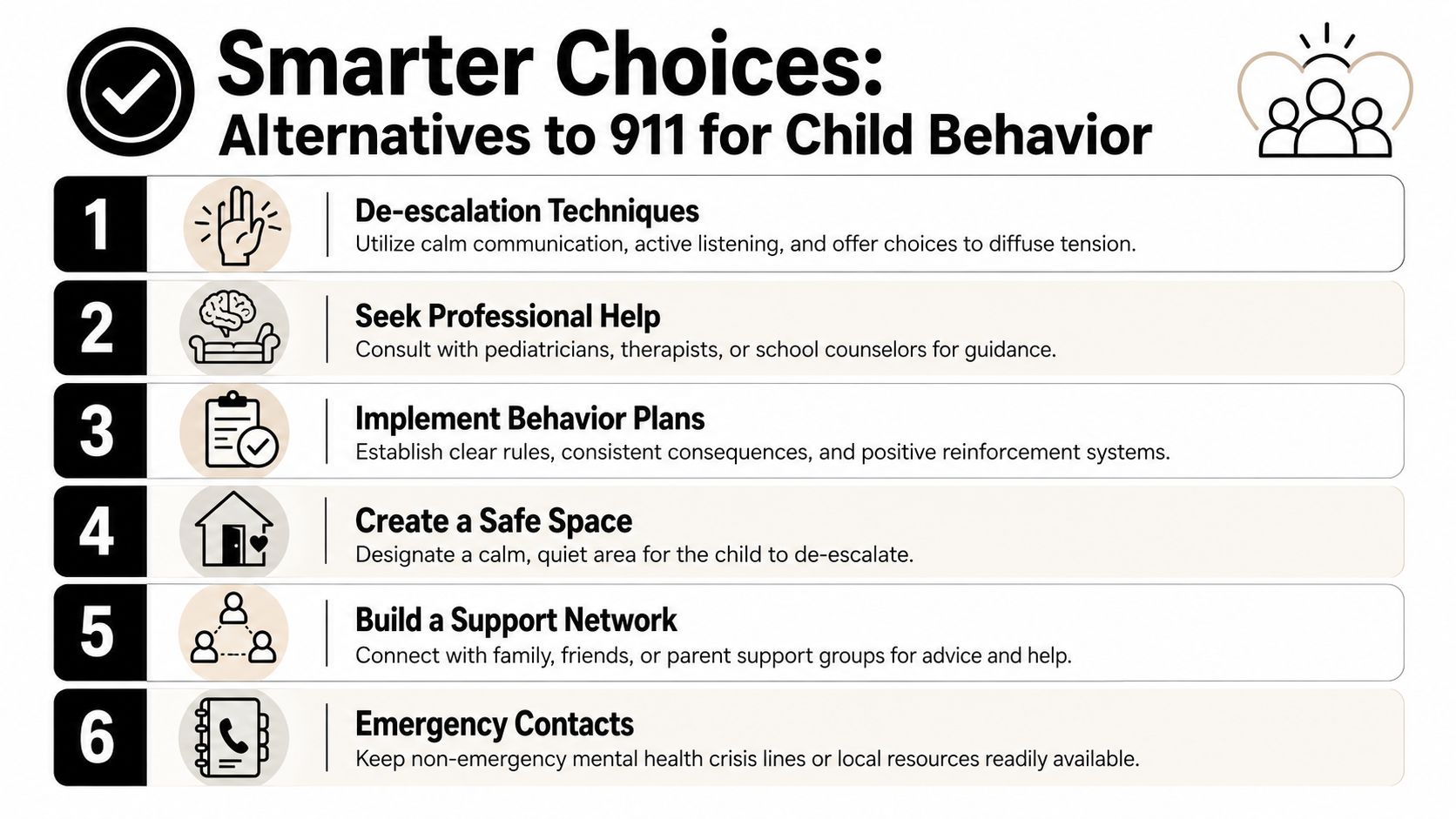
A practical order of operations
When there is no active violence, consider this sequence:
Create space first
Move siblings to another room. Reduce the audience. Lower noise and stimulation if you can.Use a calm script
Short sentences work better than lectures. “I'm not arguing. I'm making sure everyone is safe.”Call non-emergency support
Depending on the situation, that may mean a local non-emergency line, a crisis service, a pediatric provider, a therapist, or school-based support.Document patterns, not opinions
Write dates, triggers, threats, damage, missed school, or runaway behavior. Don't diagnose in your notes.
Here's a video that may help parents think through safe responses in high-conflict moments:
Tools that often work better than a police call
- Behavior planning at home: clear rules, predictable consequences, and consistent follow-through.
- School intervention: counselor involvement, behavior meetings, attendance support, or special education evaluation where appropriate.
- Mental health response: contact a child therapist, psychiatrist, pediatrician, or local crisis team if the behavior reflects emotional instability rather than criminal intent.
- Family mediation: when conflict keeps repeating, structured communication can help. Some parents also benefit from learning about options like WeUnite for family conflict, which discusses mediation in family disputes.
Parents under sustained stress also need practical safety habits. This guide on safe parenting strategies for high-stress situations can help you build routines that reduce the odds of a crisis turning into a legal case.
If CPS is already in the picture
Once CPS is involved, your choices matter even more. A lawyer can help you think through what to say, what to document, and how to respond if investigators propose immediate restrictions. The Law Office of Bryan Fagan PLLC handles matters where criminal allegations and CPS concerns overlap, which is often exactly what happens after a family crisis call.
Try to frame every next step around one sentence: “How do I keep everyone safe without making this worse?”
Conclusion Protecting Your Family Your Rights Your Future
If you're asking whether you can call the police if your child is misbehaving, you're probably already carrying more than others might realize. Fear, guilt, exhaustion, and confusion often sit in the same room together.
The most important takeaway is this: police are for immediate danger, not ordinary discipline. When a child becomes violent or someone is at real risk, calling may be necessary. But when the problem is escalating behavior without an active safety emergency, smarter alternatives usually protect your child and your legal position better.
Texas parents also need to recognize how quickly a crisis can move into CPS territory under Chapters 262 and 263, and in severe cases, eventually raise Chapter 161 concerns. Early legal advice can make a major difference in how those cases unfold, especially if your goal is to stabilize the home and protect reunification. If your child's behavior may be tied to anxiety, dysregulation, or overwhelm, resources like Orange Neurosciences' guide on child anxiety can also help you think about support in a more constructive way.
If CPS has contacted you, if police were called to your home, or if you're trying to avoid a crisis becoming a case, it helps to understand what reunification can require in Texas. This article on CPS reunification in Texas is a good place to start.
If you're dealing with a child behavior crisis, a CPS investigation, or the fallout from a 911 call, contact Law Office of Bryan Fagan PLLC for a free consultation. We can help you understand your rights, evaluate the risks in your specific situation, and make a plan that protects your family, your case, and your future.