Skip to content
When you search for a CPS attorney near me in Texas, you're usually not browsing casually. You're sitting in your kitchen after a phone call you never wanted. Or you're replaying a conversation at the front door, wondering if you said too much, or not enough. You may also be dealing with a recent arrest, a domestic dispute, or allegations involving drugs, and now everything feels tied together in the worst possible way.
That fear is real. So is the confusion.
Texas CPS cases move fast, and they can affect where your child sleeps, what a judge hears about you, and whether your words in one case get used against you in another. The good news is that panic doesn't have to drive your next step. A calm, informed response often protects parents far better than overexplaining, arguing, or signing whatever is put in front of them.
A parent in this situation often thinks the problem is just CPS. Then the criminal case starts moving too, or law enforcement is already involved, and the true danger appears. Two different systems start asking questions about the same event. If your strategy isn't coordinated from the beginning, one case can damage the other.
The Knock on the Door Your First Steps When CPS Arrives
The moment usually feels the same. Someone knocks. You open the door. A caseworker says they're with CPS and need to speak with you about your child. Your stomach drops.

In that moment, many parents make one of two mistakes. They either slam the door and go into full defense mode, or they start talking nonstop because they hope cooperation alone will make the problem disappear. Neither extreme usually helps.
What to do in the first few minutes
Start with basic control.
- Stay polite: Anger, sarcasm, and panic get written down and remembered.
- Ask for identification: Confirm who's there and what agency they represent.
- Find out the allegation in general terms: You need to know what kind of issue CPS says it is investigating.
- Slow the conversation down: You can say that you want to speak with an attorney before answering detailed questions.
- Do not sign anything immediately: Read first. Better yet, let counsel review it.
Practical rule: Being respectful is smart. Giving broad, unguarded statements is not.
A lot of parents assume CPS only appears in rare or extreme situations. That isn't how Texas works. In fiscal year 2022, the Texas Department of Family Protective Services opened more than 309,000 new CPS investigations, and there were over 17,000 active abuse and neglect cases in court at various points that year, according to the Texas DFPS child protection data. That volume matters because it means caseworkers and courts move quickly, and your case won't be treated as a slow-moving exception.
What not to do
Some responses create damage that's hard to fix later.
| Common reaction | Why it hurts |
|---|---|
| Explaining everything at once | Long narratives often create inconsistencies or extra issues CPS wasn't focused on yet. |
| Letting fear control access | Refusing everything without legal guidance can escalate the situation. |
| Guessing facts | If you aren't sure, say you aren't sure. Wrong details can look like dishonesty. |
| Talking about the related criminal issue | Statements about an arrest, fight, or substance allegation can echo into another courtroom. |
A familiar example is a parent after a domestic disturbance call. No one was arrested yet, but police came out, the child was home, and now CPS appears the next day. The parent says, “We were both yelling, but it wasn't serious, and I only pushed the door.” That may feel like minimizing. In a report, it can sound like an admission.
If CPS has contacted you, take a breath and get grounded in a response plan before the conversation goes further. This guide on how to respond when CPS shows up at your door in Texas is a useful starting point.
The Texas CPS Timeline Explained Step by Step
Once the initial shock passes, most parents want one thing. They want to know what happens next.
Texas Family Code Chapter 262 governs emergency procedures and removals. Chapter 263 covers review hearings, permanency, and the court's ongoing supervision of a CPS case. Chapter 161 addresses termination of parental rights. You don't need to memorize those chapters tonight, but you do need to understand that each stage has a purpose, a deadline, and consequences if you walk in unprepared.
Here's the big picture.
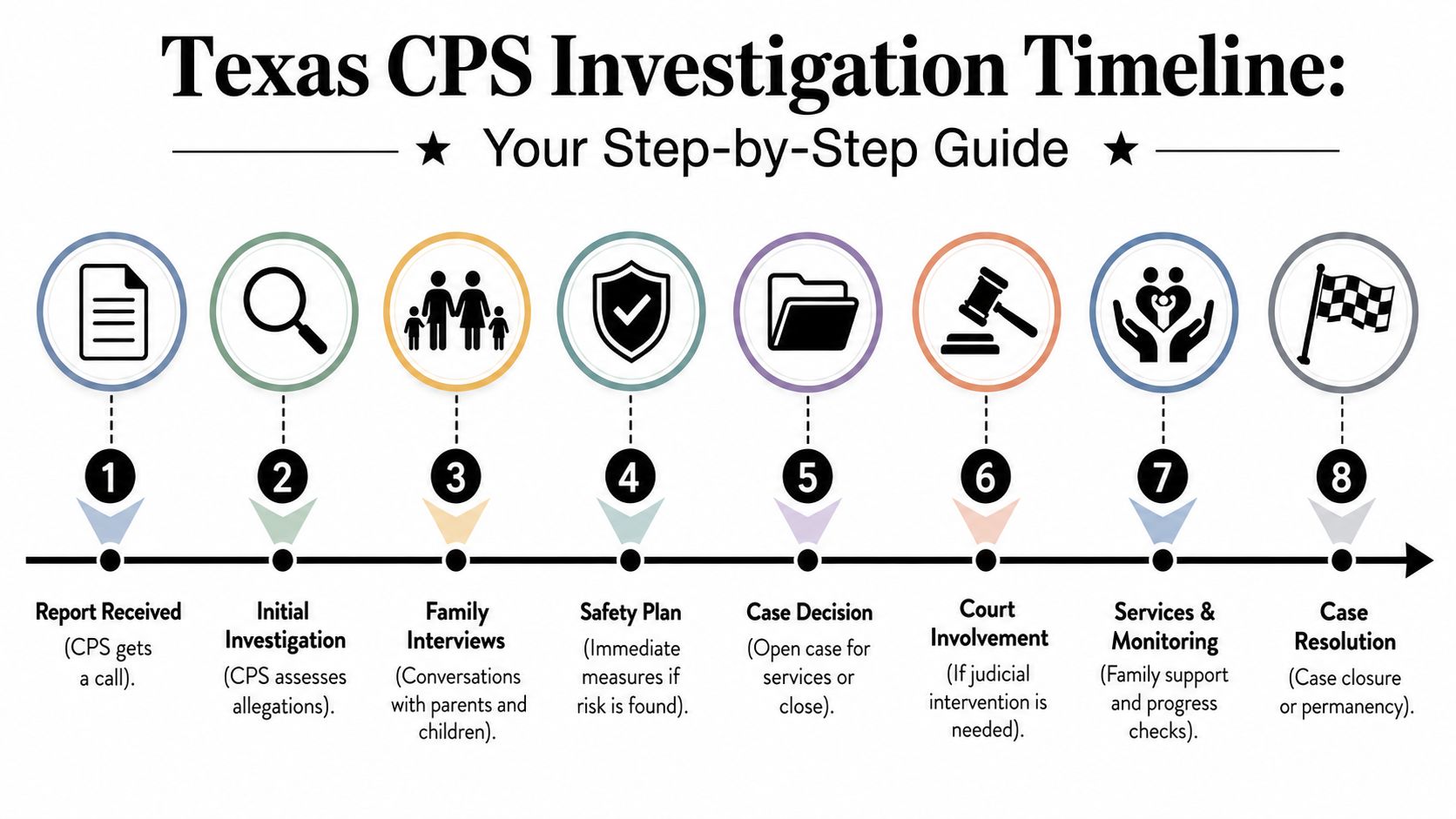
Investigation and immediate safety concerns
A report comes in. CPS screens it and decides whether to investigate. During that investigation, the caseworker may contact you, visit your home, speak with the child, contact school staff, or ask for collateral information from others.
If CPS believes there is an immediate danger, Chapter 262 is where emergency action enters the picture. That can mean a safety plan, a request that a child stay temporarily with a relative, or court involvement for removal. This is one reason early legal advice matters so much. Parents often don't realize a “temporary” decision can shape the entire case.
Early conversations matter because they create the first record. Judges, caseworkers, and opposing counsel may all return to that record later.
Hearings and court oversight
If CPS files a case, the early hearings come quickly. Many parents face critical early hearings within 14 to 28 days without representation, and backlogs for appointed attorneys in major Texas counties have made that gap a real problem, as explained by Texas Law Help's CPS information. That's one reason many families start looking for a private lawyer immediately after DFPS makes contact.
A simplified timeline often looks like this:
- Initial contact and investigation
- Safety plan or removal request if CPS claims immediate risk
- Early court hearing
- Status hearing and service planning under Chapter 263
- Review hearings and permanency planning
- Final resolution, reunification, dismissal, or trial
- Termination issues under Chapter 161 if CPS seeks that relief
Some cases close during the investigation. Some move into services. Some become full court cases with repeated hearings and strict deadlines.
For parents who want a plain-language roadmap, Texas CPS Timeline Essential Steps and Expectations for Parents gives a useful overview. So does The Texas CPS Case Timeline From Start to Finish, which maps every stage and deadline in a Texas CPS case for parents.
Why the timeline changes your strategy
Parents often focus only on the final hearing. That's a mistake. By the time a case reaches a final trial, the court has already watched your compliance, your communication, your stability, and your credibility for months.
That means the “small” moments aren't small at all:
- A missed drug test can become a major credibility problem.
- An ignored service plan task can be described as noncompliance.
- A sloppy statement in an early interview can reappear later.
- A weak explanation for a criminal charge can alter how the family court sees safety.
The parent who understands the timeline usually makes better decisions. They prepare documents. They stop casual texting about the case. They ask better questions. They don't treat the investigation stage as informal.
How to Find and Evaluate the Right CPS Attorney for You
Typing CPS attorney near me Texas into a search bar is only the beginning. The harder part is deciding who can protect you when facts are disputed, deadlines are short, and another court may also be involved.
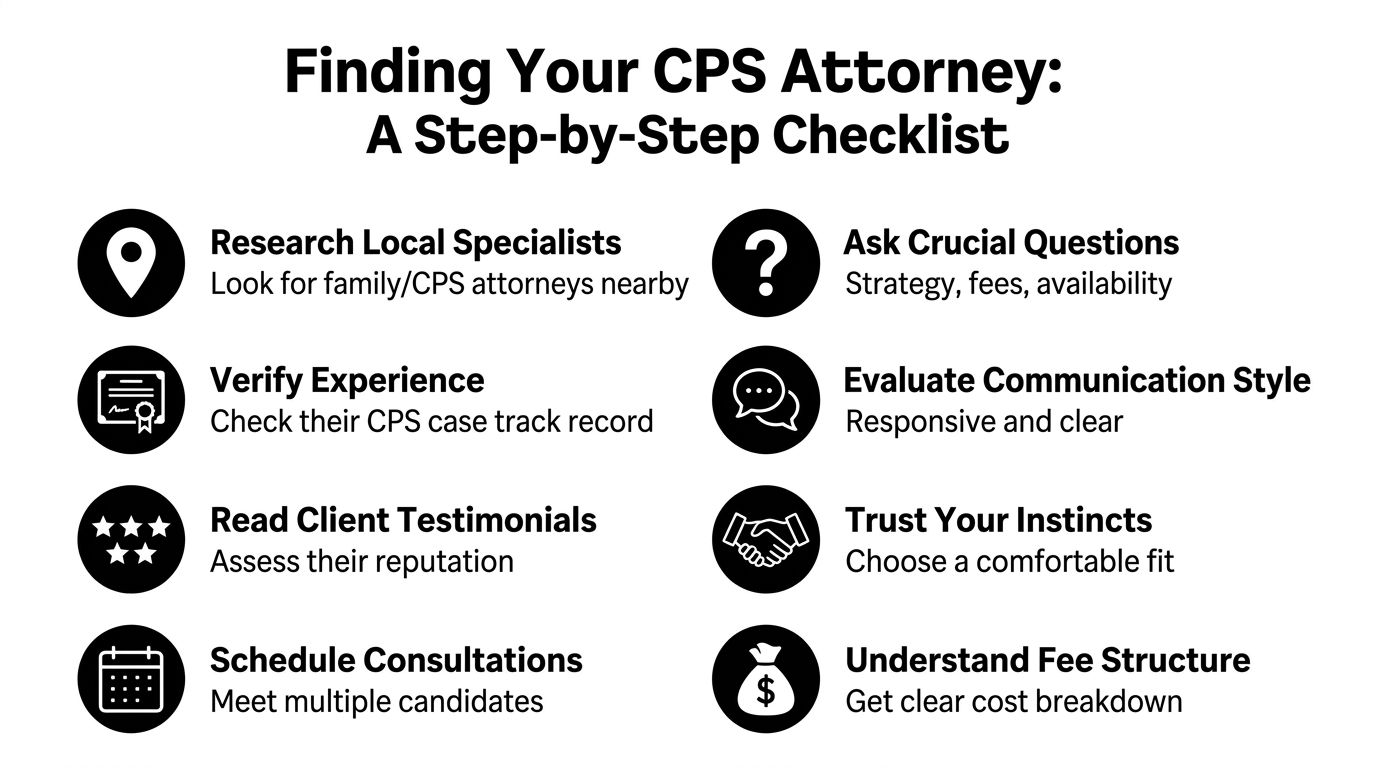
A strong lawyer for this kind of case isn't just someone who “handles family law.” You want someone who understands Texas CPS procedure, local courtroom expectations, service-plan realities, and, if necessary, the criminal overlap that can change the whole strategy.
What to screen for first
Start with practical criteria, not marketing language.
- Local court familiarity: Ask whether the attorney regularly appears in the county where your case is pending.
- CPS-specific experience: Family law is broad. CPS is its own lane.
- Comfort with urgent hearings: You need someone who can act fast, not someone who books you three weeks out.
- Clear communication: If the office can't explain the intake process clearly, that problem usually gets worse later.
- Ability to coordinate related issues: If there's a pending assault, drug, or child endangerment allegation, this isn't optional.
Here's a short video that helps frame the private-counsel question in practical terms.
Questions worth asking in a consultation
Don't use the consultation just to tell your story. Use it to evaluate the lawyer.
Ask this directly: “If CPS and a criminal case both involve the same facts, how do you protect me from helping one case hurt the other?”
Then keep going.
| Question | What you're listening for |
|---|---|
| How often do you handle CPS cases in this county? | Real familiarity with local judges, dockets, and procedure. |
| What happens at my next hearing? | A specific answer, not vague reassurance. |
| How do you prepare clients for interviews and service plans? | Concrete process and expectations. |
| Who will communicate with me and how fast? | A workable system, not promises that sound nice. |
| Do you handle criminal-family overlap, or coordinate with defense counsel? | A strategy, not an afterthought. |
Red flags parents overlook
Many people hire the first person who sounds confident. Confidence isn't the same thing as a plan.
Watch for these warning signs:
- Guaranteed outcomes: No careful lawyer promises that CPS will “go away.”
- No discussion of records or evidence: If they don't ask for documents, reports, screenshots, or prior orders, that's a problem.
- No mention of Chapter 262, 263, or 161 issues: A CPS case has legal structure. Your lawyer should talk about it.
- Casual attitude about criminal exposure: If the lawyer treats your related arrest as “separate,” be careful.
If you're weighing representation options, this comparison of public defender vs private lawyer can help clarify the trade-offs. One Texas-based option parents sometimes consider is Law Office of Bryan Fagan PLLC, which handles criminal cases and related family-law and CPS matters across multiple Texas regions.
When CPS and Criminal Charges Collide A Unified Defense
At this stage, many parents get hurt without realizing it.
A CPS case and a criminal case may look separate on paper. In real life, they often feed each other. The same police report, body-camera footage, text messages, medical records, or witness statements can shape both matters. If your lawyers aren't coordinated, you can end up taking positions that clash.
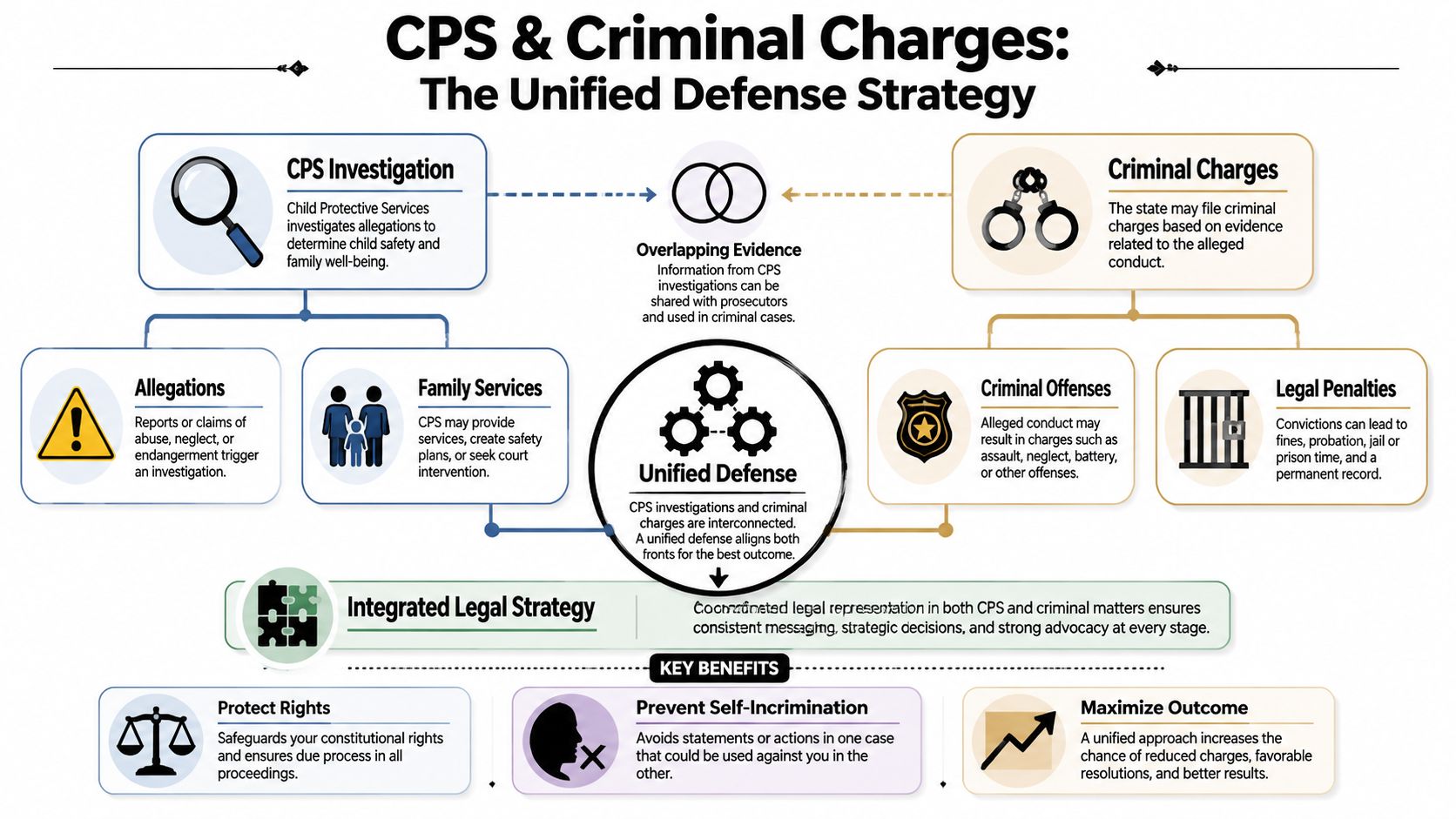
A common Texas scenario
Take a parent arrested after a domestic violence call. The criminal advice might be to stay quiet, avoid detailed statements, and challenge weak evidence. The CPS instinct, by contrast, may push the parent to “explain everything” to prove they're safe. Those instincts can collide fast.
Now add one more fact. The child was present. CPS opens a case. The parent, trying to look cooperative, tells the caseworker that the argument got physical “for a second” but the child didn't really see it. That statement may sound harmless. In a criminal file, it may function as an admission.
One unplanned explanation can become evidence in two court systems.
Why siloed representation often fails
Public resources rarely explain how to coordinate CPS and criminal defense strategies, even though defendants in domestic violence or child-endangerment situations often face parallel CPS investigations, as noted in this Texas CPS and legal guidance resource. That gap leaves families to figure out coordination on their own, usually under pressure.
Separate lawyers can work well if they coordinate. The problem is that they sometimes don't. One lawyer may push for quick compliance language, while the other is trying to prevent self-incrimination. One may encourage a class, statement, or affidavit that sounds helpful in family court but harmful in the criminal case.
Here's what unified strategy usually focuses on:
- Consistent factual framing: Your explanation of events shouldn't shift from one forum to another.
- Controlled communication: Not every question deserves an immediate answer.
- Evidence management: Photos, medical documents, texts, and witness names need one coherent review.
- Plea and service-plan coordination: A criminal resolution can affect how CPS describes risk, and vice versa.
What to ask if both cases are active
If you have both matters pending, ask any lawyer you're considering these questions:
- Who is reviewing the overlap in facts?
- What statements should I avoid making right now?
- How will you handle CPS interviews while criminal exposure is still open?
- If I'm asked to admit conduct in a class, evaluation, or service document, how is that being screened?
Parents often think cooperation means saying yes to everything. In overlapping cases, smart cooperation means doing the right things in the right order with advice that accounts for both courtrooms.
Navigating Hearings Investigations and Working with Your Attorney
Once counsel is involved, your role matters more than is commonly realized. A strong legal strategy can still be damaged by missed appointments, careless texts, a dirty home at the wrong moment, or emotional outbursts during a hearing.
How to handle the investigation day to day
Treat the case like it's being documented at every stage, because it is.
Keep a simple file with important records. Put court notices, drug-test results, counseling attendance, school records, medication information, and names of service providers in one place. If something was fixed in your home, document that. If a relative is helping with childcare, document that too.
Your attorney can use orderly records. They can't use a pile of half-remembered facts.
- Reply promptly to your lawyer: Silence creates avoidable emergencies.
- Follow instructions exactly: If counsel says don't discuss the case with certain people, don't.
- Take service-plan tasks seriously: Parenting classes, therapy, evaluations, and testing all create a paper trail.
- Stay off social media about the case: Even indirect posts can create problems.
Safety plans and hearings
A safety plan isn't always harmless just because it sounds informal. Read every term carefully. Who supervises contact? Where do exchanges happen? What behavior is expected? What happens if CPS says you violated it?
If you have a hearing coming up, preparation should be practical.
| Before court | Why it matters |
|---|---|
| Review the basic timeline with your attorney | You need to know what issue the judge is deciding that day. |
| Dress neatly and arrive early | Judges notice reliability and seriousness. |
| Bring requested documents | Missing paperwork weakens your position. |
| Let your lawyer answer legal disputes | Court isn't the place for emotional improvising. |
Courtroom habit: Answer the question asked. Stop. Let your lawyer guide the rest.
Virtual hearings changed the logistics
Texas family courts still use virtual tools in many settings, and that affects how parents should hire and work with counsel. The rise of virtual hearings since 2020 has changed how cases are handled, making an attorney's technological fluency and ability to practice remotely across counties an important factor, as discussed in guidance on requesting a lawyer for CPS matters.
That means “near me” doesn't always mean five minutes from your house. It may mean a lawyer who can appear effectively in your county, manage remote filings, prepare you for a virtual hearing, and maintain continuity if you move or a related criminal matter is pending elsewhere in Texas.
For virtual hearings, basic discipline matters:
- Log in early: Technical delays can look like disrespect or disorganization.
- Choose a quiet setting: Background noise hurts focus and credibility.
- Use a stable device if possible: Audio problems make a bad impression.
- Don't message others during testimony: Assume the court sees more than you think.
Working well with your attorney doesn't mean agreeing with every hard truth they give you. It means hearing it early enough to fix the problem before the judge focuses on it.
Protecting Your Familys Future and How We Can Help
When CPS is in your life, it is hard to think past the next phone call, the next hearing, or the next visit with your child. That is a normal reaction. But your case is bigger than the accusation in front of you today, and the choices you make now can affect your family long after the investigation ends.
Parents usually protect themselves best when they do four things early. They get legal advice fast. They learn the deadlines and pressure points in a Texas CPS case. They choose a lawyer who is ready for trial if the case heads that way. And when the same facts have triggered a criminal investigation, they make sure one legal strategy covers both cases.
That last point gets missed too often. A statement that seems helpful in family court can create trouble in a criminal file. A bond condition in a criminal case can interfere with visitation, services, or housing. A plea offer that sounds attractive in county court can later be used by CPS to argue risk to the child. If your attorney does not account for both systems at the same time, you can win a small point in one case and lose ground where it matters more.
There is also life after the case, and how you handle it affects your future. If CPS closes its investigation, if a suit is dismissed, or if a related criminal charge is resolved in your favor, you may have options to address records and reduce the long-term damage to your work, housing, and reputation.
If you need a practical overview of defense strategy, one helpful resource is How to Fight CPS and Win in Texas, as noted earlier in this article.
You do not need to solve every part of this tonight. You need a clear plan, careful communication, and advice that fits the facts you are facing. If CPS has contacted you, if your child has been removed, or if the same incident led to allegations involving domestic violence, assault, drugs, or child endangerment, get legal advice before you give more statements or agree to terms you do not fully understand.
If your family is facing CPS involvement in Texas, contact Law Office of Bryan Fagan PLLC for a free consultation. We help parents assess immediate risk, prepare for the next hearing, and coordinate CPS defense with any related criminal case so one problem does not make the other harder to fix. You do not have to face this alone.