Skip to content
When a CPS investigator shows up at your door, most parents feel the same rush of fear. Your mind jumps straight to the worst possibility. Are my kids about to be taken? Did someone lie? Do I have to let this person in? What happens if I say the wrong thing?
A Dallas parent might be standing in the kitchen, trying to keep a child calm, while a caseworker asks questions that feel loaded and urgent. In that moment, even a good parent can sound defensive, confused, or overwhelmed. That reaction is human. It doesn't mean you've done anything wrong.
A CPS lawyer in Dallas helps bring order to that chaos. The process has rules. CPS has legal limits. Courts follow timelines. And recent Texas legal changes have created new opportunities for parents to push for earlier information, earlier hearings, and a closer look at whether CPS has enough evidence to justify its actions.
What matters now is staying calm, protecting your rights, and getting clear advice before pressure turns into avoidable mistakes.
That Knock on the Door Your Guide to CPS in Dallas
A mother in Dallas hears a knock just before dinner. A CPS investigator says there's been a report. The worker wants to come inside, speak with the children, and look around the home. The mother has never dealt with CPS before. She's scared, embarrassed, and trying to figure out whether cooperation means safety or surrender.
That kind of moment changes the tone of a household instantly. Parents start second-guessing everything. A messy bedroom suddenly feels dangerous. An old argument with a co-parent feels relevant. A bruise from playground roughhousing becomes something you have to explain.
The first thing to understand is simple. A CPS investigation is serious, but it is not the same as a finding against you. Many families enter this process without knowing what the rules are, what rights they still have, or when they need a lawyer involved.
Practical rule: The earlier you understand the process, the more options you keep.
A CPS case in Dallas can move on two tracks at the same time. One track involves family law questions about custody, placement, services, and reunification. The other can involve criminal risk if the allegations include abuse, neglect, drug use, or injury. That overlap is where parents often get trapped. They think they're just explaining themselves to a caseworker, but their words may later appear in court or in a criminal investigation.
That is why this isn't just about "being cooperative." It's about being careful, informed, and strategic.
A good lawyer doesn't add drama. A good lawyer lowers the temperature. They explain what CPS can ask for, what you can decline, what deadlines matter, and how recent Texas changes may give your family more room to challenge weak evidence early.
If you're reading this with that uneasy feeling in your chest, you're not alone. You can take this one step at a time.
What a Dallas CPS Lawyer Does for Your Family
A lot of parents assume a CPS lawyer only matters if a court hearing is already scheduled. In practice, the lawyer's job starts much earlier. A CPS lawyer in Dallas protects your family during interviews, paperwork, home visits, safety plan discussions, and court proceedings.
Your lawyer becomes a shield
One common problem happens when a parent gets handed documents and is told to sign quickly. The parent doesn't want to look uncooperative, so they sign something they don't fully understand. That document may affect where the children stay, what services the parent must complete, or what CPS later says the parent agreed to.
A lawyer slows that down. They review what CPS is asking for, explain the consequences in plain language, and help you avoid statements that can be misunderstood.
They also help manage communication. Instead of every call or text from CPS landing directly on an overwhelmed parent, the lawyer can step in as the point of contact for legal issues, clarify requests, and keep the record straight.
Your lawyer becomes a guide
Texas CPS cases involve deadlines, court filings, service plans, and legal standards that most parents have never seen before. A lawyer tracks those moving parts and helps you respond with purpose.
That often includes:
- Preparing you for interviews: So you don't ramble, guess, or volunteer information that creates new problems.
- Gathering records: Medical records, school records, counseling notes, and other documents may support your side of the story.
- Correcting false allegations: A lawyer can organize evidence and witness statements instead of letting the accusation define the case.
- Explaining options: Some families face decisions about temporary placements, supervised contact, or service compliance. Those choices should be informed, not rushed.
If you want a structured overview of defense strategy, How to Fight CPS and Win in Texas is a strategic guide to mounting an effective defense against CPS in Texas.
Parents often hurt their own case by trying to "talk their way out of it" before they know what CPS is actually alleging.
Your lawyer stays focused on the whole crisis
A CPS case doesn't happen in a vacuum. It can affect school pickup, custody disputes, protective orders, and criminal exposure. A lawyer looks at the full picture. That matters because the safest short-term response isn't always the strongest long-term strategy.
When parents have counsel early, they usually make better decisions. Not because the stress disappears, but because someone is finally reading the map with them.
The Texas CPS Investigation Timeline from Report to Resolution
A CPS case feels random when you're in it. It isn't. Texas uses a sequence of investigative and court steps, and each stage creates opportunities to protect your position.
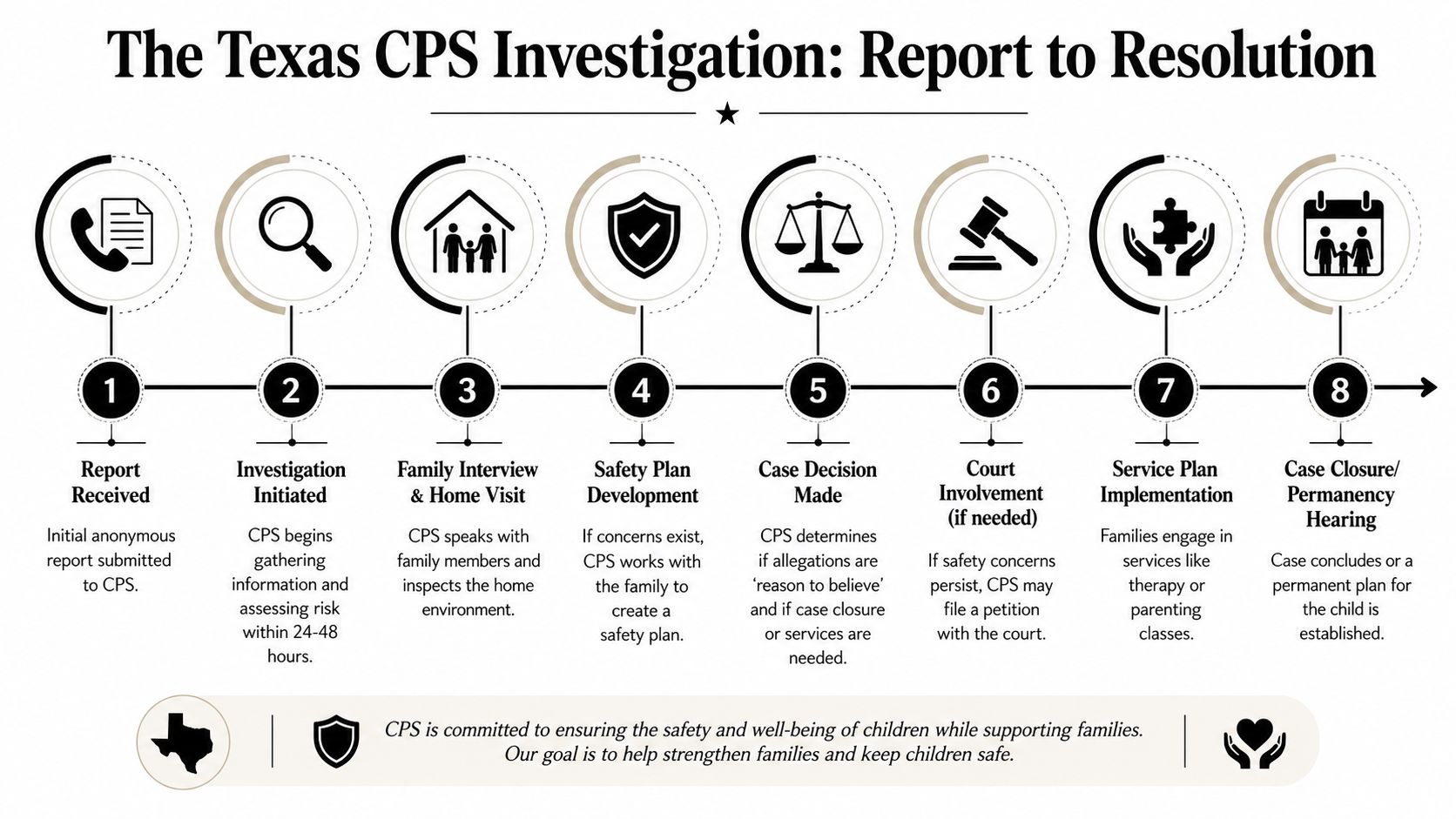
How the process usually unfolds
A report reaches CPS, often from a teacher, doctor, relative, neighbor, or someone else with concerns. CPS then decides whether to investigate. If it does, a caseworker may contact you, visit your home, speak with your children, and ask about safety concerns.
If the worker believes the risk can be managed without removal, CPS may push for a safety plan or voluntary services. If the concerns are more serious, CPS may involve the court and ask for temporary orders affecting custody and placement.
A useful overview appears in this Texas CPS timeline for parents, especially if you're trying to understand where your case sits right now.
The deadlines your lawyer watches closely
Some timelines matter because they give your lawyer a way to test whether CPS followed the law. According to the DFPS Attorney Guide, Texas Family Code Chapter 263 requires CPS to conduct a face-to-face assessment of the child within 72 hours of removal and to complete a full home study within 30 days. If those things don't happen properly, your lawyer may be able to challenge the adequacy of the investigation.
That same source explains that Chapter 161 sets out the legal grounds for terminating parental rights and requires CPS to prove those grounds by clear and convincing evidence. That is a serious burden. It is not enough for CPS to rely on suspicion, vague concern, or a weak paper trail.
A timeline is not just a schedule. In a CPS case, it can become part of your defense.
A simple way to think about the case stages
| Stage | What parents usually face |
|---|---|
| Report and intake | Confusion about who called and what was said |
| Investigation | Interviews, home visit requests, document requests |
| Safety planning | Pressure to agree to conditions quickly |
| Court action if needed | Temporary orders, placement decisions, service expectations |
| Ongoing review | Compliance, visitation, evidence gathering, permanency decisions |
One father may be dealing with a false report from a hostile ex-partner. Another parent may have real home stress but no actual danger to the child. Those are very different facts, yet CPS can initially treat both families with the same urgency. The lawyer's job is to force the case back onto evidence, deadlines, and legal proof.
When you understand the sequence, you stop reacting blindly. You start making decisions on purpose.
Your Legal Rights and Crucial First Actions
If CPS has contacted you, the first hours matter. Parents often make permanent mistakes during temporary panic. The goal is to protect your children without giving away rights you still have.
What to do first
Start with these steps:
- Stay calm and polite. Anger, insults, or panic rarely help. The worker is documenting what they see and hear.
- Ask why CPS is there. You need to know the general nature of the allegations before answering detailed questions.
- Don't sign documents you don't understand. If a paper affects placement, services, or access to your children, get legal advice first.
- Keep important records together. Medical records, school information, prescriptions, counseling notes, and contact information for supportive witnesses can matter quickly.
- Call a lawyer early. Early guidance often prevents self-inflicted damage.
For a focused discussion of these protections, review your rights with CPS in Texas.
The hearing deadline many parents miss
Parents are often shocked to learn that they aren't entitled to a court-appointed lawyer during the initial investigation stage. According to Texas Law Help's explanation of the parent attorney right in CPS cases, a parent may seek appointed counsel only if strict conditions are met, including indigence, a CPS court filing seeking temporary managing conservatorship or termination, and the parent opposing that petition. The first critical hearing occurs within 14 days after CPS removes a child or requests removal.
That hearing matters because it is often the first point where a parent without private counsel must speak up and request court-appointed representation if eligible.
Don't assume the court will automatically assign a lawyer. If you're eligible and opposing the petition, you need to raise the issue promptly at that first hearing.
What confuses parents most
Many parents ask whether cooperation means saying yes to everything. It doesn't. Cooperation and surrender are not the same thing.
A practical approach looks like this:
- Be respectful: You don't need to argue every point at the doorstep.
- Be careful: Don't guess, exaggerate, or fill silence with extra details.
- Be organized: Save messages, write down names, dates, and requests.
- Be strategic: Legal advice before a major interview or signature can change the course of the case.
A parent who calmly says, "I want to understand the allegation and speak with counsel before answering detailed questions," usually protects themselves better than a parent who tries to explain ten years of family history in one anxious conversation.
Building a Winning Defense Strategy in a CPS Case
A strong defense isn't built on one dramatic courtroom moment. It is built through disciplined choices, accurate records, and early pressure on CPS to prove what it is claiming.

Why recent Texas changes matter
Many online guides still talk about CPS defense as if the rules haven't shifted. But a recent update to Texas CPS law now requires more detailed notifications and earlier hearings for removal cases, which strengthens parental rights and can give your lawyer a way to press CPS for its evidence sooner, as described in this discussion of updated Texas CPS law and strategy.
That matters in real life. If CPS has to provide better notice earlier, your lawyer can examine the factual basis sooner, identify gaps faster, and challenge a weak removal theory before the case gains momentum.
A more detailed strategy discussion appears in this guide to building a strong defense against CPS allegations.
What a modern defense actually looks like
A Dallas CPS defense usually combines several tracks at once:
- Evidence gathering: School attendance records, pediatric records, photos of the home, counseling records, and messages from other parents or relatives may support your case.
- Witness preparation: Teachers, doctors, family members, counselors, and supervisors may help explain context that CPS missed.
- Service decisions: Sometimes completing a service helps. Sometimes agreeing too quickly creates harmful admissions. Strategy matters.
- Narrative control: Your lawyer frames the facts around actual safety, not assumptions or loaded labels.
Texas also gives context for the system itself. According to the DFPS CPS jobs page, CPS caseworker roles prefer a Bachelor's degree, and the starting salary range for CPI and CPS caseworker positions is $3,816.65 to $5,372.41 per month based on experience and qualifications. That doesn't tell you whether an individual worker is good or bad, but it does remind parents that they are dealing with a large system staffed by people following agency procedures. A defense lawyer's job is to test those procedures, challenge shortcuts, and make sure your family's case gets individualized attention.
The strongest defense usually combines two ideas at once. Show the court your strengths, and force CPS to prove its weak points.
Parents also need to think about communication discipline. One poorly framed text, one angry voicemail, or one careless social media post can distract from the central issue.
This short video helps explain why defense strategy has to start early, not after the case has already hardened.
One example of strategy in practice
Consider a parent accused of neglect because the home looked cluttered during a surprise visit. A weak defense says, "It wasn't that bad." A stronger defense uses photographs taken the same week, school records showing regular attendance, medical records showing the child is current on care, and testimony from a family member who knows the parent had just returned from a work shift and a child's illness disrupted the household.
For families seeking direct representation in this space, Law Office of Bryan Fagan PLLC handles Texas criminal matters and cases that intersect with CPS and family law.
That is how cases are won. Not by hoping CPS changes its mind, but by building a record the judge can trust.
How to Choose the Best CPS Lawyer in Dallas
Not every family law attorney is equipped for a CPS case. And not every criminal defense lawyer understands how a CPS court views placement, services, and parental rights. If your case involves both child safety allegations and possible criminal exposure, you need someone who can see both problems at once.
Look for specialization, not general familiarity
A lawyer who occasionally handles family disputes may not be prepared for the pace and pressure of CPS litigation. These cases move fast. They involve agency records, service plans, deadlines, hearings, and legal standards under Chapters 262, 263, and 161 of the Texas Family Code.
The stronger question isn't, "Does this lawyer also do CPS work?" The stronger question is, "How much of this lawyer's work involves CPS investigations and removals?"

Why dual experience can matter
According to this explanation of DFPS and CPS case representation in Texas, attorneys who are Board Certified and who handle both criminal defense and CPS investigations offer a dual-layer of expertise when abuse or neglect allegations overlap with possible criminal charges. The same source notes that Board Certified CPS attorneys must pass a rigorous evaluation and show they handle significantly more CPS cases than the average lawyer.
That background can matter a great deal in Dallas. A parent may think the issue is only temporary custody, while law enforcement is looking at the same allegations from a criminal angle. A lawyer who understands both systems can help the parent avoid choices in one case that damage the other.
Questions worth asking in a consultation
Use the first meeting to test fit, not just credentials.
- Case focus: Ask how much of the lawyer's practice involves Texas CPS matters.
- Dallas familiarity: Ask whether the lawyer regularly handles cases in Dallas-area courts and with local CPS offices.
- Communication habits: Ask who returns calls, who prepares you for hearings, and how quickly urgent updates are handled.
- Approach to overlap issues: If there is any risk of criminal investigation, ask how the lawyer handles that interaction.
A practical comparison helps. A general practitioner may be perfectly capable in an uncontested divorce, but a CPS case with allegations of injury, drug use, or unsafe supervision requires a sharper understanding of agency tactics, hearing strategy, and evidence control.
The right lawyer won't promise miracles. They will explain the risks clearly, identify the pressure points in the case, and tell you what you need to do next.
Common Questions and Your Next Step to Protect Your Family
Parents usually leave a first CPS encounter with the same few urgent questions. Clear answers can help you avoid panic-driven decisions.
Can I refuse to let CPS into my home
In many situations, parents want to know whether they must allow a home entry right away. The safest answer depends on the facts of your case and whether CPS has court authority. This is one of those moments where quick legal advice matters, because the way you handle first contact can shape everything that follows.
What you should avoid is impulsive behavior. Don't slam the door. Don't argue on the porch. Don't invite a sweeping search of your home just because you're frightened and trying to look cooperative.
What if the report against me is false
False or exaggerated reports do happen. Sometimes they come from a bitter co-parent. Sometimes from a misunderstanding. Sometimes from a person who misread a situation.
The key is not outrage. The key is proof. Save messages, identify witnesses, preserve records, and give your lawyer facts that can be verified. A calm parent with organized evidence is usually in a far better position than a furious parent making broad accusations about the reporter.
If a report is false, your response should be precise, documented, and steady.
What is a Family Service Plan
A Family Service Plan often lists tasks CPS wants a parent to complete, such as counseling, classes, evaluations, or other services. It can become a central part of the case because CPS may later argue that compliance shows progress or that noncompliance shows continuing risk.
That is why parents shouldn't treat a service plan as routine paperwork. Before agreeing to obligations that may affect your rights, learn how these plans work and how courts use them. This article on Texas CPS Family Service Plans is a helpful place to start.
What should I say to a CPS caseworker
Less is often better than too much. You want to be respectful, but you don't want to guess, speculate, or volunteer information that broadens the investigation.
For practical communication guidance, What to Say (and Not Say) to a CPS Caseworker explains how to handle those conversations without harming your case.
When your family is under scrutiny, every conversation feels loaded. But you don't have to solve everything in one day, and you don't have to face CPS by yourself. A thoughtful legal strategy can help you protect your children, protect your rights, and respond from a position of clarity instead of fear.
If CPS has contacted your family, don't wait for the situation to get more complicated. Contact Law Office of Bryan Fagan PLLC for a free consultation. You can talk through what happened, understand your options under Texas law, and get clear guidance on the next step to protect your family.