Skip to content
When CPS contacts you in Austin, the ground can shift in a matter of minutes. A phone call from an investigator, a knock at the door, or a school interview you didn't know about can leave you scared, angry, and unsure what to do next. Most parents aren't dealing with legal language at that moment. They're trying to understand one question: Can I protect my child and keep from making this worse?
You can. The right response early matters. So does the right legal guidance. A CPS attorney in Austin is not just someone who shows up in court. A good lawyer becomes your strategic partner from the first contact with CPS through hearings, service plans, and the final resolution of your case.
Texas CPS cases move fast, and they often feel one-sided at first. The investigator already has a report. The agency already has a process. You may feel like you're expected to answer everything immediately. That's not how you protect your family. You protect your family by staying calm, understanding your rights under the Texas Family Code, and getting legal help before fear pushes you into bad decisions.
The Knock on the Door: Your First 24 Hours with CPS in Austin
If CPS is at your door right now, slow the moment down.
Parents often think they have to answer every question, allow entry, sign whatever is presented, and prove they're cooperative on the spot. That instinct is understandable. It also creates serious risk. In Texas, a CPS attorney begins defending parents as soon as an abuse or neglect report leads to agency action, and that includes advising that you don't have to allow CPS into your home without a court order, speak to investigators without counsel, or sign safety plans you don't understand, as explained in this overview of what every parent should know about CPS attorneys.
What to do in the first hour
Start with simple, controlled steps:
- Ask for identification: Get the caseworker's full name, agency, phone number, and business card if they're in person.
- Ask why they're there: You need the basic allegation, even if the answer is vague.
- Keep your tone polite: Courtesy helps. It lowers tension and gives your lawyer a cleaner record to work with later.
- Don't guess: If you don't know an answer, say you don't know.
- Don't sign on pressure: A rushed signature can create obligations that affect where your child stays and what CPS expects from you.
Practical rule: Calm is not weakness. Calm is strategy.
A useful script is short: “I want to cooperate, but I'd like to speak with an attorney before answering questions or signing anything.”
For parents dealing with that exact doorstep moment, this guide on how to respond when CPS shows up at your door in Texas is a practical starting point.
What not to do before you get legal advice
The biggest mistakes usually happen because a parent is trying too hard to explain.
Avoid these moves:
- Long emotional explanations: They often create inconsistencies, even when you've done nothing wrong.
- Inviting CPS in because you feel guilty saying no: Entry changes the investigation immediately.
- Signing a safety plan without understanding consequences: These plans can affect possession of your child, contact with household members, and daily living arrangements.
- Arguing with the investigator: You won't win credibility that way.
A relatable example is the parent who gets accused after a former partner makes a report during a custody dispute. The parent, furious and embarrassed, starts talking for thirty straight minutes, hands over texts out of context, and agrees to temporary restrictions just to look cooperative. By the next day, those “temporary” decisions are part of the agency's narrative.
Your first 24-hour checklist
Use the rest of the day to get organized.
- Write down everything: Time of contact, names, what was asked, what was said, and whether they requested entry, interviews, testing, or a safety plan.
- Preserve records: Keep texts, school messages, medical paperwork, and photos that may matter.
- Limit family chatter: Don't let relatives call CPS and freelance explanations.
- Find qualified legal help: Finding a CPS Defense Lawyer Near You in Texas offers a factual overview of how Texas parents can find and evaluate a qualified CPS defense attorney.
What works in the first day is controlled communication. What doesn't work is panic, overexplaining, or trying to “clear it all up” alone.
Your Rights When Facing a CPS Investigation
Texas parents need to understand one hard truth early. The CPS investigator is not your advisor. When a caseworker is building a case against a parent, that role is investigative and adversarial, not advisory, and the caseworker does not look out for the parent's well-being or advise the parent of their rights, as explained in this discussion of the role of a CPS attorney in protecting your family.
That matters because every interaction should be filtered through your legal rights.

What Chapters 262 and 161 mean in plain English
Chapter 262 of the Texas Family Code deals with state action to protect a child, including emergency procedures and removal-related court process. During these procedures, many parents first feel the power of the state. If CPS claims there is immediate danger, the case can escalate quickly.
Chapter 161 deals with termination of the parent-child relationship. That is one of the highest-stakes parts of Texas family law. Termination is not a warning shot. It is the legal end of parental rights if the court finds the legal grounds and the required proof.
A third chapter also matters in real practice. Chapter 263 governs review hearings, permanency, and the court's management of the case over time. That chapter becomes central once the case is in court and the judge is monitoring progress, services, and placement.
Rights that parents often give up by mistake
You do have rights during an investigation. The challenge is using them without sounding combative.
Here are examples of practical responses:
- Interview requests: “I'm willing to cooperate with the assistance of my attorney.”
- Home entry without paperwork: “I'd like to see the court order if there is one.”
- Safety plan presented quickly: “I'm not refusing. I need time to review this with counsel.”
- Questions you don't understand: “Please restate that more clearly.”
You can be respectful without surrendering control of the case.
A lot of parents struggle with the difference between cooperation and self-incrimination. Cooperation means showing that you take child safety seriously. It does not mean waiving every protection you have.
Common pressure points in investigations
Some requests feel routine but carry real consequences. A lawyer helps you weigh the trade-offs.
| Situation | Risk if handled poorly | Better approach |
|---|---|---|
| Home visit | CPS documents conditions and statements in real time | Ask the legal basis for entry and get counsel involved |
| Parent interview | Off-the-cuff statements may be used later | Keep answers short and request attorney guidance |
| Drug test request | Refusal or confusion may be framed negatively | Get legal advice about timing, scope, and context |
| Safety plan | Informal “agreement” can reshape custody and contact | Review every term before signing |
Administrative challenges and due process
Not every dispute has to stay on the investigator's terms. Austin CPS practice recognizes procedural protections beyond the first interview. Parents may challenge CPS findings through an Administrative Review, and in some circumstances may seek a Due Process Hearing through the State Office of Administrative Hearings, as described in this explanation of Child Protective Services procedures and parent rights.
That doesn't mean every parent should fight every point. It means you're not powerless, and a CPS attorney in Austin should be evaluating where process errors, weak evidence, or bad assumptions can be challenged.
How a CPS Attorney in Austin Actively Defends Your Family
A strong defense starts long before trial.
Take a familiar Austin scenario. A mother leaves her child with a relative while working late shifts. The child misses school, shows up tired, and the school reports neglect. By the time CPS calls, the agency's file may already suggest instability. The parent knows the full story. She was working, the caregiver failed her, and the child is safe. But if she tries to explain that alone, the state may hear excuses instead of context.
That's where a CPS attorney in Austin changes the direction of the case.
What a lawyer does after the first call
The first shift is control of communication. Counsel can step in, identify the allegations, narrow unnecessary questioning, and begin building a timeline that matches records, not panic.
A lawyer also starts looking for weaknesses:
- missing context in the report
- unsupported assumptions by the investigator
- overbroad safety demands
- statements taken without fair explanation
- family members or professionals who can clarify what happened
If the issue overlaps with modern family life and parenting disputes, outside resources can help a parent understand how courts may view online conduct. For example, PartnerScanX OnlyFans custody discusses how digital content can become relevant in family-related litigation. That kind of issue doesn't decide a CPS case by itself, but it can affect how allegations are framed.
Your lawyer's duties are not optional
A parent's attorney in a Texas CPS case must meet with the parent before every hearing unless that is impossible, ask the parent what they want in the case, review case records, explain the proceedings and options, and keep the parent's statements confidential except where disclosure is necessary to prevent harm or crime, as outlined in Texas CASA's explanation of roles in a CPS case.
That list matters because scared parents often worry that “my lawyer will just talk to the judge.” That's not the job. The job is active representation.
A CPS case is not only about responding to accusations. It is about shaping the record before the court accepts the state's version as the default story.
A real-world defense approach
In practice, this can look like several coordinated moves at once.
One parent may need immediate help gathering pediatric records, school attendance explanations, and messages showing that a co-parent made threats before the report. Another may need a lawyer to challenge broad demands that a grandparent move out before CPS has proved any actual danger.
A lawyer can also prepare the parent for hearings in a way that changes outcomes. Parents often hurt themselves by treating court like a chance to “tell the whole story.” Judges usually need organized facts tied to legal issues. Your attorney helps sort emotion from evidence.
Some families also need a practical roadmap for how legal counsel works alongside the parent through each stage. This explanation of how lawyers help families navigate CPS cases gives a useful overview of that relationship.
What works and what doesn't
What works
- documented timelines
- focused communication
- witnesses with firsthand knowledge
- early review of records
- preparing for the court's specific concerns
What doesn't
- social media arguments
- venting to the caseworker
- changing your story to sound better
- treating “temporary” requests as harmless
- assuming truth automatically wins without proof
If you're evaluating firms, the Law Office of Bryan Fagan PLLC is one Texas-based option among others for parents seeking counsel in CPS matters that overlap with criminal or family-law issues.
The CPS Court Process in Travis County Explained
Court feels less terrifying when you know what each hearing is for.
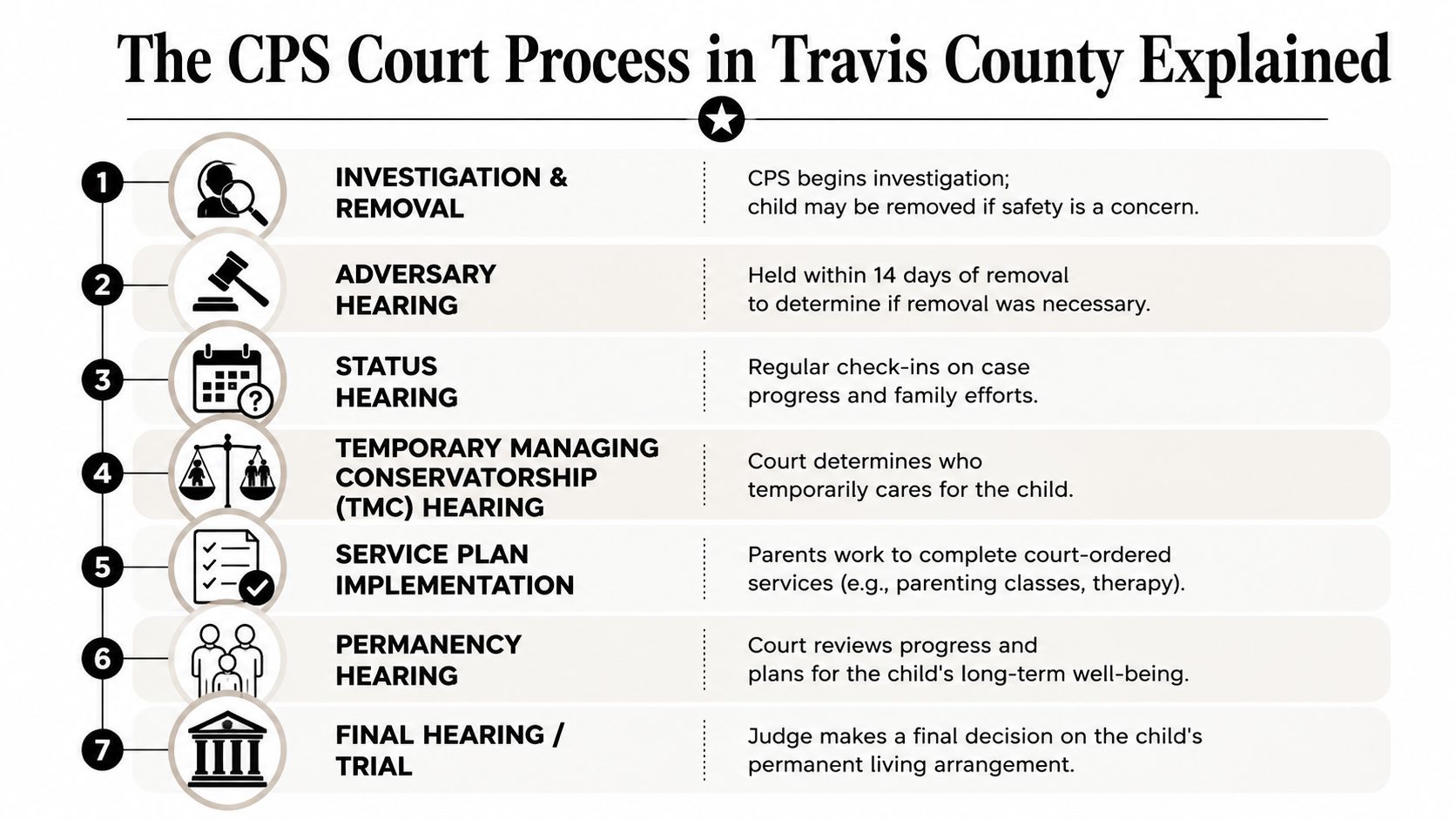
If CPS removes your child or files a lawsuit, the case enters a structured process under the Texas Family Code. Chapter 262 drives emergency intervention and removal procedure. Chapter 263 governs the ongoing review of the case, service-plan progress, and permanency decisions. A final fight over rights can implicate Chapter 161 if termination is sought.
This visual helps many parents understand the sequence.
When counsel becomes essential
In Texas, a CPS attorney becomes critically necessary when the government has filed a lawsuit against a parent or when children have been removed from the home. Parents who cannot afford private counsel have a constitutional right to free representation by an appointed public lawyer, as explained in this Austin CPS case overview.
That point changes the mindset. Once the case is in court, you're not dealing with a simple agency conversation anymore. You're in litigation with the state.
The major hearings parents should expect
A Travis County CPS case usually unfolds in stages. One of the earliest and most urgent is the Adversary Hearing, which is held within 14 days of removal under the section's required timeline. At that hearing, the court examines whether the emergency removal should continue.
After that, the case moves through review settings that often include:
Status Hearing
The court looks at the service plan, placement, and immediate expectations. This is often where parents begin to understand how much day-to-day compliance matters.Temporary Managing Conservatorship issues
The court addresses who has temporary legal authority over the child while the case is pending.Permanency Hearings
These hearings focus on progress, placement stability, and what the long-term plan may be.Final Hearing or Trial
The judge decides the permanent outcome at this stage if the case has not already resolved.
For a more detailed walkthrough of those stages, this guide to Texas CPS court hearings and timelines for parents and guardians is a useful companion.
What parents should do before each hearing
Preparation matters more than promises.
- Bring records: drug test results, counseling attendance, class certificates, medical updates, and visitation notes.
- Review the service plan carefully: don't assume you completed what the court thinks you completed.
- Tell your attorney what has changed: housing, work schedule, relatives available for placement, treatment progress.
- Ask what the judge is deciding that day: every hearing has a specific legal purpose.
Here is a short video that can help you visualize the process in context.
Court is not a series of random dates. Each hearing creates a record, and that record can either support reunification or make the path harder.
Parents often think one perfect hearing will fix everything. Usually it doesn't work that way. CPS cases are cumulative. The judge watches patterns, follow-through, honesty, and whether safety concerns are being addressed.
Choosing the Right Legal Partner for Your Family in Austin
Not every family lawyer is the right lawyer for a CPS case.
A CPS case moves on agency deadlines, court deadlines, and factual records that start forming before you ever reach a courtroom. You need someone who understands the pressure points in Travis County practice, knows how CPS investigations are built, and can tell the difference between a manageable case and one heading toward termination risk.

Questions worth asking in the consultation
The first meeting should help you evaluate the lawyer, not just the other way around.
Ask direct questions such as:
- How do you handle communication with CPS investigators?
- What's your approach if I'm asked to sign a safety plan?
- How do you prepare a parent for an adversary hearing or permanency hearing?
- What records should I start gathering today?
- How do you handle a case that overlaps with criminal allegations?
A good answer is specific. It should sound like a strategy, not a sales pitch.
Red flags parents should take seriously
Some warning signs show up fast.
| Red flag | Why it matters |
|---|---|
| Guaranteed outcome | No honest lawyer can promise that |
| Dismissive attitude toward your facts | CPS cases turn on facts and documentation |
| No clear communication plan | Confusion early becomes damage later |
| Pressure to hire without discussing process | You need informed decision-making |
| Treating CPS like ordinary divorce litigation | The procedures and risks are different |
The right lawyer won't calm you with false certainty. They'll calm you by giving you a plan.
If you're comparing options, [object Object] should help you think through what to look for in local representation and how to evaluate whether a lawyer's experience fits your situation.
What the right fit feels like
It feels organized. The lawyer asks for timelines, names, records, and court papers. They explain what matters now and what can wait. They don't encourage you to fight every point out of pride, but they also don't tell you to surrender your position just to keep things easy.
That balance matters. In CPS work, the best strategic partner is often the lawyer who knows when to push hard, when to document carefully, and when to keep a frightened parent from making a permanent mistake out of temporary panic.
Next Steps and Key Austin CPS Resources
If your family is in this position, you don't need to solve the entire case tonight. You need the next right step. That usually means protecting your words, preserving your records, and getting legal guidance before CPS defines the story for you.
Parents in Travis County should also know that if they are involved in a CPS lawsuit and cannot afford a lawyer, they may qualify for a court-appointed attorney after submitting an income-affidavit form through the court's process. Travis County provides phone lines for requesting counsel at (512) 854-7305, (512) 854-7312, and (512) 232-1290, as listed on the Travis County request-a-lawyer resource.
Quick questions parents ask all the time
Can I get a court-appointed attorney in Austin?
Yes, if you are involved in a CPS lawsuit and qualify financially through the court process in Travis County.What is a Family Service Plan?
It is the written plan that lays out what CPS and the court expect a parent to do during the case. You should review it carefully with counsel before assuming you understand its long-term effects.Can I challenge CPS findings outside the courtroom process?
In some situations, yes. Procedural review options may exist depending on the posture of your case.Where can I learn more about service plans and next steps?
[object Object] is a useful place to continue reading about what these plans require and how parents should approach them.
The fear is real, but so is the path forward. A CPS case is easier to survive when you stop reacting alone and start making decisions with a strategy.
If you're facing CPS contact, an investigation, or a Travis County court case, contact Law Office of Bryan Fagan PLLC for a free consultation. We can help you understand where your case stands, what rights you still have, and what steps may protect your relationship with your child. The conversation is confidential, and it can give you clarity when you need it most.