Skip to content
A stranger knocks at your door. They say they're from CPS. Your chest tightens before you even open it fully.
For many Houston parents, that moment feels like the ground drops away. You may be worried about saying the wrong thing, letting someone into your home, or losing your child before you've had a real chance to explain what happened. You may also believe that if you're polite and cooperative, everything will sort itself out.
Sometimes cooperation helps. But cooperation without legal guidance can create problems you didn't see coming.
A CPS case can begin with a misunderstanding, a custody fight, a report from a school, or an accusation that leaves you stunned. What matters next is how you respond in the first hours and days. When seeking a CPS attorney in Houston, you're probably not looking for legal theory. You're looking for clear answers, practical steps, and a way to protect your family.
The Knock at the Door Your Introduction to CPS
A mother in Houston hears a knock just after dinner. Her apartment is messy. The baby has been crying. She's exhausted from work, and she and the child's father have been arguing during a custody dispute. A CPS investigator says a report was made and wants to come inside, speak to the child, and ask a few questions.
That parent is often afraid of one thing above all else. If I say no, will they think I'm guilty?
That fear is real. So is the confusion. CPS workers can sound calm and routine, but the stakes don't feel routine when your children are involved. Parents often want to show they have nothing to hide. In that moment, they may talk too much, agree to things they don't understand, or sign paperwork without reading it closely.
First reality: being respectful doesn't mean giving up your rights.
You can be calm, polite, and careful at the same time. That's the balance many families struggle to find. If you need immediate guidance on what to do in those first moments, this resource on how to respond when CPS shows up at your door in Texas gives a practical overview.
Why the first response matters
The earliest stage of a CPS matter often shapes everything that follows. A parent who is flustered may make an inaccurate statement. A tired parent may agree to a "temporary" arrangement that later becomes part of the case file. A caseworker may interpret nervous behavior as evasiveness when it's really fear.
Texas law gives parents important protections, but those protections work best when you use them early.
A simple starting point
If CPS has contacted you, focus on these immediate steps:
- Stay calm: Anger and panic usually make the situation harder.
- Ask questions: Get the worker's name, contact information, and the basic nature of the allegations.
- Don't sign anything on the spot: Especially a safety plan or placement document.
- Speak with a lawyer quickly: Early advice can prevent later damage.
A Houston CPS case can feel personal, fast, and intimidating. It is personal. But it isn't hopeless. Parents who understand the process are in a better position to protect their children, their home, and their rights.
Understanding the CPS Investigation Process in Houston
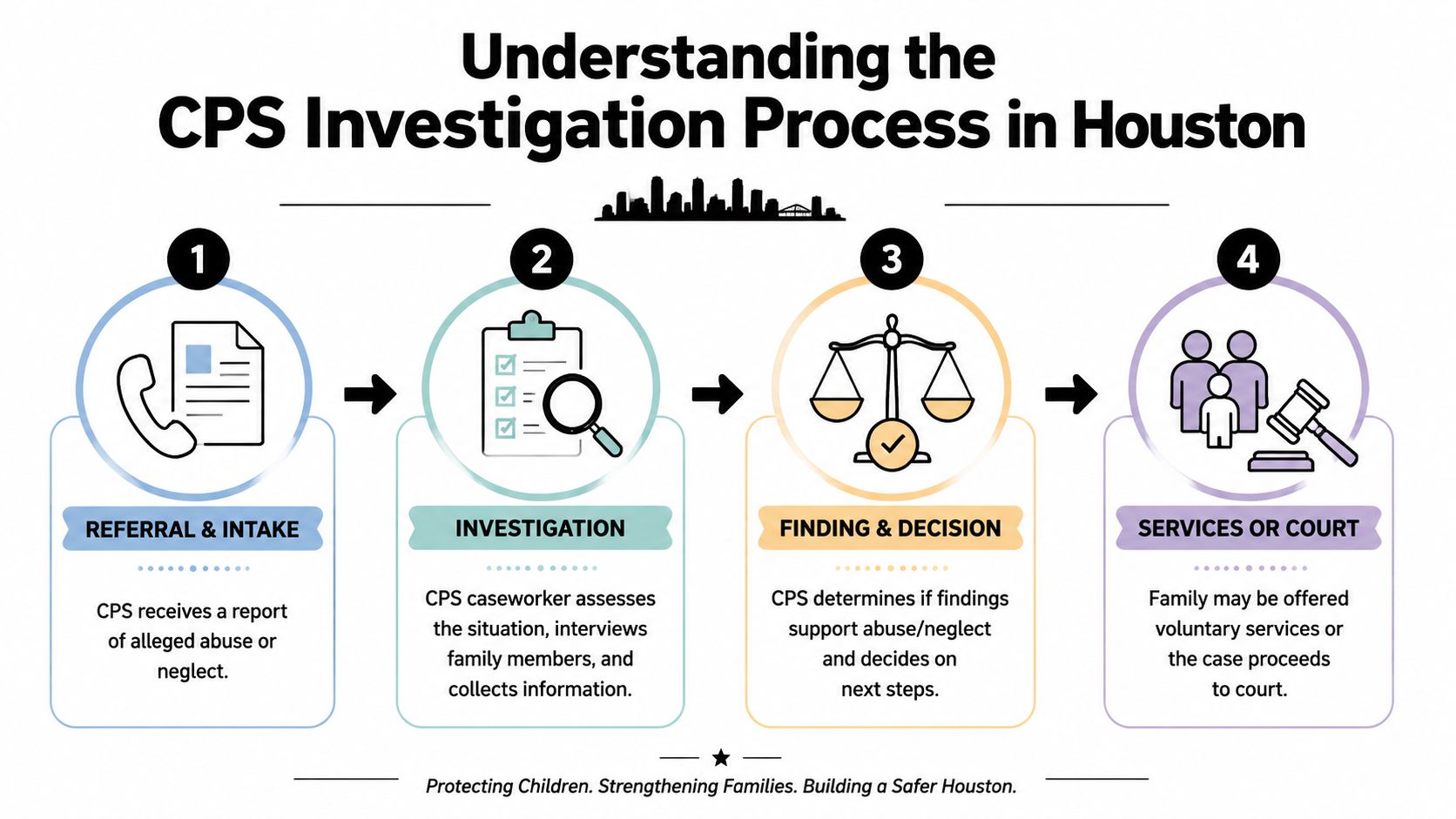
A Houston parent often meets CPS long before any judge is involved. The case usually starts with a report, then a screening decision, then contact from an investigator.
That order matters. If you wait to get organized until a court date appears, you may be weeks behind. Many parents believe polite cooperation by itself will protect them. In practice, the early investigation stage often shapes how CPS sees your family, what goes into the file, and whether the case grows or settles down.
How a case usually starts
A report can come from a teacher, doctor, neighbor, relative, or former partner. CPS first decides whether the report describes abuse or neglect that fits the agency's legal role. If it does, an investigator may call you, come to your home, contact your child's school, or ask for interviews and records.
Parents often expect a dramatic moment. More often, the first phase feels administrative. A phone call. A request to talk. A visit that seems informal. But informal does not mean unimportant.
For a clearer sequence, Texas CPS investigation process a step-by-step guide you need to know outlines what families usually see from first contact through the agency's decision. Another useful resource is The Texas CPS Investigation Process Explained, which walks through the stages and the parent rights that come up during each one.
The four stages many Houston parents will see
Referral and intake
CPS receives the allegation and decides whether it calls for agency involvement. This is the sorting stage. The agency is deciding whether the report belongs in the system at all.Investigation
A caseworker starts gathering information. That may include interviews, home observations, and requests for medical, school, or counseling records.Findings and recommendations
CPS decides whether the allegation is supported, whether the family should receive services, and whether there is a reason to ask the court to step in.Case closure, services, or court action
Some matters end here. Others continue through safety planning, family-based services, monitoring, or a court filing.
A useful way to understand this process is to compare it to a funnel. At the top, CPS starts with an allegation. As the case moves down, the agency filters information, tests the concern, and decides whether to close the matter or push it toward stronger intervention.
Where parents often get into trouble
The biggest mistake is treating every CPS request like a harmless paperwork step. A casual statement can end up summarized in a report. A rushed agreement can shape what the investigator believes the problem is. A parent who is trying to be agreeable may fill in gaps, speculate, or accept wording that is broader than the facts.
That is why early action matters.
If CPS has opened an investigation, focus on these steps right away:
- Identify the allegation clearly. Ask what conduct, incident, or condition CPS is investigating.
- Write down every contact. Keep names, dates, phone numbers, and a short summary of each conversation.
- Gather records before they are requested. School records, medical records, prescriptions, counseling notes, and text messages often matter.
- Avoid guessing or volunteering extra explanations. If you do not know an answer, say so.
- Speak with a Houston CPS lawyer early. Local counsel can tell you which requests are routine, which ones carry risk, and when court involvement may be coming.
Why local cases can feel fast and impersonal
Houston families are dealing with a large system. Caseworkers may be under time pressure and working from incomplete information. That does not make your case unimportant. It means you should not assume the investigator already sees the full picture.
Your job in this stage is simple to describe, even if it feels hard to do. Stay calm. Stay organized. Treat each contact as part of a written record that may later be reviewed by supervisors, agency lawyers, or a judge.
A CPS investigation is an information-gathering process, not a judge's order. Knowing that difference early helps a parent protect both credibility and options.
Your Legal Rights When CPS Arrives
Parents often think they have only two choices. Let CPS do whatever it asks, or look uncooperative. Texas law gives you a more balanced option.
When CPS arrives, your rights still matter. You don't lose them because an investigator is standing at your door asking urgent questions.
What Chapter 262 means in plain English
Under Texas Family Code Chapter 262, CPS can't remove a child solely because of parental conflict, divorce, or stress. Removal requires credible evidence of immediate danger to the child's physical health or safety, such as documented physical abuse, sexual abuse, serious medical neglect, or exposure to hazardous environments like drug manufacturing, as explained in this guide on Texas parental rights and legal protections in CPS cases.
That point matters because many parents blame themselves for ordinary family strain. An argument with your ex, a cluttered home during a hard week, or visible stress doesn't automatically justify removal.
Here is a helpful overview before you speak further with an investigator:
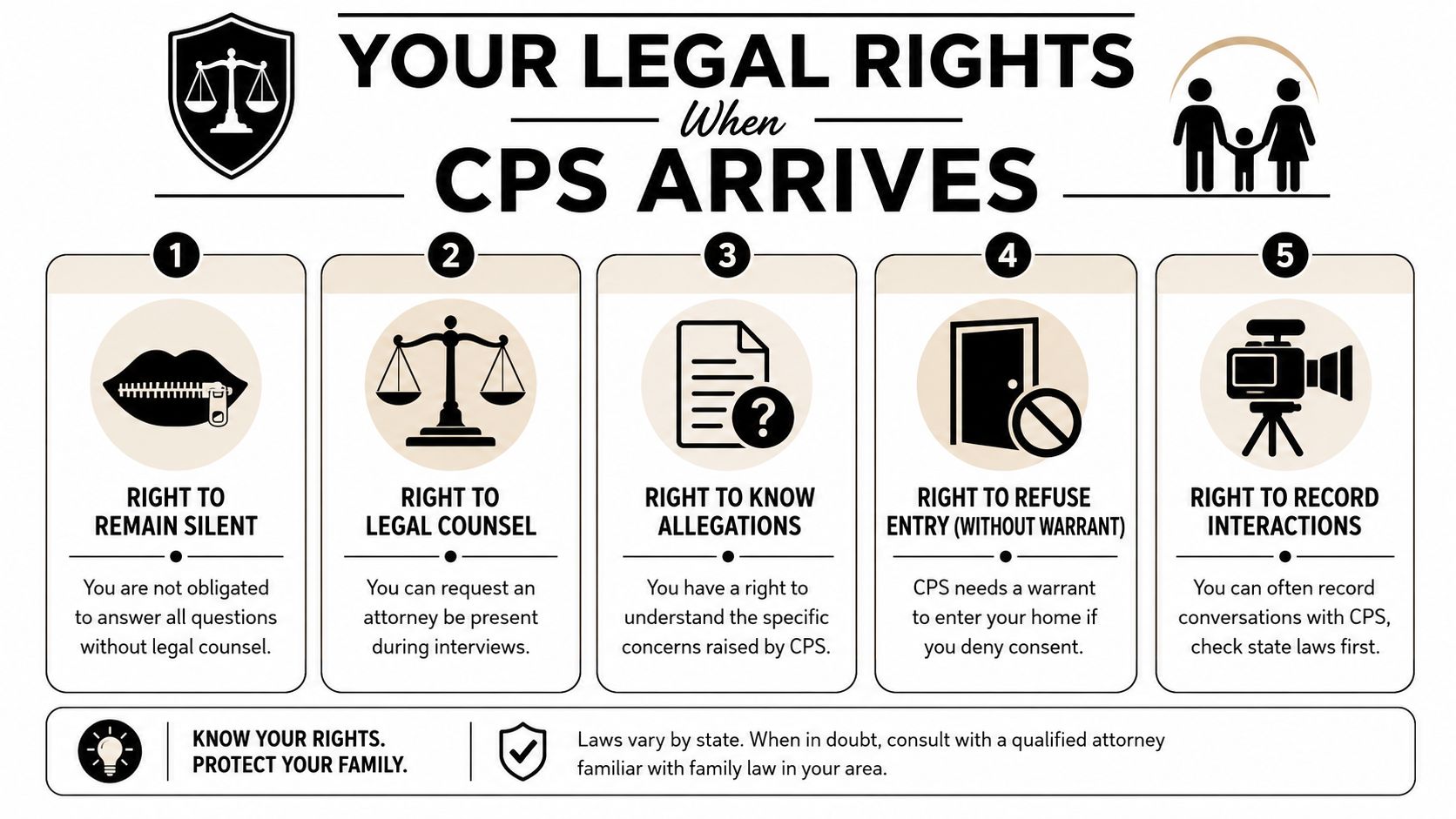
Five rights parents should remember
- Right to know the concern: Ask what allegations prompted the visit.
- Right to speak carefully: You don't have to answer every question immediately.
- Right to legal counsel: You can say you want to speak with an attorney before a detailed interview.
- Right to refuse entry in many situations: A request to enter is not always a legal order.
- Right to separate requests from requirements: Not every paper placed in front of you must be signed on the spot.
Practical rule: If you don't understand whether something is voluntary, don't guess. Ask directly, then speak with counsel before agreeing.
A common example
Suppose a caseworker says, "If you have nothing to hide, let me in and sign this plan so we can close things quickly." A worried parent may think refusal will make things worse. But that statement blends pressure with legal uncertainty.
The safer response is calm and simple: I'd like to understand the allegation, and I'd like to speak with a lawyer before agreeing to interviews, signatures, or any plan involving my child.
That's not hostility. That's caution.
The biggest mistake
The biggest mistake isn't always being rude. It's often being too eager to explain. Parents who are scared sometimes overtalk, speculate, or accept blame for conditions that don't amount to abuse or neglect under the law.
A CPS attorney in Houston helps you draw an important line. You can cooperate with the process without surrendering your protections.
How a Houston CPS Attorney Actively Protects Your Family
A CPS case can change direction in a day or two.
Many Houston parents believe full cooperation will protect them. They answer every question, hand over records, and sign a safety plan because they want to look reasonable. The problem is simple. Cooperation and protection are not the same thing. A parent can be polite, calm, and willing to work with CPS, while still making careful choices about interviews, home access, paperwork, and timelines.

A good Houston CPS attorney steps in early to keep a fast-moving situation from hardening into a case record that does not tell the full story. That early work often matters as much as anything said in court later. If you want a fuller explanation of that role, this guide on how lawyers help families handle CPS cases walks through the stages in plain language.
What a lawyer does in the first stage
The first job is often control.
CPS contacts can feel like a flood. Calls, texts, requests for meetings, requests for names of relatives, requests for records, and pressure to "just sign so we can move on." A lawyer helps turn that flood into lanes. What is required? What is optional? What should wait until records are gathered? What should be answered in writing instead of in a rushed conversation?
That usually includes several practical steps:
- Pinpointing the allegation. Your attorney works to find out what CPS is exactly investigating, not what you fear they might mean.
- Screening your responses. A lawyer helps you answer truthfully without guessing, overstating, or agreeing with labels that do not fit the facts.
- Reviewing safety plans before you sign. A "voluntary" plan can still affect where your child lives, who can be around your child, and what CPS expects from you later.
- Collecting proof early. School records, medical records, therapy notes, clean drug test results, photos of the home, and witness statements can all matter before a judge ever hears the case.
- Creating a local plan. In Houston, that may include identifying relatives, daycare providers, counselors, or supervisors who are realistic options if CPS raises placement or supervision concerns.
That work is similar to building a file before someone else builds it for you.
How an attorney protects your family if the case grows more serious
If the case starts moving toward removal, court involvement, or a long list of services, the attorney's role becomes more active and more strategic.
Your lawyer can press CPS to show why a proposed restriction is necessary. Your lawyer can challenge weak facts, point out missing context, and offer safer, less disruptive options. In many cases, the critical point is not whether CPS has concerns. Rather, it's whether those concerns justify separating a child from a parent, limiting contact, or demanding services that go beyond the facts.
That distinction matters.
Parents are often surprised by how many side issues can affect a CPS file. Text messages from a breakup, social media posts taken out of context, old accusations from a custody fight, or online harassment can all create confusion. In those situations, practical digital-safety steps can help preserve evidence and reduce harm. Some families also benefit from guidance on safeguarding your family online, especially when false reports, harassment, or digital evidence are part of the conflict.
What you can do before the case escalates
Early action gives your attorney more room to help.
Start by writing down a timeline of recent events. Save texts, emails, appointment records, school communications, and photos that may matter. Make a list of people who have firsthand knowledge of your parenting and your child's routine. Do not coach witnesses. Just identify them. If there are household issues that can be fixed quickly, such as medication storage, sleeping arrangements, or supervision gaps, address them right away and document the correction.
Then choose counsel carefully.
A Houston parent should look for a lawyer who regularly handles CPS matters in local courts, explains the difference between requests and legal requirements, reviews safety plans line by line, and can act quickly in the first days of contact. Ask direct questions. How soon can you review my documents? Will you attend interviews with me if needed? Have you handled emergency removals and adversary hearings in this county? What should I stop doing today?
As one example of a Texas firm handling these matters, Law Office of Bryan Fagan PLLC describes its work in family and criminal law matters that can intersect with CPS cases. The name matters less than the method. You want a lawyer who can move fast, explain clearly, and help you make good decisions before stress pushes you into bad ones.
Navigating Key Court Hearings and Timelines
Court is where a CPS matter becomes formal, structured, and much harder to manage by instinct alone. The names of the hearings can sound technical, but each one has a specific purpose.
The hearing most parents need to understand first is the adversary hearing.
The hearing that comes fast
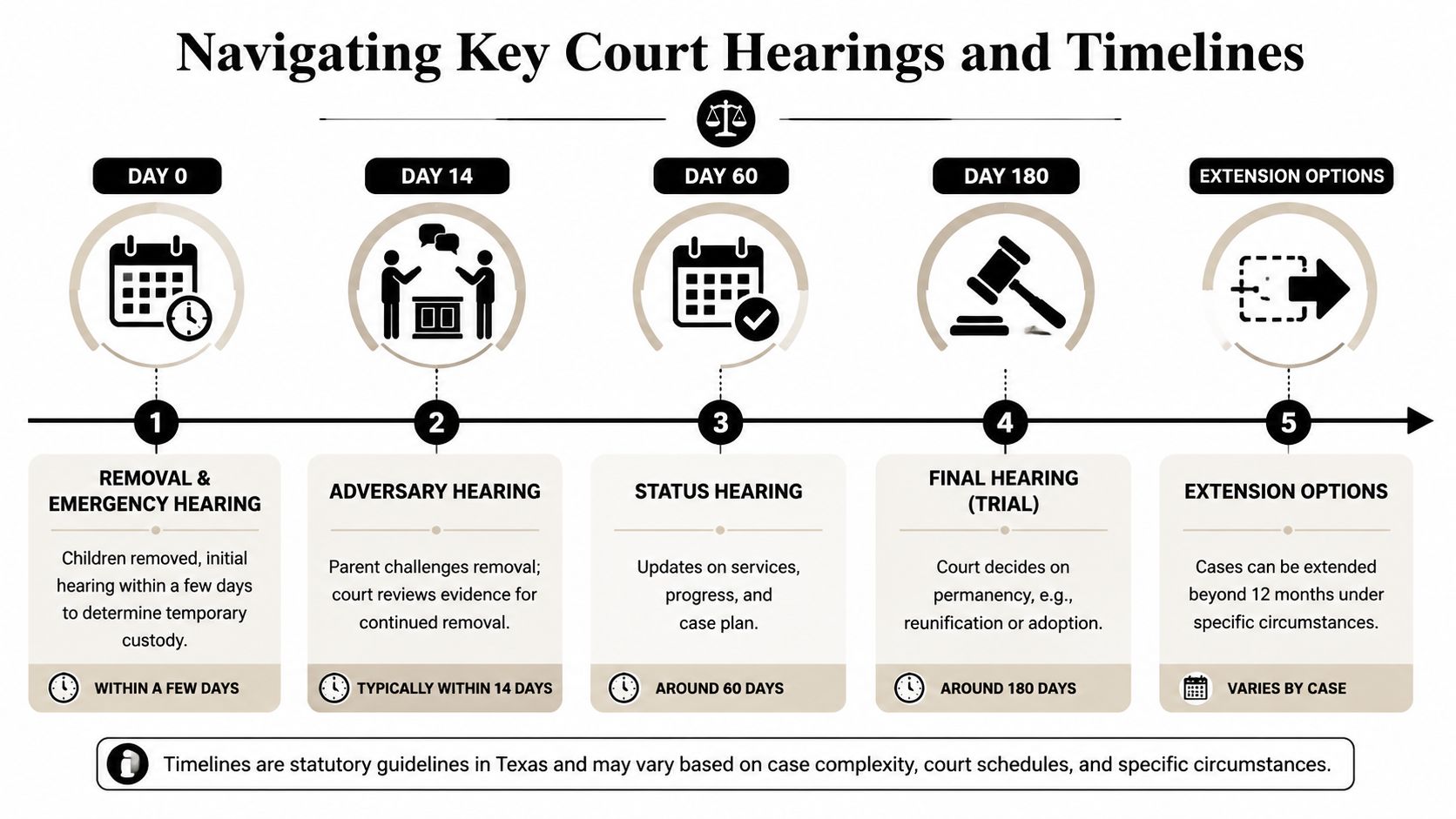
A full adversary hearing must occur no later than the 14th day after a child is taken into possession, and before that hearing the court must inform unrepresented parents of their right to an attorney and, if they are indigent and opposing the suit, their right to a court-appointed attorney, under Texas Family Code section 262.201.
That deadline matters because many parents are still in shock when it arrives. They may think there will be time later to get organized. Often, there isn't much.
The basic sequence of hearings
| Hearing | What it usually focuses on | Why it matters |
|---|---|---|
| Emergency removal stage | Immediate temporary protection issues | The court addresses urgent custody concerns right away |
| Adversary hearing | Whether CPS should keep temporary possession | This is the early chance to challenge continued removal |
| Status hearing | Service plans, expectations, and case progress | Parents learn what the court expects moving forward |
| Permanency hearings | Ongoing review of placement and parental progress | The court checks whether the case is moving toward reunification or another outcome |
| Final trial or final hearing | Long-term decision about the child's future | The court decides conservatorship, return, or other permanent relief |
What Chapters 263 and 161 mean for families
Chapter 263 generally governs review, permanency, and the ongoing court management of CPS cases. In practical terms, parents feel the pressure of deadlines, services, and repeated court check-ins as part of this process.
Chapter 161 deals with termination of parental rights. That's the most serious outcome in a CPS case. If your case begins moving in that direction, legal representation becomes even more urgent because the consequences are permanent.
Court reviews aren't just status updates. Judges use them to measure whether a parent is following through, whether CPS has met its obligations, and whether the child's placement should change.
How to prepare for each hearing
Parents do better when they treat every hearing as important, not just the final one.
- Bring documents: Certificates, clean drug test results, counseling records, and proof of stable housing can all matter.
- Follow instructions carefully: Missed services or missed visits can affect how the judge sees the case.
- Ask your lawyer what the judge will focus on: Each hearing has a different legal purpose.
- Stay consistent: Judges notice patterns more than promises.
A good hearing strategy isn't dramatic. It's steady, documented, and credible.
Choosing the Right CPS Attorney in Houston for Your Case
Not every family lawyer handles CPS cases the same way. Some focus mostly on divorce. Some are comfortable in negotiation but less experienced in urgent removal litigation. If your child is at risk of removal or your rights are under review, local CPS experience matters.
A good consultation should leave you more informed, not more confused.
Questions worth asking
When you speak with a potential attorney, ask direct questions:
- How often do you handle CPS matters in Harris County? Local court familiarity can affect strategy and expectations.
- What do you do in the first few days of a case? You want a concrete answer, not general reassurance.
- How do you approach safety plans and service plans? These documents shape the case.
- Will you handle the hearings personally or pass the case to another lawyer? Families deserve clarity about who will stand beside them.
- How do you communicate with clients during emergencies? CPS issues don't always arise during business hours.
What to listen for
Pay attention to whether the lawyer explains things in plain language. A strong attorney doesn't need to overwhelm you with jargon to sound knowledgeable.
You also want someone who understands that CPS cases can affect other relatives. In some families, grandparents become temporary caregivers or want to help stabilize placement. If your case also touches aging parents or caregiving responsibilities, this overview on understanding elder law can help you think through the broader family picture.
A simple comparison tool
| What to look for | Why it matters |
|---|---|
| CPS-specific experience | These cases move differently from ordinary family disputes |
| Clear explanation style | You need to make fast decisions under stress |
| Local court familiarity | Harris County practice has its own pace and expectations |
| Early intervention plan | The first stage can shape everything after it |
| Comfort with related issues | CPS cases often overlap with custody, criminal allegations, and protective orders |
You aren't just hiring credentials. You're hiring judgment under pressure.
Don't choose based on comfort alone
A kind lawyer is helpful. A strategic lawyer is necessary. The right CPS attorney in Houston should be both.
If an attorney promises easy outcomes, be careful. CPS cases are fact-heavy and unpredictable. The better sign is a lawyer who listens closely, identifies risks early, and tells you what to do next in specific terms.
Practical Answers to Your Most Urgent CPS Questions
A lot of parents ask the same thing in different words. "If I cooperate, won't this clear up on its own?" Sometimes cooperation helps. But cooperation without caution can also lock you into statements, plans, or deadlines you did not fully understand.
That is why the first goal is simple. Slow the process down enough to protect your rights before the case grows.
Can CPS take my kids because my house is messy
Usually, no. A home does not have to look perfect to be safe.
CPS is supposed to focus on danger, not ordinary disorder. Piles of laundry, dirty dishes, or a stressful week are very different from exposed drugs, no food, unsafe wiring, weapons within reach, or conditions that could seriously harm a child. A useful way to look at it is this. Clutter is one issue. A true safety threat is another.
If an investigator is coming, fix obvious hazards first. Put medicine, alcohol, and cleaning supplies out of reach. Make sure children have food, bedding, and a safe sleeping area. Small corrective steps taken early can matter.
What if someone made a false report
It happens more often than parents expect. Reports can come from ex-partners, relatives, neighbors, or someone who got the wrong idea.
Your first instinct may be to explain everything at once. That often backfires. A better approach is to treat the case like a record-building process. Write down what happened, save texts and emails, identify witnesses, and keep your explanation consistent. If the report is false, proof and calm judgment usually help more than anger.
What is a Family Service Plan and do I have to sign it
A Family Service Plan is a written list of what CPS says you need to do. It may include classes, counseling, drug testing, evaluations, home conditions, or visitation rules.
Do not treat it like routine paperwork. It works more like a roadmap CPS may later use to judge your progress. If a task is vague, unfair, unrelated to the allegation, or impossible for you to complete on the timeline given, that problem should be addressed before you sign if possible.
If you are confused about where a service plan fits in the larger process, the key question is whether you are still in an investigation or already in a court case. Those are different stages with different risks.
Will the court automatically give me a free lawyer
No. Many parents are surprised by this.
A court-appointed lawyer is generally tied to a filed court case, not the earliest investigation stage. That means a parent can be under pressure from CPS before any judge has appointed counsel. This is one reason early private legal advice can matter so much. Waiting for the system to assign help may leave you unprotected during the stage when parents make the most avoidable mistakes.
What if my child has an attorney too
That usually means the court wants an independent voice focused on the child.
The child's lawyer is not automatically your enemy. But that lawyer does not represent you. Their job is different from your job, and different from your attorney's job. Once another lawyer is speaking to the court about your family, details matter more. Statements, documents, missed services, and missed visits can take on added weight.
What should I do today if CPS has already contacted me
Start with the next few moves. Early action often matters more than perfect cooperation.
- Write a timeline today. Include dates, who contacted you, what was said, and any requests CPS made.
- Preserve everything. Save texts, emails, voicemails, medical records, school records, and photos of your home.
- Fix immediate safety concerns. Remove hazards, restock food, and document the changes with photos.
- Do not sign paperwork you do not understand. Ask for time to review it.
- Do not guess in interviews. If you do not know or do not remember, say that plainly.
- Start looking for local legal counsel right away. Ask whether the lawyer regularly handles CPS matters in Harris County, how quickly they can review a safety plan or service plan, and what they want you to do in the first 24 hours.
Choosing counsel under stress can feel like picking a surgeon during an emergency. Focus on practical questions. How soon can they act? Do they explain things clearly? Do they know the local court process? Can they review documents before you sign? Those answers usually tell you more than a polished sales pitch.
If you feel overwhelmed, that does not mean you are failing. It means the situation is serious, and your next careful step matters.
If CPS has contacted your family, you do not have to sort through fear and legal confusion on your own. The Law Office of Bryan Fagan PLLC offers a free consultation for Texas families who need immediate guidance about investigations, hearings, safety plans, and parental rights. A calm, informed response can make a real difference. Reach out today and get clear answers about how to protect your family.