Skip to content
If CPS is only investigating, the case is generally completed within 30 days, and a supervisor can extend it to 60 days. If your child was removed and CPS filed a court case, that case must almost always be resolved within 12 months, with a possible 6-month extension in extraordinary circumstances.
That's why parents get conflicting answers when they ask how long can CPS keep a case open in Texas. An investigation is one timeline. In-home services are another. A court case is the longest and most serious path. If you're staring at a business card from a CPS investigator, replaying every conversation in your head, and wondering whether this will drag on for weeks or swallow the next year of your life, you're not overreacting. The timeline matters because your family's stability, your job, your housing, and your relationship with your child all get tied to it.
That Knock at the Door What a CPS Case Means for Your Family
A lot of parents remember the exact moment CPS entered their lives. A knock at the door. A call from the school. A message saying an investigator wants to talk. The first question is usually not legal. It's personal: “What is happening to my family?”
The second question comes right behind it: “How long is this going to last?”
For some families, CPS closes the matter after the initial investigation. For others, the agency asks for services while the child stays at home. In the hardest cases, CPS removes a child and the case moves into court. Those are three very different tracks, and parents often get scared because nobody explains that clearly at the beginning.
A common scenario looks like this: your child's school notices bruising, a neighbor reports loud arguments, or a doctor raises a concern about supervision. You may know exactly what happened, and you may believe the report is incomplete or flatly wrong. But once CPS opens a case, your feelings alone won't shorten it. What helps is understanding the process, responding carefully, and protecting your rights without making avoidable mistakes.
Practical rule: The faster you understand which timeline you are in, the faster you can make good decisions about documents, services, court dates, and legal help.
Parents also need a way to steady themselves emotionally. Fear makes people talk too much, sign things they don't understand, or miss deadlines because they shut down. Resources that explain the core principles of trauma practice can help you recognize what stress is doing to your thinking so you can respond with more control.
You don't need to guess your way through this. You need a map. Start with the first timeline, the investigation itself.
The Initial Investigation Window 30 to 60 Days
The shortest CPS timeline is the investigation stage. Under Texas DFPS policy, CPS investigations are generally completed within 30 days from the date the report was received, though a supervisor can approve an extension up to 60 days. Priority I reports require investigation initiation within 24 hours, and Priority II reports within 72 hours, according to Texas DFPS investigation policy.
What happens first
Those early response deadlines matter because they explain why some parents hear from CPS almost immediately while others wait a bit longer. A report the agency sees as more urgent gets a faster response. That doesn't automatically mean the allegation is true. It means CPS has decided it needs to look quickly.
During this phase, the investigator may try to:
- Interview you about the report and your household.
- Speak with your child and other adults around the child.
- Look at the home if safety conditions are part of the concern.
- Gather outside information from schools, doctors, or other involved people.
If you need a more detailed walkthrough, this guide on how long CPS has to investigate in Texas helps place those deadlines in context. A more detailed resource, The Texas CPS Investigation Process Explained, gives a step-by-step breakdown of how a Texas CPS investigation unfolds and a parent's rights at each stage.
Why some investigations last longer
Not every case fits neatly into the first month. An extension can happen when the investigator still needs records, can't complete interviews promptly, or has unresolved safety questions that require more review. That doesn't always signal that the case is getting worse. Sometimes it means CPS is still sorting out conflicting information.
What matters is what comes next. In practical terms, the investigation stage usually ends in one of three directions:
| Possible outcome | What it usually means |
|---|---|
| Case closes | CPS decides the matter doesn't require ongoing involvement |
| Services begin | CPS wants the family to complete supports while the child remains at home |
| Court case starts | CPS believes removal or court oversight is necessary |
A short investigation can still feel intense. The pressure comes from uncertainty, not just the number of days.
What works for parents in this window is calm, organized communication. What doesn't work is ignoring calls, arguing with everyone involved, or assuming the matter will disappear if you wait it out.
Voluntary Services Cases The 6 to 9 Month Timeline
Some parents get through the investigation and hear something that sounds confusing at first: CPS isn't removing the child, but the case still isn't closed. That usually means the agency wants Family Based Safety Services, often called FBSS.
This is the middle timeline. It is longer than an investigation, but it is different from a court removal case. In these cases, the child typically remains with a parent or family member while CPS monitors progress and asks the family to complete services aimed at improving safety in the home. According to Texas Law Help's explanation of CPS investigations, cases where children remain with parents but receive Family Based Safety Services may stay open for 6 to 9 months if services are still required to ensure a safe home environment.
What a service plan usually looks like
A service plan is the roadmap CPS gives the parent. The exact tasks depend on the concern, but they often involve practical steps such as counseling, parenting education, or other supports tied to the safety issue CPS identified.
In plain terms, CPS is saying: “We are not asking a judge to remove your child right now, but we want proof that the concerns are being addressed.”
That can feel frustrating, especially if you think the report was unfair from the start. Still, this stage gives many families a chance to keep the household together while showing progress.
What helps close an FBSS case
Parents often ask whether these services are really voluntary. Legally, they are not the same as a removal case in court. Practically, refusing every service without a plan can increase conflict and may push the case in a more serious direction.
The parents who move through this stage more effectively usually do a few things well:
- They read the service plan carefully. They don't treat it like a stack of paperwork.
- They start quickly. Waiting weeks to schedule classes or counseling makes the case feel stalled.
- They save proof. Certificates, attendance records, and provider letters matter.
- They fix the practical problem. If the issue was supervision, they build a reliable childcare plan. If the issue was home conditions, they correct them and document the change.
What parents often miss: CPS is looking for behavior that matches the paperwork. Finishing a class helps. Showing daily stability helps more.
This path can be emotionally draining because it feels like life is on hold. But it also gives you room to demonstrate that your home is safe without stepping into a formal removal trial.
The 12-Month Clock When a Judge Is Involved
A CPS case becomes much more serious when the agency removes a child and files a court case. At that point, you are no longer dealing only with an investigation or voluntary services. You are dealing with court orders, hearings, deadlines, and the risk of losing parental rights if the case goes badly.
Under Texas law, most removal cases must be resolved within one year from the date the case is filed. The court is required to either return the child to the parent or terminate parental rights within that timeframe, according to this discussion of Texas Family Code Chapter 263. Texas Law Help also explains that if CPS files a court case involving removal, the case must almost always be resolved within 12 months, and the court may grant a six-month extension for extraordinary circumstances, allowing the case to remain open for up to 18 months in total.

Why this deadline matters
The law imposes this deadline so children don't remain in temporary foster care placements indefinitely while adults argue about the future. Once the court case begins, the clock is running whether you feel ready or not.
Parents usually receive a service plan during the case, and the court reviews progress through multiple hearings. At this stage, Texas Family Code Chapters 262 and 263 become especially important. Chapter 262 deals with removal procedures and early court review. Chapter 263 governs the ongoing case and the deadline for final resolution.
Texas Family Code Chapter 161 also matters because that chapter addresses termination of parental rights. If CPS begins talking about termination, the case has entered the most serious category possible. At that point, every missed service, failed hearing, or undocumented improvement carries more risk.
The three timelines compared
Here is the clearest way to think about the full process:
| Timeline | Typical path | Key duration |
|---|---|---|
| Investigation | CPS reviews the report and gathers facts | 30 days, with possible extension to 60 days |
| In-home services | Child stays home while parent completes services | 6 to 9 months |
| Court removal case | Judge oversees case after removal | 12 months, with possible extension to 18 months |
If your case is already approaching the one-year mark, this resource on an extension of a CPS case beyond one year in Texas can help you understand what courts look at when extra time is requested.
What works and what does not
In court cases, parents often lose time in predictable ways:
- They delay services because they are angry about the removal.
- They assume effort is enough without producing written proof.
- They miss visits or hearings, which CPS then frames as inconsistency.
- They focus only on blame, instead of showing current safety and stability.
What works is disciplined follow-through. Court cases are not won by promising change. They are influenced by documented change, steady compliance, and a clear legal strategy.
A Real-Life Example Maria's Journey to Case Closure
Maria was a single mother with two children in elementary school. CPS got involved after the school noticed her son had come to class tired several days in a row and mentioned being left with an older cousin after work. Maria felt insulted by the report. She wasn't abusing her children, and from her perspective she was doing what many working parents do. She was surviving.
Her first mistake was emotional, not legal. She almost ignored the investigator because she thought cooperating would make her look guilty. After getting advice, she changed course. She responded, stayed respectful, and started treating the case like something that needed structure instead of outrage.
How her timeline unfolded
During the investigation, Maria gathered work schedules, school records, and names of family members who regularly helped with childcare. She also explained the cousin's role more clearly and showed that food, utilities, and housing were stable. CPS still had concerns about supervision, so the matter did not close immediately.
Instead, the case moved into an in-home services track. Maria agreed to a parenting-related service and took steps to tighten up her childcare plan. She stopped relying on informal last-minute arrangements and created a written routine for pickups, after-school care, and backup support when work ran late.
That mattered because her actions matched the concern. She wasn't just saying, “I'm a good mom.” She was showing how the identified risk had been addressed.
Why Maria's case closed
Maria's case closed because she did three things many parents resist:
- She stayed engaged even when she felt judged.
- She completed what was asked instead of arguing about every step.
- She documented progress so the file reflected the same progress she saw at home.
Parents often want closure to come from being right. In CPS cases, closure more often comes from being prepared, consistent, and able to prove it.
Maria's story is relatable because nothing about it felt dramatic to her. That's true in many CPS matters. A case can begin with a misunderstanding, a hard season, or one bad snapshot of family life. But once CPS opens the file, your response shapes how long it stays open.
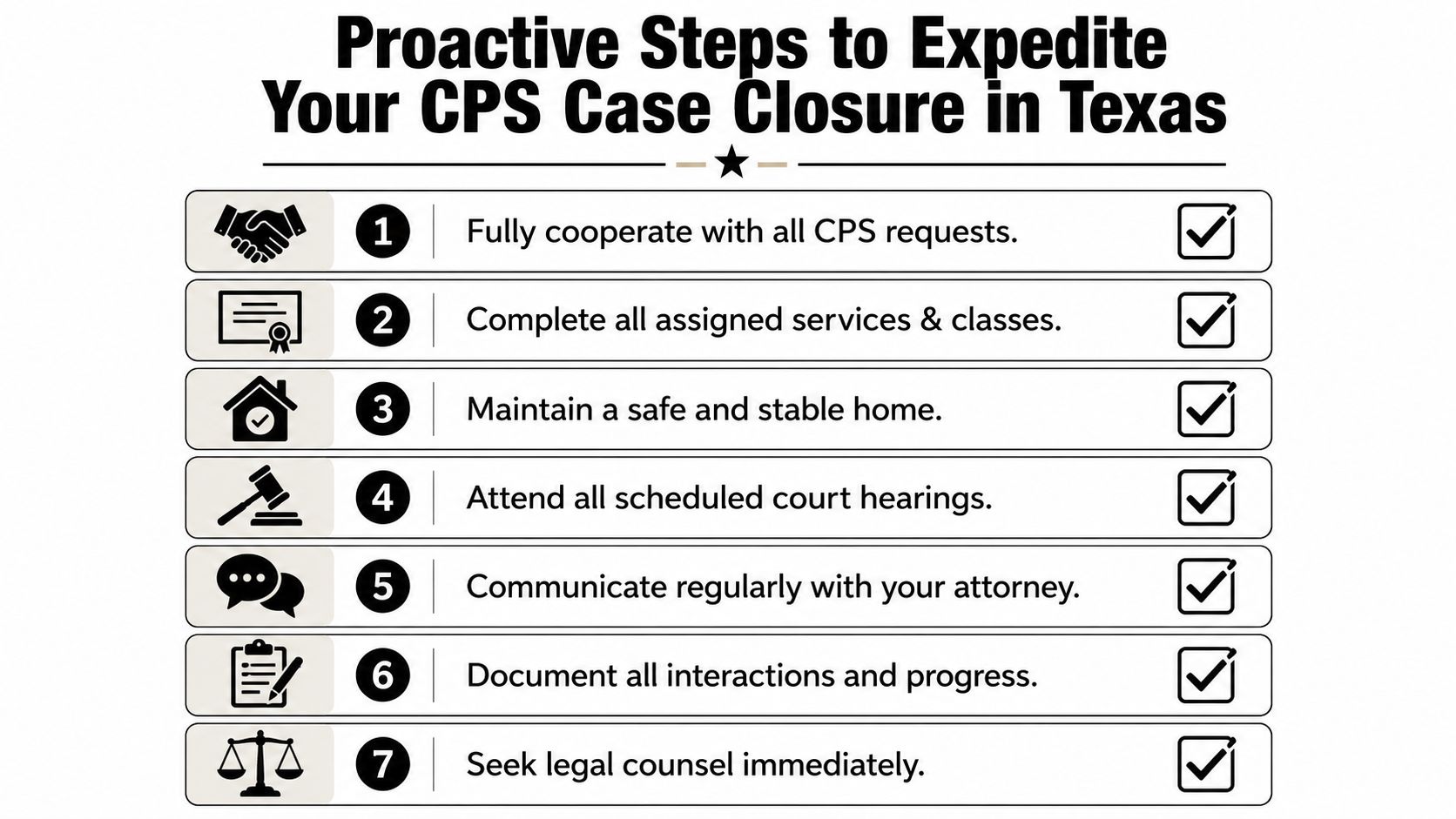
Proactive Steps to Help Close Your CPS Case
Once CPS has opened a case, you can't control everything. You can control whether your file shows movement or drift. That difference often affects how long the matter stays open.
Early in the case, many parents benefit from hearing practical guidance in plain language. This video addresses common concerns families face during CPS involvement.
Start with the service plan and the calendar
If CPS gives you a service plan, treat it like a court deadline even if you are not yet in court. Read each task. Ask questions if a requirement is vague. Put every class, evaluation, visit, and meeting on a calendar the same day you learn about it.
Parents get in trouble when they carry the plan around in their head. Memory is not a system.
Build a paper trail that helps you
A clean record helps in almost every CPS setting. Keep a folder with appointment confirmations, class certificates, testing results if applicable, provider letters, screenshots of scheduling messages, and notes from conversations with the caseworker.
Use this checklist:
- Track every contact. Write down who called, what was requested, and when you responded.
- Save proof the same day. Don't plan to organize later.
- Confirm important conversations in writing. A short follow-up message can prevent disputes about what was said.
- Keep your home ready. If home conditions were raised, don't wait for another visit to fix them.
Know when cooperation needs legal backup
Cooperation is often wise. Blind cooperation is not. If a request feels unclear, unrealistic, or disconnected from the alleged concern, get legal advice before you agree to everything placed in front of you.
Parents who need a stronger defensive strategy can review practical guidance on how to fight CPS in Texas. The Law Office of Bryan Fagan PLLC represents Texans dealing with CPS matters that intersect with hearings, removals, and broader family-law-related risks.
Best use of your energy: Don't spend it trying to win arguments with the investigator. Spend it completing tasks, gathering proof, and preparing for the next review point.
The fastest path to closure is usually not emotional. It is organized, documented, and steady.
Warning Signs You Need a CPS Attorney Immediately
Some CPS problems are too serious to handle casually. If any of the following is happening, stop hoping it will sort itself out and speak with counsel right away.

Red flags that change the stakes
Under Texas Family Code Chapter 262, if CPS removes a child from the home, a judge must hold an Adversary Hearing within 14 days of the removal to review whether CPS had a legitimate legal reason to take the child, as discussed in this overview of the 14-day adversary hearing requirement in Texas.
That is not a minor deadline. It is one of the first moments when your rights, the agency's evidence, and the child's placement all come under court scrutiny.
You should call an attorney immediately if:
- Your child has been removed. The case has moved into a far more dangerous stage.
- You hear the words “Adversary Hearing.” The court process is active and time-sensitive.
- CPS mentions termination. That raises Chapter 161 issues and the risk of permanently losing parental rights.
- The requests keep expanding. When the list of demands stops matching the original concern, you need advice.
- You feel pressured to sign quickly. Pressure and confusion are a bad combination in CPS cases.
If you are unsure whether your situation has reached that point, this guide on whether you need a lawyer for a CPS case in Texas can help you spot the difference between a manageable issue and a legal emergency.
You Are Not Alone Let Us Help You Close This Chapter
The answer to how long can CPS keep a case open in Texas depends on which track your case is in. An investigation is usually measured in days. In-home services are often measured in months. A court removal case is measured on a one-year legal clock, with limited room for extension.
What matters most is this. You do not have to face CPS in a fog of fear and guesswork. Parents make better decisions when they know the timeline, understand the purpose of each phase, and act early instead of react late. If your case is already affecting your access to your child, your home, or your future as a parent, waiting usually makes things harder.
If CPS has contacted you, asked you to sign a service plan, scheduled a hearing, or removed your child, contact Law Office of Bryan Fagan PLLC for a free consultation. We can help you understand where your case stands, what deadlines control it, and what steps may help you move toward reunification and closure.