Skip to content
A CPS call usually comes at the worst possible moment. You're making dinner, getting ready for work, or trying to settle an argument at home, and suddenly a stranger says they're investigating your family. Your heart drops. You start wondering whether your child could be taken, whether you should explain everything right away, and whether one wrong sentence could make this much worse.
Those fears are normal. They also matter, because panic makes parents talk too much, agree too quickly, or sign something they don't fully understand.
If CPS has contacted you in Texas, you need two things immediately. You need calm, and you need a plan. You also need to understand one hard truth that many parents don't hear soon enough: a CPS case can stay in family court, but it can also spill into criminal court if the allegations involve abuse, neglect, drugs, injuries, or violence in the home. That overlap changes everything about how you should respond.
The Phone Call Every Parent Dreads
The call often sounds ordinary at first.
A CPS investigator introduces herself, says she received a report, and asks if this is a good time to talk. A scared parent hears a calm voice and assumes the fastest way to make this go away is to explain everything. That instinct is human. It is also where many cases start to turn against the parent.
I have seen this happen more than once. A mother tries to explain a bruise, a missed school day, or an argument with the other parent. A father tries to sound cooperative and starts filling in details no one asked for. By the end of the conversation, the parent feels shaken, and the investigator has a list of statements that can be compared against medical records, school reports, text messages, police notes, or later interviews.
That first call matters because CPS cases in Texas do not always stay inside one lane. Parents often assume this is only a family court problem. Sometimes it is. Sometimes the same allegation also creates criminal risk, especially if the report mentions injuries, drugs, domestic violence, child endangerment, or accusations of physical abuse. In plain terms, what sounds like a child welfare inquiry can become evidence in a criminal case.
That overlap is what many parents miss.
CPS and criminal investigators can look at the same facts for different reasons. CPS asks whether a child is safe. Police and prosecutors ask whether a crime may have occurred. One conversation can affect both. A statement made in panic to "clear things up" may later be treated like an admission, even if that was never the parent's intent.
A CPS call is not a finding of guilt. It is the start of an investigation, and the safest response is usually a careful one, not a fast one.
That is why early legal advice matters so much. You need someone who sees the whole board, not just one piece of it. A lawyer handling these cases should be thinking about your family court position and any criminal exposure at the same time.
If a caseworker has called or said a visit is coming, read this guide on how to respond when CPS shows up at your door in Texas. Then slow the situation down before you give a detailed statement.
What parents often get wrong in the first contact
The first mistake is treating the call like an informal conversation. It is not. It is closer to the opening move in a chess game. Small decisions early can shape what happens next.
Another common mistake is assuming politeness means you must answer every question right away. You can be respectful and still be careful. Those are not opposites.
Parents also underestimate paperwork. A safety plan or release form may look temporary and harmless, but signing before you understand the legal effect can change the course of the case.
And many parents miss the biggest danger of all. They focus only on keeping CPS happy and do not stop to ask whether the same facts could trigger criminal charges.
Discipline helps. So does calm. The goal in those first hours is not to tell your whole story. The goal is to protect your family without making a hard situation harder.
Your Rights During the Initial CPS Investigation
The first contact with CPS often feels like a test you did not know you were taking. A caseworker may sound calm. The questions may sound routine. But early conversations can affect both the CPS case and, in some situations, a criminal investigation.
That is why your rights matter from the first phone call, first home visit, and first request to sign paperwork.
Texas parents often assume they have only two choices: cooperate fully or look guilty. The law is more nuanced than that. You can be respectful, protect your child, and still set legal boundaries. A good way to understand it is to picture your rights as guardrails on a narrow road. They do not stop the process. They help keep you from sliding into a worse position.
What rights matter most at the start
At the beginning of a CPS investigation, several protections matter right away.
You can decline to answer questions that could expose you to criminal risk.
You can ask to speak with a lawyer before giving a detailed statement.
You can refuse to sign documents before you understand what they do.
You can ask what allegations CPS is investigating, rather than guessing and talking too much.
You can challenge CPS findings and requests through the legal process instead of treating the caseworker's first version of events as final.
If you want a clearer overview of these protections, review this guide on parents' rights during a Texas CPS investigation. If you want a plain-language summary focused on the legal protections Texas parents have at the investigation stage, Your Rights During a CPS Investigation is a useful starting point.
What to do in the first 24 hours
Start by slowing the pace.
Get the caseworker's full name, phone number, office, and the general nature of the allegation. Write down the date and time of every call, text, visit, and request. Save voicemails. Keep screenshots. If a relative, teacher, doctor, or neighbor is mentioned, note that too.
Then be disciplined with your words. Short, accurate answers are safer than long explanations. Parents under stress often fill silence with details, guesses, or apologies. That can create new problems where none existed before.
Do not sign a safety plan, medical release, drug testing agreement, or voluntary placement form on the spot unless you understand the effect. Paperwork that looks temporary can still change where your child stays, who may be in the home, or whether CPS later argues that you admitted a safety concern.
And if the allegation involves injuries, drugs, domestic conflict, discipline, or anything that could interest police, talk with a lawyer before a detailed interview. That overlap is easy to miss. It is also where families get hurt by advice that looks only at family court and ignores criminal exposure.
The rights parents overlook most often
The right many parents forget is the right to pause.
CPS may act with urgency. You still have the right to gather yourself, get advice, and respond carefully. That is not the same as refusing to cooperate. It is using judgment in a high-risk situation.
Another overlooked issue is the difference between letting CPS see that you care and giving them a full narrative before you know the accusation. Those are not the same thing. A parent can say, "I want to cooperate, but I want legal advice before answering detailed questions." In many cases, that is the smartest sentence in the room.
The safety plan causes a lot of confusion. CPS may describe it as informal, temporary, or just a way to keep the case from getting worse. But a safety plan can function like a set of house rules written by someone else. It may limit contact with your child, require another adult to supervise you, or push a child into a relative's home without a court order. Before you sign, you need to know what problem CPS says it solves, how long it lasts, and what happens if you disagree.
A simple example
Suppose a mother says, "I only grabbed his arm because he would not listen and I was scared he would run into the street."
A CPS investigator may hear possible excessive discipline or poor emotional control. A police officer reviewing the same statement may hear an admission that physical force was used on a child. The parent was trying to sound honest. The wording still created risk in two places at once.
That is why parents need a unified strategy early. The goal is not to hide facts. The goal is to avoid handing one statement to two different systems that may each use it against you.
Here is the mindset that protects families best in the opening stage:
- Be polite.
- Be organized.
- Be brief.
- Be careful with documents.
- Be represented before giving a full statement.
You do not have to solve the case at your front door or on a surprise phone call. You do need to treat the first contact as legally important.
The Hidden Danger of Criminal Charges
A CPS case can turn into a criminal case faster than many parents realize.
You may believe you are answering questions about parenting, discipline, or the condition of your home. At the same time, a police officer or prosecutor may be looking at those same facts through a different lens. What sounds like a family problem to you can be treated as possible evidence of child endangerment, assault family violence, injury to a child, drug possession, or neglectful supervision.
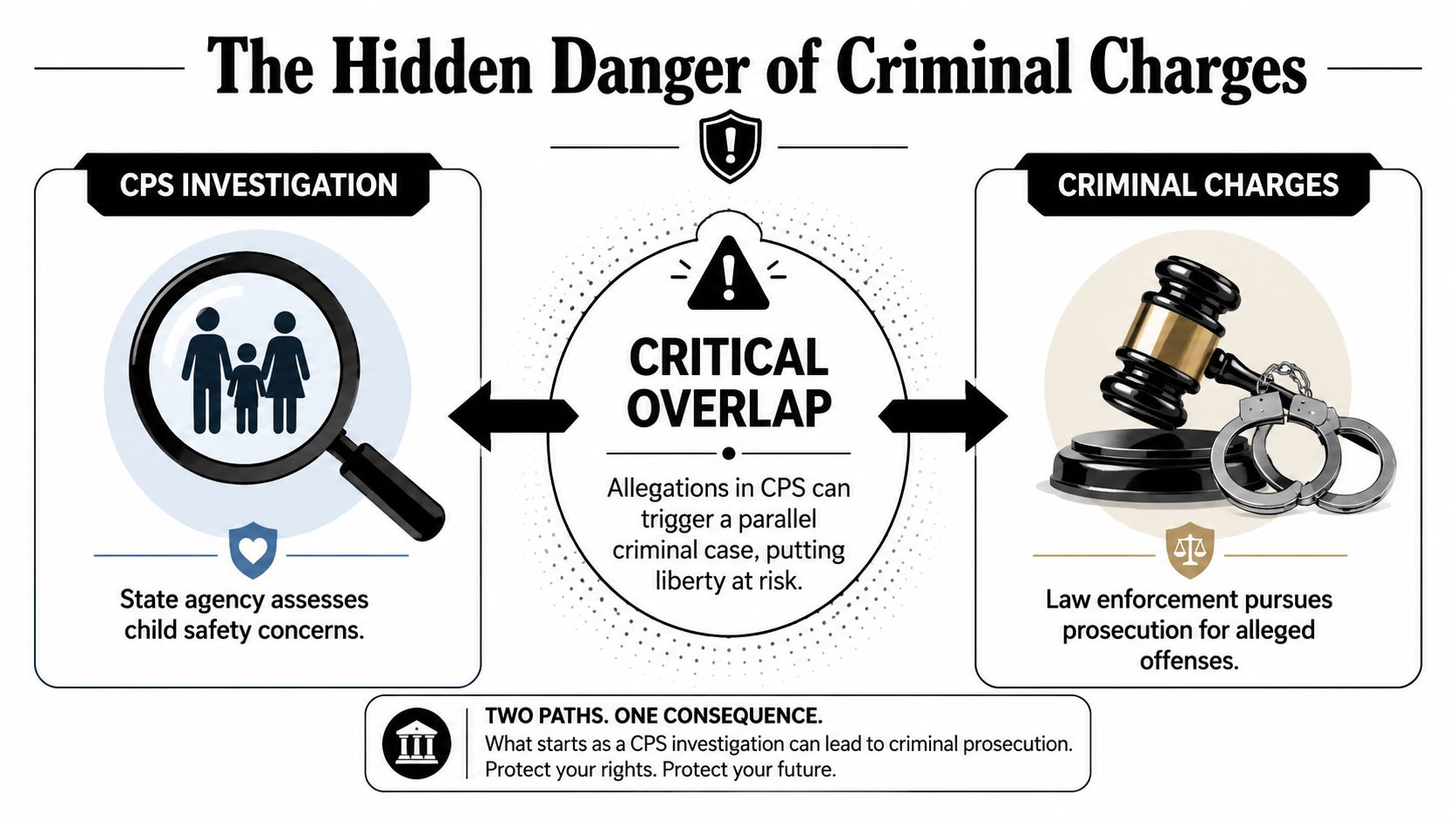
That overlap happens often enough that parents should plan for it early, not after an arrest. CPS and law enforcement have different jobs, but their evidence can overlap. A photo taken during a home visit, a child's statement, a medical record, or your own explanation can travel from one case file to the other.
How the same facts get used twice
A CPS investigation asks, "Is this child safe right now?" A criminal investigation asks, "Can the state prove a crime beyond a reasonable doubt?" Those are different questions, but they can grow from the same event.
Here is a common example. A father tells CPS, "I only left her in the car for a minute while I ran inside." He may be trying to show there was no bad intent. CPS may hear poor judgment and unsafe supervision. A prosecutor may hear an admission that supports a criminal charge.
One sentence can create two problems.
That is why parents need a unified defense strategy. Handling the CPS side without accounting for criminal exposure is like fixing a roof while ignoring a fire in the walls. The issues are connected, and the wrong move in one place can make the other much worse.
What a unified defense actually does
A coordinated legal response usually focuses on four things:
- Controlling statements carefully, so a parent does not make broad admissions out of fear or pressure
- Reviewing records early, including medical records, school reports, text messages, and body camera footage when available
- Protecting against inconsistencies, because what helps in family court may create risk in a criminal case if phrased carelessly
- Building one theory of the case, so the explanation given to CPS does not undercut the defense if police or prosecutors get involved
This is the piece many family law only firms miss. They may know CPS procedure well, but if they do not watch for criminal exposure from the start, a parent can walk into an interview thinking it is about services and leave with statements that support charges.
If your case includes allegations that could draw police attention, this explanation of how to protect your family when facing criminal accusations in a Texas CPS case lays out the risks in plain language.
I see the same mistake over and over. A parent hires help for the CPS case, assumes the criminal side is only a possibility, and waits. By the time that danger feels real, the record is already full of statements, releases, and documents that are hard to take back.
Navigating the Texas CPS Court Process
You may walk into your first CPS hearing thinking the judge will hear the whole story that day. That is rarely how Texas court works. Early hearings usually focus on immediate safety, temporary placement, and what happens before the next court date. If police are also looking at the same facts, every step in family court can affect the criminal side too.
That overlap is easy to miss when you are scared and tired. A CPS case can feel like one track, and a criminal case can feel like a separate track. In real life, they often run side by side. A statement in one courtroom, a drug test result, or an explanation given in a service meeting can show up somewhere else later.
Removal and the first court review
Under Texas Family Code Chapter 262, CPS usually needs a court order to remove a child unless the agency claims there is an immediate danger. If CPS removes first, the court must hold an adversary hearing within 14 days. That hearing is your first real chance to challenge whether the child should stay out of the home. You can review the official law in the Texas Family Code, Chapter 262.
Parents often expect that hearing to decide everything. It does not. It works more like the emergency room than the final diagnosis. The judge is deciding what should happen now, with limited time and limited evidence, while the larger case is still developing.
Later, if CPS seeks termination, Chapter 161 controls the legal grounds. CPS must prove both a statutory ground and that termination is in the child's best interest by clear and convincing evidence. That is a high burden. It is higher than suspicion, concern, or a caseworker's opinion.
What each stage usually means for a parent
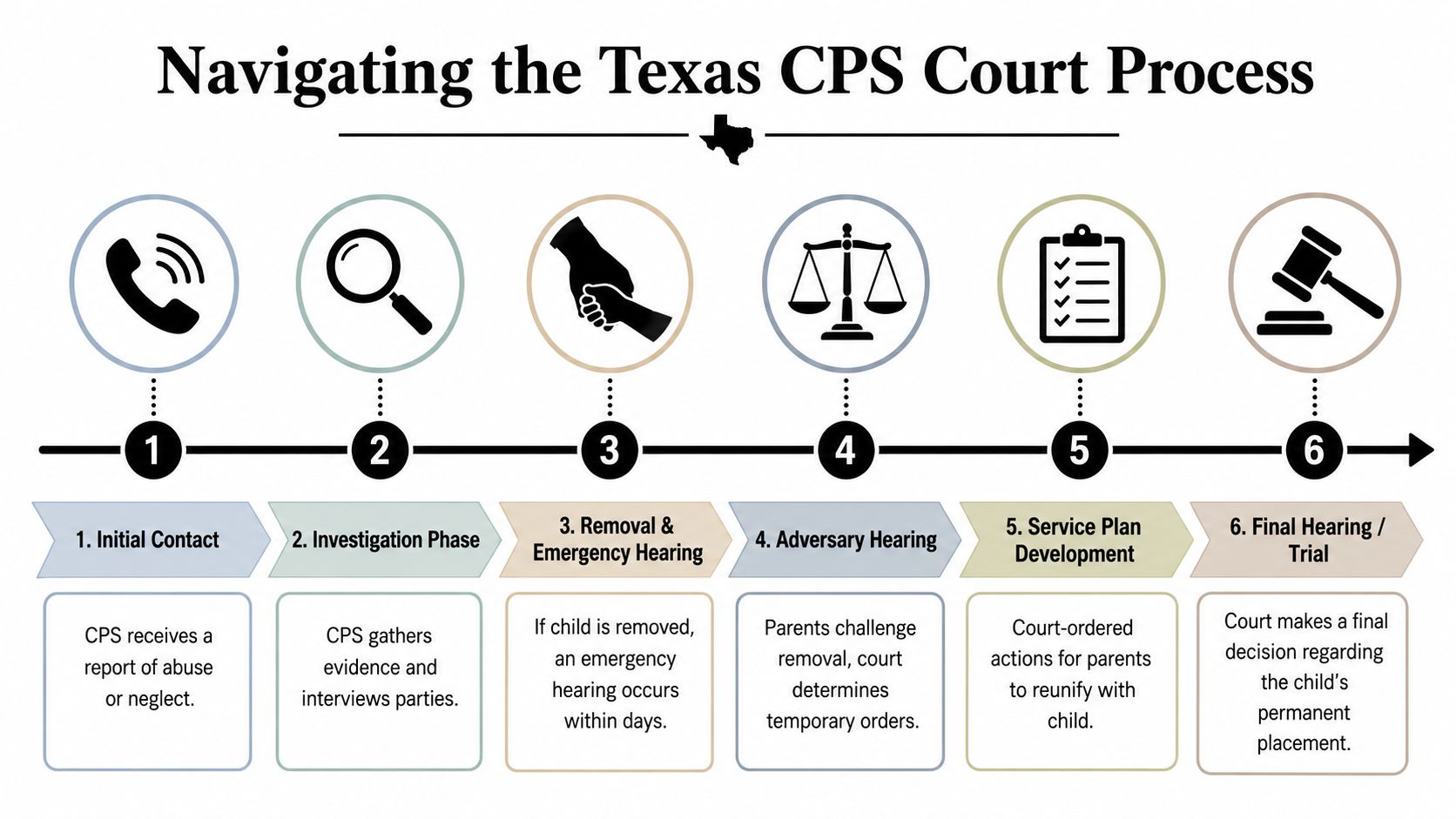
A Texas CPS case often moves through these stages:
| Stage | What it usually means |
|---|---|
| Initial contact | CPS receives a report and begins gathering information |
| Investigation | Interviews, records, home observations, and safety decisions begin |
| Emergency removal, if any | CPS asks for immediate protection if it claims the child faces urgent danger |
| Adversary hearing | The court decides whether temporary removal should continue |
| Service plan phase | The parent is given tasks or services tied to reunification |
| Final hearing or trial | The court decides the long-term outcome |
The chart looks simple on paper. Living through it is not. Deadlines pile up, service referrals start, visitation rules may change, and every missed appointment can be written down and repeated to the judge later.
Why Chapter 263 affects daily life
Chapter 263 governs the review hearings, service plans, and permanency process while the case is pending. In plain terms, this is the part of the law that measures whether the court believes progress is happening and whether return is possible. You can read the statute in the Texas Family Code, Chapter 263.
That means ordinary parts of your week can become courtroom evidence. Drug testing. Counseling attendance. Stable housing. Visitation. Parenting classes. School involvement. If you complete something, keep proof. If you cannot complete something, tell your lawyer early so the problem can be addressed before it is framed as noncompliance.
This is also where the criminal overlap can become dangerous. A parent may feel pressure to "explain everything" in counseling, in a psychosocial assessment, or in a service-plan meeting. Sometimes that helps. Sometimes it creates admissions that can later be used by law enforcement or prosecutors. A unified defense strategy watches both risks at the same time.
"Clear and convincing evidence" means proof that is strong and persuasive, not just possible. CPS does not get to terminate parental rights because the situation looks bad from a distance.
A simple way to understand the timeline
The process works like three building blocks.
First, the court deals with emergency control. Should the child stay out of the home right now, and under what temporary conditions?
Second, the court watches proof and progress. What can CPS prove, what has the parent done, and are the stated concerns getting better or worse?
Third, the court reaches a long-term decision. That may be reunification, placement with another caregiver, or termination.
Parents lose ground when they treat the service plan like friendly advice. If the court adopts it, treat it like a written roadmap with deadlines. Follow it carefully, save every certificate and sign-in sheet, and let your lawyer know about transportation problems, work conflicts, or requests that may create criminal exposure. Careful organization matters. Tools discussed in Streamlining case law with AI show how legal teams sort large records and spot issues early, which matters in CPS cases where one missed detail can shape the judge's view of the whole family.
The Role of Your CPS Defense Attorney
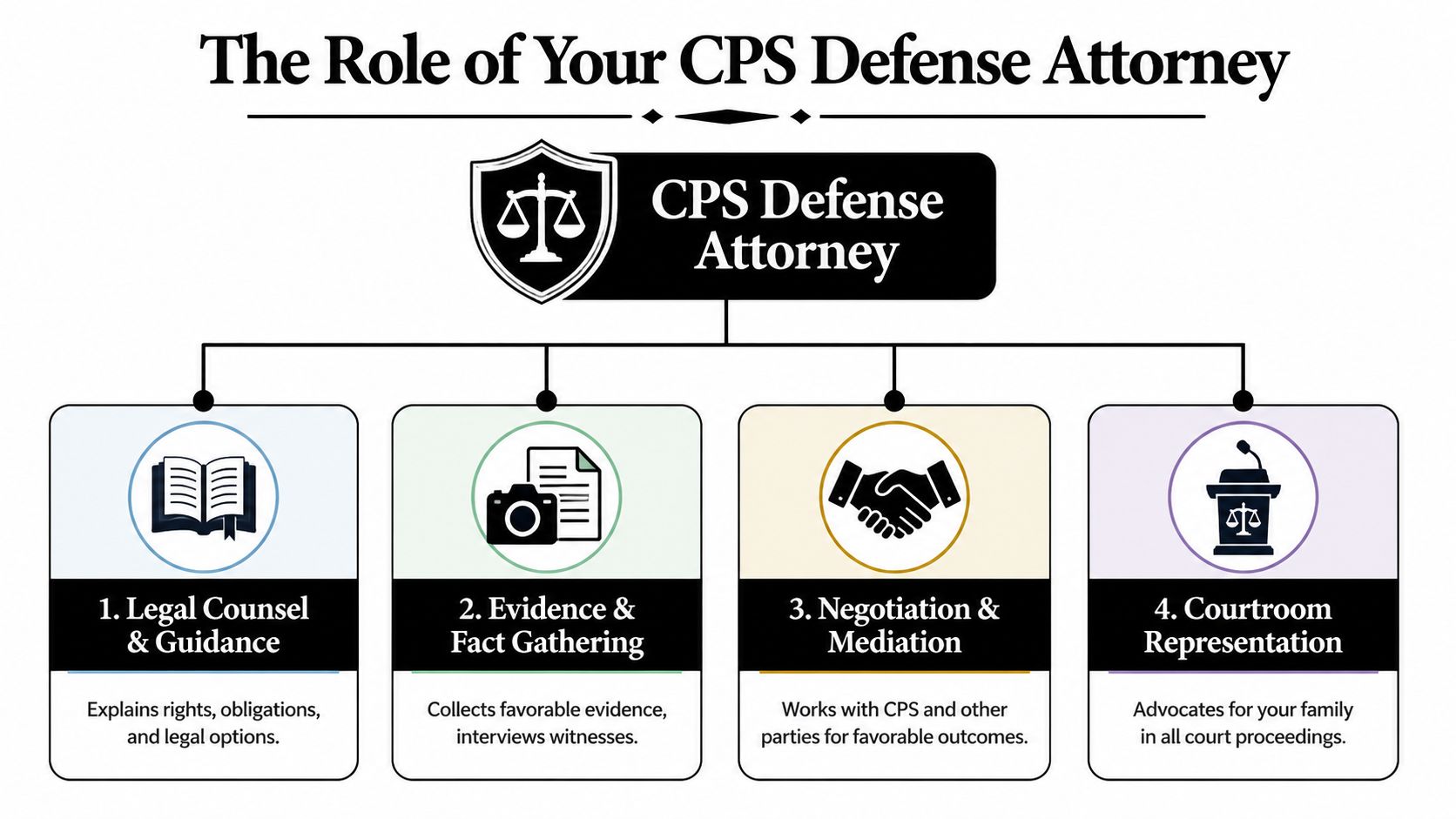
A lawyer in a CPS case doesn't just show up in court and argue. A good attorney acts like a shield, a translator, and a strategist at the same time.
That matters even more in Texas because representation can be hard to find early. A 2025 survey found that only 19% of Texas legal professionals reported CPS defense representation was available in their community, and 51% of counties reported declining attorney availability due to inadequate funding, according to the Texas legal representation brief.
What your attorney actually does
A CPS defense lawyer should help with work that parents often can't safely handle alone:
- Control communication: The lawyer can manage key contact with CPS so you don't make avoidable statements.
- Check the paper trail: Safety plans, affidavits, service plans, court orders, and investigation notes need close review.
- Build your evidence: That may include school records, medical records, witness statements, counseling records, and timelines.
- Prepare you for hearings: Parents need to know what questions may come and what topics create legal risk.
- Coordinate with criminal defense if needed: When the facts create possible criminal exposure, strategy must stay consistent.
Case organization matters. Firms and attorneys who are streamlining case law with AI can often review authorities, fact patterns, and procedural issues more efficiently, which is useful in fast-moving cases where court dates come quickly and records pile up.
A real-world example of why counsel changes outcomes
A parent once told me CPS wanted an immediate written statement. She was ready to send a long email explaining every family argument from the previous month. Her lawyer stopped her, narrowed the response, gathered supporting records first, and kept the written communication focused on the actual allegation.
That kind of intervention doesn't guarantee the case disappears. But it can keep a messy situation from becoming much worse.
The Law Office of Bryan Fagan PLLC represents Texans in criminal matters and related CPS issues where criminal allegations and family consequences overlap. In a case with both risks present, that kind of combined focus can matter.
The lawyer's job isn't only to react. It's to stop unforced errors, develop favorable proof, and protect your position in every forum involved.
How to Choose the Right Attorney for Your Family
Choosing a lawyer while you're scared is hard. Most parents want someone who sounds reassuring. Reassurance matters, but this is also a technical decision. You need someone who can spot danger early, explain the court process plainly, and handle the criminal overlap if it appears.

Questions worth asking in a consultation
When you speak with a lawyer, don't focus only on whether they "do CPS cases." Ask sharper questions.
- Have you handled Texas CPS cases that also involved possible arrests or criminal investigations?
- How do you advise clients about speaking with CPS when criminal charges may follow?
- What hearings should I expect first in my county?
- How will you help me prepare for a safety plan, service plan, or adversary hearing?
- Who will I talk to when something urgent happens?
A parent doesn't need perfect legal vocabulary to judge whether a lawyer is clear. If the answer feels evasive, rushed, or overly vague, pay attention to that.
What to look for beyond credentials
The right fit often comes down to three things.
First, clarity. The lawyer should explain hard truths without sugarcoating them.
Second, discipline. A CPS case with possible criminal exposure requires careful messaging. You want someone who won't treat every conversation as harmless.
Third, responsiveness. These cases move fast. Delayed callbacks create real damage.
Hiring support also affects how law firms serve families under pressure. If you're curious about the staffing side of modern legal practice, this look at cost-effective legal talent acquisition offers context for how firms build support systems around urgent casework.
Here is a short video that can help you think about what legal guidance should feel like when your family is under investigation.
A practical checklist for your decision
Use this simple screen after each consultation:
| Question | Good sign |
|---|---|
| Did the lawyer explain risk in plain English? | You understood the next steps clearly |
| Did they ask about criminal exposure? | They treated that issue seriously |
| Did they discuss local hearings and deadlines? | They sounded grounded in Texas procedure |
| Did they tell you what not to do? | They focused on prevention, not just reaction |
If you still feel uncertain, keep looking until you find someone who can explain the situation without confusing or pressuring you. The lawyer you hire should help you feel steadier, not more lost.
You Can Fight for Your Family and We Can Help
The hardest part for many parents is the feeling that everything is slipping at once. CPS is asking questions. A caseworker may be talking about safety plans or home visits. At the same time, one statement made in panic can create problems far beyond family court if the allegations also suggest a crime under Texas law.
That overlap changes the strategy.
A CPS case is not only about proving you love your child. It is also about protecting what you say, what you sign, and how you respond so you do not hand the state evidence it can use in two different places. Family court and a criminal investigation can work like two tracks running side by side. If your lawyer only watches one track, you can get blindsided by the other.
You still have time to act with purpose. Good decisions early often matter more than perfect explanations later. Keep records. Stay calm. Follow court orders. Get legal advice before long interviews, written statements, or agreements that seem simple but carry legal consequences.
As noted earlier, the safest approach is one that addresses both the CPS case and any possible criminal exposure together, not as separate problems.
If CPS has contacted you, or if you are concerned the allegations could lead to criminal charges, contact Law Office of Bryan Fagan PLLC for a free, confidential consultation. We help Texas families understand their rights, respond carefully, and take immediate steps to protect both their children and their future.