Skip to content
When a CPS investigator shows up at your door, most parents feel the same rush of fear. Your mind jumps straight to the worst-case scenario. Am I about to lose my child? Do I have to let them in? What happens if I say the wrong thing?
If you're in San Antonio or anywhere in Bexar County, that fear is real, but so are your rights. A CPS case moves fast, and confusion is often what hurts parents first. The good news is that Texas law gives you specific protections, clear court deadlines, and options to challenge what CPS is doing.
A CPS lawyer in San Antonio can change the direction of a case. The legal issues are rarely limited to one allegation. Many families are also dealing with custody orders, pending divorces, old protective orders, or a prior criminal charge that suddenly gets pulled into the CPS investigation. When those issues overlap, parents need a strategy that looks at the full picture, not just the next interview with a caseworker.
That Knock on the Door What to Do When CPS Arrives
Maria is getting her kids ready for school when someone knocks. A CPS investigator says there's been a report and asks to come inside. Maria is shaken. She wants to cooperate, but she also doesn't know whether she has to open the door, answer questions, or let the investigator speak to her children right then.
That kind of moment can make even a calm parent panic. It also happens more often than people realize. The Department of Family and Protective Services handles over 100,000 child protective services investigations annually across Texas, with Bexar County being one of the four largest urban counties for these cases, accounting for a significant portion of the state's total.
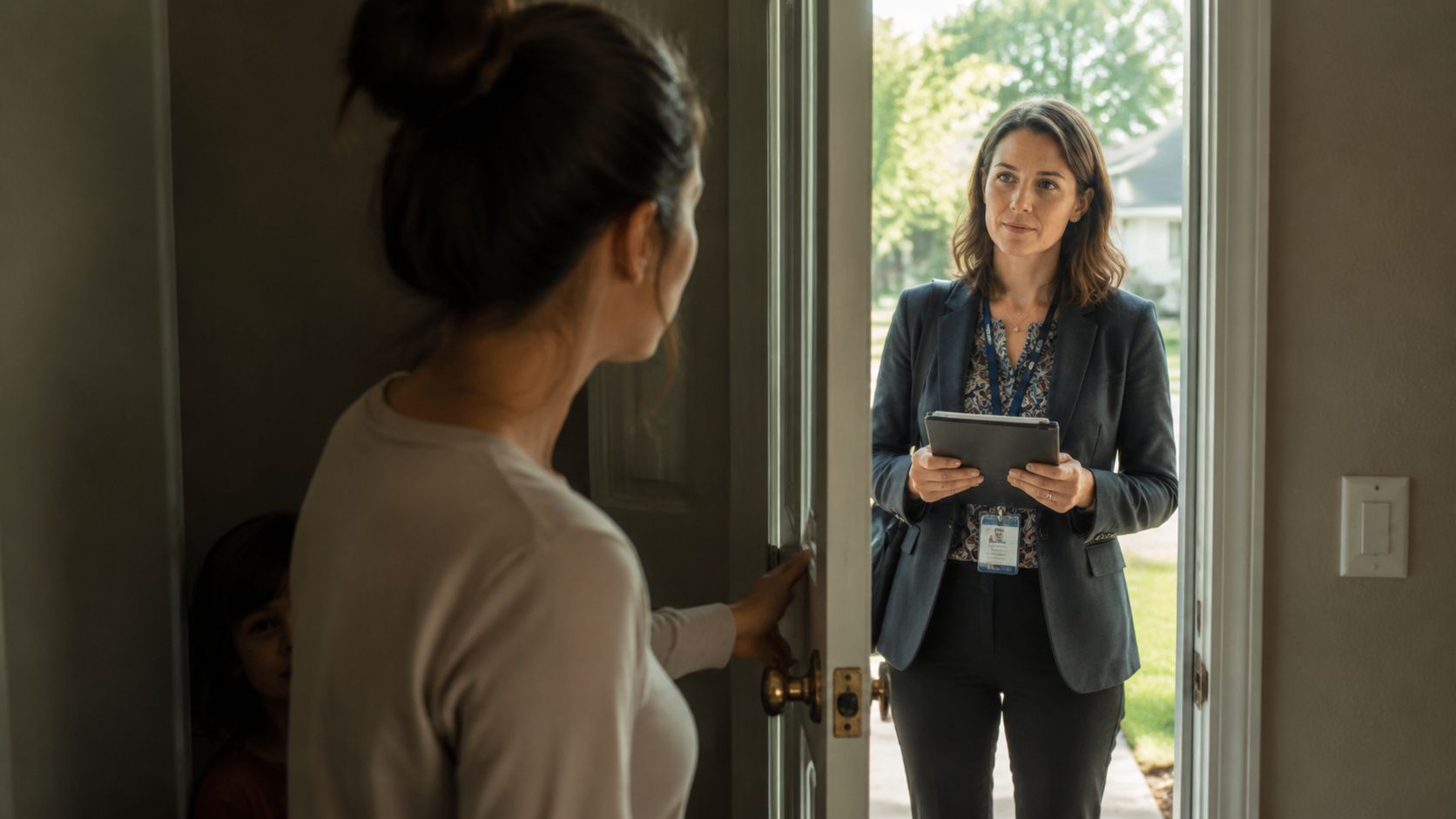
Start with calm, not panic
The first goal isn't to win the whole case at the doorstep. It's to avoid making rushed decisions that create problems later. Parents often think they have only two choices: fully cooperate with everything immediately, or refuse everything and look guilty. In reality, there's a middle ground.
You can stay respectful, protect your rights, and get legal advice fast.
A simple response might sound like this:
I want to take this seriously, but I want to speak with a lawyer before answering questions or signing anything.
That kind of response isn't hostile. It's careful.
What to do in the first few minutes
- Confirm identity: Ask for the investigator's name, office, and contact information.
- Stay at the door if possible: Don't invite anyone inside until you understand your rights.
- Avoid long explanations: Stress makes people overtalk. That can create inconsistencies.
- Write down what happened: Note the time, what the investigator said, and whether police were present.
- Get legal guidance quickly: A practical first step is reviewing how to respond when CPS shows up at your door in Texas.
Some parents are dealing with more than a CPS report. They may already be in a custody fight with the other parent, or they may have an old DWI or assault case that now makes the allegations feel more dangerous. In those situations, every early conversation matters because each statement can affect more than one case.
Your Fundamental Rights During a CPS Investigation
The most important thing to remember is simple. You still have rights even when CPS is investigating you. A caseworker may sound urgent, confident, or persuasive, but that doesn't erase the protections Texas law gives parents.
Under Texas Family Code Chapter 262, parents have the right to refuse entry to their home unless CPS has a valid court order or is with law enforcement that has legal authority to enter. Parents also aren't required to speak with investigators or sign safety plans without their lawyer present, as explained in this overview of Texas CPS rights in San Antonio.
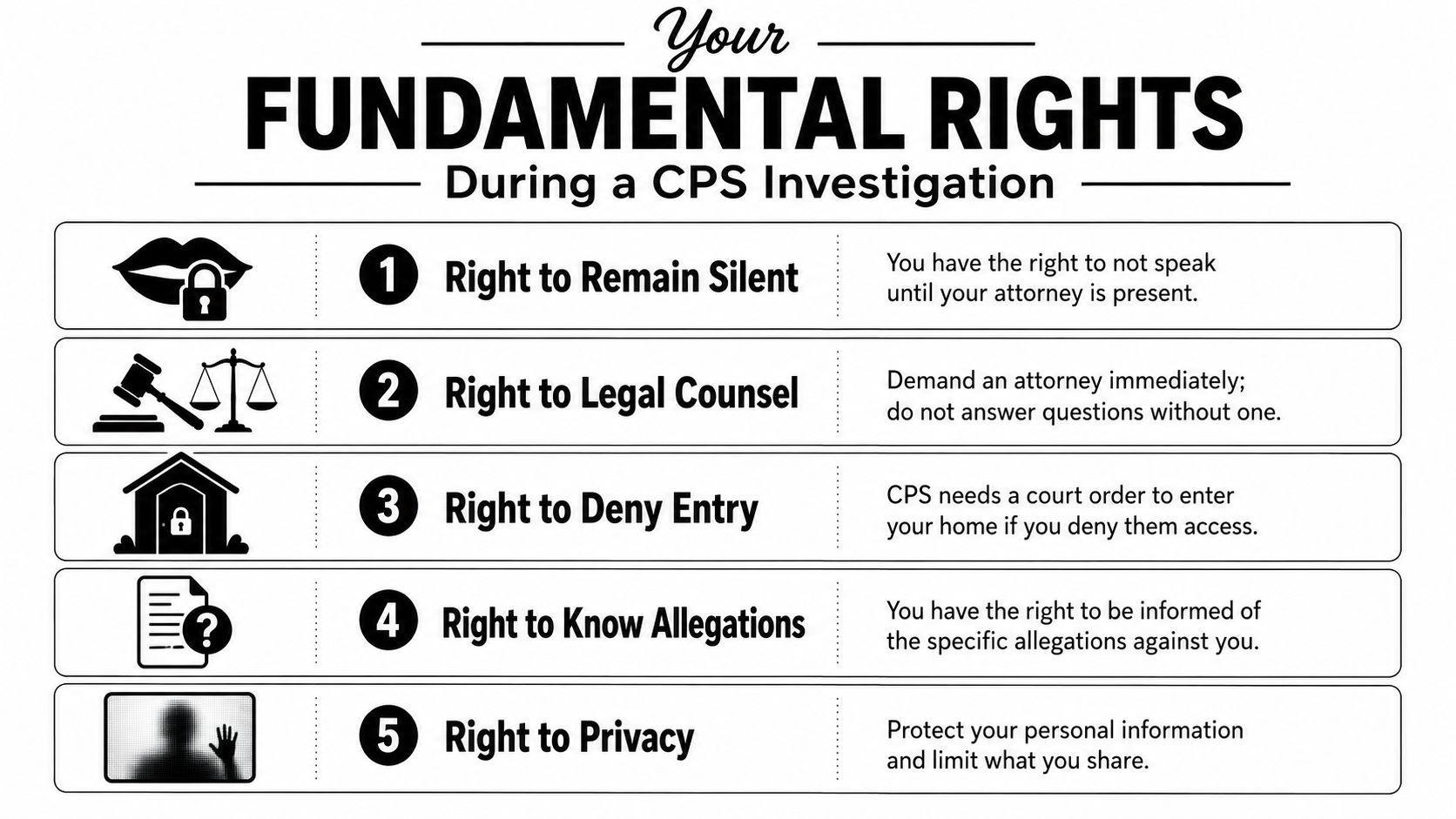
The rights parents most often misunderstand
Many parents think refusing entry automatically makes them look guilty. That's not what the law says. The law says CPS must have proper legal authority to enter if you do not consent.
Parents also think they must sign a safety plan on the spot. That's another common mistake. A safety plan can affect where your child lives, who can be around your child, and what CPS expects from you going forward. You should understand every part of it before agreeing.
For a focused explanation, Your Rights During a CPS Investigation outlines the core legal rights every Texas parent has when CPS comes to the door.
Do this and avoid this
Do ask what the allegation is: You need to know the basic claim being investigated.
Do ask if there is a court order: If they want entry, ask whether they have legal authority to require it.
Do say you want an attorney present: That protects you from rushed statements and unclear agreements.
Don't sign forms under pressure: If you don't fully understand a document, wait.
Don't guess or fill in gaps: If you don't know an answer, don't speculate.
Don't argue at the doorway: A calm, short response is stronger than an emotional one.
A short script can help:
- If asked to come in: “Do you have a court order or warrant?”
- If asked to answer questions: “I'd like my attorney present before any interview.”
- If asked to sign a safety plan: “I won't sign until my lawyer reviews it.”
After you've had a chance to absorb those basics, this video may help put the process in plain language:
Practical rule: Being polite is smart. Giving up your rights is not.
The Texas CPS Investigation Timeline Explained
One reason CPS cases feel overwhelming is that parents don't know what happens next. The timeline matters because missing even one deadline can affect custody, visitation, services, and the evidence the court hears.
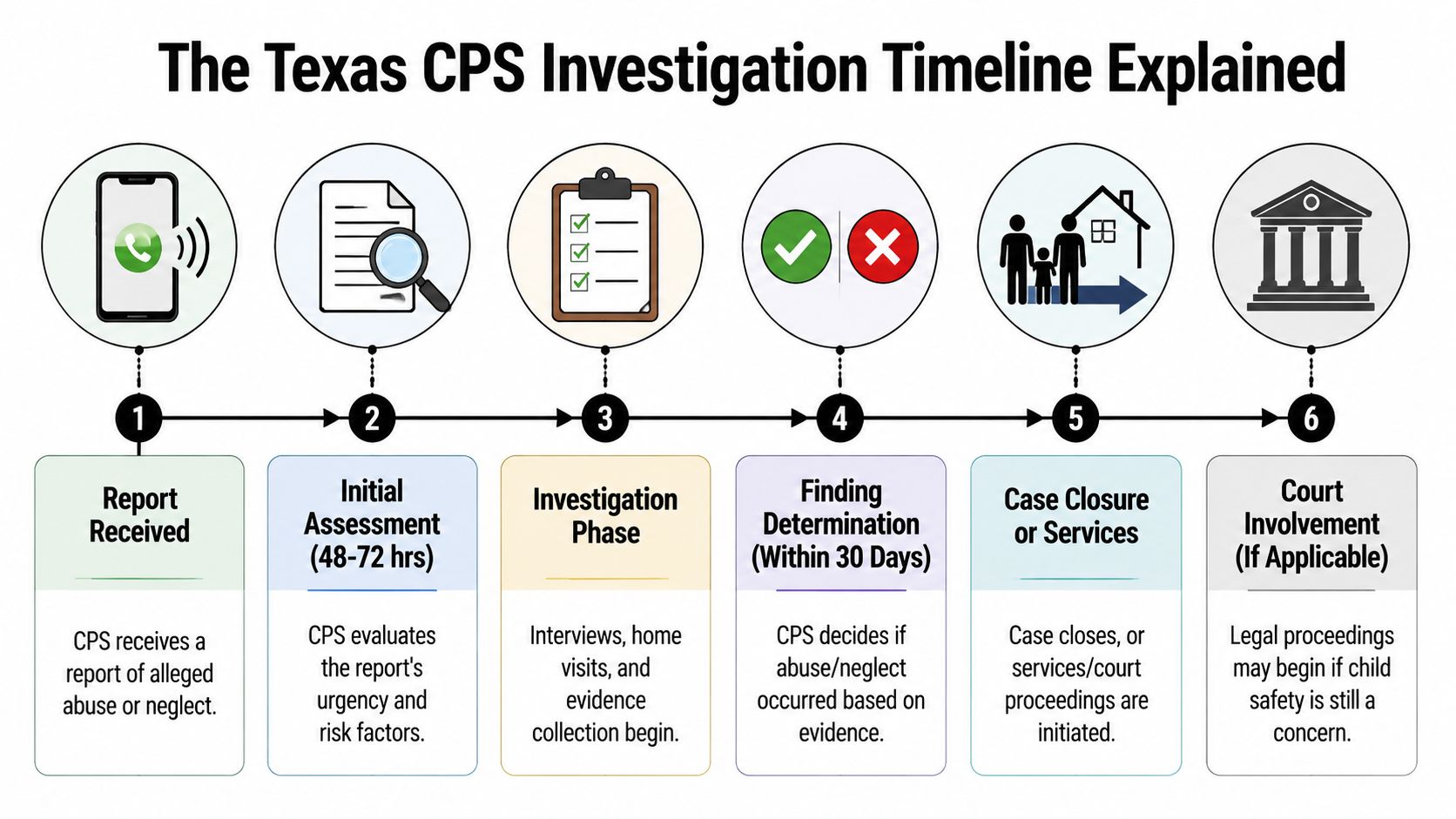
The early investigation stage
A CPS case usually starts with a report. That report may come from a teacher, doctor, neighbor, family member, or the other parent in a custody dispute. Once CPS starts investigating, caseworkers often try to gather interviews, inspect the home, review records, and assess immediate safety concerns.
In some cases, CPS asks for voluntary cooperation. That may include interviews, a temporary placement with relatives, or agreement to a safety plan. If parents and their lawyer handle this stage carefully, it can shape the rest of the case in a better direction.
Early decisions tend to set the tone for everything that follows.
When removal becomes a court case
If CPS believes it can't secure voluntary cooperation, it may seek court-ordered removal. When that happens, the case stops being just an investigation and becomes active litigation. Court deadlines start to matter immediately.
Texas law requires a preliminary hearing within 14 days of a child's removal, and if a parent doesn't have counsel at that first critical hearing, the parent should ask the court to appoint a free attorney if the legal requirements are met, as explained by Texas Law Help's guide to the parent attorney.
You may also hear about a critical hearing under Texas Family Code §262.201. When CPS petitions for court-ordered removal, a critical hearing must occur within 60 days. Verified data also shows that early voluntary cooperation, guided by a lawyer, can increase the chances of reunification within 30 days and reduce the probability of prolonged removal by over 40%.
The longer court process under Chapters 263 and 161
Once the case is in court, Chapter 263 becomes important because it governs review hearings, permanency planning, and the court's oversight of what parents must do to work toward reunification. During this phase, service plans often become central. The court may expect drug testing, counseling, parenting classes, stable housing, or proof of compliance with other orders.
Chapter 161 matters when CPS seeks a more severe result: termination of parental rights. That is the point where the case shifts from temporary intervention to the possibility of a permanent legal separation between parent and child. If that issue comes up in your case, you need focused guidance on both the evidence and the statutory grounds CPS is alleging. Families dealing with that risk may also need to review Termination of Parental Rights in CPS Cases.
A simple way to think about the timeline
| Stage | What usually matters most |
|---|---|
| Initial contact | Protecting your rights and avoiding harmful statements |
| Investigation | Records, witnesses, home conditions, and communication strategy |
| Removal stage | Emergency legal action and early hearing preparation |
| Court review stage | Full compliance, documentation, and challenging unfair requirements |
| Termination risk | Strong legal defense under Chapter 161 |
Parents often get stuck because they treat each step like a separate crisis. It isn't. It's one continuous case, and each early choice can help or hurt later hearings.
What a San Antonio CPS Lawyer Does for You
A CPS lawyer in San Antonio helps shape the case before a judge ever hears your name. That matters because CPS cases often turn on early choices. A parent may agree to a safety plan that is too broad, hand over records that need explanation, or answer questions in a way that creates confusion instead of clarity.

A CPS attorney in Texas acts as a legal buffer between your family, the investigator, and the court. The attorney's job is to protect your rights, keep the case focused on facts, and push back when assumptions start filling gaps in the evidence.
That role is especially important in San Antonio cases that do not fit neatly into one legal file. A CPS report may overlap with an existing custody order, a pending divorce, a past arrest, probation terms, or a protective order. Those issues can change how CPS views risk, even if they do not prove a child is in danger. A lawyer helps connect those dots in a way that protects you instead of letting the state define the story first.
During the investigation
In the investigation stage, the lawyer often helps control how information is presented. That does not mean hiding facts. It means giving records, explanations, and witness information in a careful order and with the right context.
For example, if you already have a custody order, that order may explain why the other parent was absent, who normally picks up the child, or why the child was staying with a grandparent that week. Without that context, an investigator may read ordinary family scheduling as instability. If you have a criminal record, your attorney can separate an old allegation or resolved case from your current parenting, instead of letting CPS treat your past as your whole identity.
A lawyer may help by:
- Handling communication so the caseworker gets clear, accurate responses instead of emotional, rushed statements.
- Reviewing proposed safety plans and objecting if the terms go beyond what the facts justify.
- Organizing records and witnesses such as school files, medical records, text messages, custody paperwork, and statements from relatives, teachers, or counselors.
- Spotting hidden legal risks when CPS concerns overlap with family court orders or criminal matters.
In hearings and negotiations
Once the case reaches court, your attorney becomes the person who translates your life into legally useful proof. Judges do not decide cases based on who seems the most upset or who talks the longest. They look at evidence, credibility, and whether CPS followed the rules.
Your lawyer prepares you for that setting. The attorney can challenge weak claims, object to unreliable statements, question whether removal was justified, and present evidence showing your home is safer and more stable than the allegations suggest.
Sometimes the hardest part of a CPS case is not the accusation itself. It is the way other legal issues get pulled into it.
- A custody dispute can lead to strategic accusations between parents.
- A criminal charge or prior record can cause CPS to assume present danger without looking carefully at timing, facts, or rehabilitation.
- A protective order or bond condition can affect who may live in the home, pick up the child, or attend visits.
Those cases require a wider view. One example of a firm handling criminal cases that intersect with family law and CPS matters is Law Office of Bryan Fagan PLLC.
A CPS case can spread into family court, criminal court, and daily life at the same time. Your legal strategy needs to address all three.
With service plans and reunification
Service plans often confuse parents because they look like a checklist but function more like a test. Each requirement becomes a way for CPS and the court to measure whether you are making progress, whether the agency's concerns are being addressed, and whether reunification is realistic.
A lawyer helps you read that plan the way a judge will read it. If a requirement is vague, unrealistic, or unrelated to the allegations, your attorney can raise that issue early. If you are completing services, your lawyer can help make sure the proof is documented correctly. Completion only helps if the court can clearly see it.
That practical help often includes:
- identifying what documents show compliance,
- tracking deadlines and missed referrals,
- correcting caseworker notes that leave out important facts,
- explaining how outside issues, like a custody order or old criminal case, affect the way compliance is judged.
A general practice attorney may know courtroom procedure. A lawyer who regularly handles CPS cases in Bexar County usually has a clearer sense of how investigators, courts, and service plans interact. That knowledge can help stop a temporary crisis from turning into a longer separation or a termination fight.
A Relatable Scenario The Johnsons' CPS Case
The Johnsons live on the west side of San Antonio. James works long shifts, and Alana has primary responsibility for their two children during the week. After a loud argument between the parents, a neighbor calls the police. No one is arrested, but a few days later CPS appears at the door.
Alana makes the same mistake many parents almost make. She starts explaining everything at once. She talks about stress, money, James's old misdemeanor case, and the fact that they're also arguing over whether his mother should keep helping with childcare. The investigator listens and takes notes, but the conversation isn't helping. It is widening the case.
How the case changed once they got legal help
After speaking with counsel, the Johnsons changed their approach. They stopped trying to solve everything in emotional conversations and started documenting facts.
Their lawyer helped them organize:
- school attendance records,
- pediatric records,
- proof of clean and appropriate sleeping arrangements,
- text messages showing family support,
- their existing custody and caregiving schedule.
The criminal issue also had to be handled carefully. James's old record didn't automatically make him an unfit parent, but ignoring it would have been a mistake. The lawyer helped frame it correctly and kept the CPS case from becoming a shortcut for assumptions based on past conduct.
Why this scenario feels familiar to so many families
Nothing about the Johnsons' situation was unusual. One report led to multiple questions. A parenting issue became tied to a relationship conflict. An old record suddenly mattered again. A home that was functioning well looked unstable on paper because nobody had organized the facts.
The families who do best are often the ones who stop reacting and start documenting.
Their case improved once they treated it like a legal matter, not just a misunderstanding that would fix itself. That doesn't mean every case ends quickly or easily. It means parents usually have more room to respond than they first think.
Choosing the Right CPS Attorney in San Antonio
Not every family lawyer handles CPS cases well. Not every criminal defense lawyer understands how a service plan, an adversary hearing, or a Chapter 161 termination claim works. If your case involves custody conflict, domestic allegations, or a prior charge, you need a lawyer who can connect those dots.
That distinction matters. Texas State Bar data shows that when parents are represented by qualified CPS attorneys, successful family reunification increases by 40% compared to cases where parents are unrepresented or use a general practice lawyer.
What to look for beyond a good website
A polished website can be helpful, but it doesn't tell you whether the lawyer knows how CPS practice works in Bexar County. If you want to assess whether a lawyer has thought seriously about legal visibility and client education, resources like this 2026 roadmap for law firm SEO can show what strong legal content strategy looks like. Still, your decision should turn on case experience, communication, and whether the attorney understands overlapping legal risks.
A more direct starting point is how to choose the right CPS defense attorney in Texas.
Questions to ask in a consultation
| Question Category | Specific Question to Ask |
|---|---|
| CPS focus | How much of your practice involves CPS defense rather than general family law? |
| Local experience | Have you handled CPS matters in Bexar County courts? |
| Court strategy | How do you prepare for the first major hearing after removal? |
| Service plans | How do you challenge service plan terms that are unrealistic or unrelated to the allegations? |
| Criminal overlap | If I have a prior charge or open criminal case, how will that affect the CPS defense? |
| Custody overlap | How do you handle cases where the other parent is also involved in a custody dispute? |
| Communication | Who will I be speaking with regularly about deadlines, hearings, and documents? |
Red flags parents shouldn't ignore
- The lawyer talks only about family court: CPS cases have their own pace, hearings, and evidentiary issues.
- The lawyer dismisses the criminal angle: A prior DWI, assault allegation, or pending case may shape the court's view of safety.
- The lawyer gives guarantees: No honest attorney can promise a result in a CPS case.
A strong consultation should leave you clearer about the process, not more confused.
Your Next Steps Protecting Your Family in Bexar County
If CPS is involved with your family, your next step shouldn't be guessing. It should be getting organized and getting help. Parents often lose valuable time hoping the caseworker will see the truth on their own. Sometimes that happens. Often, it doesn't happen fast enough.
What to do today
Start with the basics:
- Save every document: Keep notices, business cards, emails, texts, and court papers in one place.
- Write a timeline: List contacts with CPS, police, doctors, teachers, and the other parent.
- Follow court orders carefully: If a judge has entered an order, treat every part of it seriously.
- Ask before signing: If CPS presents a plan or agreement, have counsel review it first.
If you're also dealing with a custody order, support dispute, or criminal accusation, tell your attorney immediately. Those details are not side issues. They can shape placement, visitation, and what CPS asks the court to do.
Focus on proof, not panic
Judges and caseworkers respond to records, consistency, and compliance. They don't respond well to long emotional explanations without supporting evidence. Parents who keep clean records, show up on time, complete required services, and correct misinformation early put themselves in a stronger position.
You may also need practical guidance on what comes after the first hearings, especially if CPS has proposed ongoing conditions for reunification. In that stage, parents often benefit from reviewing a step-by-step resource like how to find a CPS lawyer near you a step-by-step guide.
No parent wants to be in this position. But being under investigation doesn't mean you've lost your voice, your rights, or your chance to protect your family. With a careful plan, accurate legal advice, and fast action, many families find a path forward.
If CPS has contacted you in San Antonio or Bexar County, don't wait for the situation to get harder. The Law Office of Bryan Fagan PLLC offers a free consultation so you can talk through what happened, understand your rights under Texas law, and get clear guidance on the next step for your family.