Skip to content
When CPS shows up unannounced, most parents feel the same thing first. Fear. You worry that one wrong sentence, one wrong move, or even one look of frustration could put your family at risk.
That reaction is normal. It’s also why the first few minutes matter so much.
If you’re searching can you refuse cps entry texas, the short answer is yes. In Texas, you can refuse entry to Child Protective Services unless the investigator has lawful authority to come in, such as a court order, a warrant, or a true emergency that justifies immediate action. But the better question is usually not just whether you can refuse. It’s how to do it calmly, when it makes sense, and what happens next.
Texas parents need more than a slogan about rights. They need a plan for the front porch, a realistic understanding of what refusal can trigger under Texas Family Code Chapter 262, and a strategy for protecting themselves if the case moves into court under Chapters 263 and 161. That’s where legal guidance changes the entire tone of a CPS case.
That Knock at the Door What to Do When CPS Arrives
A common scene goes like this. It’s late afternoon. The kids are inside. Someone knocks, and when you open the door, a person identifies herself as a CPS investigator. She says she needs to come in and ask a few questions.
At that moment, many parents make one of two mistakes. They either panic and invite the investigator in because they think they have no choice, or they become angry and turn a tense situation into a confrontational one. Neither response helps.

A steadier approach works better. Step outside if you can. Close the door behind you if your children are safe inside with another adult or in a secure spot nearby. Keep your voice even. Ask who the investigator is, what agency she’s with, and why she’s there.
Parents often assume that refusing entry will automatically make them look guilty. It doesn’t. Exercising a legal right is not an admission. At the same time, refusing entry doesn’t make the case disappear either. It shifts the matter away from an informal doorstep encounter and toward a more structured legal process.
What helps in the first five minutes
Three things usually help immediately:
- Stay polite: A calm tone lowers the chance of an unnecessary escalation.
- Keep the conversation at the doorway or outside: Don’t casually say, “Come in for a minute.”
- Don’t start explaining the whole family history: The more you talk under stress, the easier it is to make statements that can be misunderstood.
You don't have to win an argument at the door. You need to protect your rights and avoid making the situation worse.
If you want a fuller picture of what investigators look for during these visits, this guide on a Texas CPS home visit is a useful companion.
A relatable example
Take a parent who has never dealt with CPS before. She opens the door, hears there’s an allegation involving neglect, and immediately starts defending herself. She invites the investigator into the living room, apologizes for the mess, explains a recent argument with her ex, and tries to show she has nothing to hide. From her point of view, she’s cooperating.
From CPS’s point of view, every statement becomes part of the investigation record.
That’s why the best first move is usually not a long explanation. It’s a controlled one.
Your Fundamental Rights A Shield for Your Family
Your home matters under the Constitution. CPS doesn’t get a free pass on the basis of an allegation alone. The legal starting point is that your house is protected, and government entry generally requires either your consent, judicial authority, or a genuine emergency.
In Texas, that protection became more visible in May 2025, when the state enacted a law requiring CPS workers to give parents a written “Miranda-style” notice of due process rights at initial contact, including the right to refuse entry without a court order and the right to consult an attorney, as reported by The Imprint’s coverage of the 2025 Texas reform.
Know this: Texas now requires clearer notice of your rights at first contact, which is a major shift for parents who previously felt pressured into “consent.”
The three legal ways CPS gets inside
There are really three paths.
Consent
This is the most common. A parent opens the door and lets the investigator in. Sometimes the consent is explicit. Sometimes it happens casually, with a phrase like, “Sure, come on in.”
Once you consent, you’ve given CPS access you didn’t have to give voluntarily.
Court order or warrant
If CPS has a valid court order or warrant, the situation changes. You should still ask to see it and read it carefully, but you generally can’t refuse lawful entry under that authority.
Emergency circumstances
There are cases where CPS or law enforcement claims a child faces immediate danger. Those situations are fact specific and often litigated later, but the key point is that emergency authority is not the same as ordinary investigative convenience.
What the new notice should tell you
The recent reform is important because it addresses a problem many parents faced for years. They had rights, but no one clearly told them.
You should expect information about:
- The allegations: CPS should tell you the nature of the abuse or neglect concern.
- Your right to refuse entry: You can decline home access absent court authority.
- Your right to counsel: You can speak with an attorney before deciding how to respond.
- The process: You should be told what the investigation involves.
That matters because a parent who understands the rules makes better decisions under pressure. If you need a plain-language refresher on asserting yourself without escalating the conflict, this short piece on how to advocate for yourself is helpful outside the legal context too.
Rights are strongest when you use them clearly
Many parents lose the benefit of their rights by asserting them emotionally rather than clearly. A better phrase is simple: “I’m willing to communicate, but I do not consent to entry without a court order. I’d like to speak with counsel first.”
That response is firm, lawful, and controlled.
For a broader breakdown of your rights during a CPS investigation, it helps to review the full process before the next contact happens.
A Practical Script for Interacting with a Caseworker
Rights are only useful if you can use them while your pulse is pounding. The goal is not to be hostile. The goal is to avoid accidental consent, avoid unnecessary statements, and create a record that you were respectful and clear.
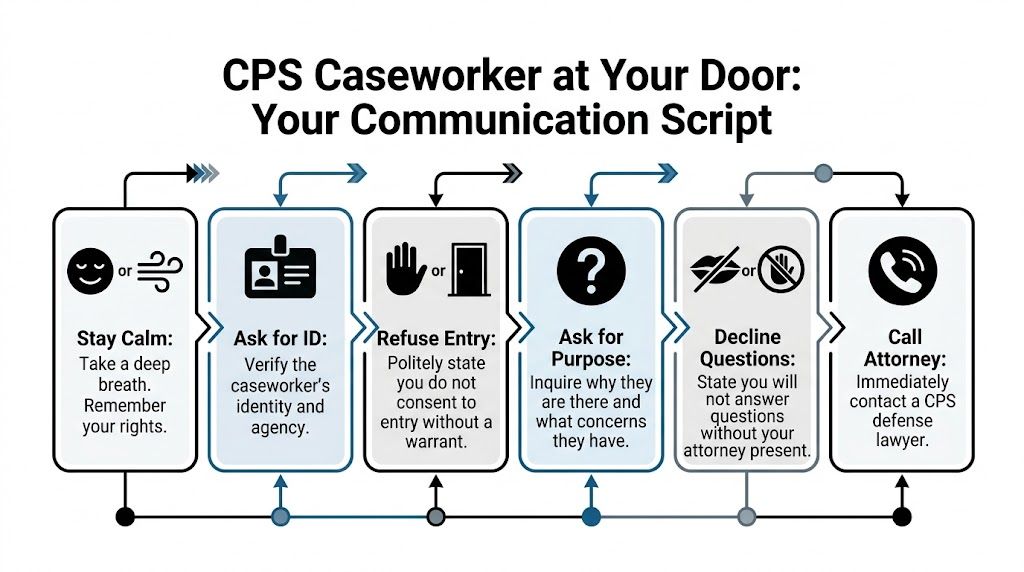
Texas House Bill 730, effective in early 2025, requires CPS investigators to provide both verbal and written notice of rights during initial contact, including the right to refuse entry without a court order and the right to know the specific allegations, according to this discussion of refusing entry to Child Protective Services in Texas.
The doorstep script
Use language like this. You don’t need to sound like a lawyer. You need to sound calm.
Start with identity
Say: “Please show me your identification and tell me your full name and agency.”
Keep the meeting outside
Say: “I’ll speak with you here, but I’m not inviting anyone inside right now.”
Ask for the allegations
Say: “Please give me the allegations in writing and explain the reason for the visit.”
State your boundary clearly
Say: “I do not consent to entry into my home without a court order or warrant.”
Don’t answer substantive questions on the spot
Say: “I’m not going to answer questions until I’ve spoken with an attorney.”
Close the conversation professionally
Say: “Please leave your contact information. My attorney or I will follow up.”
What not to say
Parents often undercut their own position with nervous filler. Avoid these common phrases:
- “I guess you can come in for just a minute.” That is consent.
- “I have nothing to hide.” You don’t need to prove innocence by waiving rights.
- “Let me explain everything.” Stress usually makes explanations longer and less accurate.
- “My child would never say that unless…” Speculation can create new issues.
Practical rule: Short answers protect you better than emotional speeches.
The tone matters as much as the words
You can refuse entry and still appear reasonable. In many cases, that’s the best posture. Think of it as lawful boundary-setting, not defiance. The same communication skill shows up in other high-stress relationships, and the broader idea of setting healthy boundaries applies here too, even though a CPS investigation is obviously a legal matter, not a personal one.
A few practical habits help:
- Keep your hands visible and your voice low: Don’t create a scene on the porch.
- Write things down immediately after: Note the investigator’s name, date, time, and what was said.
- If you record, do it carefully and lawfully: Focus on accuracy, not performance.
- Don’t let other family members freelance: One anxious grandparent can unintentionally invite CPS in.
If they insist on coming in
Repeat yourself. “I do not consent to entry without court authority.” If they say they have legal authority, ask to see the document. If there is no document and no active emergency, don’t physically block anyone or escalate the encounter. Call a lawyer immediately.
That’s how you handle can you refuse cps entry texas in real life. Not with a speech. With a script.
A Real-Life Scenario The Story of the Garcia Family
The Garcia family lives in a quiet Texas neighborhood. Their children are fed, in school, and doing well. Then a CPS investigator appears at the door after an anonymous report claims the children are left unsupervised and the home is unsafe. The report is false, but the family doesn’t know where it came from.
Mr. Garcia opens the door, hears “CPS,” and feels his stomach drop.
Path A when consent is given
He panics and tries to look cooperative. He lets the investigator into the house right away. She looks through the kitchen, asks questions about discipline, asks where the children sleep, and begins talking to family members separately.
Nothing illegal happened there. He consented.
But the practical problem is that he gave up control of the timing, the setting, and the flow of information. A cluttered room that would mean nothing to a neutral visitor now becomes part of an investigative narrative. A child’s offhand statement can sound more serious in a written report than it did in the moment. Mrs. Garcia comes home halfway through and is caught off guard, which creates more confusion.
This path doesn’t guarantee a bad outcome. It just gives CPS more access before the family has legal guidance.
Path B when the family uses a calm refusal
In the second version, Mrs. Garcia answers the door. She steps outside, asks for identification, and requests the allegations in writing. She says, respectfully, “I do not consent to entry without a court order. I’d like to speak with an attorney before answering questions.”
The atmosphere changes immediately.
The investigator may not like the answer, but she now knows the family understands its rights. The conversation becomes narrower. Instead of an open-ended home walkthrough, the case moves toward a documented legal process. The Garcias contact counsel the same day, preserve notes about the interaction, and prepare for the possibility that CPS will seek court involvement under Chapter 262.
A parent who refuses entry through legal channels is not refusing to deal with the case. That parent is insisting the case proceed lawfully.
Path C when CPS arrives with court papers
In the third version, CPS returns with a signed court order. Now the family’s strategy must change.
You generally don’t fight that battle on the front porch. You review the document, comply with what it legally requires, and immediately contact counsel to evaluate whether the order is valid, whether it goes beyond what the law allows, and what challenge should be filed next.
That matters because CPS cases often move fast after court involvement. Once a child is removed or litigation begins, Chapter 263 governs many review and permanency deadlines, and Chapter 161 can become relevant if the state later seeks termination of parental rights. By then, early mistakes are harder to fix.
What the Garcia example shows
The same family, the same allegation, and three very different outcomes.
| Response at the door | Immediate effect | Practical result |
|---|---|---|
| Consent given | CPS enters and begins inspection/interviews | Family loses control early |
| Entry refused calmly | CPS must reassess and may seek court action | Family gains time to involve counsel |
| Court order presented | Entry proceeds under judicial authority | Legal fight moves into court |
The lesson isn’t that refusal always ends the problem. It doesn’t. The lesson is that how you respond shapes what kind of problem you’ll be dealing with next.
Understanding the Consequences of Refusing Entry
Most parents ask the same question after they hear they can refuse. “If I say no, are they going to take my kids?”
Not automatically. Refusing entry is a protected choice. But it does have consequences, and it’s better to understand them before you’re standing in your driveway trying to make a split-second decision.

Under 40 Tex. Admin. Code § 700.308, if a parent refuses entry, DFPS can seek a court order through the county or district attorney. DFPS files over 30,000 such court petitions annually for access or removal, and succeeds in 85% of removal requests when imminent danger is alleged, according to this overview of refusing to talk to CPS in Texas.
What refusal actually changes
Refusal doesn’t end DFPS’s duty to investigate. It changes the forum.
Instead of conducting the investigation on your terms inside your home that day, CPS may move the issue into court. That can be frustrating, but there is also an important upside. A judge becomes involved. Your lawyer can challenge the allegations, the need for access, and the legal basis for emergency action.
Immediate legal and practical outcomes
Here’s the trade-off in simple terms:
- You keep control of your home in that moment: CPS does not get voluntary entry.
- You may accelerate legal action: The investigator may seek judicial authority quickly.
- You create a clearer record of boundaries: That can matter later if CPS overstates what happened at the door.
- You need to be ready for the next step: Refusal without legal follow-up is often where parents get caught flat-footed.
What doesn’t work
Some parents think they can refuse entry and then ignore calls, avoid service, or hope the case fades away. That usually makes things worse. If you assert your rights, you need to act like someone who understands the seriousness of the case.
That means:
- Don’t disappear: Ignoring CPS after refusing entry can make you look reckless.
- Don’t coach your children: That can create a much bigger problem than the original allegation.
- Don’t destroy messages or clean up evidence in a panic: Sudden changes can be misread.
- Don’t sign a “voluntary” plan without understanding it: Informal agreements can carry major consequences.
Refusal is a legal boundary, not a strategy by itself. The strategy is refusal plus immediate preparation for court.
In short, can you refuse cps entry texas is a rights question first, but it becomes a litigation question very quickly if CPS decides to press forward.
Why Your First Call Should Be to a CPS Defense Attorney
Once you’ve refused entry or even once CPS first contacts you, the most useful thing you can do is get counsel involved fast.

Parents often wait because they think hiring a lawyer makes them “look guilty.” In practice, it usually does the opposite. It shows you’re taking the case seriously enough to handle it properly.
According to the cited legal summary of Texas CPS procedure, parents with attorney representation achieve case dismissal in 40% more cases than unrepresented parents, and attorney involvement can halve the duration of child removals, as described in this resource on Texas CPS legal standards and representation.
What a lawyer does immediately
A good CPS defense attorney doesn’t just show up in court later. Early counsel changes the first phase of the case.
That includes:
- Taking over communication: This reduces the chance that you’ll make statements under stress that hurt you later.
- Reviewing allegations and notices: Counsel can separate what CPS suspects from what CPS can prove.
- Preparing for Chapter 262 hearings: If CPS seeks emergency orders or removal, speed matters.
- Protecting the long game: A bad first step can affect services, permanency planning under Chapter 263, and in severe cases, termination litigation under Chapter 161.
One option parents often consider is working with a firm focused on Texas CPS and related family law matters, such as a Texas CPS lawyer, especially when the case may overlap with criminal allegations, protective orders, or custody disputes.
Why waiting is risky
A CPS case can move faster than most parents expect. Investigators are gathering statements while you’re still trying to figure out what the accusation even means. If there is a parallel criminal issue, even minor comments can affect both matters.
That’s why legal advice needs to come early, not after a petition is already filed.
This video gives a useful overview of the stakes involved when CPS makes contact:
What works better than trying to “handle it yourself”
Parents often think they can smooth things over by being extra accommodating. Sometimes that instinct comes from fear, sometimes from pride. Either way, it can backfire.
What tends to work better is:
- Prompt legal advice
- Careful documentation
- A controlled communication plan
- Compliance with actual court orders, not informal pressure
- A clear presentation of the home, the child’s care, and the family’s support system through proper channels
The first call after CPS contact shouldn’t be to the relative who likes giving strong opinions. It should be to someone who knows how Texas CPS cases unfold.
Frequently Asked Questions for Texas Parents
Specific questions keep parents awake at night. Here are direct answers to some of the ones that come up most often.
Common concerns after a refusal
Parents can refuse home entry and refuse a “voluntary” safety plan, but that often prompts CPS to seek emergency court orders under Texas Family Code Chapter 262. The same source notes that low-income families face a 40% higher removal rate when they lack legal counsel to contest escalations, as discussed in this article on what CPS can and cannot do in Texas.
That doesn’t mean refusal is wrong. It means refusal should be paired with quick legal action.
Common CPS Questions and Answers
| Question | Answer |
|---|---|
| Can I refuse CPS entry into my home in Texas? | Yes, unless CPS has a valid court order, warrant, or claims immediate danger justifies emergency action. The safer approach is to refuse calmly and call a lawyer immediately. |
| If I refuse entry, will CPS automatically remove my child? | No. Refusal alone is not automatic grounds for removal. But CPS may seek court intervention quickly, especially if the investigator believes there is a safety issue. |
| Do I have to answer questions at the door? | You can decline to answer substantive questions until you speak with counsel. Short, respectful statements are usually safer than trying to explain everything on the spot. |
| Should I sign a safety plan if CPS says it is voluntary? | Not before understanding exactly what it requires. “Voluntary” documents can still affect possession of your children, your home access, and later court arguments. |
| What if CPS comes with a court order? | Ask to see the order, read it, comply with its lawful terms, and contact your attorney immediately. The argument usually needs to happen in court, not at the doorway. |
| Can CPS interview my child without me present? | That depends on the setting and the circumstances. The safest response is to get legal advice quickly so you know what to object to, what to permit, and how to preserve issues for court if needed. |
| What if there is also a criminal allegation? | Be even more careful. Statements you make in the CPS case may affect a criminal investigation. Coordinated legal advice matters a great deal in those cases. |
A few final practical answers
Should I clean up the house before CPS comes back?
Normal cleaning is fine. Panic cleaning that looks like you’re trying to erase evidence is not. Don’t throw away medication bottles, devices, or documents because you’re scared.
Should I let them in if I know I’ve done nothing wrong?
Not necessarily. Innocent parents can still make harmful admissions, consent to unnecessary searches, or create confusion that later appears in affidavits. Innocence and strategy are not the same thing.
What if I already let them in once?
You still need legal advice. One mistaken consent doesn’t mean you’ve lost every protection going forward. A lawyer can help limit damage, clarify the record, and deal with any next-step demands from CPS.
If CPS has contacted you, waiting rarely makes things easier. The sooner you understand your position, the more choices you keep. The attorneys at Law Office of Bryan Fagan PLLC help Texas parents respond to CPS investigations, emergency court actions, and related family law and criminal issues with a clear legal strategy. Contact the firm for a free consultation if you need immediate guidance about what to say, what not to sign, and how to protect your family.