Skip to content
Nothing about a CPS investigation feels normal when you're living through it. A knock at the door, a call from your child's school, or a message saying an investigator wants to talk can turn an ordinary day into panic within seconds.
Most Texas parents in that moment think the same things. Am I in trouble? Are they taking my child today? Do I have to let them in? If I say the wrong thing, will it make everything worse?
Those fears are real. So is the confusion.
A cps risk assessment texas case isn't just paperwork. It's a process that can affect where your child lives, what services CPS demands, and what a judge may later think about your family. But it is still a process. That matters because processes have rules, records, and opportunities to respond.
A mother once told me her hands were shaking so badly when the investigator arrived that she forgot her own address while answering routine questions. She thought that mistake made her look guilty. It didn't. It made her look scared, which she was. Fear is common. The problem starts when fear turns into panic, oversharing, or signing documents you don't understand.
You don't need to know everything today. You do need a calmer map than the one fear is giving you. That's what this guide is for.
The Knock at the Door What to Do When CPS Arrives
The first visit often happens fast. A caseworker may show up unannounced and speak in a calm voice while asking questions that feel anything but casual. They may ask to come inside. They may want to see your child, look around the home, or talk about an allegation you haven't even heard before.
Your job in that moment is simple. Stay steady.
If you can, step outside, close the door behind you, and speak respectfully. Ask for the worker's name, title, office, and the reason for the visit. Write it down. If you're flustered, use your phone notes.
A common scenario looks like this. Your child missed school, a neighbor heard yelling, or a doctor made a report after an injury. You know the full story. CPS only knows the report. That gap is where many families get hurt. Parents often rush to fill it by talking too much, arguing, or trying to explain everything in one breath.
Instead, slow the pace.
- Ask what allegation is being investigated: You need to know whether CPS is looking at neglect, supervision concerns, substance use, domestic conflict, or something else.
- Ask whether they have a court order or warrant: That question matters before any home entry or compelled action.
- Call a lawyer early: Early advice can shape the entire case, especially before interviews and paperwork.
- Stay polite: Anger may feel justified, but hostility can become part of the investigator's impression.
For a fuller overview of what happens during a home visit, this guide on a Texas CPS home visit is a useful next read.
Practical rule: Calm is not surrender. Being respectful protects you better than being combative.
If your child is safe and there is no emergency, the first contact is not the end of your case. It's the beginning of a record. Start acting like every detail matters, because it does.
Understanding the Purpose of a CPS Risk Assessment
A CPS risk assessment is not the same thing as a criminal conviction. It is not a final ruling that you're a bad parent. It is closer to a forecast. CPS uses it to decide how likely it believes future abuse or neglect may be within the next 12 to 18 months, using a structured process described in Texas CPS guidance and summarized by Child Welfare Information Gateway's Texas safety and risk assessment resource.

What the assessment is trying to do
Texas CPS uses a structured system that places families into very high, high, moderate, or low risk categories. The tool uses validated items for abuse and neglect separately, and the final risk level comes from the higher of those two columns. In some situations, policy or discretionary overrides can change the final level.
That sounds technical, but the basic question is straightforward. CPS wants to know whether the agency believes a child faces future danger if nothing changes.
It's like a doctor evaluating symptoms. The doctor isn't declaring your future. The doctor is deciding whether the signs point to a serious enough concern that treatment or monitoring is needed. CPS does something similar, except the stakes involve your children, your home, and sometimes the court system.
What the assessment is not
Parents often hear words like "high risk" and assume the decision is permanent. It isn't.
A risk level is an administrative finding used to guide agency action. It can influence whether CPS pushes services, increases monitoring, asks for a safety plan, or goes to court under Texas Family Code Chapters 262, 263, and 161 depending on how the case develops. But that finding is still based on facts gathered by people, and people can be mistaken, incomplete, or too quick to draw conclusions.
Here is where many parents get confused:
| Concern | What it means |
|---|---|
| Safety assessment | Immediate danger right now |
| Risk assessment | Likelihood of future harm if concerns continue |
| Court case | A legal proceeding with judicial oversight |
| Criminal case | A separate process with its own rules and consequences |
Why cooperation needs to be thoughtful
Texas uses this framework to balance child protection and family preservation. The same source notes that non-cooperation can increase legal risk in a case involving Texas Family Code § 261.101 and § 161.001. That does not mean you should talk without limits. It means you should respond carefully and understand that silence, delay, or refusal may be interpreted by CPS through a risk lens.
The assessment isn't a verdict. It's a working judgment that shapes what CPS does next.
That distinction matters. If you understand the purpose of the tool, you're in a better position to challenge unfair conclusions instead of treating them like they can't be touched.
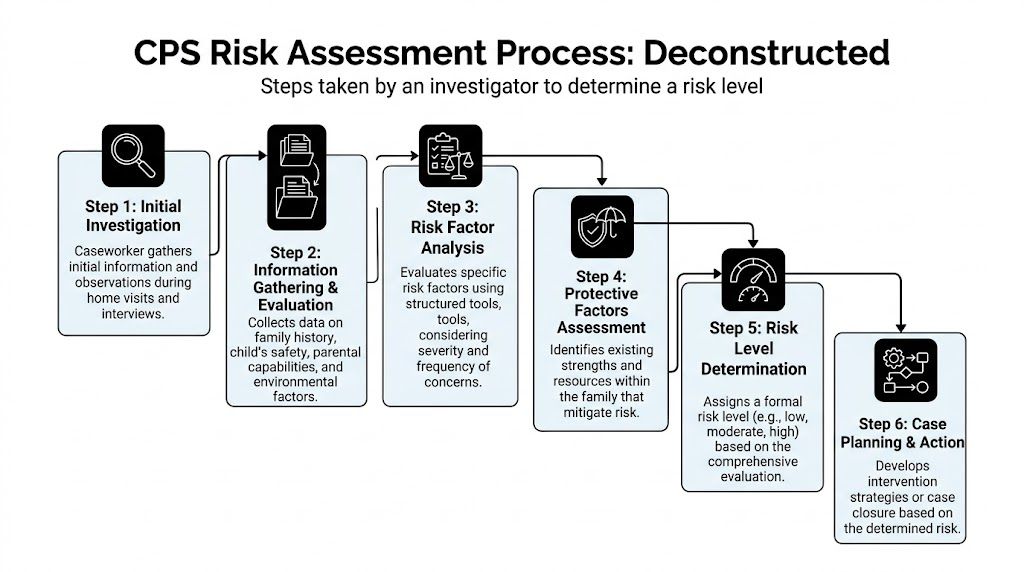
The Assessment Process Deconstructed What Investigators Evaluate
The Texas Risk Assessment Tool, often called the RAT, is more detailed than most parents expect. It doesn't run on a vague feeling that something seems off. It works through a hierarchy of 54 individual risk factors, grouped into 16 categories of concern, which are then grouped upward until CPS reaches one overall risk finding, as described in the Texas DFPS CPS Handbook guidance on the Risk Assessment Tool.
How scoring works in real life
Caseworkers use professional judgment to score each factor on a 5-point scale:
- None
- Very little
- Somewhat
- Considerable
- Extreme
That sounds orderly, but one of the most important parts of the process is how concern moves upward. A single factor scored as extreme can raise the whole category. That category can then increase the broader area of concern. In some cases, one serious issue can help push the final result to high or very high risk.
The logic is protective from the agency's perspective. If one severe concern exists, CPS doesn't want that concern diluted by less serious ones.
What kinds of issues get attention
Parents usually think CPS is only looking for dramatic facts. Broken bones. Drugs in plain view. Obvious neglect. Those things matter, but the tool often reaches further into daily family life.
Investigators may focus on issues such as:
- Caregiver substance abuse: Not just use itself, but whether it appears controlled or uncontrolled.
- Domestic violence: Even if the child wasn't physically harmed, exposure can affect scoring.
- Supervision problems: Who watches the child, how often, and whether prior concerns exist.
- Parenting capacity: Routine, discipline, responsiveness, and ability to meet needs.
- Home environment: Stability, safety, and whether the setting appears chaotic.
A parent may say, "Yes, I had a relapse, but my sister has been helping and the children haven't been alone with me." CPS may hear two different things. One worker hears accountability and support. Another hears substance abuse in the home. That difference in interpretation can shape the score.
Why one issue can dominate the case
The RAT is hierarchical. That means problems don't stay in one box.
Here's a simple example:
| Observation | How CPS may treat it |
|---|---|
| Single extreme concern | Can elevate the category |
| Elevated category | Can raise the larger area of concern |
| Raised area of concern | Can drive the final risk level upward |
| Policy override | Can force a higher outcome regardless of total pattern |
So if a caseworker believes a caregiver's incapacity places a child in imminent danger, that concern may trigger a policy override. The overall case can then be labeled much more severely than the parent expected.
What parents miss during interviews
Parents often answer questions as if they are speaking socially. The investigator is usually listening for patterns, control, and credibility.
Some examples:
"We argue, but every couple argues."
CPS may focus on whether arguments become threats, police calls, or child exposure."I only left him alone for a few minutes."
CPS may focus on the child's age, location, and history."I stopped drinking."
CPS may ask what supports prove the risk is now controlled.
A strong response doesn't just deny a concern. It shows what protects the child today.
Protective facts matter too
The tool is about risk, but controlled factors can matter. Family support, treatment participation, stable housing, and reliable child care can all help frame a concern differently if the evidence is real and current.
That is one reason documentation matters so much. A parent who merely says, "I'm doing better," is easy to discount. A parent who shows attendance records, counseling appointments, negative tests if applicable, or a written child care plan gives the investigator something concrete to weigh.
Your Rights and Common Red Flags During an Investigation
You have rights during a CPS investigation, even when the process feels one-sided. Knowing those rights won't stop every problem, but it can stop avoidable ones.

Rights parents should know early
A few protections matter immediately.
- You can ask for an attorney: That is often the smartest move before interviews become detailed.
- You can ask what the allegations are: You need enough information to understand the subject of the investigation.
- You can ask whether CPS has a court order or warrant: That matters before entry or compelled action in many situations.
- You can read before signing: Never sign a safety plan or agreement you don't understand.
This overview of your rights during a CPS investigation can help you spot issues before they grow.
What investigators often treat as warning signs
A red flag doesn't always mean abuse or neglect happened. It means the worker may see something as increasing uncertainty or danger.
Some red flags are obvious. Others surprise parents.
- A chaotic home: Not perfection. Basic safety, sleeping arrangements, food access, and obvious hazards matter.
- Adults contradicting each other: Inconsistent stories raise credibility concerns fast.
- Visible conflict between caregivers: Tension in front of the worker often becomes part of the risk picture.
- Evasive answers: Long explanations that avoid the question can look worse than a short truthful answer.
- Blaming everyone else: Teachers, doctors, ex-partners, and neighbors may all be wrong. But if a parent takes no responsibility for anything, CPS notices.
Parents sometimes think defensiveness proves they care. In practice, extreme defensiveness can make the worker wonder what isn't being said.
A short educational video may help make that dynamic easier to picture:
The difference between helpful and harmful cooperation
Helpful cooperation means being reachable, respectful, and prepared. Harmful cooperation means volunteering broad statements without context, agreeing to inaccurate summaries, or signing on the spot because you feel pressured.
If CPS asks a fair question, answer it carefully. If CPS asks you to make a legal decision, slow down.
A useful habit is to pause before answering. You are allowed to think. You are allowed to say, "I want my attorney present before I answer that in detail." You are allowed to ask for a copy of any document before signing it.
When people are frightened, they often either shut down or talk endlessly. Neither usually helps. The safer middle ground is measured, polite, and documented.
How to Prepare and Respond to a CPS Asssessment
Preparation changes how a case feels. It doesn't remove the stress, but it replaces guesswork with structure.
If CPS has contacted you, assume every interaction could matter later in an internal review, a Chapter 262 removal hearing, a Chapter 263 permanency setting, or in severe cases a Chapter 161 termination case. That doesn't mean panic. It means organization.
A practical checklist before the next contact
Start with the basics around your child.
- Gather key records: School attendance notes, medical appointments, prescription information, counseling records, and child care details can all help explain your daily reality.
- Clean for safety, not appearance: You don't need a magazine-perfect home. You do need working utilities, food, safe sleeping space, and a home free of obvious hazards.
- Identify supportive adults: Grandparents, aunts, uncles, trusted family friends, and church contacts may matter if CPS asks who can help.
- Create a timeline: Write down what happened, when the report may have started, and every contact with CPS since.
Keep your own file
Many parents rely on memory. Memory gets shaky under stress.
Create one folder, paper or digital, and keep:
| Item | Why it matters |
|---|---|
| Caseworker names and dates | Helps track who said what |
| Texts and emails | Preserves exact wording |
| Service referrals | Shows what was requested |
| Your notes after calls | Captures details before you forget them |
Write down the date, time, and summary after each call or visit. If the worker says your home was missing food, note what was present. If they ask for counseling records, note the request and your response.
What to say and what not to say
Here, many cases turn.
Do:
- Answer directly: Short, truthful answers are usually stronger than emotional speeches.
- Correct factual errors: If the worker states something untrue, say so calmly and specifically.
- Show documentation when it helps: Proof beats argument.
Don't:
- Guess: If you don't know, say you don't know.
- Speculate about who reported you: That conversation rarely helps.
- Minimize serious facts: If there was a real incident, denial can damage credibility.
- Sign first and read later: That is one of the costliest mistakes parents make.
Know when to stop talking
There is a point where self-representation stops being practical. If the case involves alleged drug use, domestic violence, serious injury, prior CPS history, pending criminal charges, or any threat of removal, get legal advice immediately.
The Law Office of Bryan Fagan PLLC offers a video resource discussing what happens during a CPS home visit for risk assessment, and educational material can help parents understand how investigators frame concerns. Education is useful. Legal advice specific to your situation is better when the risk rises.
How a Risk Assessment Impacts Your Family's Future
A risk assessment can reach far beyond the CPS file.
Take a father arrested for DWI after a minor traffic stop. His child was not in the car. He assumes the criminal case and his parenting are separate issues. A week later, CPS calls because someone reported concerns about alcohol use at home. He thinks, "I'll explain the arrest wasn't about my child." That may be true, but the agency isn't only asking what happened that night. It is asking what the event suggests about future safety.
Now add a custody dispute. The other parent learns CPS is involved and asks the family court for restrictions. Suddenly one incident is affecting criminal strategy, possession periods, and the image of the home itself.
Why CPS often acts cautiously
Part of the reason families experience CPS as aggressive is the pressure the system carries. In FY 2024, Texas reported 99 confirmed child maltreatment fatalities, and over half involved children or perpetrators with prior CPS history, according to this Texas child abuse deaths and CPS failures discussion. That same source says broader 2024 data identified 258 child fatalities tied to abuse or neglect.
Those numbers don't tell you what will happen in your case. They do help explain why a caseworker may lean toward caution when facts are incomplete and why neglect concerns can draw a strong response.
How the assessment can affect court decisions
A high-risk finding can influence several parts of your life at once:
- Family court: A judge may view CPS involvement as relevant to temporary orders, visitation, or conservatorship decisions.
- Service plans: CPS may push parenting classes, counseling, treatment, or supervision arrangements.
- Emergency hearings under Chapter 262: If CPS seeks removal, the agency may use the assessment to support immediate intervention.
- Permanency stages under Chapter 263: Risk concerns can shape whether reunification appears realistic and on what timeline.
- Termination exposure under Chapter 161: If serious conditions continue and the parent doesn't make progress, the legal stakes rise sharply.
The hidden danger of informal statements
Parents often focus on the official report and forget the informal interview. But what you say to CPS can echo elsewhere.
A mother facing an assault allegation tied to a domestic dispute may tell CPS, "It only got physical once." She means to minimize the event. In a criminal case, that statement may become an admission that physical violence occurred. In a custody case, the same statement may support restrictions on the children being around the other parent. In the CPS file, it may support ongoing domestic violence concerns.
When one case touches CPS, family court, and criminal law at the same time, every statement needs a strategy.
That is why risk assessments matter so much. They don't stay in a silo. They can become the framework through which multiple decision-makers view your family.
Can You Challenge a CPS Risk Assessment Finding?
Yes. You can challenge it.
That answer surprises many parents because CPS findings often feel final when they arrive. They aren't. A risk assessment is an administrative decision, and families may have options to push back, including requesting an administrative review under Texas Family Code Chapter 262, as discussed in this guide on Texas CPS safety assessments and challenges to risk findings.

What a challenge usually looks like
A successful challenge is rarely built on outrage alone. "They were unfair" may be true, but it usually isn't enough.
A stronger response focuses on evidence:
- Incorrect facts: Wrong dates, wrong household members, wrong history.
- Missing context: A relapse followed by immediate treatment is different from ongoing unmanaged substance abuse.
- Controlled factors: Risks that once existed may now be managed through family support, treatment, housing changes, or supervision.
- Overreach in scoring: A severe conclusion may not fit what the evidence shows.
The key phrase many parents never hear is "Factors Controlled." If a concern exists but the family has shown the ability and willingness to manage it safely, that may support reassessment.
What evidence can help
An attorney may help gather material such as:
| Evidence | Why it can matter |
|---|---|
| Sobriety program records | Shows active response to substance concerns |
| Mental health treatment records | Demonstrates engagement and stability efforts |
| School and medical records | Can rebut neglect assumptions |
| Support from protective relatives | Helps show practical safety planning |
Families caring for both children and older relatives may also need broader support with legal planning. In those situations, this resource on general legal assistance may help identify additional practical support needs outside the CPS file.
Why legal help changes the quality of the response
The challenge process is usually not about emotional storytelling. It is about reframing the case with proof, procedure, and precision.
A lawyer can compare what the worker wrote against what occurred, identify whether an override was justified, and argue that current protective factors deserve weight. If you need a starting point for that process, this guide on appealing Texas CPS decisions explains the review path in more detail.
A high-risk finding is serious. It is not untouchable.
The earlier you start building that response, the better your chances of preventing the finding from shaping the rest of your case unchecked.
You Are Not Alone Let Us Help Protect Your Family
CPS cases are scary because they move into the most personal parts of your life. Your home. Your parenting. Your child's safety. Your future with your family. That kind of pressure can make even careful people feel lost.
But fear doesn't have to make the next decision for you.
If you understand how cps risk assessment texas works, what investigators are evaluating, where parents make avoidable mistakes, and how findings can be challenged, you are already in a stronger position than many families are on day one. Knowledge won't solve everything by itself. It does help you respond with purpose instead of panic.
If your case involves a home visit, a safety plan, a high-risk finding, a removal threat, or overlap with criminal charges or custody litigation, get advice early. Waiting usually helps CPS build its file. It rarely helps you build yours.
You do not have to guess your way through Chapters 262, 263, or 161. You do not have to assume the agency's first version of events is the final one. And you do not have to face the process alone.
If you're overwhelmed, confused, or worried about what CPS may do next, contact Law Office of Bryan Fagan PLLC for a free, confidential consultation. A focused legal strategy can help you protect your rights, respond to the investigation wisely, and work toward the safest path for your family.