Skip to content
When CPS calls or shows up at your door, most parents don’t hear legal terminology. They hear one thing: threat. Threat to their children, their home, and their future. If you’re searching for voluntary family based services cps texas, you may already be standing at one of the most important decision points in a CPS case.
What makes this stage so hard is the word voluntary. It sounds informal. It sounds optional. It sounds safer than court. Sometimes it is. Sometimes it’s the off-ramp that helps a family stabilize and move forward. But sometimes it’s more like signing a roadmap while someone else is holding the pen.
Texas parents deserve a plain-English explanation before they agree to anything. That matters even more if your CPS case overlaps with a criminal allegation, a domestic violence accusation, or a protective order. In those situations, what you say to a caseworker and what you sign in a service plan can affect more than one case at once.
A common example looks like this. A mother is investigated after a report of domestic violence in the home. CPS says the children can stay home if she agrees to counseling, safety steps, and parenting services. At the same time, there may be a pending assault allegation, a no-contact order, or a protective order request. She wants to cooperate. She also doesn’t want to say something that gets used against her somewhere else. That tension is real, and it’s where careful legal guidance matters.
That Knock on the Door What Happens When CPS Contacts You
One evening, a parent answers the door after work. A CPS investigator introduces herself and says there’s been a report. Maybe the allegation involves neglect. Maybe drug use. Maybe an argument between adults that a neighbor heard through the wall. Sometimes law enforcement is nearby. Sometimes the parent has no idea what this is about until that moment.
That first contact can feel surreal. Your body goes into defense mode. You may want to explain everything at once, deny everything at once, or sign whatever is put in front of you just to make the fear stop. That reaction is human.

Why this moment matters
In many cases, CPS starts with an investigation. If the agency believes the children can remain at home with supports, it may offer voluntary family based services instead of going straight to court. That sounds like good news, and sometimes it is. But it’s also a fork in the road.
One path keeps the case outside formal court, at least for now. The other path can lead to a petition under Texas Family Code Chapter 262, where CPS seeks court involvement and possibly removal. The problem is that parents often make this decision while scared, exhausted, and under pressure.
Practical rule: The first conversation with CPS can shape everything that comes after it. Stay calm, be respectful, and don’t assume you must make final decisions on the spot.
What parents often misunderstand
Many parents believe “voluntary” means they can sign now and sort out the details later. In practice, those details become the case. The services you agree to, the admissions you make, and the deadlines you accept can all affect how CPS judges your cooperation and your protective abilities.
Another point of confusion is this. A CPS case may begin outside court, but it doesn’t stay consequence-free just because no judge is involved yet. Decisions made in the voluntary phase can influence whether CPS later seeks removal, whether a judge orders services, and in severe cases under Texas Family Code Chapter 161, whether the agency argues for termination of parental rights.
If you feel confused, that doesn’t mean you’re failing. It means the system is complicated, and you need clear information before you move.
Understanding Voluntary Family-Based Services
Family-Based Safety Services, often called FBSS, is Texas’s statewide voluntary intervention program designed to help keep children safely with their families instead of removing them from the home. Under this approach, the caseworker and the family create a service plan that may include drug testing, counseling, behavioral intervention, domestic violence counseling, parenting training, mental health treatment, and practical supports. Texas law requires formal reviews at least every six months, and DFPS regulations require monthly oversight by caseworkers and supervisors, as described by the Texas Center for Child and Family Studies summary of FBSS.
The simplest analogy is this. FBSS works a little like a probationary period, but in the child welfare setting. You are being asked to show CPS that the safety concerns can be managed without court-ordered removal. If the plan works and safety improves, the case can close. If the plan doesn’t work, the agency may escalate.
What the service plan really is
The heart of FBSS is the Family Plan of Service, often shortened to FPOS. This is the written plan that spells out what CPS believes the risks are, what it expects the parent to do, and what services may be offered.
Typical tasks might include:
- Drug testing: If the report involves substance use, CPS may ask for testing and treatment participation.
- Counseling: This can include mental health counseling, domestic violence services, or individual therapy.
- Parenting classes: CPS may require structured training tied to supervision, discipline, or child development.
- Concrete support: Daycare help, crisis intervention, and referrals can appear in the plan when practical barriers are part of the problem.
Parents often need to slow down at this point. A service plan shouldn’t feel like a punishment list. It should connect to actual safety concerns. If the allegation involves alcohol misuse, that doesn’t automatically justify unrelated requirements. If the concern involves one incident of family conflict, the plan still needs to fit the facts.
Why parents feel pressured to sign
Parents can refuse to sign a voluntary service agreement, but that can lead CPS to seek formal child removal. That’s why many parents feel they don’t have a real choice. Legally, the plan may be voluntary. Emotionally, it may feel anything but.
That’s one reason informed review matters. If substance use is part of the concern, a parent may benefit from understanding how family therapy for substance abuse works in practice before agreeing to a treatment-based plan. Not every counseling referral is the same, and family-centered treatment can matter when CPS is looking at household safety.
A voluntary plan should be read like a legal document, not like a school permission slip.
How this fits into Texas family law
FBSS sits in the prevention and family preservation side of the child welfare system. It is designed to avoid removal when possible, but it still exists in the shadow of later court action. That’s why parents often benefit from learning how preventive programs operate in Texas CPS cases through resources on family preservation programs in Texas CPS initiatives.
The key takeaway is simple. FBSS can be helpful. It can also become the document trail CPS uses to decide whether you are cooperative, protective, and capable of meeting your child’s needs.
Navigating the Voluntary Services Process and Timeline
A lot of parents expect FBSS to feel like a clear program with a start date, a checklist, and an end date. In reality, it often feels more like stepping onto a moving walkway while someone reads instructions to you at the same time. That confusion is not a small issue. The first few weeks often shape what CPS later says about your judgment, your cooperation, and your ability to keep your child safe.
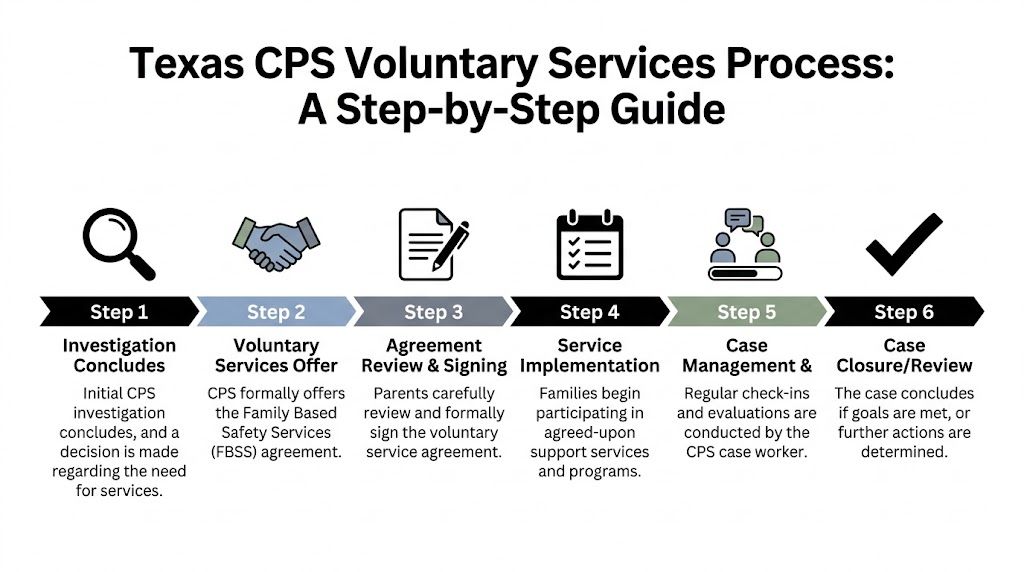
The early timeline matters more than many parents realize
Once CPS decides a child can stay at home, or stay with relatives under a temporary arrangement, the case may shift into FBSS. As noted on the DFPS page mentioned earlier, the agency generally moves quickly at this stage. A caseworker is expected to make an in-person assessment within 10 days, and the Family Strengths and Needs Assessment, or FSNA, is generally completed within 21 days.
Those dates are not just office deadlines. They often become the frame for the entire case.
If the first assessment says the main problem is drug use, unstable housing, untreated mental health issues, or unsafe supervision, that description can keep showing up in later meetings and service plans. In some families, the wording also spills into other legal problems. A statement made casually in an assessment can later be read by a prosecutor, referenced in a protective order dispute, or used in a custody fight to argue that danger existed in the home.
What the FSNA is really doing
The FSNA sounds clinical, but the idea is simple. CPS is trying to decide two things at once. What is the current safety threat, and what in this family can control that threat?
That means the worker may ask about school attendance, routines, discipline, child care, relatives, counseling history, alcohol or drug use, domestic conflict, and prior CPS reports. Parents sometimes answer quickly because the questions sound informal. Treat them more carefully than that. An FSNA interview works less like small talk and more like the first draft of the agency's case theory.
Words matter here. A lot.
If a caseworker says you need to improve "stability," ask what that word means in this case. Does CPS mean stable housing, stable income, stable mental health treatment, or stable child care? Vague language is dangerous because it can grow over time. A narrow concern can become a broad list of obligations if no one pins it down early.
Meetings can help, but they also create a record
Many families are asked to attend Family Team Meetings, or FTMs. These meetings can be productive when the group is solving a specific problem, such as who can supervise the children after school or how a parent will get to counseling while keeping a job. They can also become crowded, emotional, and hard to track.
A good way to approach an FTM is to treat it like a business meeting about your family. Bring notes. Write down what CPS says is required, what is only being suggested, who will make referrals, and when each step is due. If a relative offers help, make sure the help is described clearly. "Grandma will support the family" is too vague. "Grandma will supervise Saturday visits from 10 a.m. to 4 p.m. until counseling begins" is much safer because everyone knows what was agreed.
That level of detail protects you later if someone claims you failed to cooperate.
Ask for the rules in writing
Parents get into trouble in FBSS because they follow verbal instructions that later change. Do not rely on memory alone. Ask for the plan in writing and ask follow-up questions until the requirements are concrete.
Focus on four things:
- Each required service. Ask what class, evaluation, counseling, or testing is required.
- The deadline for each task. Ask when the deadline starts and what counts as completion.
- The practical logistics. Ask about provider names, cost, transportation, waitlists, and scheduling conflicts with work or school.
- The success standard. Ask whether CPS expects attendance, discharge, a therapist's recommendation, negative drug tests, or something else.
A simple binder or phone folder can save a parent months of trouble. Keep certificates, sign-in sheets, discharge papers, text messages, emails, and screenshots of canceled appointments. If a provider has a waitlist, keep proof that you contacted them. In these cases, documentation is like keeping receipts after a major purchase. You may not need every page, but if someone says you failed to do your part, those records become your proof.
If a service requirement is too vague to write down in one sentence, it is too vague to measure fairly.
How long FBSS usually lasts
FBSS is often supposed to move toward closure once CPS believes the immediate danger has been reduced and the family has addressed the agency's concerns. As noted earlier, the DFPS description indicates that closure often happens within about 60 days after the investigation stage, although some cases continue longer if concerns remain. That same DFPS page states that strong parent participation allows many FBSS cases to avoid foster care.
Parents should hear that statistic with caution as well as hope. Participation helps, but FBSS does not run on autopilot. Cases often stretch out because services are hard to schedule, allegations shift, new household members are questioned, or a related criminal or protective order issue changes the agency's view of risk.
If your case starts to feel open-ended, review the broader Texas CPS case timeline so you can see where FBSS fits in relation to later court action under Chapters 262 and 263.
The practical rule is straightforward. Show up. Keep records. Correct inaccuracies early. If a service plan starts drifting from child safety into vague character judgments, address that problem immediately, because the "voluntary" stage often creates the paper trail that drives everything that comes after.
Voluntary Services vs Court-Ordered Services A Critical Choice
Parents often ask a hard question in a whisper. “Should I just sign this to stay out of court?” The answer depends on the facts, the allegations, and the quality of the proposed plan. There is no universal right answer.
Voluntary services can preserve privacy and keep the case out of the courtroom for the moment. But court-ordered services come with judicial oversight and formal procedure. In some situations, that structure protects parents from an open-ended, moving-target service plan.
Why voluntary services may appeal to parents
The attraction is easy to understand. No immediate courtroom hearing. No public judge’s docket. More room to negotiate day-to-day details. If CPS is acting reasonably and the plan is tightly linked to the actual safety issue, FBSS can be a sensible path.
For a parent who had one crisis event and quickly stabilized, voluntary services may function as a bridge. The parent keeps more direct involvement in the home, and the case can close without a drawn-out lawsuit.
Why court involvement can sometimes offer protection
Court has obvious downsides. It is stressful, formal, and time-consuming. But a courtroom also brings structure. A judge can review evidence, hear objections, and issue enforceable rulings. That matters if CPS is overreaching or if the allegations are weak.
Under Texas Family Code Chapter 262, removal and emergency intervention are governed by legal standards. Under Chapter 263, ongoing review and permanency hearings create a timeline and accountability framework. If a case reaches Chapter 161, the stakes become far more serious because parental rights may be at issue.
A parent in court may also gain clearer rules about what is required, what evidence supports the allegations, and when the agency must justify its decisions.
Voluntary Plan vs Court Order Key Differences
| Feature | Voluntary Family-Based Services (FBSS) | Court-Ordered Services |
|---|---|---|
| How it begins | CPS offers services without initial court intervention | A judge orders services in a pending case |
| Parent’s initial choice | Parent may refuse to sign, though CPS may then escalate | Parent must comply with court orders |
| Oversight | Caseworker and supervisor oversight | Judicial oversight plus agency oversight |
| Flexibility | Can be more flexible in scheduling and structure | Often more formal and less flexible |
| Evidence rules | Decisions often develop through agency process | Court process uses formal legal procedure |
| Risk of misunderstandings | High if tasks are vague or expanded informally | Lower when orders are specific and on the record |
| Impact of non-compliance | CPS may seek removal or court-ordered services | Non-compliance can lead to sanctions or stronger agency action |
| Best fit | Cases where the plan is narrow, realistic, and tied to clear safety concerns | Cases involving disputed facts, overbroad demands, or major legal overlap |
Questions to weigh before choosing
A smart decision usually starts with a few direct questions:
- Is the plan narrow or sprawling? A focused plan tied to one issue is different from a document that reads like every service CPS can think of.
- Can you complete it? A plan that ignores work schedule, transportation, insurance, or childcare problems may set you up to fail.
- Is there another legal case in the background? If criminal charges or a protective order exist, every statement and service referral needs careful review.
- Are the allegations supported? If CPS is leaning on assumptions instead of evidence, formal court scrutiny may matter more.
A practical example
Suppose a father is offered voluntary services after an allegation that he left a young child unsupervised. He admits he made a bad decision and is willing to take a parenting class. That may be an appropriate FBSS case.
Now change the facts. The same father is also facing a pending assault allegation from the child’s other parent, and CPS wants him to sign a plan that includes anger management, substance abuse treatment, supervised contact, and broad admissions about household violence. That is no longer a simple “sign and move on” situation. The overlap changes the risk.
The question isn’t whether cooperation is good. The question is whether the specific agreement protects your family or creates a record that harms you later.
Understanding Your Rights and Risks with a Voluntary Plan
The most dangerous misunderstanding in these cases is thinking a voluntary plan is harmless because it isn’t a court order yet. It can still become the foundation for later court action. That’s why parents need to know both their rights and the practical risks before signing.

You can refuse, but refusal has consequences
A parent can refuse to sign a service agreement. That is real. But it is only half the sentence. The second half is that CPS may respond by seeking court involvement or removal. So the choice is not “sign or nothing happens.” The choice is usually between one set of risks and another.
This is why timing matters. If you’re asked to sign a plan, the safest move is often to pause long enough to get legal advice. Even a short consultation can help you spot admissions, overbroad terms, impossible deadlines, or conflicts with another case.
The self-incrimination problem
Parents often speak openly to caseworkers because they want to show honesty. Honesty can help. Unprotected admissions can also hurt. If your case touches drug possession, assault, family violence, or a protective order allegation, statements made in the CPS context may not stay neatly inside that file.
It's helpful to consider this: A voluntary plan is not a private diary. It is more like a shared legal notebook. Once a damaging statement goes into it, you may spend months trying to explain the context.
Scope creep is real
Some plans start with one issue and expand. A parent agrees to counseling, then gets asked for extra evaluations, additional classes, repeated testing, or household restrictions that were never clearly tied to the original report. Parents are often told that if they are “fully cooperative,” they should just comply.
That can backfire. A plan becomes unmanageable when the tasks exceed your time, money, transportation, childcare, or available providers. Then the agency may label you non-compliant, even though the underlying issue was an unrealistic plan.
One of the sharpest examples involves mental health services. A documented problem in Texas is the gap in Medicaid coverage for intensive in-home mental health interventions. As of 2024, Texas had not fully rolled out reimbursements under FFPSA, which means families may agree to services they cannot access or afford. That gap contributed to up to 6% of Texas foster care entries involving parents who relinquished children because of unmet mental or behavioral health needs, according to the Texas Children’s report on gaps in mental health services.
A scenario parents recognize
A mother agrees to a voluntary plan after CPS raises concerns about depression and household stress. The written tasks sound manageable at first. Counseling. Parenting support. Home visits.
Then reality hits. The referred in-home mental health service has a waiting list. Another provider doesn’t accept her coverage. A third is too far away and conflicts with work. CPS still expects progress. She misses deadlines because the services aren’t realistically available, and the case starts reading like defiance instead of a systems failure.
That is why “yes” is not always the safest answer unless the plan is grounded in available services and real logistics.
What to do before you sign
Parents do better when they treat the service plan like a contract with child custody consequences.
- Read every line: Ask what each task means, who provides it, and what counts as successful completion.
- Push for fit: If a service doesn’t match the allegation, ask why it’s there.
- Raise barriers early: Insurance, work schedule, transportation, and childcare problems should be documented immediately.
- Get legal advice first: Even if you intend to cooperate, you need to understand the downstream effect.
If you’re already dealing with a plan that feels unfair or inflated, guidance on how to dispute a Texas CPS safety plan can help you think through next steps.
How Voluntary Plans Affect Criminal and Protective Order Cases
This is the part many parents don’t hear soon enough. A CPS case and a criminal case may be separate proceedings, but they are not sealed off from each other in any practical sense. Information flows. Decisions overlap. One mistake in one case can echo in the other.
Statements can travel
If CPS is investigating alleged drug use, assault, domestic violence, or child endangerment, what you say to a caseworker may later matter in a criminal case or a protective order hearing. A parent may think, “I’m just explaining the family situation.” But if that explanation includes an admission, it can become evidence or lead investigators in a damaging direction.
That doesn’t mean you should be combative or silent in every interaction. It means you should be strategic. Cooperation and self-protection have to coexist.
Service completion can help, but only if handled carefully
The overlap isn’t always harmful. Sometimes a parent’s participation in counseling, substance treatment, or anger management shows rehabilitation and accountability. In the right context, that can support a more favorable outcome in related proceedings.
But context matters. If the service plan contains language that effectively concedes a disputed criminal allegation, the “good fact” of participation may come bundled with a damaging admission. That’s why parents should not assume a helpful service is a harmless document.
Domestic violence cases are especially complicated
Domestic violence allegations create some of the hardest FBSS cases because the family may need services that are difficult to access in real life. A 2021 UT Austin study found major service gaps. Only 18.5% of Texas domestic violence agencies offer full-day child care, and over half lack capacity for youth counseling, creating a risk that a parent agrees to a plan involving services that are functionally unavailable, according to the UT Austin report on gaps in domestic violence and child welfare services.
That matters even more when there’s a criminal family violence charge or a protective order. A parent may be ordered to avoid contact with one adult while CPS expects coordinated parenting exchanges. Or the parent may be told to attend services that require childcare they cannot get. These are not excuses. They are legal and practical conflicts that need to be addressed directly.
Arrests change the case immediately
If an arrest happens during FBSS, the service plan may change overnight. New restrictions may appear. Home access may change. CPS may treat the arrest as proof of risk, even before a criminal case is resolved.
For families trying to understand the immediate criminal side, a plain-language guide to what happens after you get arrested can help explain the early stages. In a CPS context, though, the larger point is this. Don’t handle the criminal case and the CPS case as if they belong to separate universes. They rarely do.
A smart legal strategy in an overlapping case looks at every statement, every service referral, and every court date as part of one larger picture.
When to Call an Attorney and Key Questions to Ask
Parents wait too long for legal help because they think hiring a lawyer means they are “making it worse.” In CPS matters, early advice usually does the opposite. It helps you avoid avoidable mistakes.

Call right away if any of these happen
You don’t need to wait for a court hearing to call counsel. Reach out promptly if:
- CPS first contacts you: Early conversations shape later records.
- You are asked to sign anything: Especially a safety plan, FPOS, or release of information.
- The plan feels vague or excessive: Unclear tasks become future compliance problems.
- There is a criminal accusation too: Drug, assault, DWI-related parenting concerns, or family violence all raise the stakes.
- A protective order is involved: Safety conditions can conflict with parenting arrangements.
- CPS mentions removal: At that point, delay can cost you options.
Questions worth bringing to a consultation
A productive consultation is not just “Can you take my case?” It’s also “How do you think about cases like mine?”
Consider asking:
- How do you evaluate whether a voluntary service plan is reasonable?
- What parts of this plan would you want changed before I sign?
- If I refuse this plan, what is CPS likely to do next?
- How do you handle a CPS case that overlaps with criminal charges or a protective order?
- What records should I start gathering today?
- If CPS files in court, what happens under Chapters 262 and 263?
- What risks could later affect my parental rights under Chapter 161?
- How should I communicate with my caseworker while represented?
This video may help you think through the importance of getting informed early in a CPS matter.
Bring documents, not just memories
Bring every paper or screenshot you have. That includes the report summary if you have one, the service agreement, text messages from the caseworker, drug test notices, provider referrals, and any related police paperwork. If you’ve been trying to understand the system on your own, keep those notes too.
Parents often feel calmer once they can turn fear into a checklist. The goal is not perfection. The goal is to stop guessing.
Protecting Your Family is Not a Voluntary Matter
The phrase voluntary family based services cps texas can be misleading if you hear only the first word. These cases may begin outside a courtroom, but they still carry serious legal weight. A service plan can help preserve your family. It can also create risk if it is rushed, overbroad, unrealistic, or tied to a criminal or protective order case.
You do not have to choose between cooperation and caution. You can take child safety seriously and still protect your rights. You can be respectful to CPS and still ask hard questions. You can want peace for your family and still insist on clarity before you sign anything.
If CPS has contacted you, time matters. So does strategy.
If your family is facing CPS involvement, a voluntary safety plan, or a case that overlaps with criminal charges or a protective order, the Law Office of Bryan Fagan PLLC can help you understand your options and protect your rights. Our team offers free consultations for Texas families who need clear answers, practical guidance, and a steady advocate during a stressful time. Reach out today for a confidential case review.