Skip to content
When your Texas CPS case gets close to the one-year mark, it can feel like everything is hanging on a single court date. You may have spent months doing services, taking drug tests, attending visits, finding housing, and trying to prove that your child should come home. Then, just when you think the end is near, someone mentions an extension.
That word can hit hard.
For many parents, an extension of cps case beyond one year texas sounds like the system is moving the finish line. It can bring up fear, anger, and exhaustion all at once. But this moment also gives you something important. It gives you a chance to focus on the exact legal rule, the exact evidence that matters, and the exact arguments that can protect your rights.
A CPS extension request is not automatic. It is not supposed to be routine. And it is not the same thing as a final loss. Texas law puts real limits on how long the state can keep a case open, and parents can take concrete steps to fight an extension or use that added time wisely.
The Year Is Almost Up What Happens Now
The final stretch of a CPS case often feels strange. You may feel hopeful because you've worked hard for months. At the same time, you may feel afraid that one more delay could keep your family apart longer.
That fear is real. Parents often tell me the hardest part isn't only the court hearings. It's the uncertainty. You've done what the court asked, but you still don't know whether the judge will return your child, set a final hearing, or allow CPS to ask for more time.

Take a common example. A father has finished counseling, kept a job, and stayed consistent with visits. He circles the one-year date on his calendar because he believes the case should finally end. Then he learns CPS may ask the court for an extension because they want more time to evaluate placement. He isn't just worried about delay. He's worried that delay will be used against him.
That's why timing matters so much in these cases. If you're trying to understand the bigger process around hearings, reviews, and deadlines, this guide to the Texas CPS timeline and what parents should expect helps place the one-year mark in context.
Why this moment matters so much
The one-year point is not just another hearing. It is a legal deadline with serious consequences. As that date approaches, the judge has to decide whether the case will end, move into trial, or continue for a limited period under strict rules.
Practical rule: The closer your case gets to the dismissal deadline, the more important your records become. Verbal progress helps. Written proof helps more.
Parents sometimes make the mistake of waiting for CPS to summarize their progress fairly. Don't rely on that. If your housing is stable, document it. If you've completed services, gather certificates. If you've tested clean, organize every result. Near the deadline, small details matter because the court is looking at whether there is still a legally valid reason to keep the case open.
What worried parents often misunderstand
Many parents assume CPS can extend the case because they ask. That's not how the law works. Judges must make specific findings before extending the case.
Others think an extension means the court has already decided against reunification. That also isn't always true. Sometimes an extension request is really a sign that the case has reached a pressure point. The judge wants more evidence, or CPS wants more time, or the lawyers disagree about whether the case is ready to end.
Your job is to make sure your side of the story is documented, organized, and hard to ignore.
The One-Year Deadline in Texas CPS Cases
Texas uses a strict dismissal deadline in many CPS conservatorship cases. This deadline operates like a legal shot clock. Once the state is appointed temporary managing conservator, the case can't stay open forever.
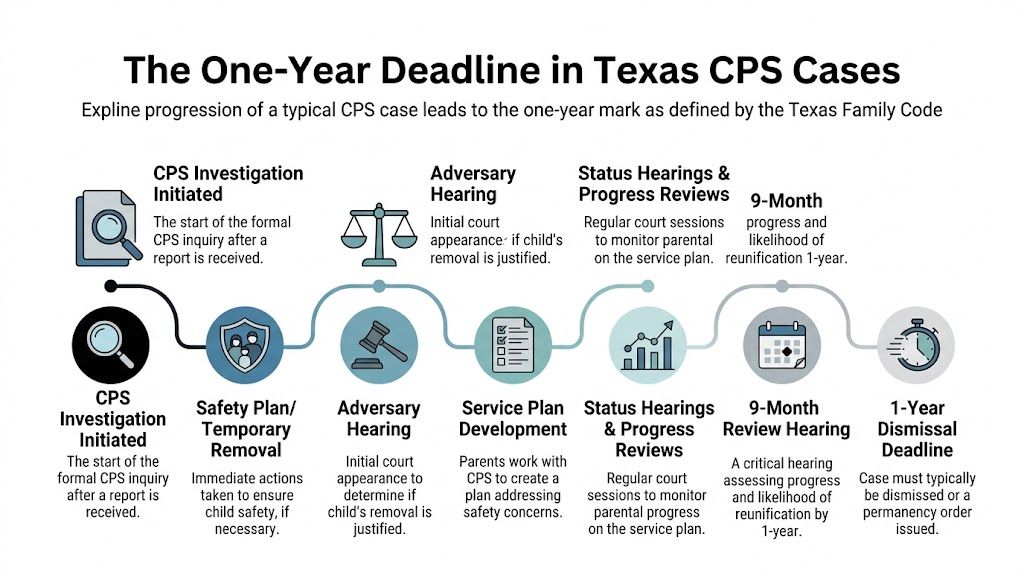
Under Texas Family Code Section 263.401 as explained by Texas Law Help, CPS cases must be resolved within one year from when DFPS is appointed temporary managing conservator. If the court doesn't start a trial or grant an extension, the case is automatically dismissed on the first Monday after that one-year anniversary. This deadline is an important protection for families.
When the clock starts
The deadline usually starts when the court appoints the Department of Family and Protective Services as temporary managing conservator, often shortened to TMC. That date matters more than almost any other date in the case.
Parents often confuse this with the date of removal, the date of the first hearing, or the date they signed a service plan. Those dates may be important for other reasons, but the dismissal deadline generally ties back to the TMC appointment date.
Here is a simple explanation:
| Event | Why it matters |
|---|---|
| Child is removed or safety concerns arise | This starts the crisis, but not necessarily the dismissal clock |
| Court appoints DFPS as temporary managing conservator | This is usually the key date for the one-year deadline |
| One-year anniversary approaches | The court must move toward dismissal, trial, or a valid extension |
Why Texas has this rule
This deadline exists for two reasons at the same time.
First, it protects children from staying in legal limbo for too long. A child needs permanency, not endless uncertainty.
Second, it protects parents from indefinite government control over the family. If the state removes a child and asks a court to keep the case open, the state has to move the case forward within the time the law allows.
The deadline isn't a technical detail. It is one of the strongest procedural protections parents have in a Texas CPS case.
What automatic dismissal means
If the court reaches the dismissal date and trial hasn't started, and no proper extension has been granted, the court's jurisdiction ends and the case is dismissed without an order. That language matters because it means the case doesn't just drift along informally. The law cuts it off.
That doesn't mean every parent walks out of court with no concerns left to address. It does mean CPS cannot keep the suit alive past the statutory deadline unless the legal requirements have been met.
A simple example
Assume DFPS was appointed temporary managing conservator early in the year. The one-year anniversary approaches. If the court has not begun trial and has not entered a valid extension order, the case must be dismissed on the first Monday after that anniversary.
That is why parents should never treat the one-year setting as a routine hearing. It is often the most important scheduling point in the entire case.
What you should check right away
As the deadline gets close, confirm these items with your attorney:
- The exact TMC date so there is no confusion about when the dismissal deadline falls.
- Whether trial has commenced under the law, not just whether a hearing was scheduled.
- Whether CPS filed a motion for extension and what reasons they claim justify it.
- Whether your evidence is updated through the present date, not just through the last review hearing.
If you don't know your dismissal date, ask for it today. Parents lose advantage when they don't know the calendar.
Understanding Extraordinary Circumstances for an Extension
The phrase that causes the most confusion is extraordinary circumstances. Texas law allows an extension only when the court finds extraordinary circumstances and also finds that keeping the case open is in the child's best interest.

According to the DFPS handbook discussion of extensions under Section 263.401, a court must find extraordinary circumstances and that the extension is in the child's best interest. The same guidance notes that about 15 to 20% of cases approaching the deadline receive such an extension, which shows that the one-year rule is meant to be meaningful.
What the phrase really means
Texas law does not give a tidy checklist that defines extraordinary circumstances in every case. That leaves judges with discretion, which can be frustrating for parents. But it also means CPS still has to offer a real reason, not just a vague statement that they want more time.
Courts usually look for something unusual, serious, and case-specific. The problem must be significant enough that it justifies delaying final resolution.
Examples that may support an extension
Some situations are more likely to be viewed as extraordinary because they involve facts outside ordinary case management. Examples can include:
- A major evidentiary issue such as waiting on important test results or information necessary for a final decision.
- A sudden emergency affecting a key participant such as a serious medical event that disrupts a necessary hearing or evaluation.
- A narrow but realistic reunification window where a parent is close to completing what the court requires and the judge believes a short extension could safely change the outcome.
These examples are not automatic winners for CPS. They are the types of facts that sound more like extraordinary circumstances than routine delay.
What usually shouldn't be enough by itself
Parents often hear reasons that sound important but may not satisfy the legal standard by themselves.
A heavy caseload is a system problem. Staff turnover is a real problem. Scheduling frustration is common. But those issues are often ordinary features of litigation, not extraordinary facts unique to your case.
That distinction matters because parents shouldn't assume every delay is legally justified.
If CPS asks for more time, the right question isn't "Would more time help?" The right question is "Has CPS shown extraordinary circumstances and proved the extension is in my child's best interest?"
Best interest is a separate requirement
Even if the judge sees an unusual complication, the court must still decide whether the extension serves the child. That gives parents room to argue that delay itself causes harm.
A stable, ready parent may argue that more waiting is not in the child's best interest when reunification could happen now. A parent may also point out that uncertainty can damage family bonds and interfere with progress that has already been made.
A useful way to evaluate CPS's request
When you read an extension motion, test it against this short framework:
| Question | Why it matters |
|---|---|
| Is the reason truly unusual? | Ordinary delay should not be enough |
| Is the reason supported by evidence? | Judges need facts, not broad claims |
| Is the problem tied to your case specifically? | Generic agency issues are weaker |
| Would delay actually help the child? | Best interest must be shown, not assumed |
If the motion sounds vague, unsupported, or disconnected from your actual progress, that may be a sign the request can be challenged effectively.
A Parent's Story Facing a Last-Minute Extension
Maria had spent almost eleven months doing everything she was told to do.
She completed parenting classes. She attended counseling. She kept working, found stable housing, and showed up for visits with snacks, homework help, and patience. Each month, she believed she was getting closer to bringing her daughter home for good.
Then her lawyer called to say CPS was asking for more time.
Maria's first reaction wasn't legal. It was personal. She felt like the work she had done didn't count. She had rearranged her life around court orders and service requirements, and now the state was saying the case might continue anyway.
The motion used broad language. CPS said they still had concerns and wanted the court to extend the case. But Maria kept asking the same question many parents ask. "Concerns about what exactly?"
Why Maria's story matters
Maria's situation is familiar because many parents face an extension request after making real progress. They assume that if they comply, the case will naturally close on time. Sometimes that happens. Sometimes it doesn't.
The problem is that progress alone isn't enough if the proof of that progress is scattered, incomplete, or not clearly presented to the judge. Maria had done the work, but she hadn't gathered everything in one place. Her clean tests were at one provider. Her counseling records were somewhere else. Her landlord had never written a letter confirming stable housing. Her employer supported her, but nobody had asked for a written statement.
That changed quickly.
What Maria and her lawyer focused on
They stopped thinking in general terms and started building a record. Maria collected certificates, visit logs, pay stubs, lease documents, and proof of counseling attendance. Her lawyer prepared to challenge the extension by asking the court to look at what Maria had already achieved, not what CPS vaguely hoped to review later.
Parents often lose ground when they assume the judge already knows how hard they've worked. Judges need evidence they can review, compare, and trust.
Maria also prepared emotionally for court. That mattered more than she expected. Instead of reacting in anger, she came ready to answer questions calmly and specifically. She could explain where she lived, how she arranged childcare, what she learned in services, and how she had changed since the case began.
Whether a parent is named Maria or something else, this part of the story is common. A last-minute extension request can feel unfair. But it can also become the point where a parent shifts from reacting to advocating.
How to Fight a CPS Case Extension Request in Court
When CPS asks for an extension, don't treat it like a routine scheduling matter. Treat it like a hearing that may decide whether your family stays in limbo or moves toward reunification, dismissal, or trial.

One practical reality stands out. According to the Texas Children's Commission benchbook material on extension practice, approximately 70% of CPS case extensions are linked to parents not completing parts of their service plans. That makes documented compliance one of the strongest ways to resist an extension request.
If you're preparing for a hearing near this deadline, this resource on how to prepare for a Texas CPS status hearing can help you organize your presentation and avoid common mistakes.
Start with a direct legal response
If CPS files a motion to extend, your attorney may file a written response opposing it. That response can do several things at once:
- Challenge the legal standard by arguing CPS has not shown extraordinary circumstances.
- Dispute best interest by showing the child benefits more from reunification or timely resolution than from delay.
- Force specificity by requiring CPS to explain exactly what remains unfinished and why.
A vague motion should be met with a specific response.
Ask for an evidentiary hearing
Parents should not assume the judge will decide this issue based only on argument from lawyers. If facts are disputed, evidence matters.
An evidentiary hearing creates a structured opportunity to put your proof in the record. It also gives your lawyer a chance to question the caseworker and expose weak points in the request.
Build a parent evidence file
The strongest extension defense is usually organized proof, not a general statement that you've "been doing better."
Create a folder, paper or digital, with items like these:
- Service completion records including parenting classes, counseling, substance use treatment, anger management, or any other ordered program.
- Drug testing history with lab results, attendance logs, and explanations for any disputed missed test.
- Housing documents such as a lease, photos of the home, utility bills, or letters confirming a safe and stable residence.
- Employment proof including pay stubs, a work schedule, or a letter from a supervisor.
- Visit history showing consistency, punctuality, and positive interaction with your child.
- Support letters from therapists, sponsors, clergy, teachers, relatives, or employers who can describe changes they have personally seen.
Focus on the gaps CPS may try to exploit
Not every weakness in a CPS motion is legal. Some are practical.
If CPS says you're missing services, compare that claim to your records. If CPS says housing is unstable, bring current documents. If CPS says they need more time to assess your progress, show the court your progress has already been measurable and documented.
Here is a useful comparison:
| CPS claim | Parent response |
|---|---|
| Services incomplete | Produce certificates, attendance logs, provider letters |
| Sobriety concerns remain | Present clean test records and treatment updates |
| Housing is uncertain | Show lease, home photos, utility records, testimony |
| Child needs more time to transition | Show visit consistency and parenting readiness |
Prepare your own testimony carefully
Parents sometimes hurt their own case by testifying too broadly. General claims like "I've changed a lot" don't carry the same weight as specific answers.
Better testimony sounds like this:
- About housing: "I've lived in the same apartment since spring, I pay utilities there, and I brought photos showing my child's bed and supplies."
- About sobriety: "I completed treatment, I continue counseling, and my test records are in the exhibit packet."
- About parenting: "During visits I help with meals, routines, homework, and behavior redirection. The visit supervisor has seen that consistency."
Bring facts the judge can verify. Dates, documents, and witnesses are stronger than promises.
Consider witnesses who fill in the picture
A good witness doesn't need fancy credentials. Sometimes the most persuasive witness is the person who has watched your effort up close.
Possible witnesses may include:
- A counselor who can speak to attendance and progress
- An employer who can verify steady work and reliability
- A family member who has observed visits or helped prepare the home
- A treatment provider who can explain compliance and recovery efforts
Keep your argument child-centered
This matters more than many parents realize. Judges are not only measuring your compliance. They are deciding what serves the child.
That means your argument should connect your progress to the child's safety, stability, and emotional well-being. If your child can safely come home now, say why. If the extension would only prolong uncertainty without solving a real problem, say that clearly.
Potential Outcomes of an Extension Hearing
After the hearing, the judge usually moves the case into one of a few paths. Knowing those paths helps parents plan instead of panic.
One important reality about delay should stay in view. In the CPS workforce analysis discussing caseworker consistency and permanency, a child's chance of achieving permanency within one year was 74.5% with a consistent caseworker and 17.5% after even one handoff to a new worker. That doesn't decide any individual case, but it does show why stability and timely resolution matter so much.
If your case continues forward after this hearing, this guide to the permanency hearing in a Texas CPS case can help you understand the next court stage.
The judge denies the extension
This can happen when CPS hasn't met the legal standard or when the evidence shows delay isn't justified. If that occurs, the case may move toward dismissal or immediate final resolution, depending on the posture of the case.
For a parent, this often means the pressure on CPS increases sharply. They can no longer rely on extra time to fill holes in their case.
The judge grants the extension
If the judge grants the request, that does not mean CPS gets endless time. Texas law allows only a one-time extension of up to 180 days when the required findings are made, as described earlier in this article.
That new deadline matters. It becomes the final window for the case to resolve. Parents should treat it as a hard deadline and use every week wisely.
The court orders a monitored return
Sometimes the child returns home while the case stays open during the extension period. This is often called a monitored return.
For some families, that can be a major step forward. The child is back home, but the court and CPS continue supervising the placement for a period of time. Parents in this position should take the rules seriously. A monitored return is an opportunity, but it also places your parenting under a microscope.
A granted extension is not the end of your leverage. It is a shorter, more focused period in which every action matters.
What parents should do after the ruling
Your next move depends on the outcome, but the core response is the same. Get clarity in writing.
Ask your attorney to confirm:
- The new dismissal date if an extension was granted
- Any additional services or conditions the court ordered
- Whether trial has been scheduled
- What evidence needs updating before the next hearing
Parents do best when they leave court with a plan, not just a feeling.
Take Control of Your Case and Your Family’s Future
A pending extension of cps case beyond one year texas can feel like your life is being decided by a calendar you didn't create. But the law still gives you tools. The one-year deadline matters. The standard for extending the case is high. And the evidence you gather can make a real difference.
If CPS is asking for more time, don't assume the request is justified. Look closely at the reason. Compare it to your progress. Organize your records. Push for evidence, not vague statements. If the extension is granted, treat that added time like the final stretch it is and use it to show the court your child can safely be with you.
Parents often feel powerless in CPS cases because so much of the process seems controlled by other people. That feeling is understandable. But parents who know the deadline, understand the legal standard, and document their progress are in a far stronger position than parents who only hope the system will notice their effort.
You don't have to know every statute by heart. You do need to act early, stay organized, and get legal guidance before the deadline closes in.
If your CPS case is approaching the one-year mark or CPS is asking for more time, the Law Office of Bryan Fagan PLLC can help you understand your rights, evaluate the extension request, and build a strategy focused on protecting your relationship with your child. A free consultation can give you clarity on what the court may do next and what steps you can take right now to protect your family.