Skip to content
A CPS case often begins with a knock at the door, a voicemail you never wanted, or a hearing date that appears before you've had time to breathe. One day you're parenting your child, handling school pickup, dinner, and bedtime. The next day you're reading words like "removal," "safety plan," and "termination of parental rights" and wondering how your life changed so fast.
If that's where you are right now, your fear makes sense. Texas CPS cases move quickly, and parents often feel like everyone else in the courtroom knows the rules except them. One of the most important things to know, though, is that you are not without rights. In some of the most serious CPS cases, Texas law gives parents a powerful protection: the ability to ask for a jury trial instead of leaving everything to a judge alone.
That right can matter more than many parents realize. It can shape how your story is heard, how the evidence is viewed, and how your attorney builds the case. The choice between a judge trial and a jury trial isn't automatic, and it isn't right for every family. But if you're facing a case that could affect your relationship with your child forever, you need to understand it clearly before making that decision.
The Moment Your World Turns Upside Down
Maria had never been in a courtroom before. She found a CPS business card tucked into her front door after work, then listened to a message saying there were concerns about her child. By the next morning, she was trying to remember every doctor visit, every school absence, every argument with her ex, and every moment that could be misunderstood.
That kind of panic is common. Parents often tell me the same thing: they feel judged before they've had a chance to speak. Some are accused after a misunderstanding. Some are dealing with a false report from a bitter former partner or relative. Others made a mistake, but not the kind of mistake that should permanently end a parent-child relationship.
The hardest part is the loss of control. CPS has investigators, paperwork, deadlines, and a process that can feel cold and fast. You may feel like your family has been reduced to a file number.
You don't have to understand everything on day one. You do need to act quickly and learn which rights can protect you before the case moves forward.
For many Texas parents, one of those rights is the chance to have ordinary people hear the case. Not every stage of a CPS matter involves a jury, and not every issue goes to one. But when the state is asking for the most extreme outcome, ending parental rights, the right to a jury can become one of the most meaningful checks on government power.
Why this feels so overwhelming
A CPS case isn't just legal. It's personal. It reaches into your home, your parenting, your reputation, and your child's daily life. That's why even confident parents can feel frozen when papers are served.
A few worries show up again and again:
- Fear of being misunderstood: Parents worry that a single bad day will be treated like a permanent pattern.
- Fear of the system: CPS and the court have procedures that feel unfamiliar and one-sided.
- Fear of losing time: Hearings come quickly, and delays can hurt your position.
- Fear for your child: Parents don't just fear losing a case. They fear losing trust, routine, and connection with their child.
The first shift from panic to strategy
The first helpful change is simple. Stop asking only, "Why is this happening?" Start asking, "What decisions are coming next, and who will make them?" That question opens the door to real legal strategy.
In a jury trial in cps case texas matters, the decision-maker may be a group of citizens instead of one judge on the final trial issues involving termination. For some families, that changes everything. For others, it creates risks that need to be weighed carefully.
Knowledge won't erase the stress. It can give you back some footing.
Your Fundamental Right to a Jury Trial in a CPS Case
Texas doesn't treat the possible termination of parental rights as a minor court dispute. The law recognizes how serious that decision is. In Texas CPS cases, parents have a constitutional right to a jury trial of 12 citizens, and the verdict must be unanimous to terminate parental rights, according to this explanation of jury trial protections in Texas CPS cases.
That matters because it means the state doesn't get to ask for the permanent end of your legal relationship with your child in a casual way. Texas law places that decision in the hands of members of the community. The right exists because families need protection when the government's power is at its highest.
What this right really means for a parent
A constitutional right can sound abstract. In plain English, it means you may be able to insist that real people hear the evidence before your parental rights are terminated. Those jurors don't come into court with the same daily exposure to CPS cases that a judge may have. They bring life experience, common sense, and their own sense of fairness.
That doesn't mean jurors automatically side with parents. It means your case may be evaluated by people who are hearing your family story with fresh eyes.
A jury can be especially important when the case is emotionally loaded, when CPS is asking the court to make harsh assumptions, or when the facts don't fit neatly into the agency's paperwork. Sometimes a parent's humanity comes through more clearly in front of fellow citizens than in a fast-moving docket.
Why timing is part of the right
This protection comes with pressure. Texas CPS cases don't drag on forever. The final case resolution often must happen within about a year from the first court order under Chapter 263, as discussed in this overview of Texas CPS deadlines and trial settings. That means the right to a jury exists inside a system that moves quickly.
Practical rule: A strong right can still be lost in practice if deadlines are missed, paperwork isn't filed, or trial strategy starts too late.
Parents are often surprised by how fast a case changes from investigation to hearings to a final trial posture. Texas Family Code Chapter 262 deals with emergency removal procedures and early hearings. Chapter 263 creates the pressure of a final deadline. Chapter 161 supplies the legal grounds CPS may rely on if it seeks termination.
What this right is designed to balance
The core idea is fairness. CPS investigators, agency lawyers, and state systems can feel overwhelming. A jury right helps balance that by placing the most life-changing decision before a panel of citizens.
Think of it this way. If the state wants to permanently sever your legal relationship with your child, Texas law doesn't treat that as something a parent should just accept without a meaningful chance to be heard. The jury right exists because parents needed a safeguard.
That doesn't answer the next question, which is whether you should choose a jury in your case. But it does establish this much clearly: if termination is on the table, asking about a jury isn't a technical side issue. It's part of protecting your family.
When and How to Demand a Jury for Your Case
Many parents assume the court will automatically ask whether they want a jury. That isn't how this works. In a jury trial in cps case texas litigation, the right usually must be actively requested.
The first thing to understand is that a jury is not the tool for every hearing. Early emergency proceedings under Chapter 262 happen fast. Those hearings address urgent questions like temporary placement and immediate safety. They are not the stage where a parent gets a jury to decide the final merits of a termination case.
The stage where a jury matters most
The jury issue becomes critical as the case moves toward the final trial under Chapter 263. That's the point where the court may decide whether CPS proved grounds to terminate and whether that result is in the child's best interest.
If your case is heading toward that final trial, waiting too long to discuss a jury can be a serious mistake. Your attorney needs enough time to evaluate the allegations, the local court, the available witnesses, and whether your family's story is better presented to a judge or to citizens on a jury panel.
Parents who want a practical overview of that final stage can review what happens at a final CPS trial in Texas.
The basic steps to request a jury
The process is procedural, but it isn't mysterious. Usually, it involves a formal written jury demand and payment of a jury fee.
Here are the key moving parts:
- Written demand: Your side must file a jury demand with the court. This puts everyone on notice that you want a jury trial rather than a bench trial.
- Jury fee: The verified information allows these amounts: $10 in district court or $5 in county court, as described in the earlier-cited Texas CPS jury trial overview.
- Fee waiver option: If you can't afford court costs, the fee can be waived by filing a Statement of Inability to Afford Payment of Court Costs.
- Deadline awareness: A jury demand isn't useful if it's made too late for the court's scheduling rules.
Why this can't be handled casually
The legal right is strong, but the paperwork still matters. A parent can have a valid reason for wanting a jury and still lose that opportunity if the request isn't made correctly or on time.
That is one reason parents should raise the issue with counsel early, not shortly before trial. Strategic decisions in CPS cases build on each other. Witness preparation, document organization, theory of the case, and even settlement discussions can all change depending on whether the final decision-maker will be a judge or a jury.
Ask your lawyer one direct question as early as possible: "If CPS is seeking termination, should we demand a jury in my case, and what deadline controls that decision?"
A simple example
Take a parent accused of neglect because a child missed school repeatedly during a period of housing instability. If the case later shifts toward possible termination, the final trial may involve a much broader picture. The parent may have proof of medical issues, efforts to stabilize housing, family support, counseling, and progress on service-plan tasks.
A jury demand matters because it affects who hears that fuller story. A judge may focus tightly on legal sufficiency and procedural history. A jury may be more receptive to context and common-sense explanations. Neither forum is always better. The point is that you should be making that choice on purpose.
What a Jury Actually Decides and Why It Matters
When parents hear "jury trial," they sometimes assume the jury will decide everything about the family going forward. That's not how these cases work. The jury's role is narrower, but the decisions it makes can be enormous.
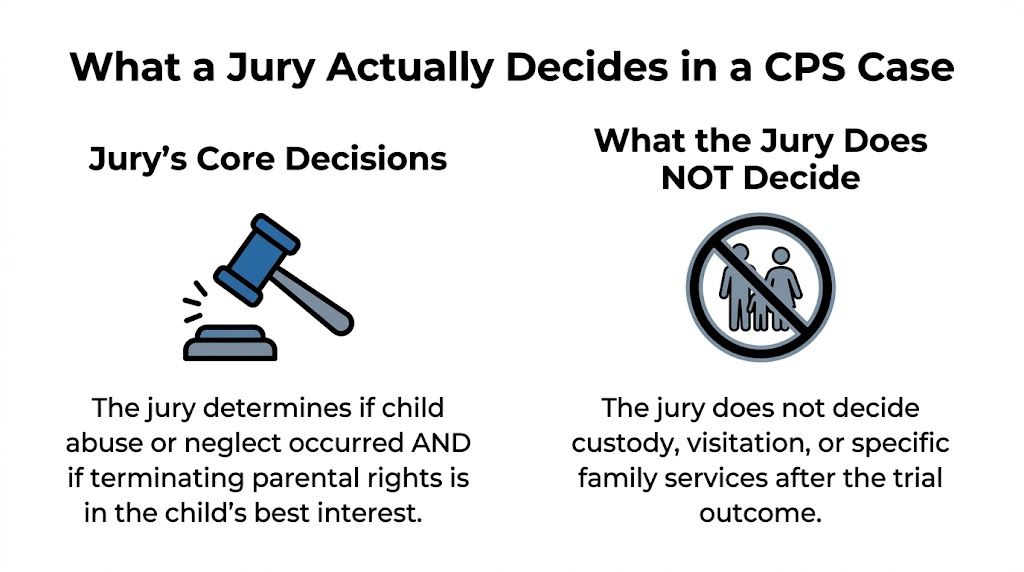
In a termination case, the jury is typically asked to decide whether CPS proved a legal ground for termination under Chapter 161 and whether termination is in the child's best interest. Those questions sound simple on paper. In practice, they can hide a serious complication in Texas jury charges.
The broad form problem
Texas CPS termination cases often use a broad-form jury charge, which bundles multiple allegations together. Under this discussion of broad-form submissions in Texas parental-rights termination cases, only 10 of 12 jurors must agree on termination, and they don't have to agree on the specific reason.
That can confuse parents because it sounds inconsistent with the idea of proving a serious accusation clearly. Here's a plain-language example.
Suppose CPS accuses a parent of several different forms of misconduct under different statutory grounds. Some jurors may believe one accusation. Others may reject that accusation but believe a different one. If enough jurors support termination in the aggregate, the verdict can still go against the parent even if there isn't a supermajority agreement on the same single ground.
If you're accused of many different things at once, a broad-form question can make it harder to know whether the jurors truly agreed on what you supposedly did wrong.
That is why jury strategy in these cases isn't only about persuading people emotionally. It also requires careful work on the wording of the jury charge and the legal objections made before the case goes to deliberation.
What the judge decides and what the jury decides
The division of labor in the courtroom often looks like this:
| Area of Decision | Role of the Judge | Role of the Jury |
|---|---|---|
| Applicable law | Explains the law and controls courtroom procedure | Follows the law as instructed |
| Evidence disputes | Rules on objections and admissibility | Hears admitted evidence |
| Statutory termination grounds | Frames the questions submitted in the charge | Decides whether CPS proved the submitted grounds |
| Best interest of the child | Gives legal instruction | Decides the best-interest question if submitted |
| Post-trial orders and court management | Enters judgment and handles procedural matters | Returns the verdict |
Why this matters so much in real life
Parents often focus on the facts alone. Facts matter, but so does how those facts are packaged for the jury. If CPS pleads many grounds, and broad-form submission is used, the risk isn't just "Will the jury believe me?" The risk is also "Will the charge allow disagreement among jurors to still produce a termination verdict?"
That doesn't mean a jury is a bad choice. It means the choice requires sophistication.
A lawyer handling a jury trial in cps case texas work needs to think about more than witness testimony. They need to challenge weak grounds early when appropriate, push for precise jury questions when the law allows, and protect the record if the charge is overbroad.
A relatable scenario
Consider a father who completed services, maintained contact, and addressed the issue that brought CPS into the home, but CPS still pleads several termination grounds based on old conduct, missed support, communication problems, and broad claims about endangerment. The father may believe, reasonably, that if he disproves the main accusation, he should win.
But if the jury charge sweeps several theories together, the fight becomes more complex. That is exactly where detailed trial preparation matters. The jury is deciding monumental questions, but the form of those questions can shape the outcome.
Navigating the Courtroom A Step-by-Step Guide to the Trial Process
The courtroom feels less frightening when you know the sequence. Parents often picture trial as one dramatic speech and an instant verdict. In reality, it's a series of steps, each with its own purpose.
If you want a broader overview of hearings before trial, what happens at CPS court in Texas can help you place the final trial in context.
Jury selection
Jury selection, also called voir dire, is where lawyers question potential jurors. The point isn't to find people who already agree with you. The point is to identify people who can't be fair.
In Texas CPS trials, attorneys often have only 30 to 45 minutes for voir dire, and failure to preserve issues properly can matter later on appeal. The Texas Children's Commission materials also note that 80 to 90% of unchallenged errors are affirmed on appeal in this context, according to this guide on jury trial basics in child welfare cases.
That means your lawyer has to listen for more than obvious bias. They need to spot subtle warning signs, such as a juror who assumes CPS wouldn't file a case unless the parent had done something terribly wrong.
Opening statements and the first impression
After the jury is selected, both sides give opening statements. This isn't evidence. It's the roadmap.
A good opening in a CPS case helps jurors understand the family before the allegations start piling up. It gives them a frame for documents, testimony, and timelines they are about to hear. It also begins the careful work of separating a parent's worst moment from the larger truth of that parent's relationship with the child.
Evidence and objections
CPS usually presents its witnesses first. That may include investigators, caseworkers, service providers, police officers, medical professionals, or foster placement witnesses, depending on the case. Your side then presents witnesses and documents that tell the fuller story.
This is also where technical legal work becomes essential. Preserving error requires specific, timely objections. A lawyer may need to object to hearsay, unfairly prejudicial testimony, improper expert opinions, or charge issues later in the process. If that isn't done correctly, the appellate court may treat the issue as waived.
The trial isn't only about what evidence exists. It's also about what evidence comes in, how it's framed, and whether objections are made at the right moment.
A parent may see an objection as an interruption. Trial lawyers see it as protection.
Closing arguments and deliberation
Closing argument is the final chance to walk the jury through the evidence and connect it to the legal questions they must answer. Good closings don't ignore bad facts. They explain them candidly and place them in context.
Later in the section, this short video gives a useful courtroom-centered perspective on trial practice and presentation:
After closings, the jury receives the charge and deliberates. Parents often find this wait unbearable because they no longer control the pace. That is normal. By that point, though, the work has already been done in weeks or months of preparation.
What your role looks like during trial
Your attorney carries the legal burden of presenting and protecting the case, but your role matters too. Parents who help their lawyers prepare usually do better than parents who stay reactive and disorganized.
Useful preparation often includes:
- Organize documents: Keep service records, counseling proof, testing results, school records, medical records, and visitation logs in one place.
- Be consistent: Trial testimony is stronger when it matches what you've already told your lawyer and what records show.
- Prepare emotionally: Jurors notice tone, patience, and honesty. They also notice defensiveness.
- Tell your lawyer the hard facts early: Surprises hurt more in court than in the office.
One practical option for families facing CPS litigation is to consult counsel that handles Texas CPS hearings and trial work, including firms such as Law Office of Bryan Fagan PLLC, so the jury decision is part of a broader case strategy rather than a last-minute reaction.
When a Jury of Your Peers Can Be Your Strongest Ally
Some CPS cases are built around a story that sounds far worse on paper than it does in real life. A judge reading reports all day may focus on the allegation category. A jury may focus on what happened.

Take a mother accused after leaving a child briefly with a relative who turned out to be unreliable. CPS may frame the event as severe neglect. The parent may have an explanation that doesn't excuse the mistake but shows it wasn't the kind of ongoing danger that should permanently destroy the family. Jurors, especially parents and caregivers, may understand the difference between a bad decision and an unfit parent.
When common sense matters
A jury can be especially helpful when the case involves:
- A false or exaggerated report: Jurors may be willing to scrutinize motive, family conflict, or gaps in the reporting.
- A single incident framed as a pattern: Community members may be more open to context.
- Overreach by the agency: Jurors sometimes push back when the requested outcome feels larger than the proven facts.
- A parent who presents as human, credible, and accountable: Jurors often respond well to honesty and effort.
This isn't about asking for sympathy instead of evidence. It's about recognizing that people evaluate facts through life experience. In some cases, that perspective helps a parent.
A recent example of jury power
That possibility isn't just theoretical. A 2025 Houston case marked a notable event in which a jury ruled against CPS and denied the agency custody of a child already in its care, according to this report on the Houston jury decision involving CPS custody.
That result doesn't mean every jury will reject CPS, and it doesn't create a guaranteed trend for every county. It does show something important. Jurors can serve as a real check on agency action when they believe the state has gone too far or failed to justify what it is asking the court to do.
A jury can sometimes see what a file can't. A family under stress is not automatically a family beyond repair.
The emotional advantage and the strategic caution
There is a human side to jury trials that matters. Parents often feel more fully heard when they know the final decision won't be made by only one official who sees CPS cases every week. That feeling alone doesn't win cases, but it can help a parent testify with more confidence and less hopelessness.
Still, strategy has to stay grounded. A jury may be a strong option when your facts are compelling and understandable. It may be less attractive when the key issues are highly technical, document-heavy, or tied to narrow legal arguments a judge may process more predictably.
That is why the best jury decisions aren't made from fear. They're made from an honest assessment of your facts, your witnesses, and how your story is most likely to be understood.
Making the Right Choice for Your Family's Future
The decision between a jury trial and a bench trial is one of the most important choices a parent can make in a serious CPS case. Neither path is automatically better. Each comes with benefits, risks, and trade-offs that should be weighed carefully.
A jury may offer fresh eyes, common sense, and a stronger sense that the community is judging whether CPS has gone too far. That can be powerful in a case with strong human facts, a misleading investigation, or allegations that look harsher in a report than they do in context.
A bench trial may offer more precision when the case turns on technical legal issues, procedural mistakes, or disputes that a judge may sort through more efficiently. Some cases are better argued through careful legal framing than through emotional persuasion.
A simple way to think through the choice
Ask yourself, with your lawyer's guidance, where the strength of your case really lives.
If your strongest points are these, a jury may deserve serious consideration:
- People will understand what happened: The story makes sense in everyday terms.
- The allegations are overstated: The state's framing feels bigger than the evidence.
- You present well in person: You come across as credible, accountable, and real.
- The case needs moral context: Jurors may better appreciate your efforts, your growth, and your bond with your child.
If the stronger points look more like this, a bench trial may be worth discussing:
- The case hinges on legal interpretation: The issue is less emotional and more technical.
- You need tight evidentiary rulings: The judge's courtroom control may be the bigger advantage.
- The allegations are numerous and confusing: A judge may be better positioned to separate weak claims from stronger ones.
- Speed matters: A shorter path may help in some case postures.
Questions to ask your attorney before deciding
Parents often feel pressured to make this decision before they know what to ask. Start with these:
- What are the strongest and weakest facts in my case?
- Would a jury likely understand my explanation, or would the legal issues dominate?
- How does this court usually handle CPS trials?
- Are the allegations simple enough for jurors to sort through clearly?
- What risks do you see if CPS submits multiple grounds for termination?
- What preparation would change if we choose a jury instead of a judge?
Those questions help turn fear into strategy.
What you can do right now
Even before the final trial decision is made, there are concrete steps that help almost every parent:
- Follow court orders closely: Missed services, missed visits, and missed deadlines create avoidable damage.
- Document progress: Save certificates, attendance records, counseling proof, clean test results, and messages that show cooperation.
- Stay calm in communication: Assume texts, emails, and statements may later be examined in court.
- Tell your lawyer the full story: Good facts and bad facts both matter. Hidden problems are harder to fix.
- Use reliable resources: The firm's website includes access to other Texas CPS and family law resources that can help you understand investigations, hearings, and trial issues.
The right forum for your family depends on your county, your judge, the evidence, the specific allegations under Chapter 161, and how the deadlines under Chapters 262 and 263 are shaping the case. There is no universal answer. There is only the answer that best protects your family in your specific circumstances.
If you're reading this while your case is active, don't wait for clarity to arrive on its own. Ask for it. The earlier you get strategic advice, the more options you usually have.
If you're facing a CPS case and need clear answers about whether a jury trial makes sense for your situation, contact Law Office of Bryan Fagan PLLC for a free consultation. A lawyer can help you evaluate the allegations, the court timeline, and whether your family is better served by a jury or a judge. You don't have to sort through this alone, and you can find additional Texas CPS resources on the firm's website as you prepare for the next step.